
SABAH SOFTWOODS BERHAD
SABAH SOFTWOODS BERHAD
Office Address:
KM 8, Jalan Sin San, P. 0. Box 60966, 91019, Tawau, Sabah.
Tel: 089-771333 Fax:089-754225
Website: http://www.softwoods.com.my
Dumpas Estate Office
Oil Palm Central Office
Forest Plantations
Sabah Softwoods Berhad (SSB) was established in 1974, as a pioneer
company to venture into a large commercial planting of fast growing trees
species for the production of pulp and timber. Its vision is to assure Sabah of
a sustainable unbroken cycle on productive timberland with and economic
potential that has been proven to be many times greater than that of natural
forest. It has also been proven that man made forest is not only commercially
exploitable, but also has the advantage of fast growing characteristics, with
maturity between 7-12 years compared with a minimum of 60 years or more for
natural forest.
SSB is currently 70% owned by ICSB with the main objective to reforest 60, 729
ha [40, 486 ha at Brumas and 20, 243 ha at Kalabakan] of logged forest land. To
date, 36,466.04 ha has been planted with fast growing trees and 14,164.91 ha
with oil palm.
AGRICULTURE
Sabah Softwoods Berhad first Oil Palm Plantation was in 1981 to 1988
planting with an area of about 500 ha. The present 15,000 ha of Oil Palm
Plantation development was initiated in 1995 with
various year of planting until 2001. This Oil Palm Plantation is located at
Brumas and Kalabakan area with about 7500 ha respectively.
Sabah Softwoods Berhad is currently in the process of accelerating its Oil Palm
Plantation to further develop some 25,000 ha to commence in 2005 @ 5,000 hectare
annually.

LADANG MAWANG PLANTATION
of Sabah Softwood Bhd.
80km from Tawau Town, Jalan Luasong - Kalabakan.
RESEARCH AND DEVELOPMENT
Experience over the last 28 years of research and land development
work-particularly in the field of tree plantation has contributed handsomely
towards the current success and progress of the company.



March 22, 2010 15:01 PM
Sabah Softwoods: Model For Human-wildlife Co-existence
By Nashir Mansor
TAWAU, March 22, 2010 (Bernama) -- These days, it is common to hear about wild
elephants foraging and rampaging into villages, destroying crops including
rubber and oil palm trees.
There were also reports about tiger attacks on villagers in their rubber
orchards and incidences of flash floods and landslips that damaged properties
apart from causing fatalities.
These phenomena are actually consequences of the conflict between mankind and
mother nature that have created debates particularly at the international level
when it is linked to the economy of a certain nation.
Entry of tropical wood or its products and derivatives are facing stricter
conditions in Europe, United States and Japan as it is linked to the
non-environmental friendly logging of timber and other forest resources.
The campaign against palm oil and its products are being aggressively carried
out in Europe and Japan as the exporting countries are believed to have cleared
forests for the creation of oil palm estates, endangering the wildlife habitat.
CO-EXISTENCE
Can the conflict between man and nature be halted? Can they co-exist?
Maybe it is easier said than done, but Sabah Softwoods Berhad (SSB), a Sabah
government investment agency involved in rapid-growing wood (softwood)
plantation since 1973, has taken steps to find a solution to this conflict.
SSB, one of the subsidiaries of Sabah Foundation's Innoprise Corporation Sdn Bhd
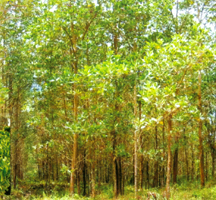
that ventured into planting fast-growing trees such as Acacia mangium, Albizia
falcataria and Gmelina arborea, has been trying to create the harmonious
co-existence between man and wildlife.
For this matter, SSB had set aside 2,680 hectares of the agency's more than
60,000 hectares of land in Tawau (of which 27,533 hectares are planted with wood
for commercial purposes) for the High Conservation Value Forest (HCVF) that must
be left untouched.
The move is to conserve the flora and fauna ecology in that area apart from
protecting the water catchment and wildlife sanctuary.
With the existence of the HCVF, SSB has created the wildlife corridor that
enables wildlife like elephants and Orang Utan to move freely in and out of the
wood estate.
MAN AND NATURE
According to SSB general manager (Timber Operations) Dominic Rusman Dambul, HCVF
represents some 10 per cent of the whole wood estate and its presence is an
attempt to create a balance between man and nature.
The SSB officers that carried out an inventory of flora and fauna in that area
found more than 60 species of reptiles and birds there.
There are also various wood of value such as 'kayu bulian', 'seraya' and 'kayu
selangan batu' growing well in that particular area.
The softwoods plantation is itself a forest as the trees take nine to 10 years
to be fully grown before harvesting, the area also benefits wildlife such as the
elephants and Orang Utan that make the plantation their habitat apart from the
HCVF.
THREAT BY JUMBOS
"So far we have detected the presence of three herds of wild pygmy elephants
that frequent the plantation. The elephants, that number no less than 40, have
their own route.
"We do not disturb their paths in order to prevent them from following new
tracks. We also do not disturb these elephants if we see them. So far they have
not threaten people in the estate and did not damage the properties," he said.
According to Dominic, one of the wild elephant herds that frequent the
plantation had earlier numbered only two but now there are three including a
calf.
"This means the number of elephants is increasing," he said.
"We have also came across the Orang Utan on the acacia trees while others also
carry their young. It appears that the wildlife is getting used to the estate
workers," said Dominic.
He said even though the wild animals were fequently seen in the plantation, they
did little or insignificant damage to the SSB trees.
Dominic said in 2006, the SSB with the assistance from Sabah Wildlife Protection
Department had relocated seven pygmy elephants to Kuamut Forset Reserve at the
cost of RM200,000.
However, even after the relocation the pygmy elephants still frequented the
estate with the possible inclusion of the jumbos moved earlier.
Taking into account that the mammals did little damage to the estate nor did
they threaten the safety of workers there, the SSB management decided to leave
alone the elephants.
NATURE COMES FIRST
The compliance on environmental conservation apart from the commercialisation of
estate resources are among the factors that enabled the SSB to be accorded the
Forest Stewardship Council (FSC) certificate by the United State's-based
Scientific Certification System (SCS) on Set 25, 2007.
With this certificate, SSB's wood and wood products such as sawn wood and
woodchips are accepted and free to enter the market in Europe, United States and
Japan without the imposition of any ban related to environmental destruction
issue.
Dominic said there are 10 principles that need to be adhered by the SSB before
being accorded the certificate and among them are the preservation of the
natives' rights, community relations and the workers' rights, benefit from the
forest, environmental impact, estate management plan, monitoring and maintenance
of the HCVF.
He said it took four years before the SSB was awarded the certificate. The
effort was initiated in 2003 and since then officers of the accrediting body had
visited the plantation regularly to observe, monitor and analyse whether the
agency had adhered to the conditions required.
"In Malaysia, maybe the SSB is the only agency that receives this international
recognition," said Dominic.
FACILITIES
The SSB estate is located between Tawau and Kalabakan, some one hour journey
from Tawau town. The estate employs 1,257 workers including eight who are
disabled.
Apart from being compliant to environmental conservation requirements, the
agency also places importance on the welfare of its workers by providing the
basic facilities such as free housing, power and treated water supply for their
comfort.
Among the other facilities available are school, kindergarten, field and
playground, place of worship for different religions, nine-hole golf course,
rest house for guests and a stadium which is under construction.
The first harvest was made in 1982 and up to last year, SSB had harvested 6.65
million cubic metres of wood and retains its sustainable wood production of
360,000 cubic metres of wood a month.
SSB was awarded the Caring Employer Award by the Sabah Manpower Department and
the national-level 'Ladang Bahagia' Award from the Human Resources Ministry
presented by Prime Minister Datuk Seri Najib Tun Razak on May 2, 2009 at Putra
Stadium in Bukit Jalil, Kuala Lumpur.
-- BERNAMA




Chip mill Operation

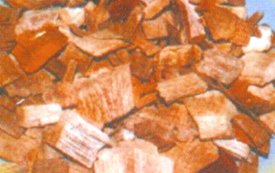
Tawau is home to one of the region's most sophisticated woodchip mill. The Sabah
Softwoods mill is not only a principal link in Innoprise Corporation Sdn. Bhd's
outstanding chain of timber operation, it is a remarkable industrial enterprise
in its own right, and a first of its kind in the country. Designed by Fulghum
Industries of USA, this chip mill is located at Sg. Udin about 45 minutes drive
from Tawau town. Installation of machineries was done in May 1997 and completed
at the end of October the same year, currently producing 90,000 - 120,000 BDMT
per annum. Not only is the largest integrated woodchip mill in Sabah and
Malaysia, it is the only mill in the country designed to process high volume of
man made forest plantation timber at low cost.
RELATED TOPICS
|
|
PLACES OF INTEREST |