Agriocnemis pygmaea (Rambur, 1842) 橙尾細蟌
- the world smallest damselfly -
Last Updated on Sunday, 10 April, 2022 02:09:56 PM
Damselflies of Borneo > Family Coenagrionidae > Genus Agriocnemis > Agriocnemis pygmaea (Rambur, 1842) 橙尾細蟌
Agriocnemis pygmaea (Rambur, 1842) 橙尾細蟌
- the world smallest damselfly -
Found in Asia: Bangladesh, China, Guandong, Guangxi, Hong Kong, Hainan,
Indonesia, India, Japan, Sri Lanka, Myanmar, Malaysia, Philippines, Peninsular
Malaysia, Thailand, Taiwan
The damselfly of Family Coenagrionidae is the most abundant damselfly in Sabah,
Malaysia. They are black pattern with ground colour in either green, blue,
yellow, orange, or purple.
Some species are two female colour forms, one of which is similar to the male.
Their wings are narrow, usually colourless and clear.
They prefer to lay eggs in pond or slow running water. They rest with the body
horizontal and the wings pressed together above the abdomen.

Ovipositor of a female damselfly Agriocnemis pygmaea
♀25mm
2017-05-23 SRI INDAH
1- A paired Valves with stylus
2- A cutting Basal blades
A pair of Cerci (Anal appendage)

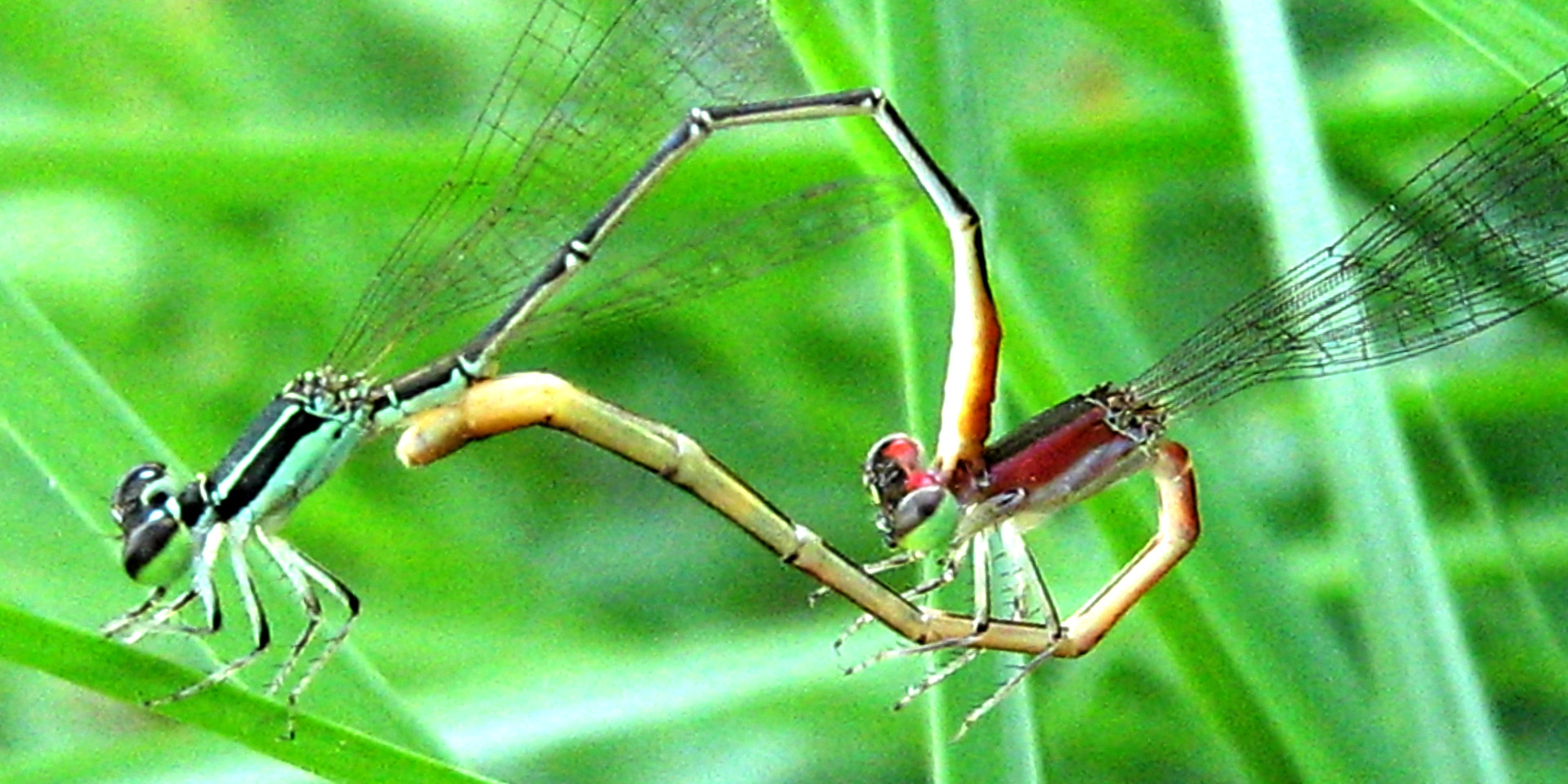
A female Ariocnemis pygmaea (Rambur, 1842) mating at 5:18PM – an unusual time
when other dragonflies and damselflies are stopping activities.
A female with this common color is otherwise difficult to identify without this
male Ariocnemis pygmaea mate together.
The male clasped female at the prothorax (neck), a part between
the head and the thorex.

Another female Ariocnemis pygmaea at the same drain of previous picture
Female Ariocnemis pygmaea is a confusing species because of color changes with
maturity. It could be easily mistaken as Ariocnemis femina if not the male as a
pair for identity.

The male curves his abdomen to clasp her prothorax with his anal appendages to
form the tandem pair. The male does this clasp less than a second.
The tandem position remained for about 10 minutes during which they flew
together from one grass to another hen disturbed.
This heart shape wheel is known as Wheel Position. (In dragonfly the tandem is
holding the back of head.)

All males have their genital opening for sperm at the ninth abdominal segment.
Beside the first genitalia male Damselflies have a secondary genitalia on the
second abdominal.
Before copulation, sperm is moved from the first genitalia (Section 9) into the
secondary genitalia (section 2). This is done by The bending the abdomen forward
for the first genitalia to touches the secondary genitalia. This take few
seconds.
When the sperm in the male secondary genitalia is ready, the pair forming a
tandem by male holding by female's neck (prothorax). The female bend up her
abdomen to the of the male's genitalia and form the wheel position. The female's
abdomen contact with male's secondary genitalia to receive sperm.

The male curves his abdomen to clasp her prothorax.
Noteice that for damselflies the clasping is on the prothorex. But for
dragonflies the clasping is on the back of the head
| Pair 1 | Pair 2 | Pair 3 |
 |
 |
 |
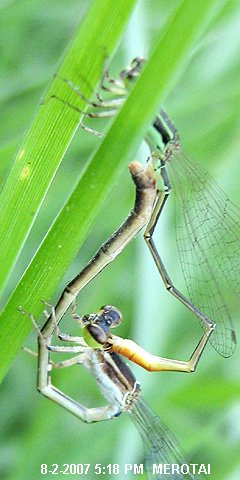
| This 1st Female Agriocnemis pygmaea
is GRAY form. An unusual color. Normally this female species are RED or GREEN |
This 2nd Female Agriocnemis pygmaea is RED form. | This 3rd Female Female Agriocnemis
pygmaea is GREEN form. The thorax is pale green in colour with black pattern. Abdomen is pale green with black with the red tail light. |


This smallest damselflies in Malaysia is also the smallest in the world .
Hind wing is 11 mm. Abdomen Length is 20mm
The male damselfly's head and thorax is pale green in colour with black pattern.
Abdomen is pale red with black with the red tail light.
They are not easy to find for they are very small in size. They usually hide low
and near the water edge, among thick grasses. They fly slow and float like a
moth from one grass to another less than a foot away. But during mating, they
are relatively easy to photograph because they seem too weak to fly when the two
are in the wheel.
These two families of Agriocnemis pygmaea and Agriocnemis femina oryzae always
live in the same territories. Because they mingle so close to each other very
often the young male of both are mistaken as the other.

A female Agriocnemis pygmaea 橙尾細蟌 eating a tinny green fly.
Damselflies are beneficial predators because they consume large quantities of
insects such as flies, mosquitoes and moths and some eat beetles and
caterpillars.

Female Agriocnemis femina oryzae Lieftinck, 1962
| The 3 color developing stages of an Female Agriocnemis pygmaea | |||
| Full Adult Form | |||
| Teneral Form | Sub Adult Form | Red Form | Green Form |
RELATED TOPICS
|
|
Spiders of Borneo |