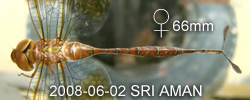
A. Panybeus
♂88mm

G. Basiguttata
♂67+7=74mm

I. Grubaueri
♂96mm

O. Foliacea
♂60+3mm
♀60+8mm

G. Dohrni
♂62+6=68mm

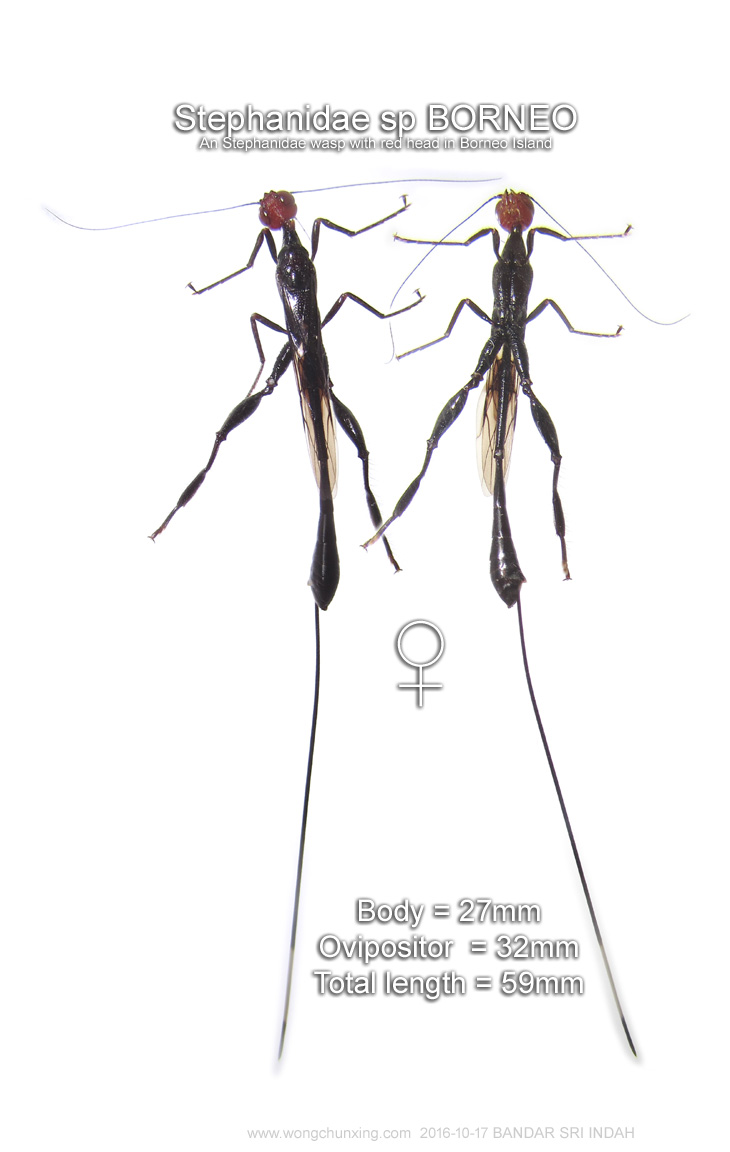
Indaeschna sp SBC
♀75mm
Last Updated on Sunday, 16 July, 2023 01:36:03 AM
INDEX > Dragonflies of Borneo > Family of Aeshnidae 蜓科
Family of Aeshnidae 蜓科
Family of Aeshnidae is the largest dragonflies on the planet. Also the fastest flying dragonflies.
The Aeshnidae is a well defined group with over 400 species worldwide. In Borneo there are 29 species in 8 genera. These constitute an interesting mix of very widespread genera and endemic or regional ones.
The family includes medium-sized to enormous species (hw 35-80+ mm).
We have in our image records the following four genus of Aeshnidae of Borneo
:
1- Genus Anax
偉蜓屬
2- Genus Gynacantha 長尾蜓屬
3- Genus
Indaeschna
(This genus is very much a Philippines genus. Only two species found in Borneo.
It is not found in China)
4- Genus
Oligoaeschna
(Four out of seven found in Borneo are Endemic. This genus is not found in China)
Family of Aeshnidae
Comparison of Size of the 4 genus of Aeshnidae:
| 1 | 2 | 3 | 4 |
| Genus Anax | Genus Gynacantha | Genus Indaeschna | Genus Oligoaeschna |
|
A. Panybeus ♂88mm |
G. Basiguttata ♂67+7=74mm |
I. Grubaueri ♂96mm |
O. Foliacea ♂60+3mm ♀60+8mm |
|
G. Dohrni ♂62+6=68mm |
Indaeschna sp SBC ♀75mm |
||
Comparison of ProThorex of the 4 genus of Aeshnidae :
| 1 | 2 | 3 | 4 |
| Genus Anax | Genus Gynacantha | Genus Indaeschna | Genus Oligoaeschna |
 A. Panybeus ♂92mm |
  G. Basiguttata ♂67+7mm ♀70+6mm |
 I. Grubaueri ♂95mm |
  O. Foliacea ♂60+3mm ♀60+8mm |
|
|
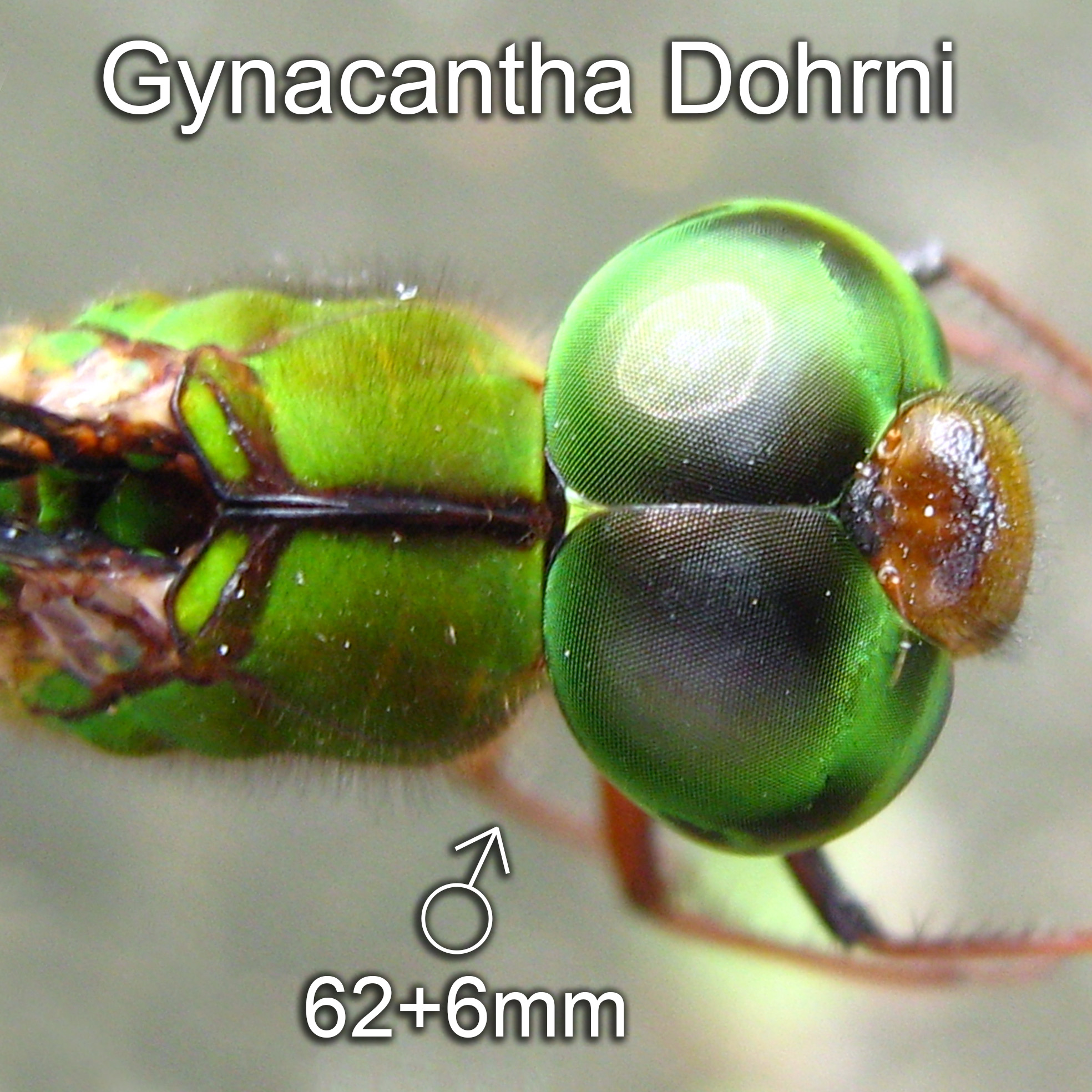 G. Dohrni ♂62+6mm |
 Indaeschna sp SBC ♀75mm |
Family of Aeshnidae
Comparison of segment 8,9,10 of FEMALEs dragonflies from 3 Genus in the family of Aeshnidae:
| Genus Gynacantha | Genus Indaeschna | Genus Oligoaeschna |
 Gynacantha Basiguttata |
 Indaeschna sp HSBC unidentified |
 Oligoaeschna Foliacea |
The female of Tetracanthagyna plagiata may have the greatest wingspan of any
living anisopteran and it is reputedly the heaviest of all odonates.
Aeshnids are typically robust species with dark colours, often marked with green
or less often blue or yellow. The eyes are very large and dark green.
The discoidal triangles of fore- and hindwings are similar in shape and
orientation, a condition unique to this family. The wings are typically hyaline
but are often suffused with a smokey brown coloration which darkens with age. A
few species have opaque brown patches on the wings and sometimes there is a
broad dark streak along the costa, or leading edge of both wings.
The abdomen is long and thin, sometimes extremely constricted at segment 3.
Male anal appendages are usually long and thin, and minute differences in their
structure are often critical for species identification.
The Aeshnidae are the only anisopteran family in the region in which the female
has an ovipositor and eggs are inserted into vegetation or debris.
A great many species are crepuscular or even partly nocturnal and almost all may
be active until sunset. Some are eocrepuscular—that is they fly before sunrise.
It is quite common for aeshnids to come to the lights of buildings at night.
Aeshnids mainly breed in standing water, including forest pools, open ponds,
drains and large phytotelmata. Tetracanthagyna larvae occur in streams. The
larvae are elongate and the labial palp is armed with a strong movable hook.
Many are fierce predators, taking large tadpoles and small fish. There is far
less variation in their body form than in the Gomphidae, but the armature of
the mask varies a good deal according to diet.
| Family: Aeshnidae Genus: Anax
|
| Family: Aeshnidae Genus: Oligoaeschna
|
| Family: Aeshnidae Genus: Gynacantha
Gynacantha basiguttata visit houses in the country side at night...
|
| Family: Aeshnidae Genus: Indaeschna Only 1 species in Borneo under this genus But 1 unidentified FEMALE found in 2017 believed to be a new record for Borneo
MALE no record
FEMALE no record |
The 3 families of dragonflies found in Borneo Island:
1 Family of Aeshnidae
RELATED TOPICS
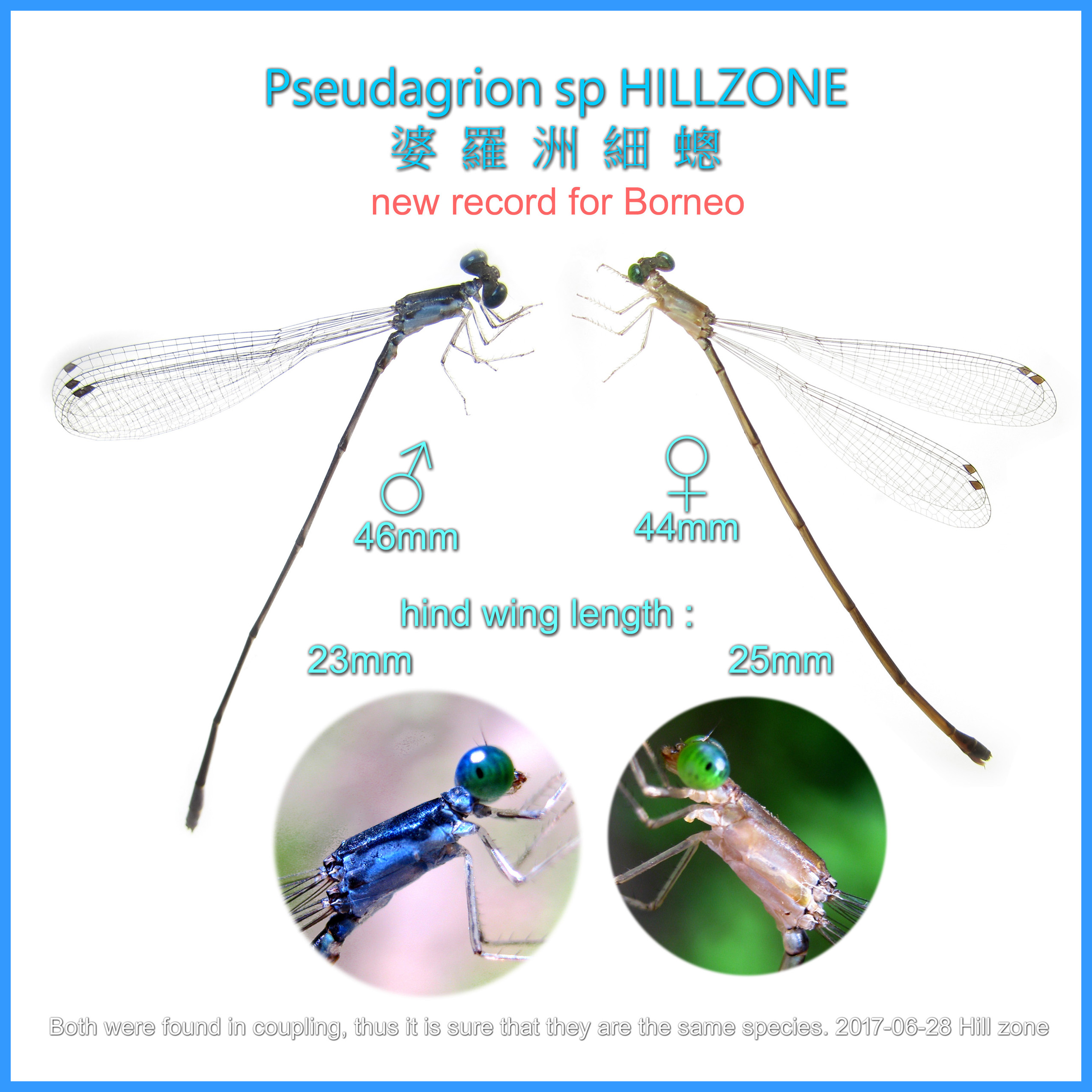
INTRODUCTION TO THE DAMSELFLIES OF SABAH, BORNEO ISLAND
Insects are diverse and dominant inhabitants of the tropical rainforests in Borneo Island. New species are discovered too often. Entomologists are still struggling to cope with the documentation of tropical insect diversity.
Most of the common dragonflies in Sabah are red coloured, especially from the family Libellulidae. Some red pecies are even confused as same species, for example the three species of Genus Neurothemis.

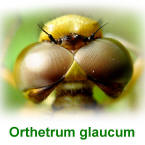
The compound eyes of dragonflies
Dragonflies and damselflies have large compound eyes that can see in all directions. When the compound eye is magnified several hundred times, each individual facet (ommatidium) is shown to be hexagonal in shape.
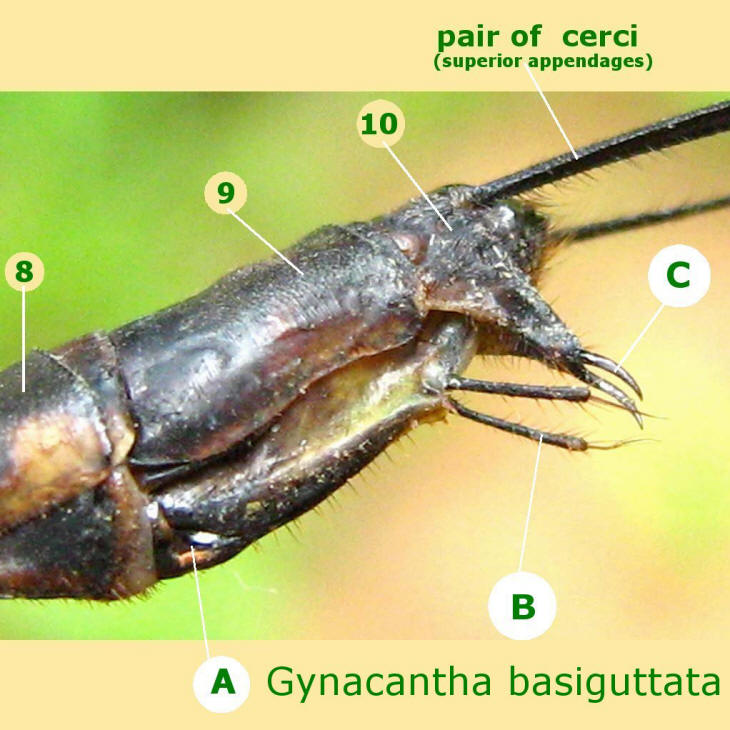
Ovipositor (Vulvar Lamina)
of FEMALE Dragonflies and Damselflies
FEMALE dragonflies have either one of the two method of depositing eggs from
the abdomen:
1- using Ovipositor Structure
2- using Vulvar Lamina
MALE do not have an ovipositor. Instead MALE dragonfly and damselfly have appendages.
|
GO FURTHER FLORA Borneo has 150 species of wild fig trees. Most of them are found in forests of Sabah. FISHERIES Prawn farming is a main commercial activities in Tawau. Spawners from Tawau are graded the best in Malaysia. For decades, Tawau has been exporting high-grade tiger prawns to several countries such as Korea, Japan, Taiwan, China, Vietnam, Singapore, Egypt and Australia. |
|
|
Damselflies of Borneo |