Endemic Dragonflies of Borneo Island
Last Updated on Friday, 22 September, 2023 11:39:33 PM
Endemic Dragonflies of Borneo Island
IDENTIFICATION CHARTS OF BORNEO DRAGONFLIES
The following are some colour image illustrations of common dragonflies
in Borneo:
 WINGS of dragonflies and damselflies |
|
 Identification Guide to ♂♀Gynacantha basiguttata a common species of Borneo Island |
 Identification Guide to ♂♀Orthetrum chrysis common in marshes and clear streams of Borneo |
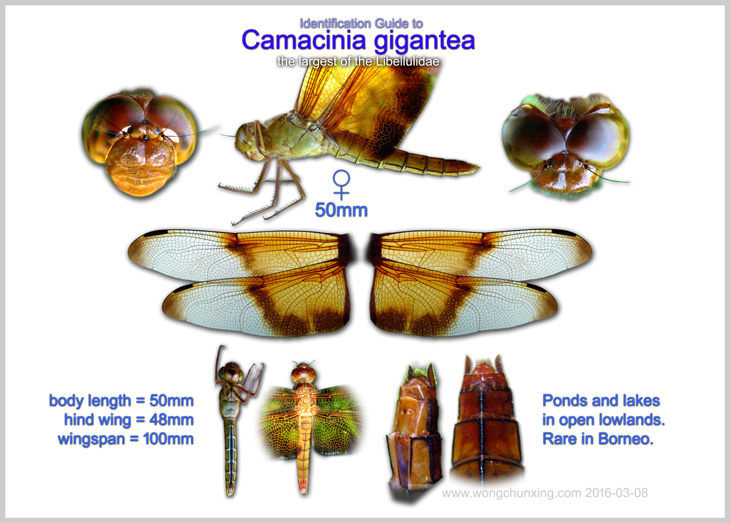 Identification Guide to Camacinia gigantea the largest of the Libellulidae |
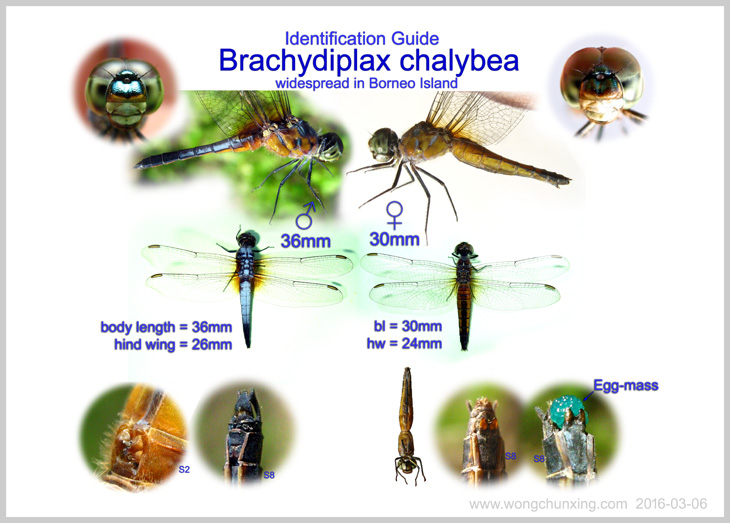 Identification Guide to Brachydiplax chalybea Widespread in Borneo Island |
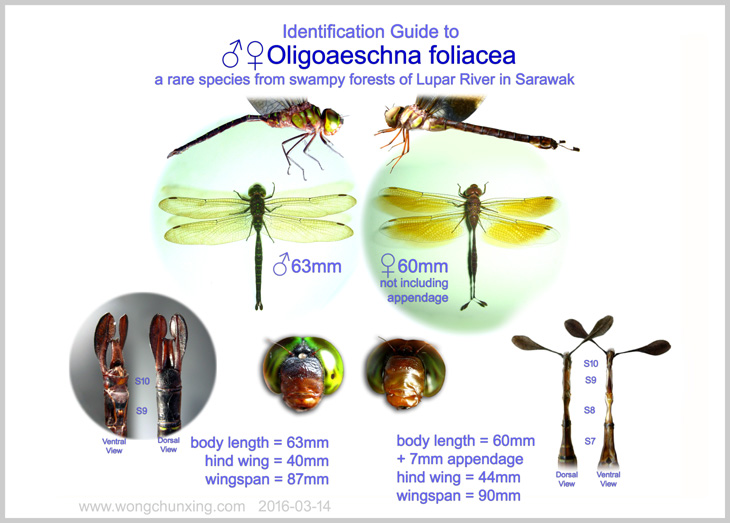 Identification Guide to ♂♀Oligoaeschna foliacea a rare species from swampy forests of Lupar River in Sarawak, Malaysia |
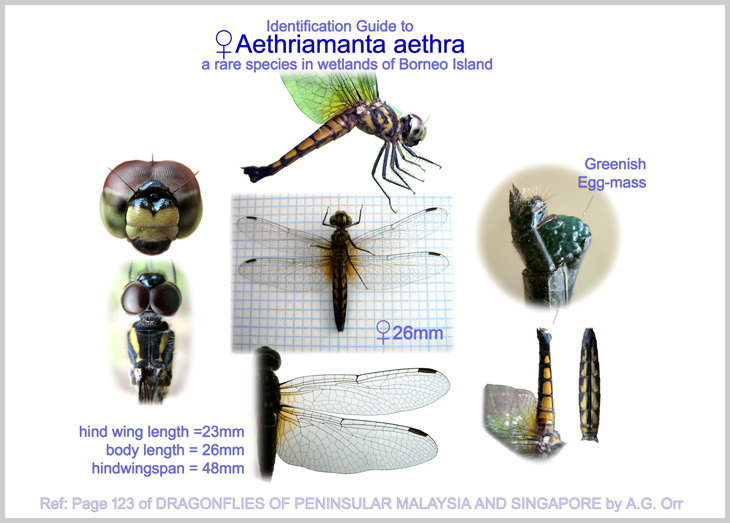 Identification Guide to ♀Aethriamanta aethra a rare species from wetlands of Borneo Island |
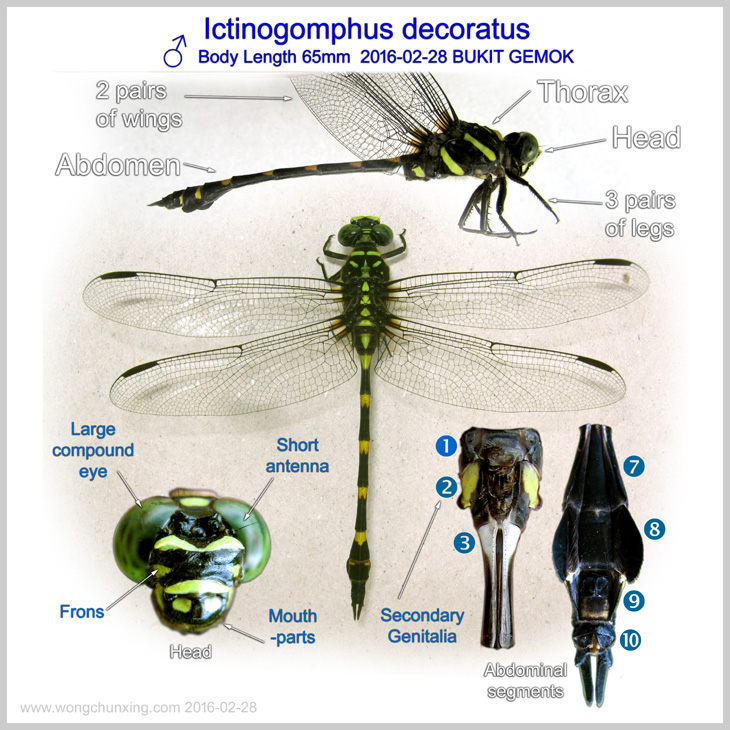 Ictinogomphus decoratus Male ♂65mm 2016-02-28 BUKIT GEMOK G eneral morphology of a male dragonfly |
 Gynacantha basiguttata (Selys, 1882) |
 Identification Guide to Orthetrum pruinosum |
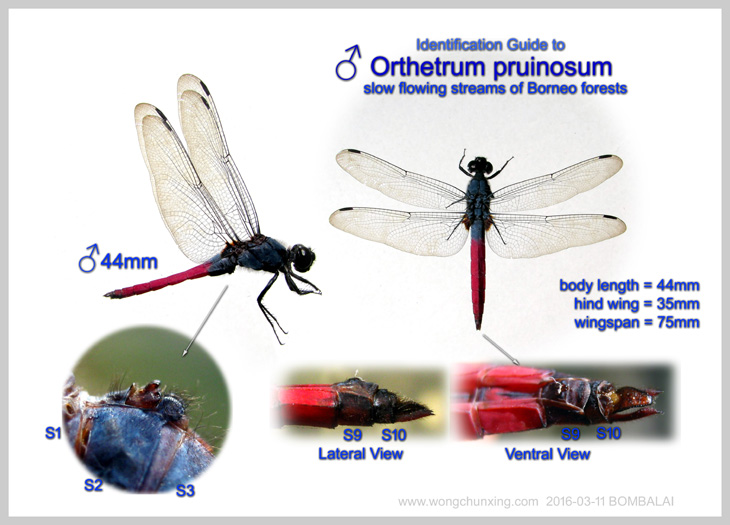 Identification Guide to ♂ Orthetrum pruinosum slow flowing streams of Borneo forests |
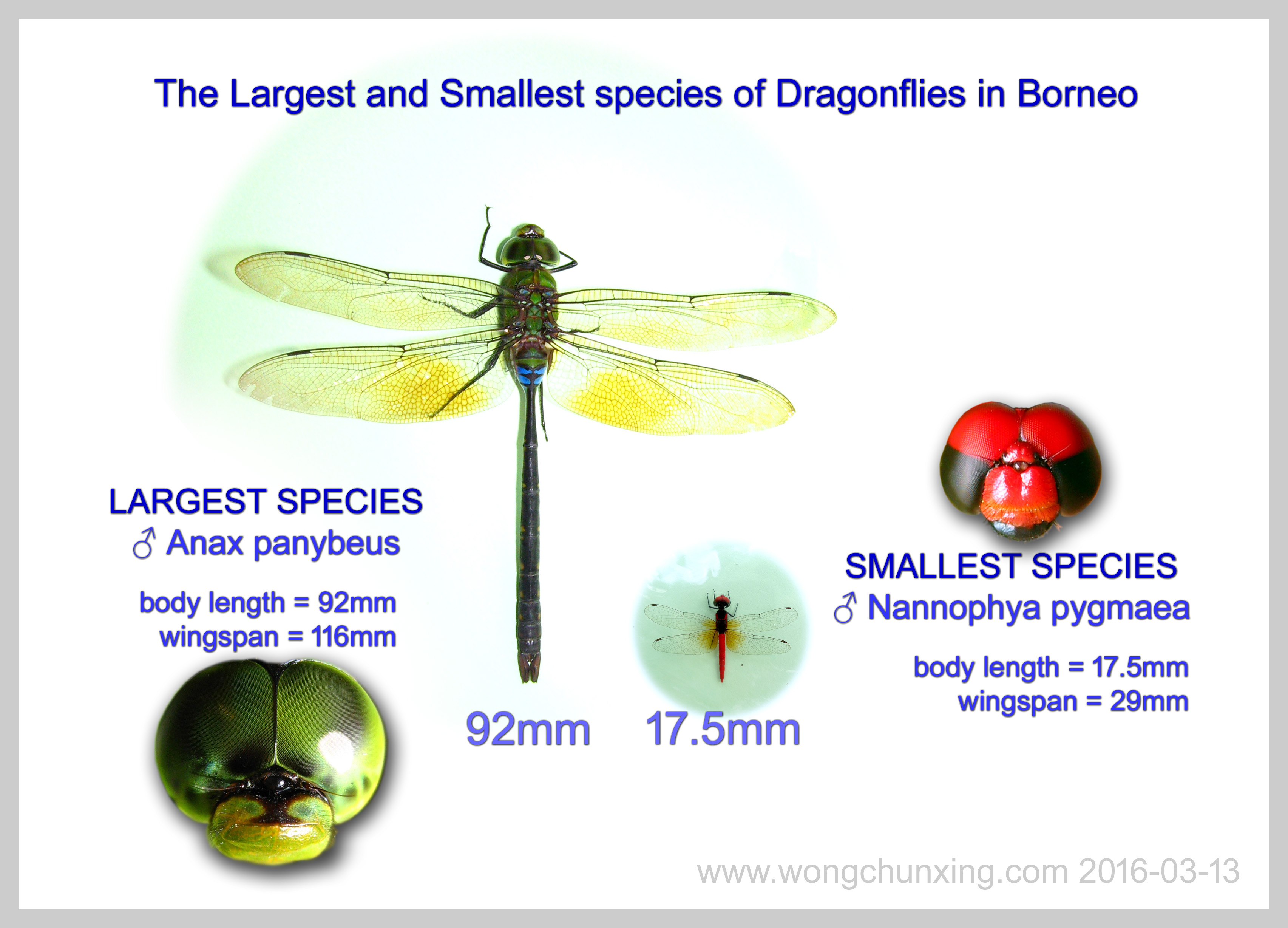 The Largest and Smallest species of Dragonflies in Borneo Anax panybeus Nannophya pygmaea |
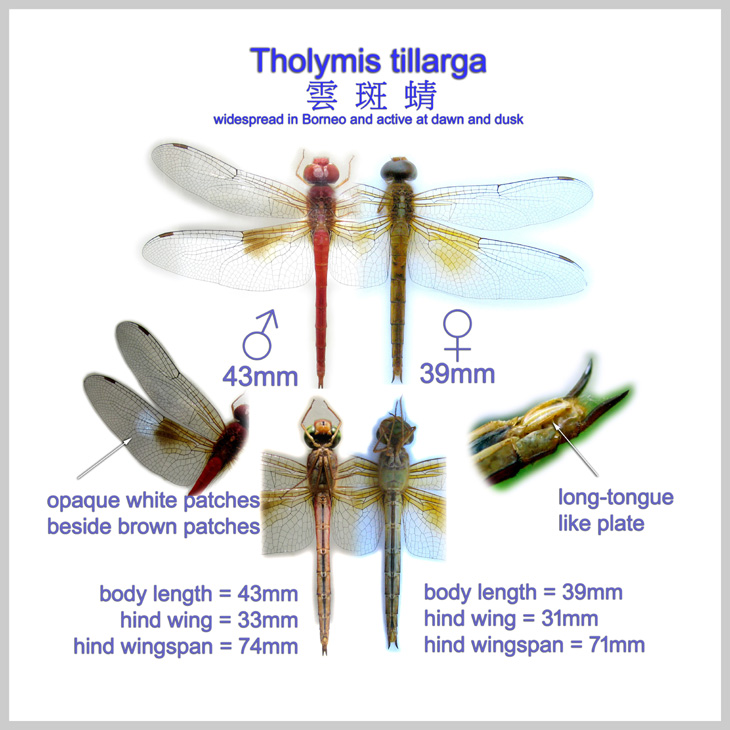 Tholymis tillarga widespread in Borneo and active at dawn and dusk |
 Neurothemis terminata Female ♀35mm Type 1 Clear Wings 2016-02-29 BUKIT GEMOK |
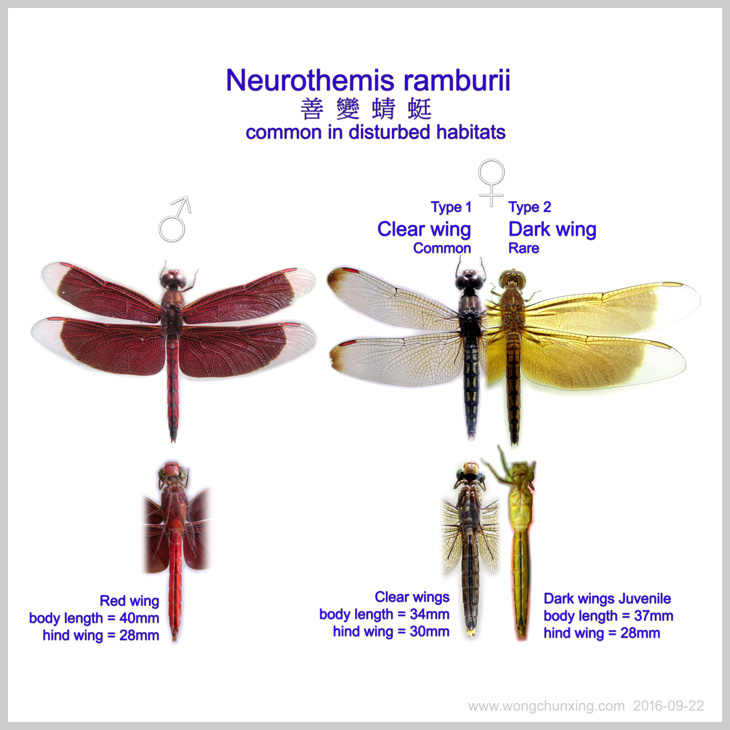 Neurothemis ramburii 善變蜻蜓 common in disturbed habitats |
 ABDOMEN DIFFERENT BETWEEN MALE AND FEMALE DRAGONFLIES Most male dragonfly abdomen is often narrower at segment 3, whereas the female abdomen is more robust. |
 Orthetrum sabina 杜松蜻蜓 |
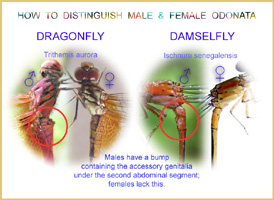 HOW TO DISTINGUISH MALE AND FEMALE ODONATA (DRAGONFLIES AND DAMSELFLIES) Males and females can be distinguished as follows: Males have a bump containing the accessory genitalia under the second abdominal segment; females lack this. |
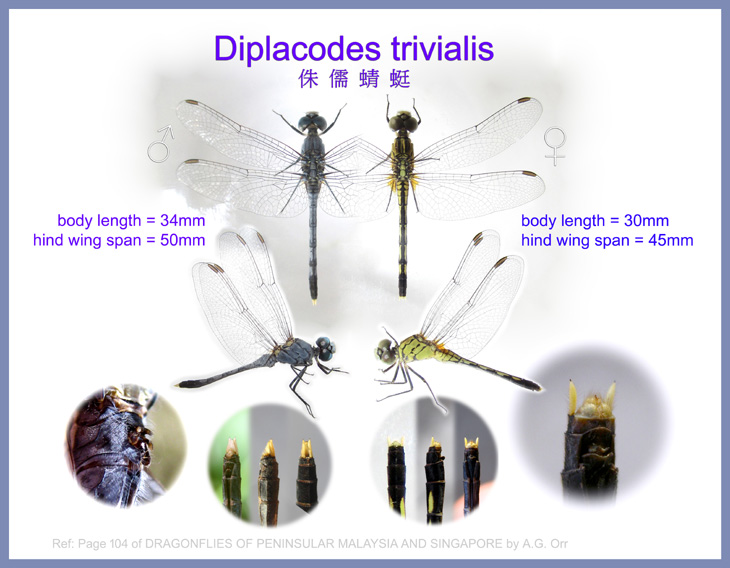 Diplacodes trivialis 侏儒蜻蜓 Diplacodes trivialis are seen everywhere , usually on the ground and behave in a friendly manner. |
 Family: Libellulidae Tetrathemis irregularis inhabits rainforest streams Tetrathemis irregularis have relatively very large compound eyes among dragonflies. |
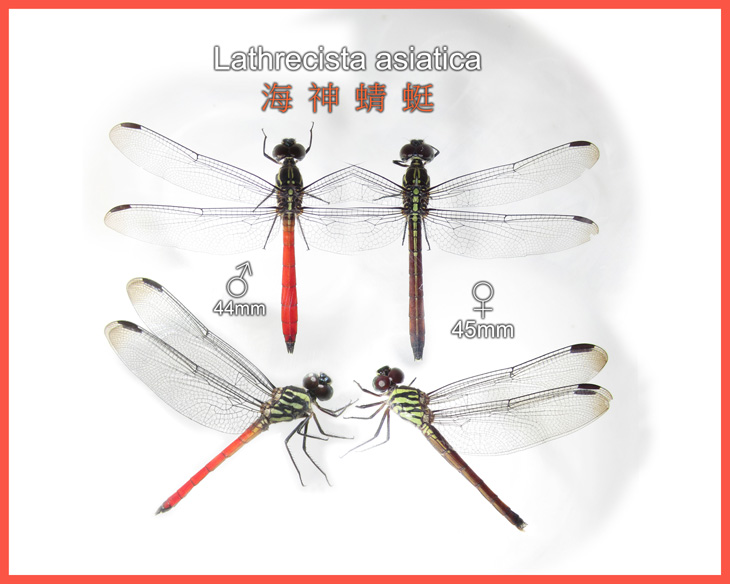 Family: Libellulidae Lathrecista asiatica 海神蜻蜓 Only 1 species worldwide in this Genus Lathrecista. |
|
|
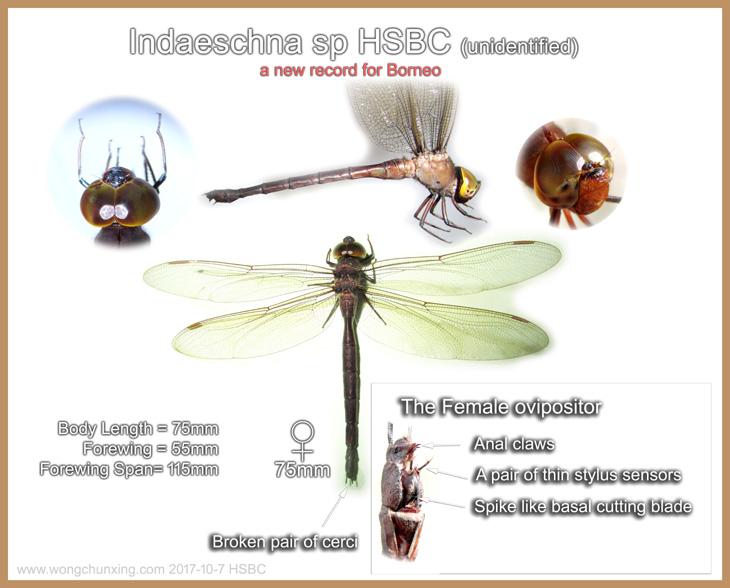
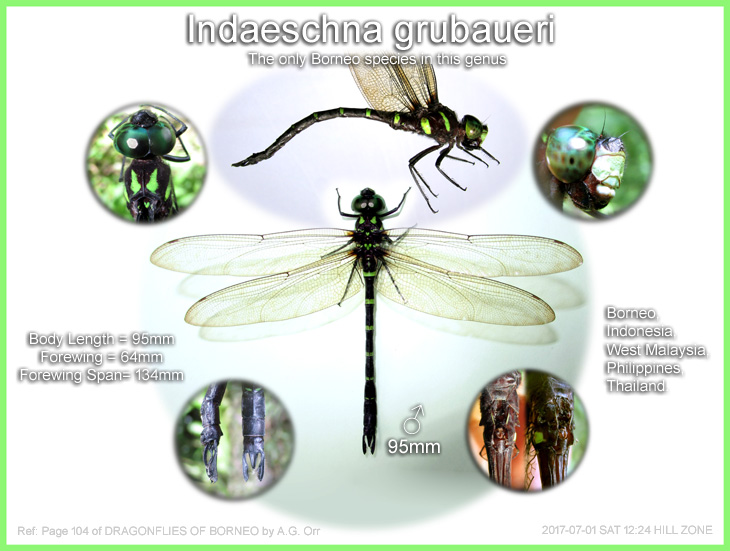 Family Aeshnidae Indaeschna grubaueri The only Borneo species in this genus |
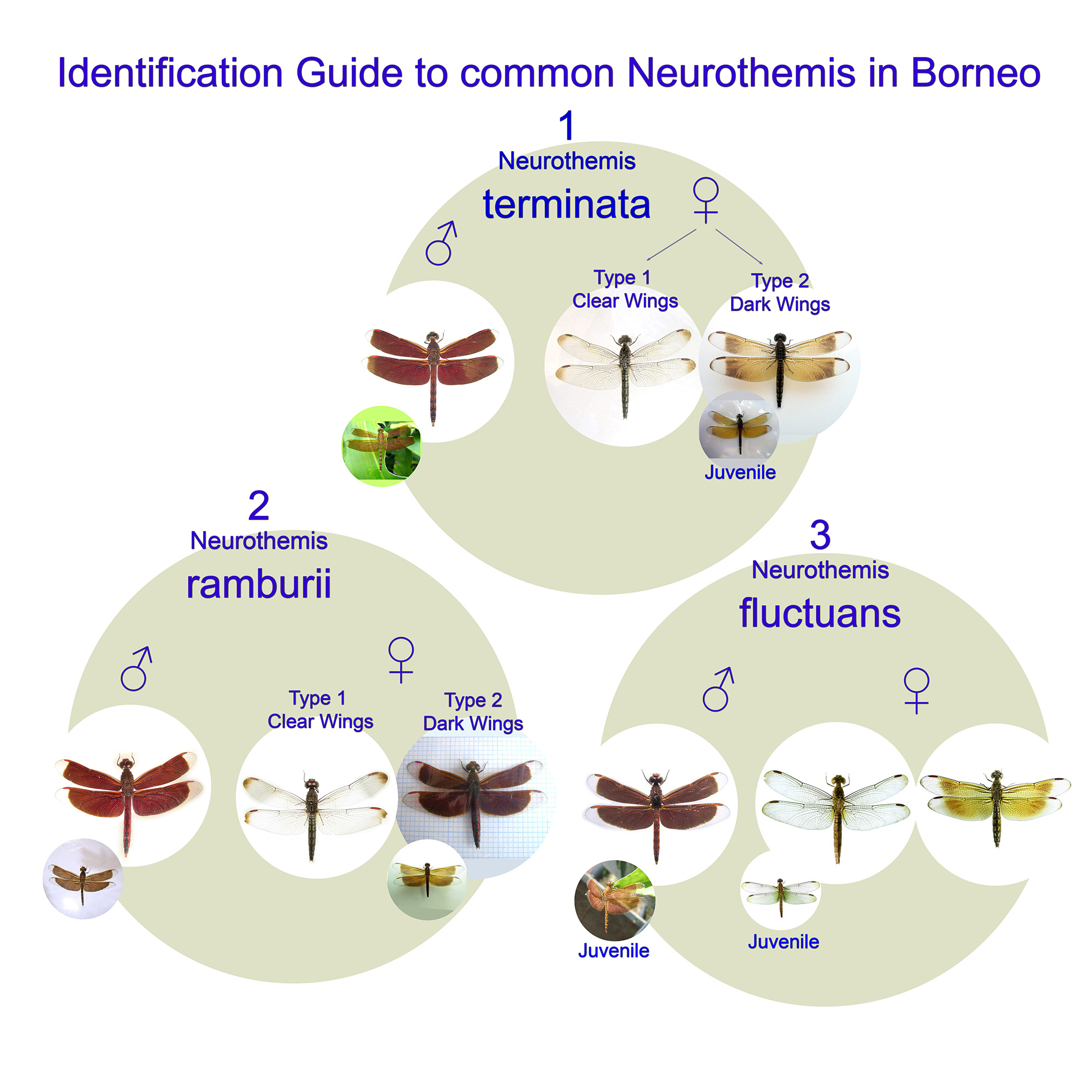 Identification Guide to common Neurothemis in Sabah |
 Identification Guide to common Red Dragonflies in Sabah All red dragonflies found in Sabah belong to the same Family Libellulidae |
Dragonflies are common in Malaysia and can be found all around the globe in
every continent except in Antarctica.
Dragonfly are very fast flyers, can be very colourful, harmless, timid and love
water. We see them dipping their tail into water, skimming on the surface,
resting on twigs and darting here and there and they are very difficult to
capture. T hey are harmless to humans but to other insects, they are fearsome
flying predator with the most advance aviation system for aerial combat. If size
doesn't matter, a dragonfly can down the latest US jet fighter Raptor in
seconds.
Speed : Can reach 60km per hour.
Range : Detected to cover a total distance of 137km per day.
Agility : Can instantly change direction while at high speed. Humans can't take
that much G force.
Vision : Compound eyes of about 26,000 lenses with individual sensors capable of
360 deg vision. Can focus up to 20 feet. Focusing speed more than twice of
humans.
Dragonflies rely almost on their eyes to find a mate.
Audio : Dragonflies are deaf. Therefore you do not need to whisper when you are
near them.
Camouflage : Colours and patterns on dragonflies are NOT for camouflage.
Dragonflies employ a kind of optical illusion called motion camouflage to trick
their prey.
They can move in a certain pattern where the prey will see them as stationary,
at a different location or very far but in fact they are actually already
closing down fast on the prey.
There are 2 general types of ODONATA :
1. The Zygoptera which is more commonly called Damselflies. When at rest their
wings are folded back like most other flying insects.
2. The Anisoptera which is commonly known as the True Dragonflies. They are
larger and when resting, their wings are opened to the sides.
All ODONATA have 2 pair of wings. And when in flight the two different pair move
inverse way meaning from the front, we'll see they'll form an 'X'. That's where
the Star Wars probably came up with the X wing fighter.
Where can we find them?
By middle of the day when temperatures are getting hot, males became more active
in their searches for females.
Dragonflies spend most of their life in larvae form in a pond, lake or stream.
Different species may prefer different type of habitat. Some prefer shady spots,
some sunny, some still water, some flowing, some prefer clear water, some prefer
muddy. They live only for a few weeks or months as an adult dragonfly compared
to a few months or a few years as larvae. The larvae are predators too feeding
on mosquito larvae, other insects, tadpoles and even small fish. As larvae or
more specifically called nymph, they instead fall prey to larger fish and bigger
nymphs. As adults dragonflies fall prey to fish, reptiles and amphibians usually
during mating and laying eggs when they are most vulnerable. Some may get
entangled in a spider web and become prey but unlike other insects, due to their
speed and agility, they are not an easy catch for birds.
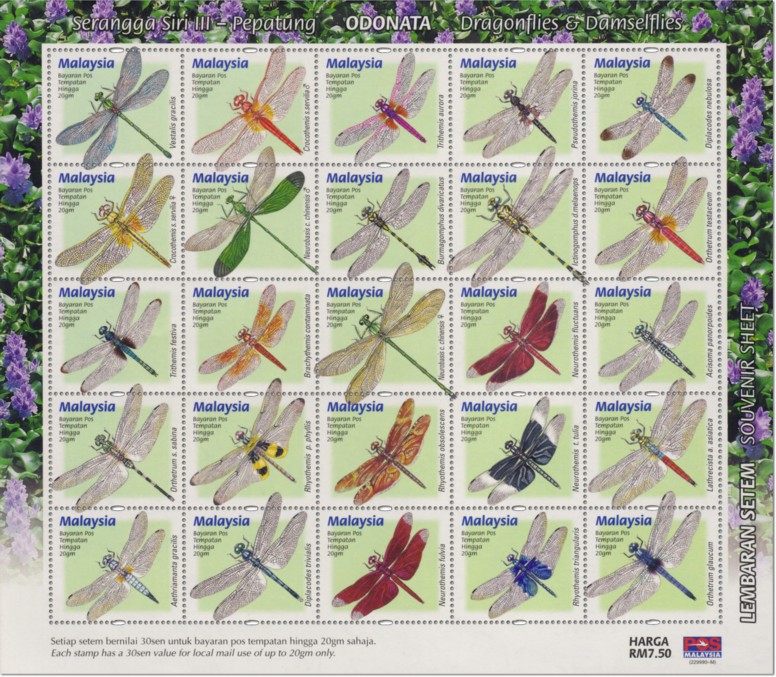
Dragonflies attract much attention of naturalists for their vibrant colour. The
showy striking colour of their body amazes many onlookers.
Odonates (dragonflies and damselflies) are insects which contains three
Suborders: 1) Anisoptera (dragonflies), 2) Zygoptera (damselflies), 3)
Anisozygoptera.
The two former suborders of dragonflies and damselflies are widespread whereas
Anisozygoptera is represented by one single species in Japan and one in the
Himalayas.
There are more than 5000 odonate species worldwide. In Malaysia more than 300
species have been found. Dragonflies are helping us in keeping down the
numbers of mosquitoes and we tend to forget that mosquitoes form a large part of
the diet of many predators including dragonflies and birds.
Photography on dragonflies is now getting popular among the nature lovers.
Morning is the best time for a beginner in photography dragonflies. Most
dragonflies require that their flight muscles reach a certain minimum
temperature before they are able to fly efficiently. Often insects are sluggish
in the morning as they wait for the temperatures to rise enough to get their
flight muscles warm. In a cool morning the dragonflies are much more
approachable. And the dew condensed on the dragonflies wings often makes for a
nice photo.
In cool, dewy mornings, one may find dragonflies covered with dew. They usually
hide in a more sheltered spot, among weeds or cattails. They won't be going
anywhere until morning sun fully warm them up.
Dragonflies have favourite perches location. One can get as close as physically
possible to the perching site and set up the camera. For macro close up work, a
small F-stop is usually required (F16 or so). The dragonfly will leave during
the setup, but will normally return within minutes landing on the same stem tip
in the same physical position.
Some dragonflies hunt into the late afternoon aided by their excellent
eye-sight. They perch on twigs, grass blades, or leaves at the water’s edge,
waiting to grab small insects that come within range. A dragonfly usually
perches with its body in a horizontal position. They take an upright posture as
if doing a handstand. It had assumed this “obelisk posture” to cool itself by
minimising the rays of the sun ray to the body.
Dragonflies are usually found near ponds, lakes, rivers, or even puddles of
water that are quite permanent. When they are not flying, you can find them
perching on leaves or twigs at the water’s edge.
Dragonfly are magnificent flying machines. It can fly at speeds of nearly
100kph. It can hover like a helicopter, fly vertically, stop or turn sharply in
the midst of rapid flight, even fly backwards. It has the best eyesight among
insects.
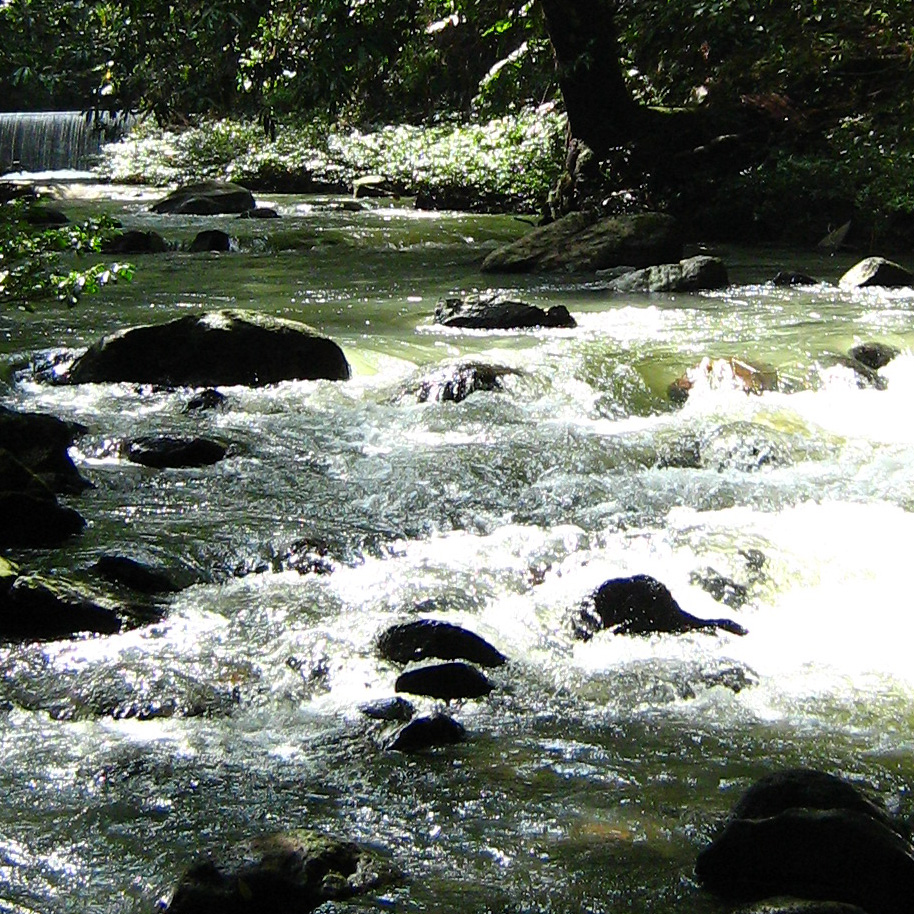
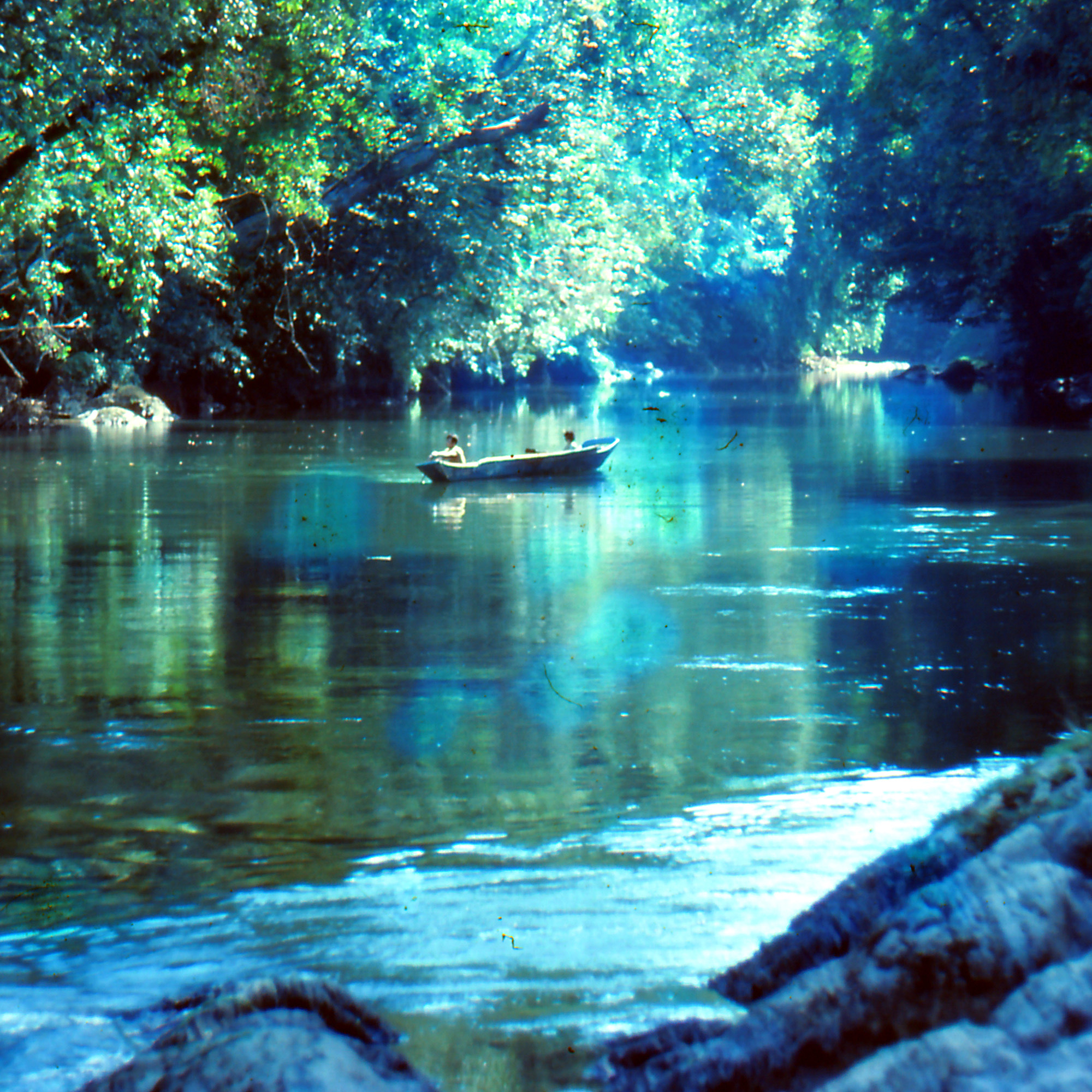
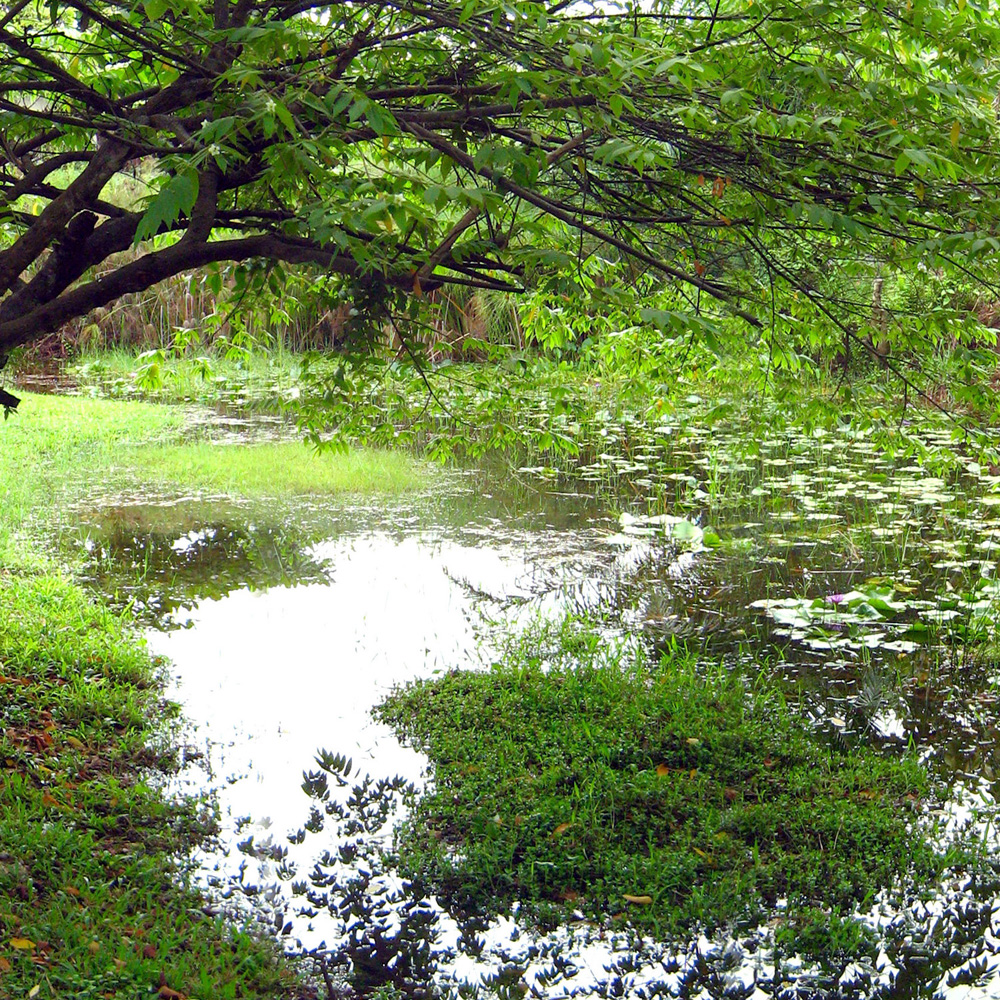
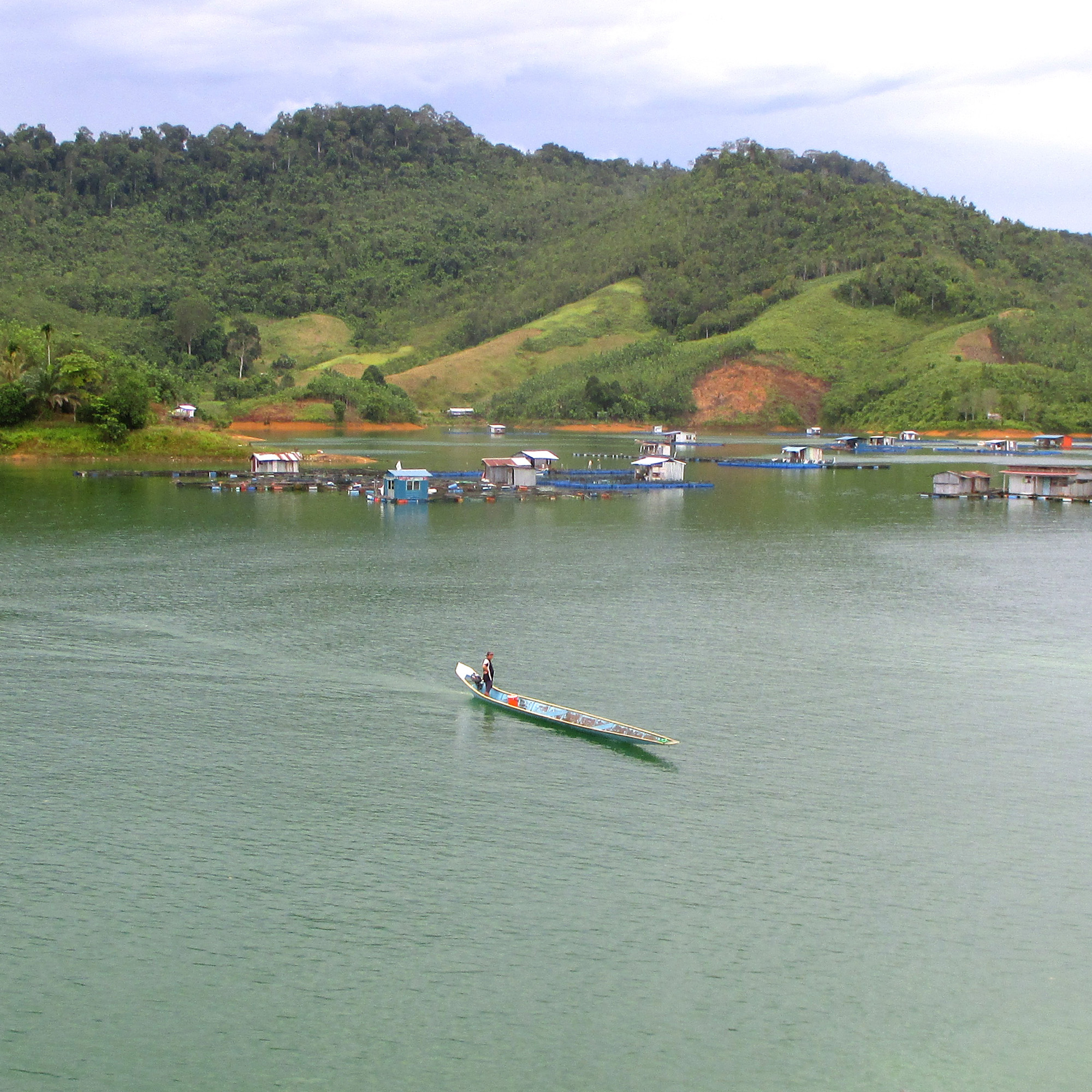
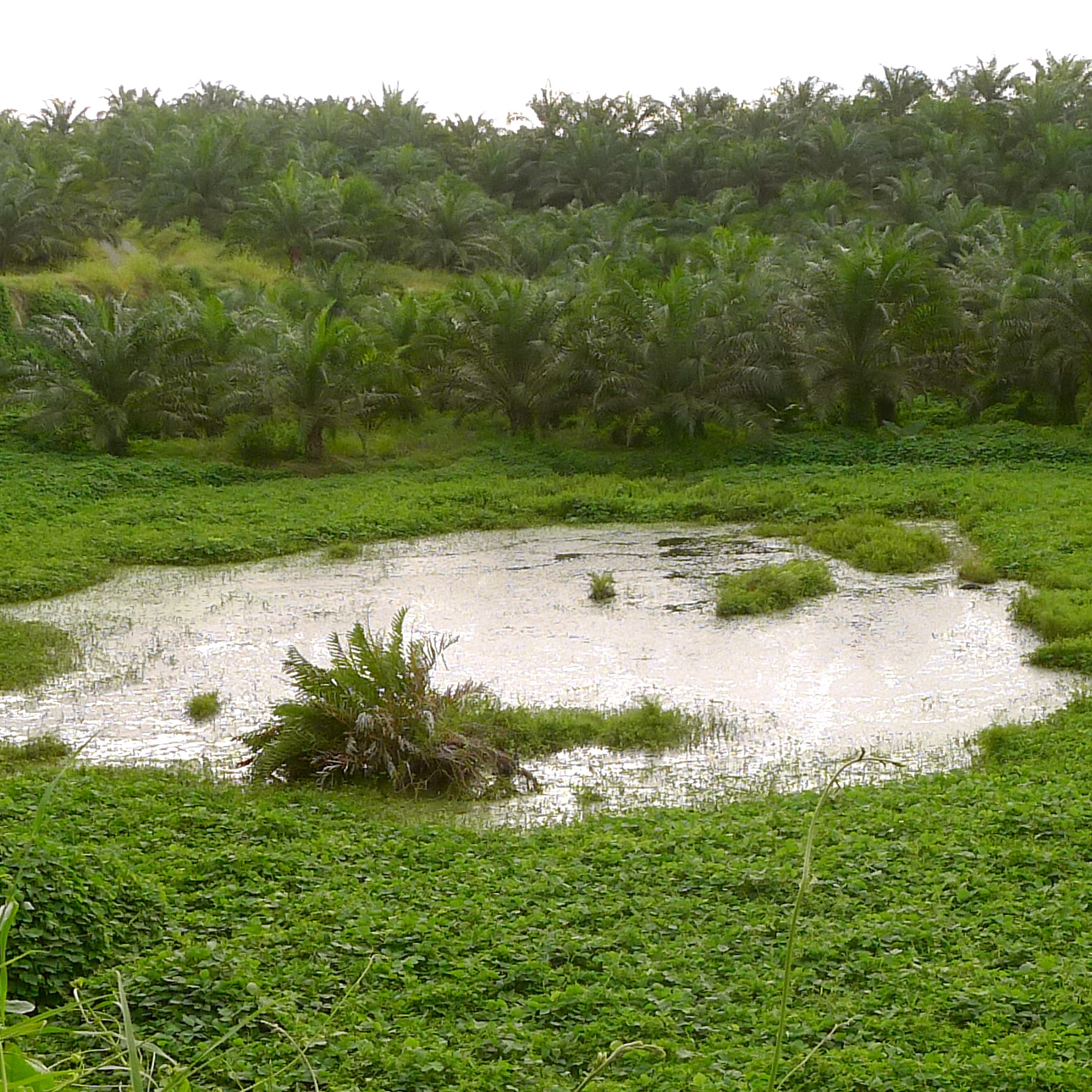
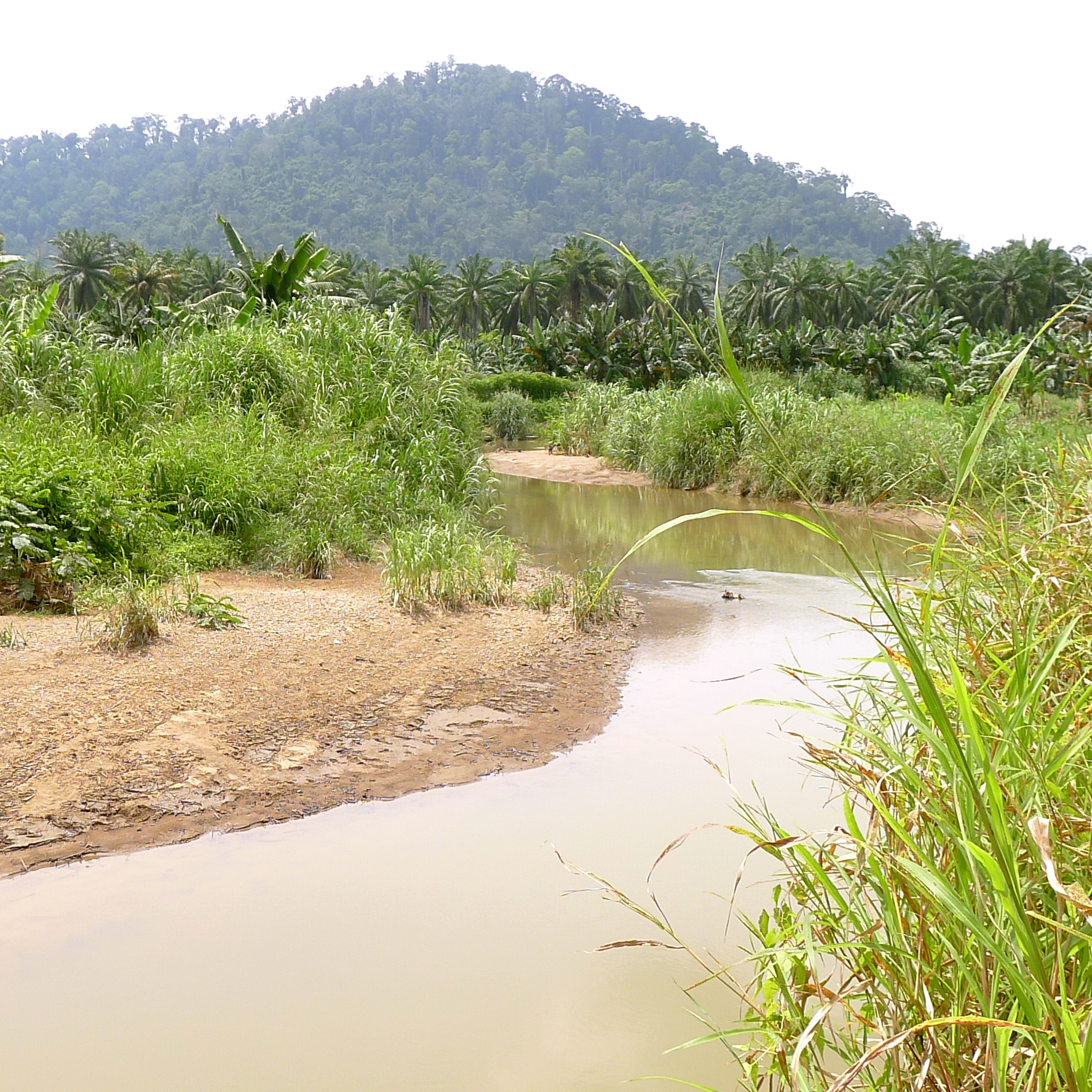
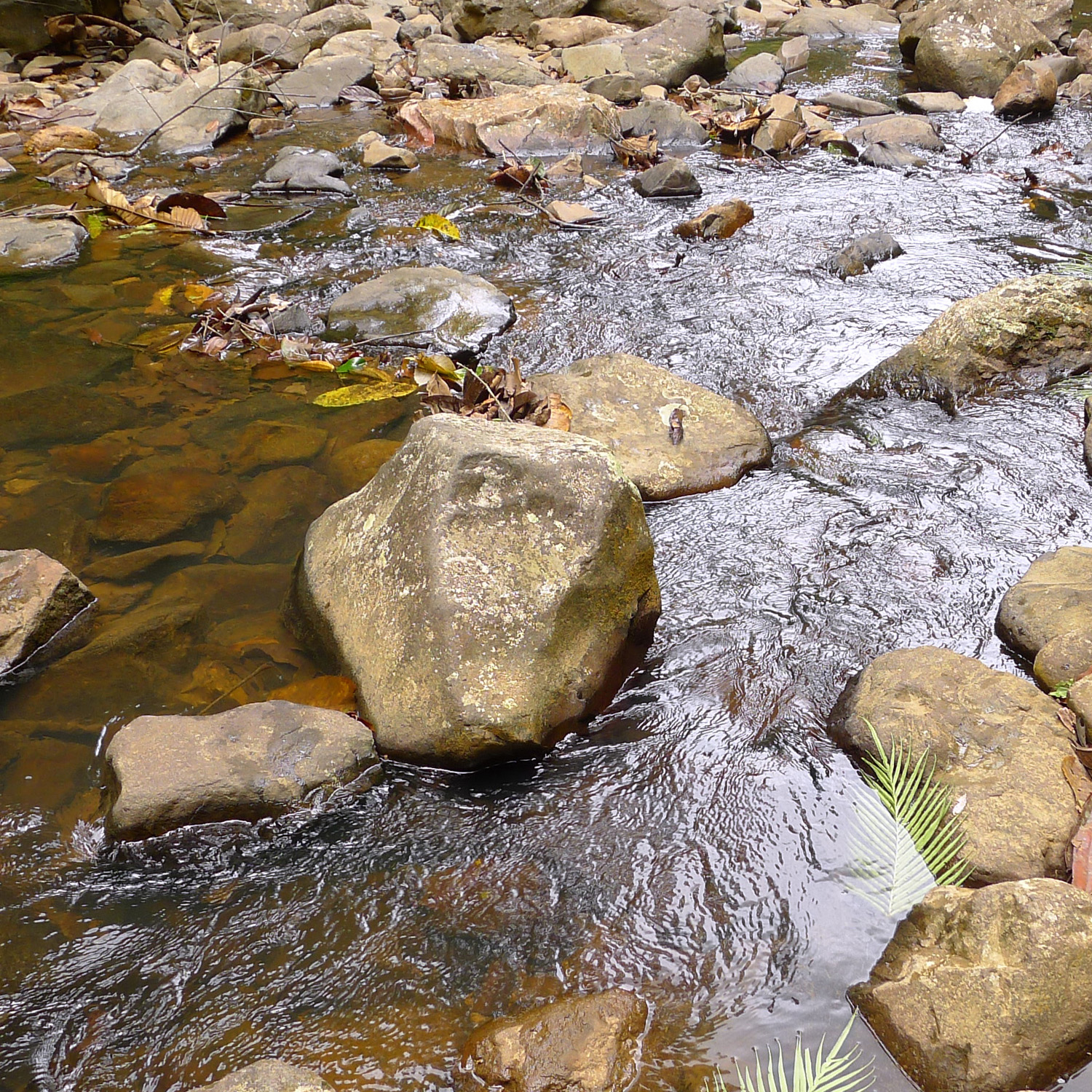
Favourite habitat of dragonflies
and damselflies :
 |
 |
 |
 |
 |
 |
 |
|
Seepage 滴流 |
Forest
Stream 森林溪流 |
Open
Stream 溪流 |
River 河流 |
Marsh 沼澤 |
Lake 湖泊 |
Pond 池塘 |
 |
|
 |
|
Lower Stream 下游 |
Mid Stream 中流 |
Upper Stream 上游 |
Shallow stream with sands and cobbles, water ran slowly and stagnant passing highly diversified habitats along river. Shrubs and grasses along the stream. Site totally exposed to the sunlight. |
Provided varieties of substrates which consist of stones, rocky, cobbles and sandy. Water surface partially covered by canopies of trees and shrubs. Slow and fast flowing water. |
Rich of substrates like stone and big rocky. Stream was too small with very fast flowing water, provided open site which is totally exposed to the sunlight, deep and very crystal clear water |
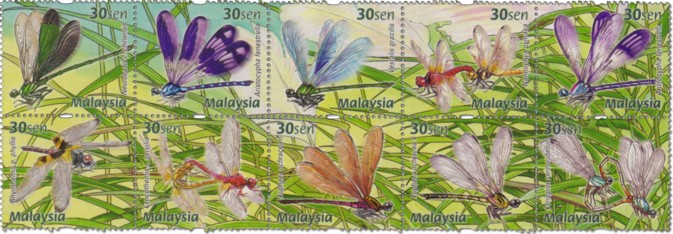
Associations between dragonflies (Odonata) and their forest habitats in North
Borneo: implications for conservation.
Albert George Orr
ENS, Griffith University, Nathan Q 4111
ABSTRACT
The Order Odonata (dragonflies and damselflies) includes nearly 6000 species
worldwide. Owing to their charismatic appeal, ease of observation, and a life
history which depends on both suitable freshwater and terrestrial habitats, they
are increasingly carrying the flag for invertebrate conservation, both as
indicators of environmental health, and as a group of special intrinsic value
deserving priority protection in their own right.
The greatest species richness of Odonata occurs in the Oriental and Neotropical
regions, which boast respectively 1666 and 1636 described species. It is
estimated that 25-30% of the total fauna is yet to be described in both regions.
Within the Oriental region 23 of the 31 extant odonate families occur, 20 of
which are found in Malaysia. At present about 360 species are recorded from
Malaysia, 235 from West Malaysia and 275 from East Malaysia. Within Malaysia 80
species and 20 genera are known only from the peninsular, whereas 136 species
and 10 genera are known only from North Borneo. However taken overall the
Bornean fauna is much more distinct, with 46% species endemic to the island.
It is believed that the greater part of the world tropical odonate fauna is
dependent on forest habitats and unpolluted streams for its survival. The island
of Borneo was originally almost completely covered by closed canopy tropical
rainforest. Owing to an aseasonal, hot, per humid climate and high rainfall,
forests were well supplied with streams and standing water. Consequently the
rich, largely endemic odonate fauna must have evolved in association with these
forests, and non-forest species, common today in disturbed land, must formerly
have been rare opportunists in forest gaps or localized lacustrine species. It
is estimated that at least 70 % of the fauna is presently confined to forest
habitats and probably depends on forest for its survival. This study relates
quantitatively odonate distribution to a mosaic of complex tropical rain forest
formations in Brunei Darussalam. The tiny sultanate of Brunei still enjoys about
80% forest cover, representative of all the seven major formations found on the
island and a great many of the 30+ sub-formations, and results from a
nation-wide survey of odonates from most habitats are considered to be broadly
applicable to the entire island of Borneo and many other parts of equatorial
south-east Asia.
Greatest odonate diversity, both Alpha and Beta, and greatest endemicity, is
found in the primary lowland mixed dipterocarp forests, especially those growing
in highly dissected landscapes such as occur at the Kuala Belalong Field Studies
Centre, at the edges of the central uplands. High diversity and endemicity is
also found in swamp forest, especially freshwater swamp, with certain endangered
peat swamp formations also important. The highly vulnerable kerangas forest
harbours fewer species, none uniquely, and the mangrove fauna is still more
depauperate, with only a single wide-ranging specialist restricted to this
habitat. Secondary dipterocarp forest is certainly less rich in odonates than
primary forest, but lack of sites for parallel comparisons makes it difficult at
present to state how serious this effect is. These results emphasize the
importance of conserving a wide range of primary forest formations to achieve
satisfactory odonate conservation, a strategy congruent with the conservation of
charismatic land-based vertebrates and forest peoples.
Feats and Facts
Fossils of prehistoric dragonflies have been found with wingspans of 30 inches
and body lengths up to 18 inches.
Adults of Odonata can fly backwards or forwards and even hover like a
helicopter. They can do these incredible aerial tricks because their two pairs
of wings move independently of each other, in contrast to most other insects.
The fastest recorded insect flight belongs to the Australian dragonfly,
Austrophlbia costalis, which can reach 36 miles per hour over short distances.
Some dragonflies can have between 10,000 and 50,000 individual eyes (commatidia)
in each compound eye.
The naiad shoots out its labium very fast to catch a prey, and the forward
movement requires less than three one-hundredths of a second.
The largest damselfly, Megaloprepus coerulatus, has a wing spread of more than
seven inches. This damselfly is found in Central and South America.
A dragonfly nymph can use jet propulsion to move forward very quickly. By
pulling water into the rectal chamber of its abdomen and then shooting it out.

The Largest and Smallest species of Dragonflies in Borneo :
Indaeschna
grubaueri and
Nannophya
pygmaea
The Largest Species is ♂
Indaeschna grubaueri
Body length = 92mm, Wingspan = 116mm
The Largest
Species is ♂ Indaeschna grubaueri
body length = 96mm, wingspan = 137mm
The
Smallest Species is ♂ Nannophya pygmaea
Body length = 17.5mm, Wingspan = 29mm
This
The largest dragonflies of Borneo are all belong to the Family of Aeshnidae. The smallest are from Family Libellulidae. In between is the Family Gomphidae.
Dragonflies and Damselflies of Sarawak
Some of the interesting Dragonflies and Damselflies we
found in Sarawak
Dragonflies in West Malaysia
West Malaysia hosts over 230 species of dragonflies and damselflies, which is
roughly double the European total. Although few of these are endemic, many have
restricted Sundaic distributions, occurring only in Malaysia, southern Thailand
and Sumatra.
Natural history tours included Fraser’s Hill and Taman Negara.
Interesting area of peat swamp forest, a habitat seldom visited by tourists of
any kind.
A short distance from Kuala Lumpur is the old and charming British hill-station
of Fraser’s Hill, small streams in and below the montage forest here are sure to
yield a number of exciting species and birds are very easy to watch here.
Small streams at mid-altitude are sure to hold the robust damselfly Devadatta
argyoides, the golden-winged Euphaea ochracea and the widespread but glorious
Aristocypha fenestrella.
A key endemic to find here is the unmistakeable Calicnemia rectangulata, which
is restricted to the mountain ranges of West Malaysia.
Taman Negera is an area of incomparable humid rainforest. This is one of the
oldest tracts of rainforest in the world and supports some quite fantastic
beasts, including one of the largest dragonflies in the world, the monstrous
Tetracanthagyna plagiata.
Time will also be spent exploring some lowland peat swamp forest – a habitat
which although depauperate in birds and mammals hosts an interesting and
specialised Odonate fauna.
Here is a good place to search for the rare and local damselfly Podolestes
buwaldai.
Inevitably during the trip we will spend some time around Kuala Lumpur, enjoying
some of the finest food in the world (here the best of Malay, Chinese and Indian
food is available) – a mouth-watering prospect for many.
In Kuala Lumpur visit the ponds of the Botanical Gardens to look for the common
and widespread species.

Common dragonflies in Borneo Island
(Information of Dragonflies of Sarawak, Sabah, Brunei and Kalimantan)
The 3 common families of dragonflies found in Borneo Island:
1 Family Aeshnidae
2 Family Gomphidae
3 Family Libellulidae
FOODS OF ODONATA
Dragonflies and Damselflies feed on insects
A small dragonfly eat mosquitoes every day. While the larger dragonflies eat
small insects like moth, butterflies, flies and sometimes each other.
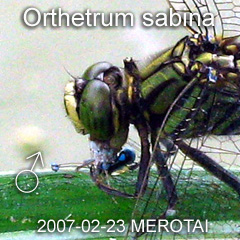
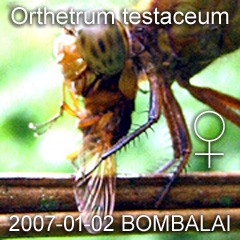
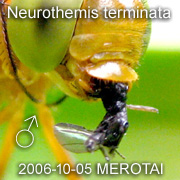

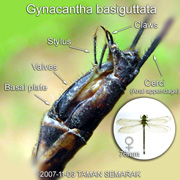

Ovipositor or Vulvar lamina
of Female Dragonflies and Damselflies
The females of all damselflies and some dragonflies (Aeshnidae and Petaluridae
families ) have a fully formed ovipositor, which is a complicated structure
containing paired valves and cutting blades, on the underside of abdominal
segments 8 and 9. The ovipositor is used to insert eggs into plant tissue, mud,
or other substrate.
Some species have a stylus, which is a thin, needle like projection, at the end
of each of the two valves of the ovipositor.
Vulvar lamina with a conspicuous “V” incision
HOW TO DISTINGUISH MALE AND FEMALE ODONATA
(DRAGONFLIES AND DAMSELFLIES)
Males and females can be distinguished as follows:
--------------
3- Males have a bump containing the accessory genitalia under the second abdominal segment; females lack this.
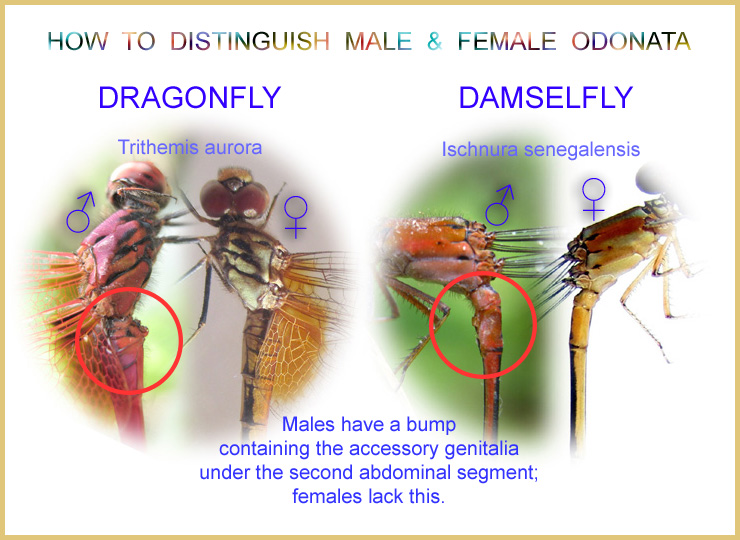
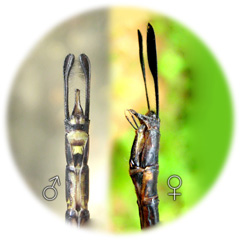
2- Male dragonflies have 3 appendages at the abdomen tip, male damselflies have 4; females of both have only 2 such appendages.

1- Females typically have a broader abdomen than males,
and female damselflies and darners (Aeshnidae) have a prominent ovipositor under
segments 8 and 9.
HOW TO DISTINGUISH MALE AND FEMALE ODONATA
| DRAGONFLY | DAMSELFLY | |
| Type 1 Female | Type 2 Female | ALL Female damselflies have a ovipositor |
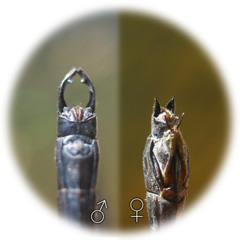
| NOT ALL female dragonflies have a ovipositor. These female have a Vulvar lamina instead | ONE family (Aeshnidae) of dragonflies have a ovipositor | |
| Dragonfly Vulvar lamina | Dragonfly Ovipositor structure | Damselfly Ovipositor structure |
 |
 |
 |
The females of all damselflies and some dragonflies (Aeshnidae and Petaluridae
families ) have a fully formed ovipositor on the underside of abdominal segments
8 and 9.
Ovipositor is a complicated structure used to insert eggs into plant tissue,
mud, or other substrate.
Ovipositor structure containing :
1- Paired valves
2- Basel cutting blades, .
3- Paired stylus, which is a thin, needle like projection, at the end of each of
the two valves of the ovipositor.
4- Some species (Gynacantha basiguttata) have sharp anal claws at segment 10.
That perhaps serves as anchor to stabilize the abdomen while the basal plate is
cutting hole and inserting eggs into plant.
Female dragonfly that do not have Ovipositor Structure will have a Vulvar lamina
with a conspicuous “V” incision

CHART OF DRAGONFLIES OF BORNEO
RELATED TOPICS
|
|
Damselflies of Borneo |