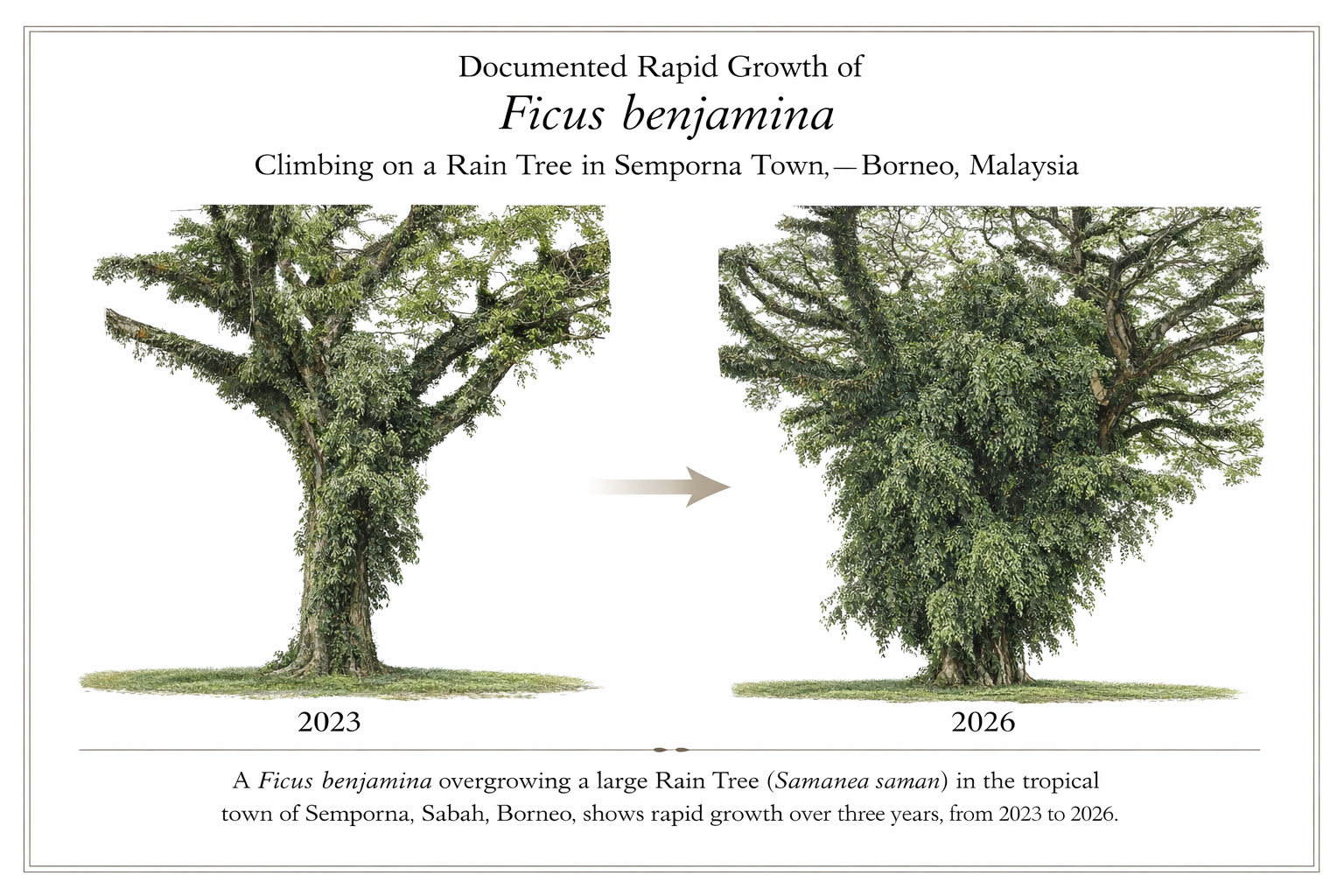
Case Study 01 - Rapid Structural Colonization by Ficus benjamina
Semporna Town, Southeast Sabah, Malaysian Borneo
2023 - 2026 (3-year documented growth period)
Scientific name: Ficus benjamina L.
Family: Moraceae
Growth form: Strangler-type hemi-epiphyte
Ecological strategy: Opportunistic canopy colonizer
In Borneo, Ficus benjamina commonly germinates in canopy forks, develops aerial roots, descends toward the ground, and gradually integrates structurally with the host tree.
Host species: Large Rain Tree (Samanea saman)
Growth setting: Urban roadside environment
Climate: Equatorial - high humidity, high rainfall, minimal seasonal variation
| Parameter | 2023 | 2026 |
|---|---|---|
| Estimated canopy volume | ~23 m3 | ~70 m3 |
| Estimated above-ground biomass | ~230 kg | ~700 kg |
| Relative increase | - | ~200-220% |
| Estimated annual biomass gain | - | ~150-170 kg/year |
This documented case demonstrates rapid canopy expansion under equatorial coastal conditions. The threefold increase in canopy volume over three years indicates an aggressive structural integration phase typical of urban tropical Ficus colonization.
The specimen appears to be entering a mid-stage structural dominance phase, where biomass accumulation becomes biomechanically significant to the host tree.
Across Borneo (Sabah, Sarawak, Brunei, Kalimantan), Ficus species function as keystone taxa, providing year-round fruit resources and influencing both urban and forest canopy dynamics.
This longitudinal documentation provides rare short-interval evidence of biomass acceleration in a coastal equatorial urban setting.