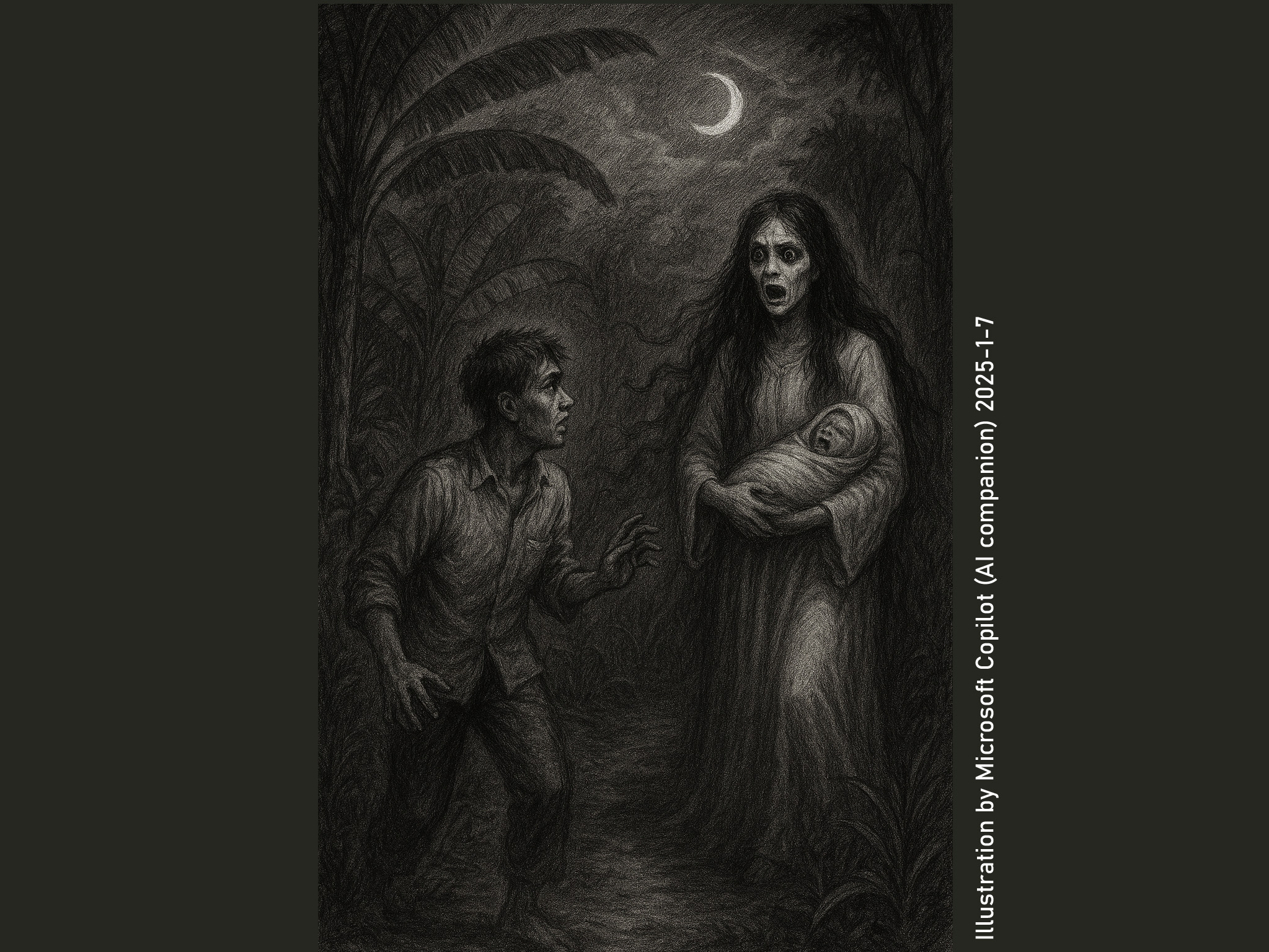
Eerie moment when Hasan encounters the Kuntilanak in the moonlit grove, with shadows, mist, and the haunting bundle at her side.
Two engaging, spooky folk-tale style stories about the Kuntilanak/Pontianak drawn from deep in Indonesian and Malay folklore.
Illustration by Microsoft Copilot (AI companion) 2025-1-7
(Inspired by Indonesia traditional countryside hauntings)
In a forgotten riverside kampung, hidden deep within the swamplands of Nusantara, whispers carried on the night breeze spoke of a ghostly woman in white — the Kuntilanak. Her arrival was never seen at first, only felt: the sudden drift of frangipani fragrance, unnaturally sweet against the heavy, humid air.
One moonlit night, Hasan, a young woodcutter, made his way home through a grove of banana trees. The crescent moon hung thin and pale, casting shadows that seemed alive. Then it came — a perfume so intoxicating, so impossibly pure, that it did not belong to the marshes. Hasan froze.
From the darkness, a sound pierced the silence: the faint cry of a baby, fragile and desperate. His heart tightened. Against his better judgment, he followed the cries deeper into the grove. Each step pulled him further from safety, each echo more urgent, until he saw her.
A woman stood beneath the starlight, her long white dress glowing faintly, her black hair cascading like a river of shadows. Beside her lay a cotton-wrapped bundle, trembling with the cries of what seemed to be a child.
Hasan stepped closer, breath shallow. She turned. Her eyes met his — hollow, mournful, carved by sorrow older than the earth itself. For a heartbeat, pity stirred in him. But then her lips parted, and instead of a mother’s voice, a shrill, piercing laugh shattered the night.
The bundle was no child. It was bait.
The air grew cold, the perfume thickened until it choked him. Hasan tried to flee, but the swamp betrayed him — his feet sank, bound by mud like roots clutching prey. The Kuntilanak reached out, her fingers long and sharp as talons, the sweetness of frangipani now suffocating, poisonous.
Just as her nails grazed his skin…
Hasan awoke in his hut, drenched in sweat, trembling. The scent of frangipani still lingered, haunting the air.
Neighbors swore he had been gone no longer than an hour. But Hasan knew the truth: he had wandered too close to a spirit that thrived on sorrow, curiosity, and the weakness of men who dared to follow her lure.
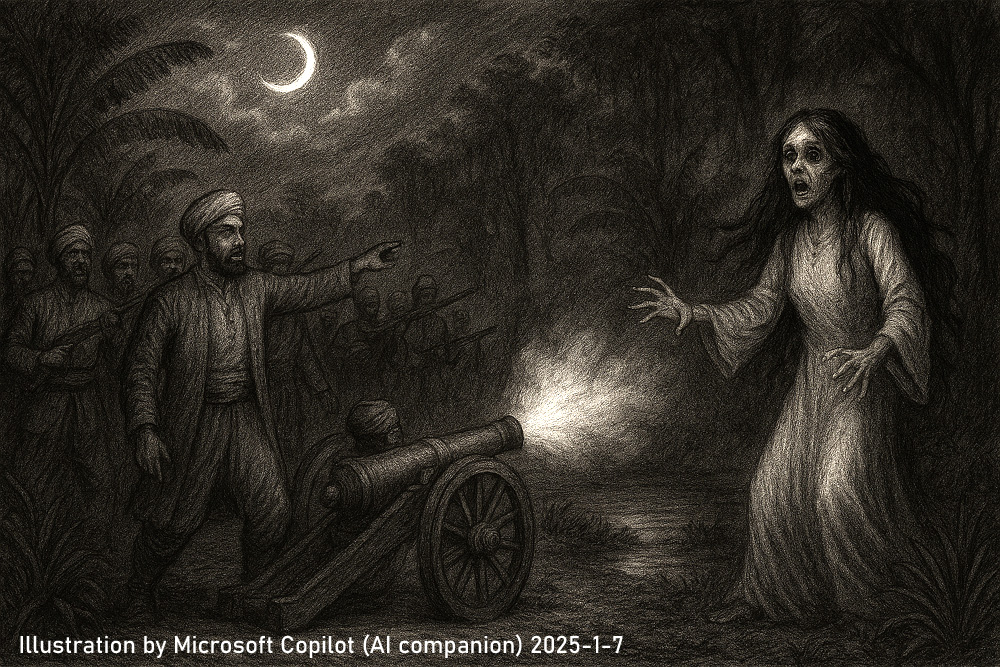
Sultan Syarif Abdurrahman Alkadrie and his men firing the cannon into the
swamp, with ghostly pontianak figures haunting the treeline under the moonlit
sky.
(Ghost Battles at the Swamp — A Legend of Nusantara)
Long before Pontianak rose beside the mighty Kapuas River, the land was wild — a tangled realm of swamp and forest, where the air hung heavy and the nights echoed with cries not born of man. Locals feared the riverbanks, for they were said to be haunted by pontianak — female spirits, born of sorrow, the restless souls of women who died in childbirth.
These were no gentle ghosts. Under the moonlight, they wept, laughed, and screamed — their grief twisted into vengeance, their beauty cloaked in terror.
When Sultan Syarif Abdurrahman Alkadrie and his followers arrived to settle the land, they pitched their tents by the muddy river’s edge. That first night, the jungle stirred.
A ripple of laughter — high, eerie, and broken — drifted through the camp. Then came the sounds: a woman sobbing, then giggling, then shrieking with rage. The men froze.
One by one, the soldiers felt eyes upon them — not from the treetops, but from the shadows beneath the trees. A figure would appear: a woman in white, her dress glowing faintly, her long black hair veiling her face. She would stand, silent… then vanish into mist with a laugh that chilled the bones.
The haunting did not pass.
Days turned to nights, and nights to dread. Ropes snapped without warning. Tools fell from unseen hands. The air grew thick with the perfume of flowers no one had planted — sweet, cloying, unnatural.
The Sultan knew this was no ordinary land. It was a battleground between the living and the dead.
So one night, he issued a challenge. He ordered his men to fire a cannon into the heart of the swamp — not at an enemy, but at the spirits themselves.
The blast thundered across the water. The jungle screamed. The pontianak howled — not in retreat, but in pain.
After that night, the laughter faded. The shadows withdrew, deeper into the forest.
The Sultan declared the land cleansed, the evil beaten back. And so, the city of Pontianak was born — named for the spirits that once ruled the riverbanks.
Even today, elders warn their children:
Respect the forest. Never walk alone at night.
For where the wild meets the city, the pontianak may still wait…