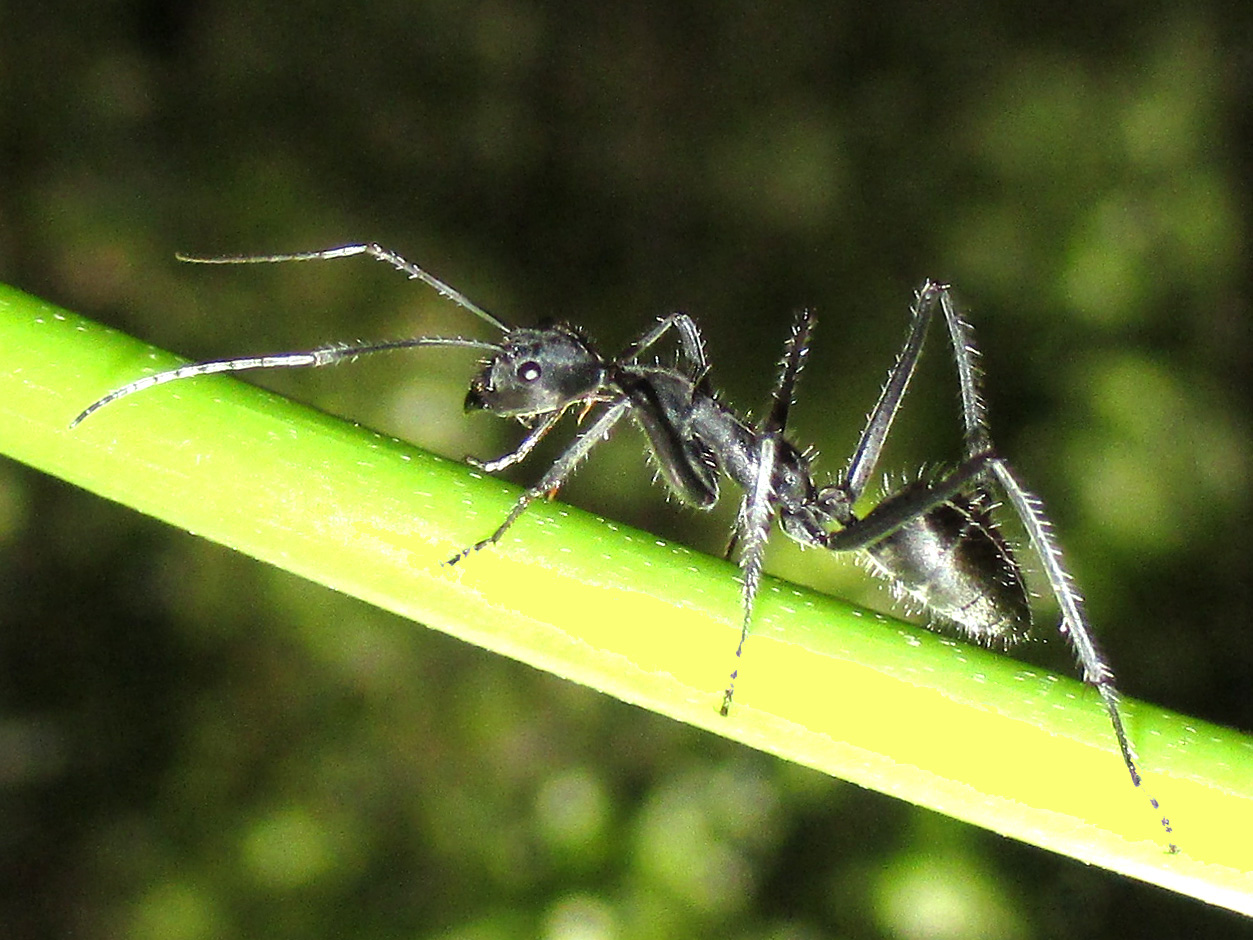
Provisional record. The family is certain. The caste and the subfamily are probable. The genus is not determined, and the two obvious candidates are set out below rather than chosen between.
Class Insecta, order Hymenoptera, family Formicidae — the ants. Almost certainly a worker. Subfamily probably Formicinae. Genus and species not determined.
Photographed by Wong Fook Yee at 12:17 on 4 September 2015, on the strip of ground opposite Tawau Hills Park, Tawau District, Sabah — the half-kilometre margin between the park boundary and an oil palm plantation, which since 2021 has been planted as a fig garden.
About 10 mm long, black and shiny, with very long legs and long antennae. It was alone, walking steadily along the stem of a tall grass, and it did not stop while it was being photographed.
The photograph was taken at midday with fill flash. The dark background is the flash, not the hour — the shutter was fast enough to lose the daylight behind the subject.
The photographer's field note is worth quoting, because it is an observation and not a lookup:
"Ants of this kind are common in the forest around Tawau. I find them on plants, on the ground and on tree trunks, and they travel singly rather than in files. I have never seen this kind inside a house or a building — the ants that come indoors here are different, and they move in long columns."
That distinction is real, and it is one of the useful things to notice about an ant before you know its name. Ants forage in two broad ways. Some send out solitary scouts that search alone and carry what they find home themselves. Others use mass recruitment: a finder lays a trail of pheromone back to the nest, nestmates follow it, and each one reinforces it, so a productive food source pulls a column of ants along a chemical line. The long files that appear in a kitchen are that second strategy working; a single large ant crossing a grass stem in the middle of the day, stopping for nothing, is usually the first.
So "alone" is not an absence of information. It is a behavioural record, and it narrows the field before a single anatomical character has been read.
This site already carries an animal that looks like an ant and is not one — a true bug from a saw mill at Merotai whose narrow waist turned out to be a pair of pale markings rather than a real constriction. That record exists precisely so that the question gets asked here rather than assumed.
It is asked, and it is answered. Two things settle it:
Those characters — geniculate antennae and a strongly constricted, node-bearing petiole — are two of the three that define the family. The third, the metapleural gland, is unique to ants among insects but cannot be seen in a field photograph, and in any case is absent in Camponotus, one of the candidates below.
It has no wings, and that is not a small detail on this site, which files insects by wing count. Among ants the wing count is a caste character rather than a species character: workers are always wingless, and only the reproductives — queens and males — ever have wings.
The alternative was considered. A queen that has already made her mating flight is also wingless, because she sheds her wings afterwards. She is distinguishable all the same: she keeps a deep, boxy thorax built to house the flight muscles she no longer needs, and the broken-off wing bases usually remain as visible stubs. The thorax in this photograph is slender and evenly curved, with nothing on it. On that reading the animal is a worker.
This is also why the record is filed under 0_Wing/ while the ant index sits a level
above it — see the ants index for the reasoning. The key describes what
was seen.
Established: family Formicidae. Probable: subfamily Formicinae, on a waist that appears to carry a single node rather than two.
Not determined: the genus. Two are obvious for a large, long-legged, shiny black Bornean ant found alone on vegetation — Camponotus and Polyrhachis — and there is one character that separates them cleanly. In Polyrhachis, the spiny ants, the pronotum is armed with a pair of spines, teeth or tubercles in every species; the propodeum is usually armed as well, and the petiole usually carries four spines. Camponotus has no such armature.
No spines are visible on this animal, which argues for Camponotus. But the argument is not conclusive, and this page will not pretend otherwise. In the only frame available the front of the thorax is crossed by a raised leg, the waist is overlapped by two more, and the flash has burnt out the highlights along exactly the ridge where a tubercle would show. A character you cannot see is not a character you can rule out.
What would settle it: a view of the thorax from above or from directly behind, showing the shoulders and the back of the thorax clearly, and a clean lateral of the waist showing how many nodes it carries. Either would probably decide the genus. Neither exists for this individual, photographed once in 2015 on a compact camera.
The reason for that caution is arithmetic. The standing checklist of Bornean ants records 717 valid species and 52 further subspecies, in 97 genera and 12 subfamilies, and its authors estimate that at least 1,100 species are actually present. Formicinae, the subfamily this animal probably belongs to, accounts for 213 of those species. The single largest genus on the island is Polyrhachis, with 98 recorded species; Camponotus is among the other well-represented ones.
Against roughly 13,800 described ant species worldwide, Borneo's share is not remarkable in number. What it means for a photograph is plain enough: with two candidate genera holding well over a hundred Bornean species between them, an image that cannot resolve the armature of the thorax is a very long way from a species name — and a very long way is where this record honestly stops.
The ground this ant was walking on has since been given a name and a purpose. In March 2021 the Bornean conservation group 1Stop Borneo Wildlife began planting figs on the margin between Tawau Hills Park and the neighbouring oil palm, close to the park entrance — the Plant4Tawau fig garden, the second such garden in Borneo. The first planting, on 19 March 2021, put in 50 fig trees of 16 species. Figs are chosen because they fruit out of season and feed a very wide range of animals, which makes them the fastest way to turn a strip of edge land back into something wildlife will use.
This photograph predates that by six years. That is what gives an otherwise ordinary picture of an ant a second life: it is a dated record of what was living on that half-kilometre before the planting began. Restoration projects are rich in "after" photographs and poor in "before" ones, because nobody knows in advance which piece of ground is going to become a project. Anything photographed on that strip before 2021 — insect, bird, plant — is now a baseline, and worth publishing with the date attached.
One discrepancy is recorded rather than smoothed over. The photographer's field note describes the strip in 2015 as forest buffer between the park and the plantation. The fig garden's own published account describes the planting site as old oil palm land beside the park entrance. Both may be true of different parts of the same boundary strip, which runs for about half a kilometre. The distinction matters for anyone using this record as a baseline, so it is stated here instead of being resolved by guesswork.
Page reviewed: 7 September 2026.