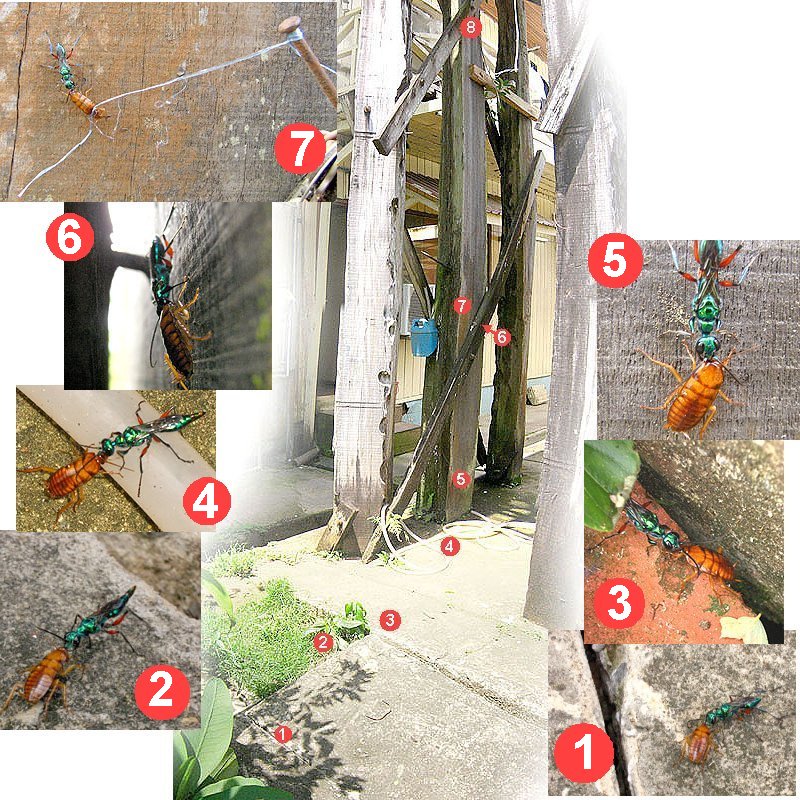
| 1 |
This is a hyperactive bug
that I never has a change to get close for a photo until today I sported
it slow down its movement with a big pray |
| 2 |
The cockroach was still
alive. Seem two of them are fighting but a close look was not. The cockroach
is alive with no sign of damages on the body and I could see very clearly
the coach roach legs were walking well. |
| 3 |
As the Emerald
Cockroach Wasp or jewel wasp (Ampulex compressa) move backward the
cockroach follow suit in the same direction with not struggle at all.
Several times the bug flew away (because my camera got too close) but
return at the exact spot within 10 seconds. During this time this
cockroach victim could easily except, but it didn't. |
| 4 |
On the way they passed
through a couple of gaps then across a couple of time a coiled garden hose
that blocked their way. All the while the cockroach has been very
coordinating the march. |
| 5 |
I tried many time to catch
an image of close up of the head to head. But either out of focus or the
wasp flew away for a moment for I intrude too close. Now up the pole they
go and I knew in a few seconds the will be distanced above and away for me
to capture further photos.....I must do something. |
| 6 |
There is a big gaps between
two woods and inside the two insects took short moment to rest
as I waited anxiously thinking whether they would come up
again or not. There was a nylon string around and
an old nail nailed on the wood at the right position for me to do
something... |
| 7 |
Look ! I tied up her
'cow'... just to delay for a
last few precious moment shoot. During these 15 minutes I managed to
get a few rear and precious close up images in the insect world.
See
next page. |
| 8 |
I released the
cockroach........ and both disappeared somewhere above the wooden
building. |