eTawau > Insects of Borneo > Caterpillars > A swallowtail caterpillar at SMK Abaka
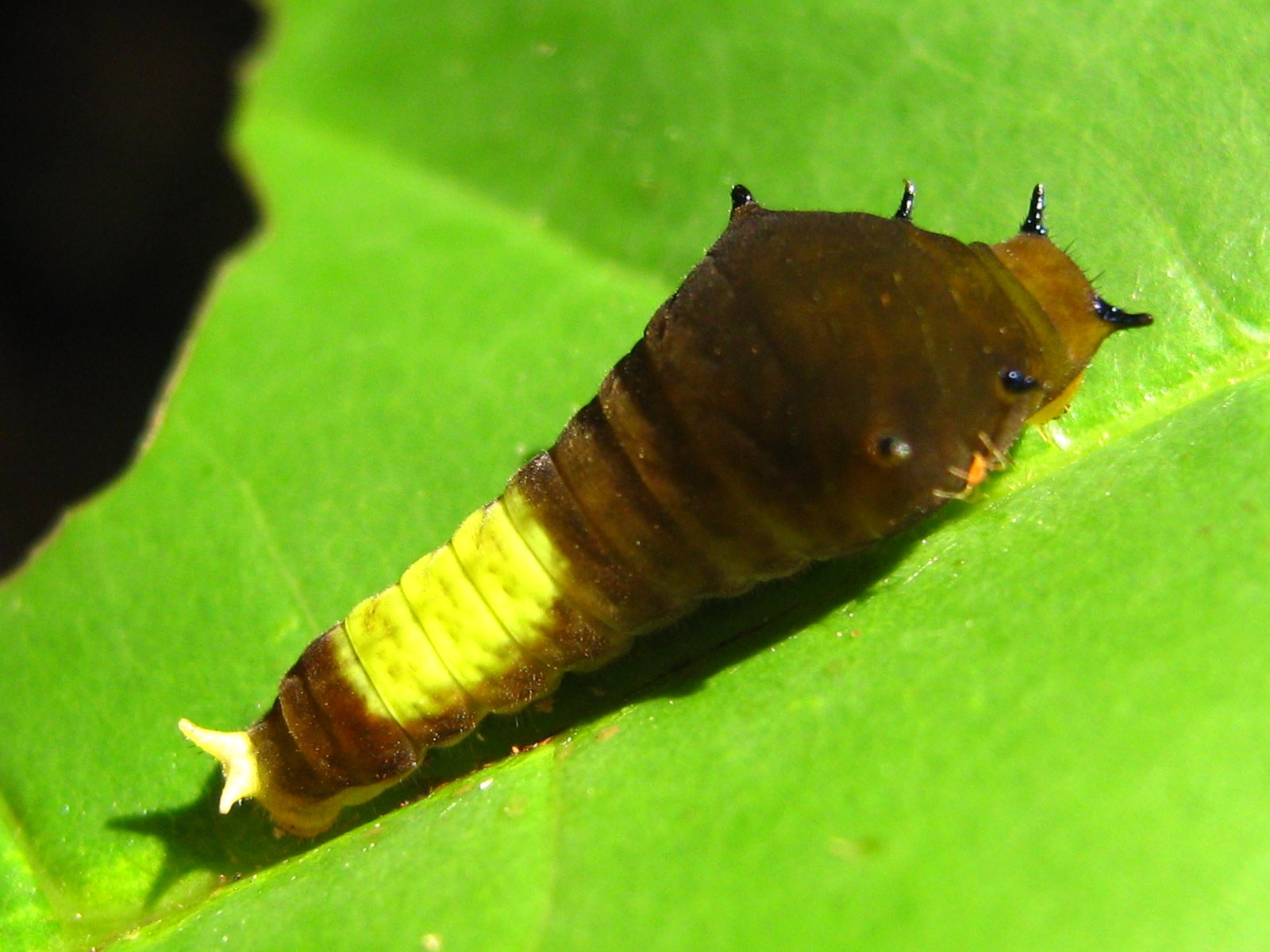
A young swallowtail butterfly caterpillar beside SMK Abaka, Tawau, and the tiny red animal that walked over it while I watched
It was sitting on the upper side of a broad, glossy leaf at the edge of the old oil palm plantation outside SMK Abaka, about 16 km from Tawau town. It did not move. Something on it did. My field note says:
"Not moving. But this caterpillar has a tinny insect in its head that was moving."
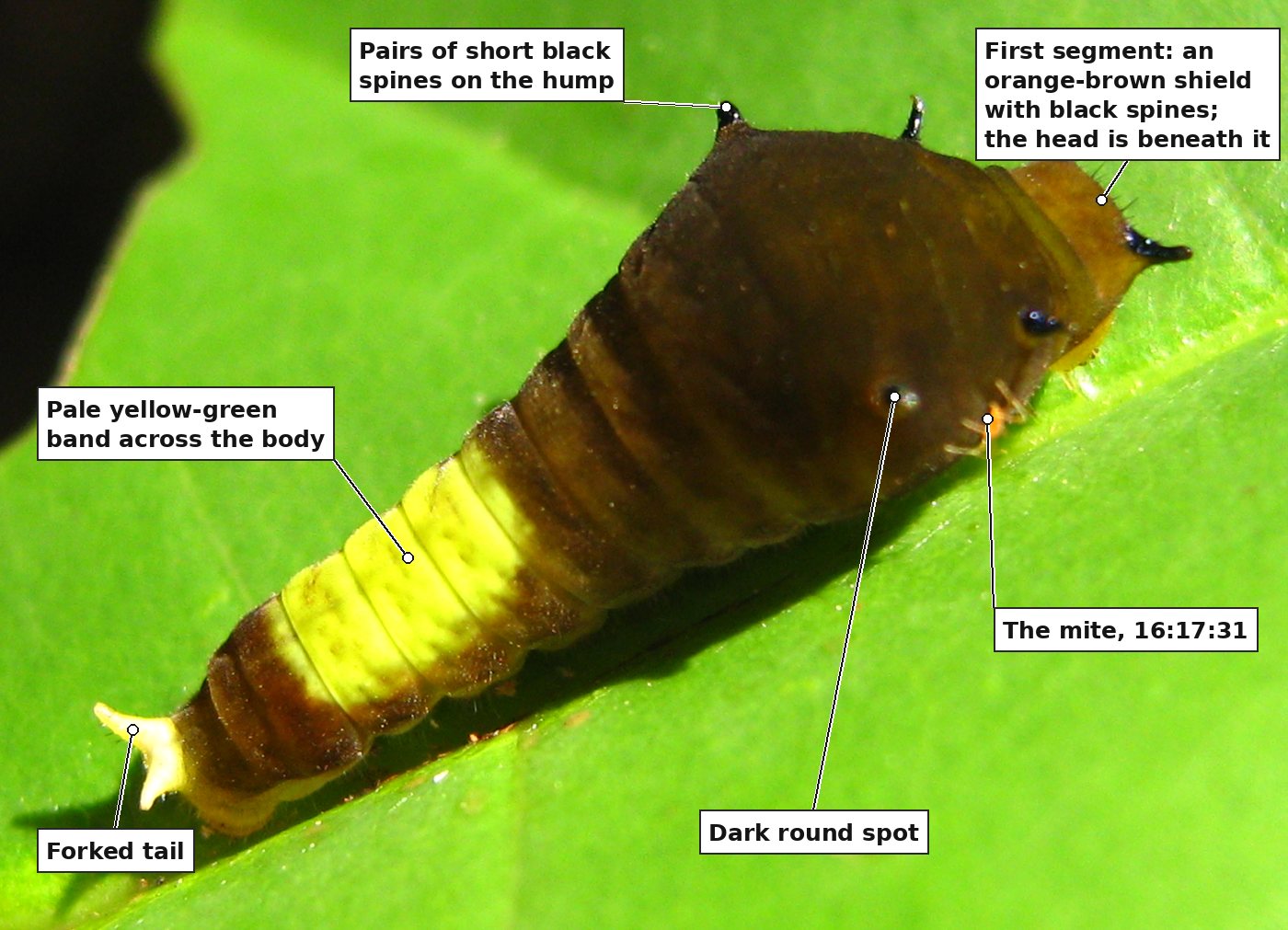
Four things in these photographs point the same way:
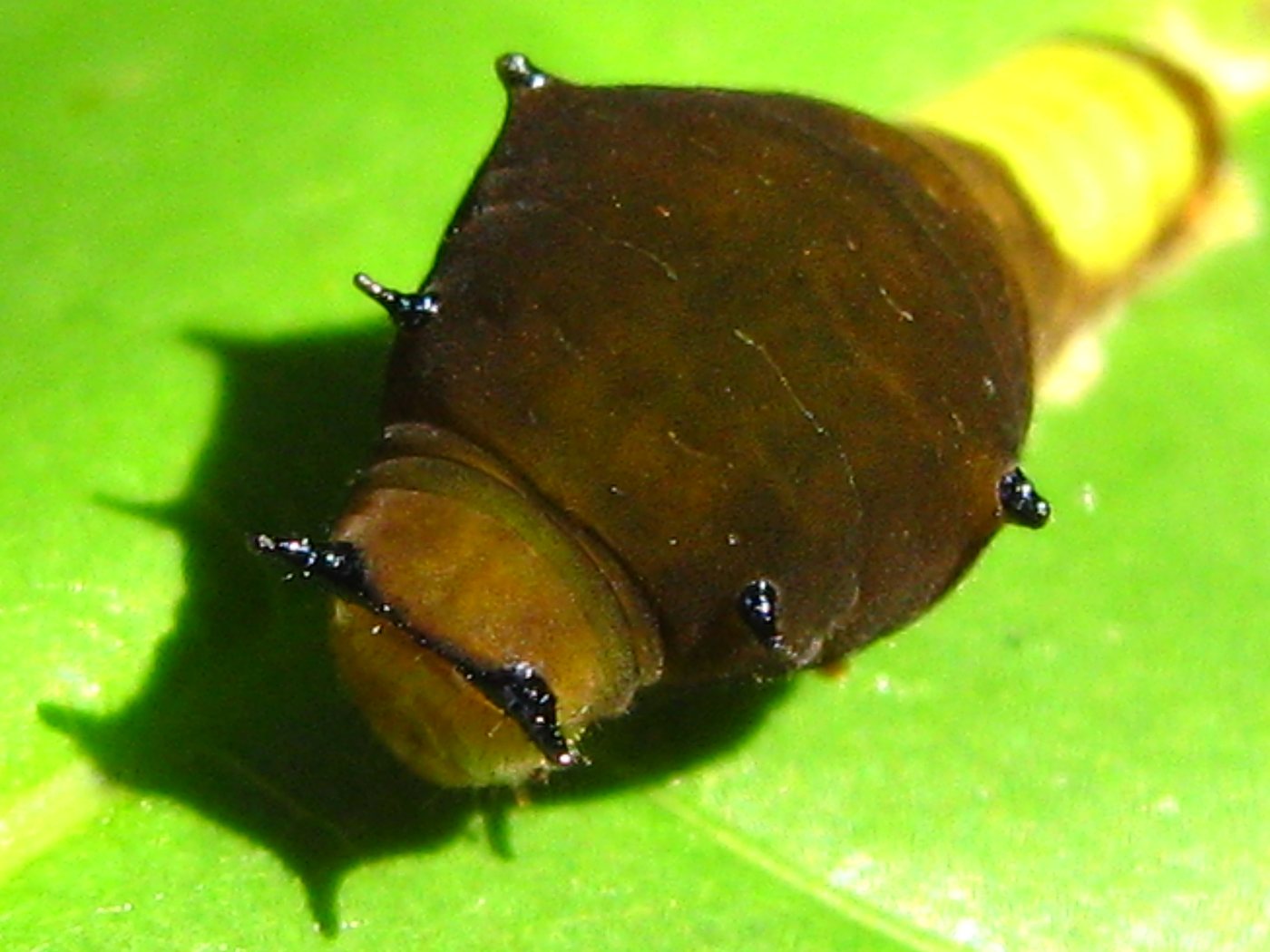
Together they fit the young caterpillar of a swallowtail butterfly, family Papilionidae. The combination looks most like the swordtails and jays, and Graphium is a possibility. But that is a direction, not a name, and this page does not give a genus.
The "tinny insect" is the most interesting thing in these photographs, and it is probably not an insect.
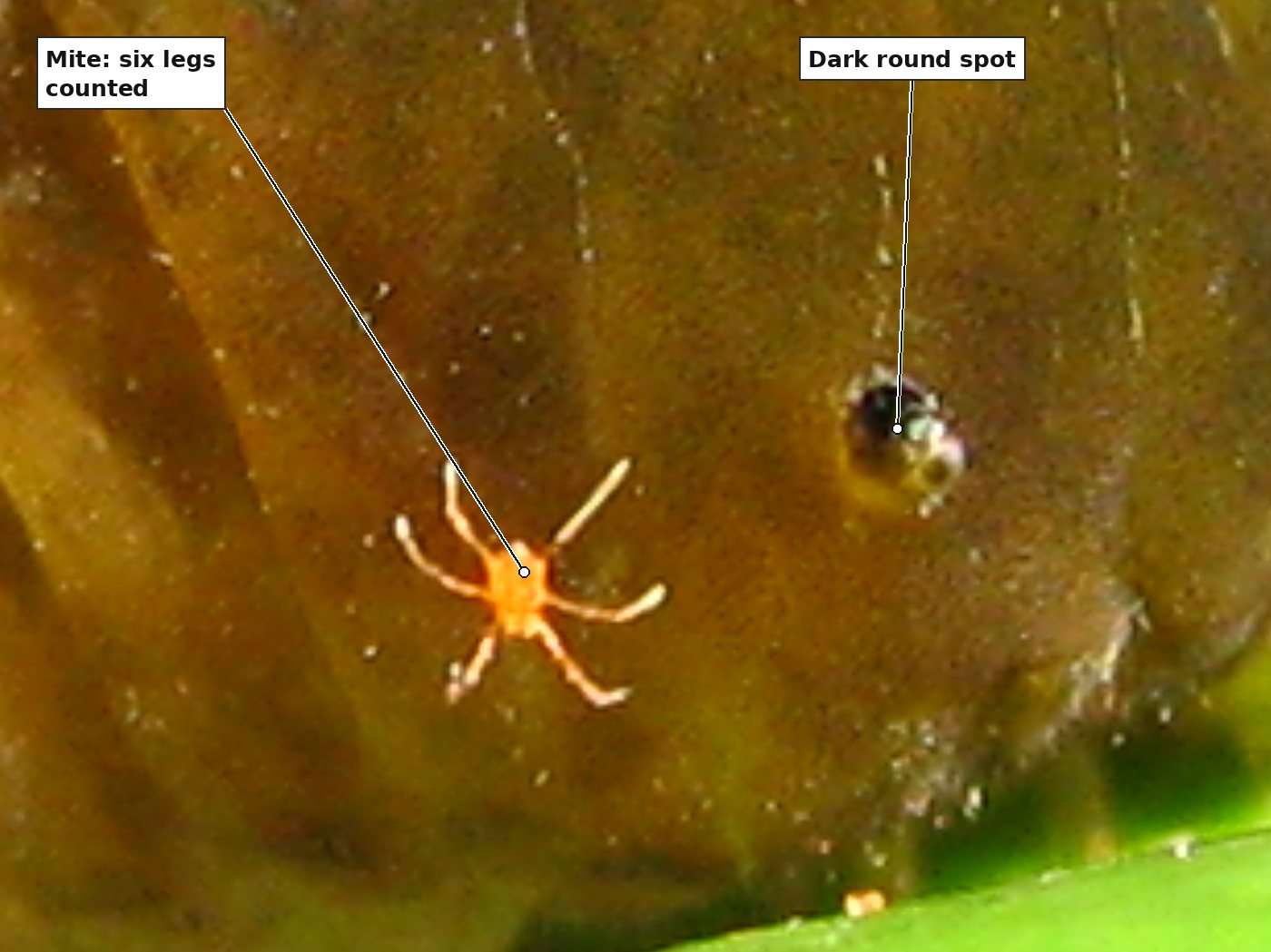
Insects have six legs, and so, at first sight, does this. But it has no visible antennae, and its body is not divided into head, thorax and abdomen. Those are the marks of a mite. Adult mites have eight legs, but young mites hatch with only six and gain the last pair later. Six legs is exactly what a young mite would show.
I count six legs in two separate photographs. A fourth pair folded underneath cannot be ruled out, though, so this page does not name the animal beyond probably a mite.
There is no ruler, coin or finger in any of the four frames, so this record has no size.
Old oil palm plantation outside
SMK Abaka, about 16 km from Tawau town,
Sabah. One caterpillar, not measured, resting on the upper side of a
broad glossy leaf of an unidentified plant, not moving. Humped behind the head and tapering to the
tail; dark brown at the front and rear with a broad pale yellow-green band across the middle; first
segment an orange-brown shield with short black spines, the head beneath it; pairs of short shiny
black spines on the hump; dark round spots on the side of the hump; a pale forked tail.
Lepidoptera: Papilionidae — a swallowtail butterfly. Genus and species not
determined. One only. A tiny orange-red animal, probably a young mite with six legs, walked over it
during the two minutes of photographs. Four frames, 16:15:33, 16:15:41, 16:17:00 and
16:17:31. Not touched; photographed where it sat and left there.
— iNaturalist observation
402848121
In 2009 SMK Abaka stood among old oil palms, with a rubber plantation on one side. Since then the old palms have been replanted with young oil palm, and the rubber has been cleared and replanted with oil palm too.
So the ground this caterpillar was found on no longer exists in the form it had that afternoon. An old plantation with undergrowth, broad-leaved plants and a rubber estate next door is a different place from a young, weeded oil palm block. That is what makes an ordinary dated photograph worth keeping: it is a record of what lived on a piece of land before the land changed, and nobody can go back and take it again.
About the photographs. Four frames by Wong Fook Yee with a Canon PowerShot A470
in macro mode, no flash, f/3.0, ISO 100, 6.3 mm, taken at 16:15:33, 16:15:41, 16:17:00 and
16:17:31 on 2 August 2009 beside SMK Abaka, Tawau, Sabah. All are camera originals that have never
been opened in an editor. For this page they have been reduced, cropped, enlarged and labelled;
nothing has been sharpened, recoloured, added or removed. The unmarked full frames are on the
iNaturalist record above.
The family characters, the osmeterium, the host-plant families of the swordtails and jays, and the
six-legged young stage of mites are from the general entomological literature. The locality, date,
times, behaviour, the moving "tinny insect" and the later replanting of the land are the
photographer's own field observations. The plant is not identified. All photographs © Wong
Fook Yee. Page written 24 September 2026.