eTawau > Insects of Borneo > True bugs > A cotton stainer at Bombalai Hill
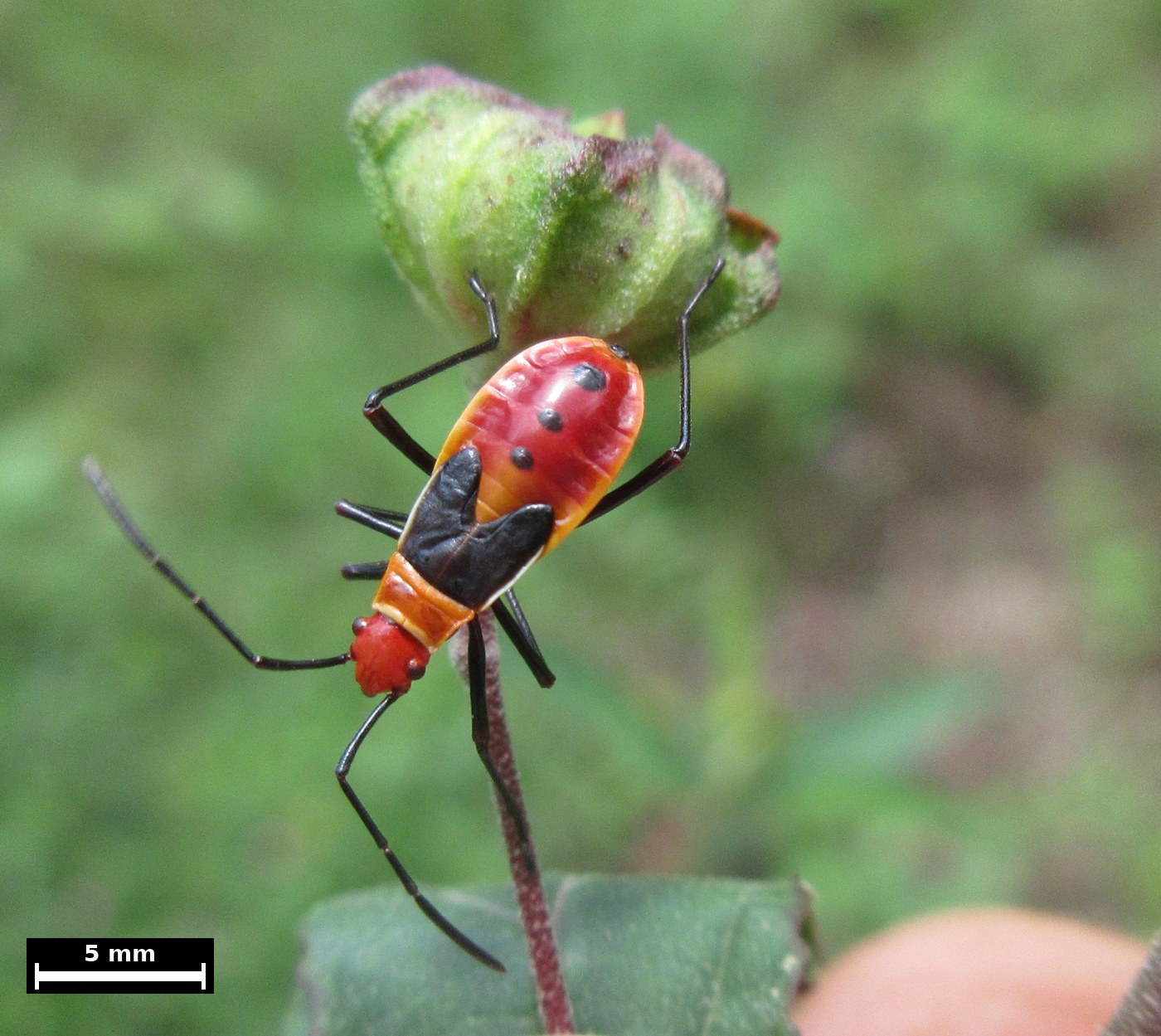
A cotton stainer on a roadside mallow, Bombalai Hill — photographed at last, after twenty years of walking past it
This is a small red insect that lives on a weed. It sits on the flower buds of a scruffy shrub along the first few hundred metres of the Bombalai Hill trail, one or two to a plant, and the plant grows all the way up the roadside. Anyone who has walked to Bombalai has walked past hundreds of them.
Which is exactly why there was no photograph of it on this site until now. The commonest animals are the worst recorded. Everybody assumes somebody else has already done it, and nobody has.
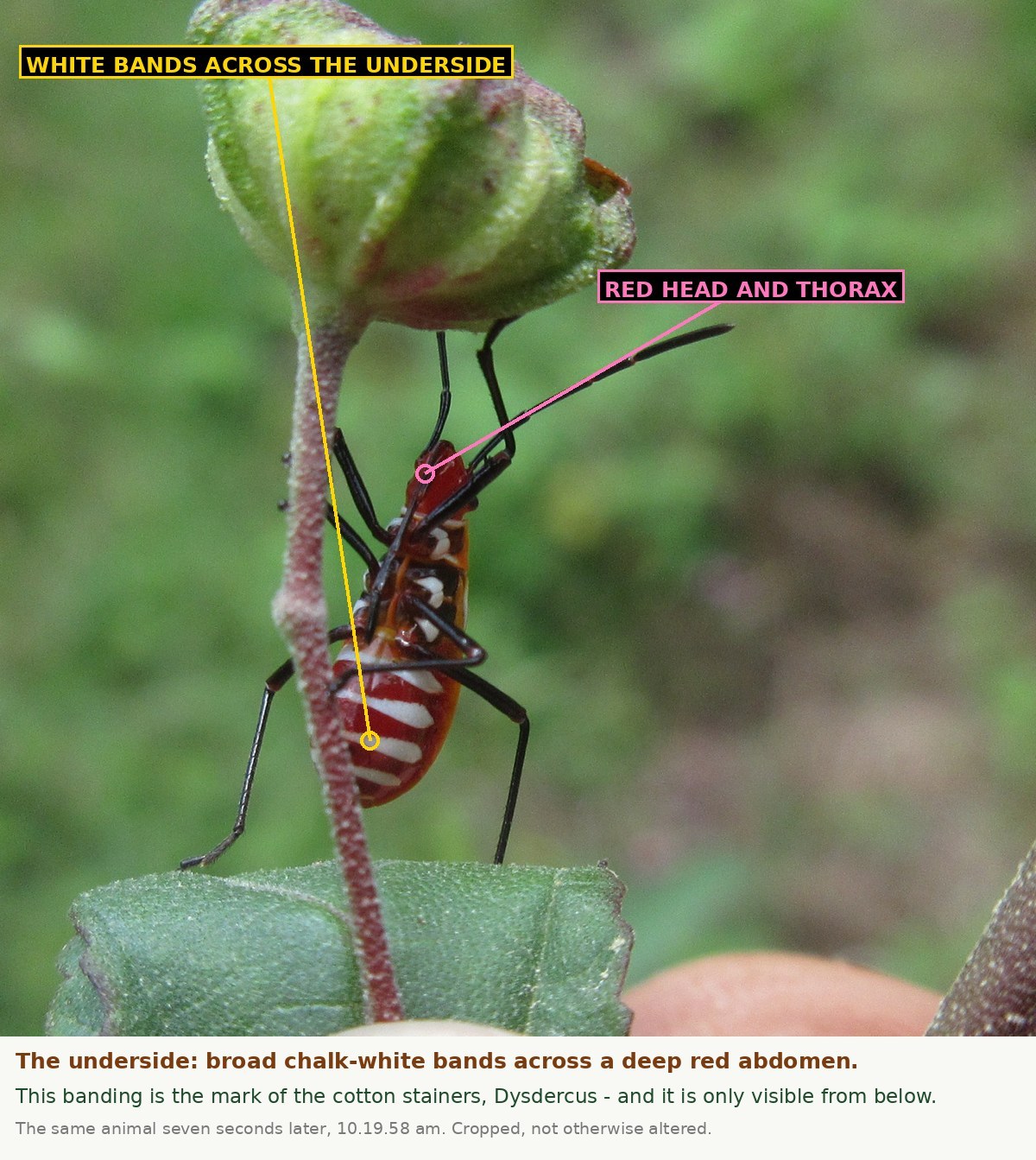
From above, this is a red and black bug and could be one of several families. The photograph that settles it is the one taken seven seconds later, from below.
Look at where the wings stop.
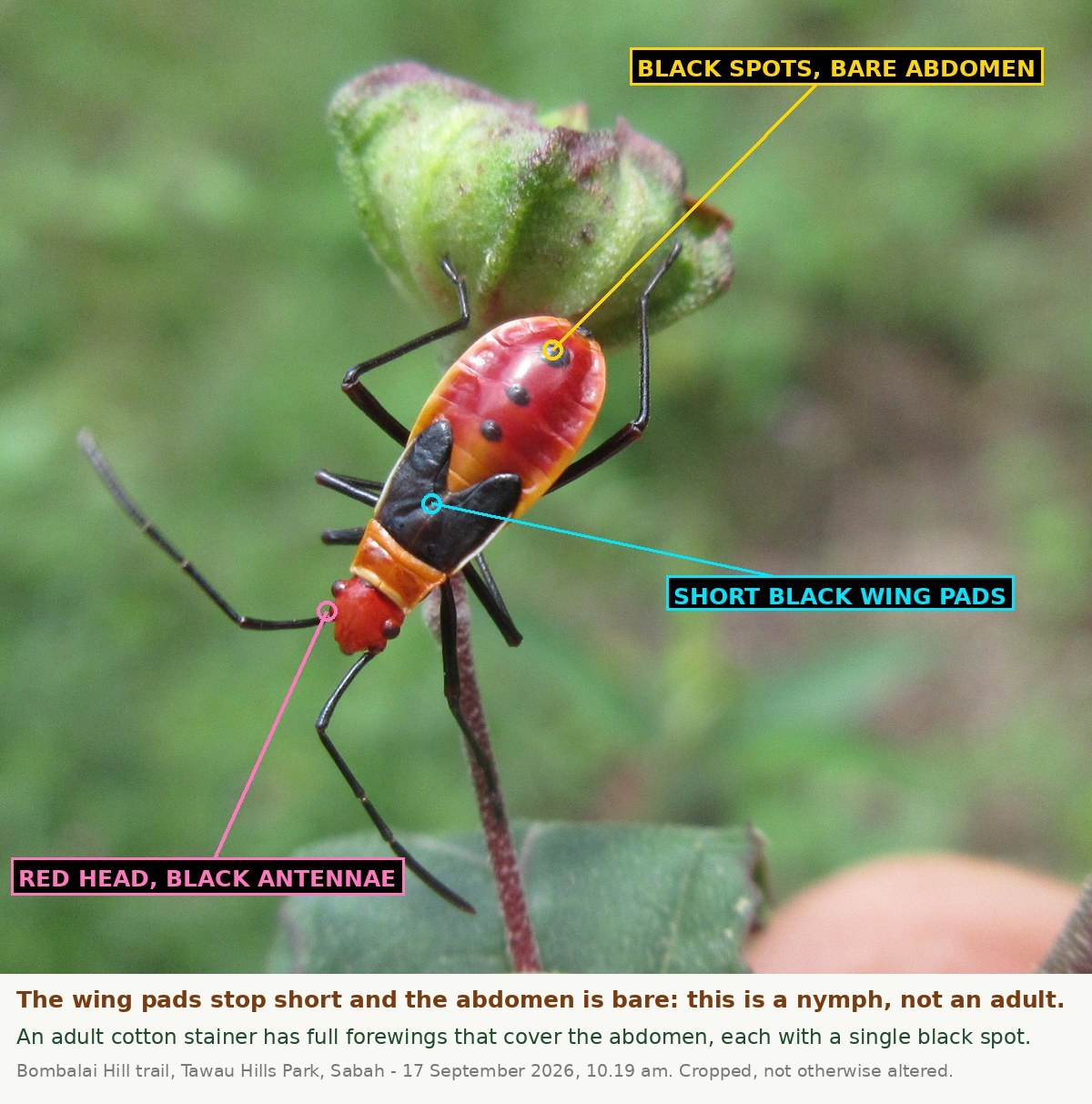
It matters because a nymph cannot be named to species. Colour and pattern change between moults, the keys are written for adults, and the species of this genus in Southeast Asia have been confused with one another in print for more than a century. The record stops at genus, and that is the honest place for it to stop.
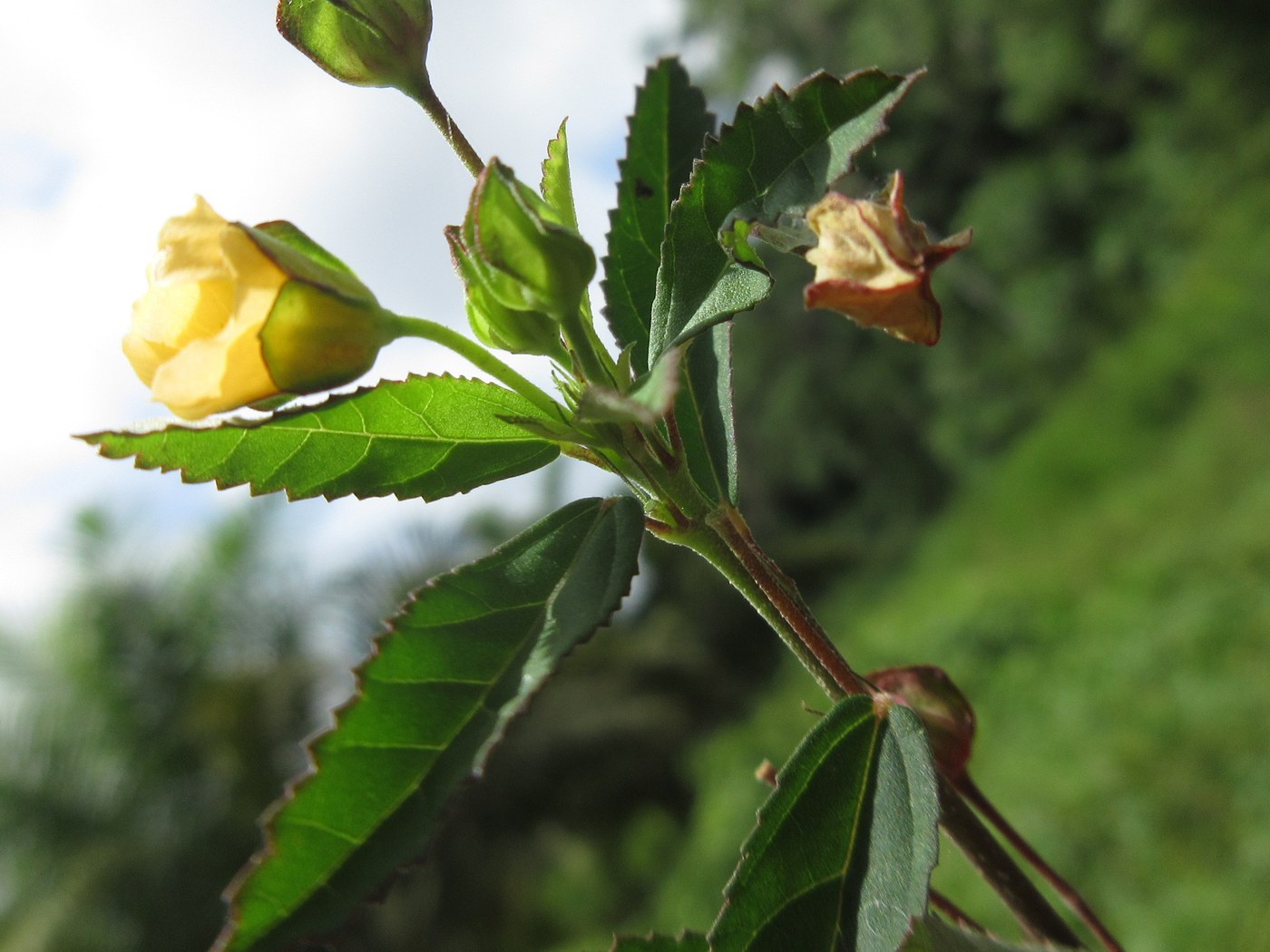
Cotton stainers are not generalists. They are specialists on the mallow family, Malvaceae — cotton, okra, hibiscus, kapok and their wild relatives — and they feed by pushing the beak into developing seeds.
The name comes from the crop. This genus pierces developing cotton bolls to reach the seeds, and the puncture lets in micro-organisms that rot the seed and stain the lint — which is what turns a pretty red insect into a serious pest, and why it has been studied for a century.
There is no cotton within reach of Bombalai Hill. There does not need to be. The wild mallows along a footpath are where this insect lives when there is no crop, and a weedy roadside is not a poor substitute for a cotton field — it is the original home, and the cotton field is the substitute.
I did not measure the animal in the field. Instead I pushed a dressmaker's pin through one of the flower buds, photographed it, and photographed the same pin on 2 mm graph paper when I got home.
That chain works, and so does a second one that needs no pin at all. The photograph measures itself. The file records the focal length (4.5 mm), the sensor width (6.22 mm) and the distance the lens was focused at (6 cm), and those three numbers give the scale of the picture directly: about 47.5 pixels to the millimetre at the animal. The pin chain gives about 48.
Bombalai Hill (Bukit Bombalai) trail, Tawau Hills Park, Tawau, Sabah. The first few
hundred metres, beside the 50-metre buffer zone. One bug, about 14 mm, on the flower
buds of a common trail-side shrub — Malvaceae, probably Sida, not confirmed. Head scarlet;
pronotum orange with a black centre; wing pads black, short, edged white; abdomen red-orange with
round black spots above and broad chalk-white transverse bands below. Legs and antennae black.
Hemiptera: Pyrrhocoridae — Dysdercus sp., a nymph. Species not determined.
One or two on each shrub, and the shrub common along the roadside. Moving over the buds; it dropped
off and out of sight after a few photographs. Two frames, 10:19:51 and 10:19:58.
Hot, sunny morning, under the annual haze from Kalimantan. Not touched; a flowering shoot was held
steady and left on the plant.
— iNaturalist observation
400910722
Bombalai Hill is a dormant volcano of about 531 metres, with a crater roughly 300 m across breached to the south. It stands just outside the entrance to Tawau Hills Park, and you do not need a park ticket to climb it. The walk is 1.9 km each way, in two quite different halves: 1 km of unpaved plantation road across private oil palm land, then 900 m of jungle trail on government protected land.
About the photographs. Taken by Wong Fook Yee with a Canon IXUS 285 HS on the
Bombalai Hill trail, Tawau, Sabah, on 17 September 2026 at 10:19:51 and 10:19:58 (the bug), 10:26:54
(the pin through a flower bud) and 10:33:05 (the plant), with the pin photographed on graph paper at
11:57:44 the same day. For this page the pictures have been cropped and two of them labelled;
nothing has been sharpened, recoloured or removed. The unmarked full frames are attached to the
iNaturalist record above.
The family and genus characters, the host-plant range and the account of cotton staining follow the
Pacific Pests and Pathogens fact sheet on cotton stainers and the published description of
Dysdercus cingulatus. The height of Bombalai Hill and the size of its crater are as
published for Mount Bombalai; the trail distances, the locality, the weather and the circumstances of
the find are the photographer's own field observations. All photographs © Wong Fook Yee.
Page written 17 September 2026.