eTawau > Insects of Borneo > Stick insects > A spiny stick insect at Bukit Gemok
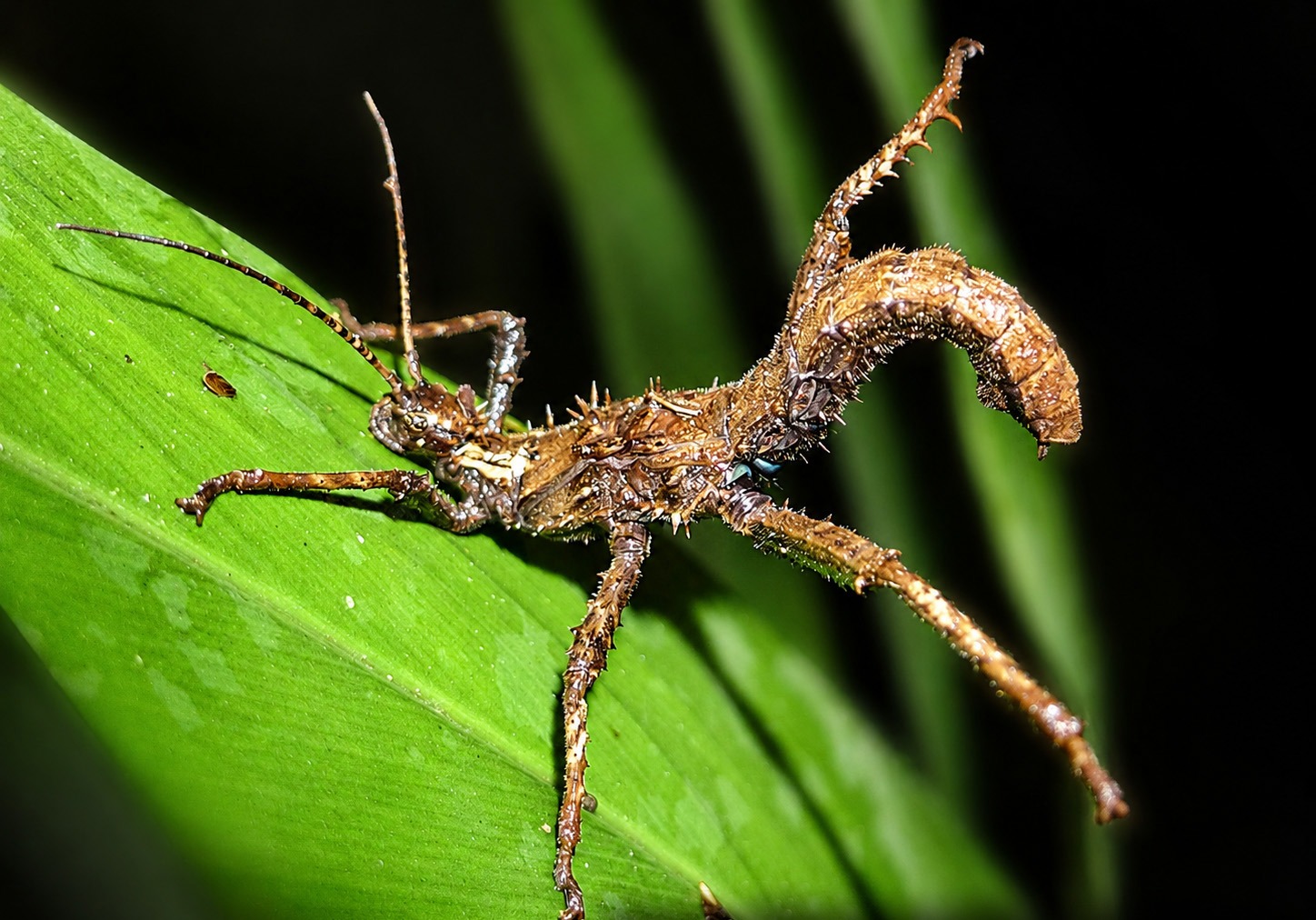
A heavily spined stick insect on a broad leaf at Bukit Gemok, on a July morning in 2015
It stood quite still on the leaf while it was photographed, and it did not look much like a stick. Every part of it is armed with short, sharp, pale-tipped spines, and it holds the end of its body raised and curled forward over its back, like a scorpion's tail. It is a stick insect all the same — one of the thickset, thorny kind that live on the forest floor and in low shrubs rather than out among the twigs.
What the photograph shows:
Adult or young? Not known. Young stick insects are wingless whatever the adult becomes, and the spines can change a great deal from one moult to the next, so neither the missing wings nor the heavy armour says this one is grown up.
Many stick insects raise and curl the abdomen when they are disturbed, and it is usually taken to be a warning: it makes the insect look like a scorpion, and in some species it goes with a hiss, a kick of the spiny hind legs or a bad smell. Whether this one was warning the photographer or simply resting that way cannot be told from one photograph of an insect that never moved.
This is the second stick insect record from Bukit Gemok on this site, and it could hardly be more different from the first. On 1 November 2009 a mating pair was photographed on the same hill: slender, smooth, green-legged and winged, with antennae longer than their bodies. This one is thickset, thorny, brown and wingless. The two show how wide the order is — and why "stick insect" on its own tells you so little about what you are looking at.
A stick insect of much the same build — robust, heavily spined, wingless and brown, about 100 mm long — was photographed at Tawau Hills Park in July 2017. The two may be the same species, or not; superficially similar stick insects are often unrelated, and that needs a specialist. Anyone identifying one of these two records should look at the other.
Bukit Gemok Recreational Forest
Park, Tawau, Sabah, 12 km from Tawau, measured from the 0 km Tawau landmark. One stick
insect, about 75 mm (about 3 inches) in body length, resting on the upper side of a
broad green leaf and completely still throughout. Heavily spined all over, mottled
brown, cream and grey; antennae long and faintly banded; no wings visible. Phasmatodea —
a stick insect. Family, genus and species not determined; adult or immature not known.
One photograph, taken with a Panasonic DMC-LX5; the camera recorded 21:59, twelve hours out.
— iNaturalist observation
396620408
About the photograph. One frame by Wong Fook Yee with a Panasonic DMC-LX5, with
flash, on 13 July 2015 at Bukit Gemok, Tawau, Sabah. The camera recorded the time as 21:59; its
clock had been set to pm instead of am, and the true time was 9.59 am. The version on this page is
the one published on this site before, cropped along the bottom edge to remove a caption that gave
the wrong place and time; nothing else has been changed for this page. Size is the photographer's
estimate in the field.
The account of stick insect defensive postures and of what can and cannot be told from one
photograph is from the general entomological literature, including Bragg, P. E. (2001),
Phasmids of Borneo, and the
Phasmida Species File. The locality, date, size and
behaviour are the photographer's own. Distances from Tawau on this site are measured from the 0 km
Tawau landmark using Google Maps. Photograph © Wong Fook Yee. Page first written 2 September
2026; rewritten with the corrected place and time 29 September 2026.