Historical Descriptions and Taxonomic Revisions
Pardosa sumatrana was initially described as Lycosa sumatrana by Tord Tamerlan Teodor Thorell in 1890. Subsequent taxonomic studies have led to significant revisions. Notably, in 2021, Wang et al. synonymized Pardosa tieshinglii and Pardosa villarealae with P. sumatrana, consolidating their classifications based on morphological similarities, particularly in the male palp and female epigyne structures.
Discovery and Specimen Records
The species was first discovered in Sumatra, Indonesia, by Thorell in 1890. Later specimens, including the holotypes of P. tieshinglii and P. villarealae, were collected in 2011 from Panja Town and Dapo Village in China. These specimens are preserved at Harbin Normal University (HANU) and Southwest University Chongqing (SWUC).
Scientific Classification
Distinctive Features
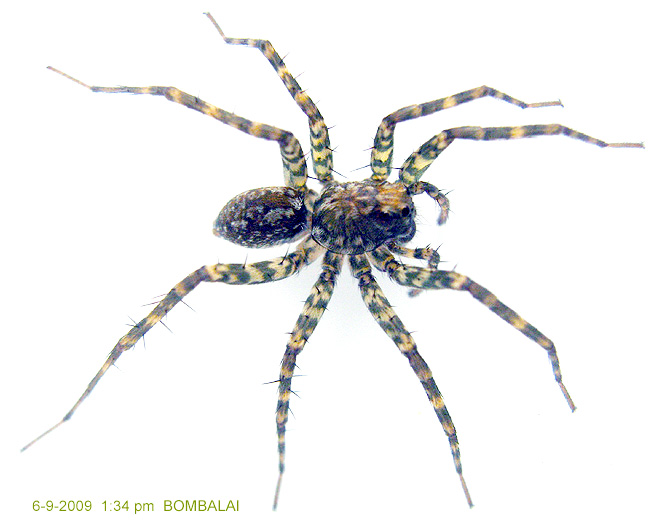
Pardosa sumatrana exhibits the characteristic morphology of wolf spiders, with a robust body and long legs adapted for agile movement. Detailed morphological descriptions, including illustrations of the male palp and female epigyne, are provided in Yin et al. (1997).
Sexual Dimorphism
Sexual dimorphism is evident in this species, as in many Lycosidae. Males possess distinctive palpal structures used in mating, while females have unique epigynal configurations. These differences are critical for accurate species identification.
Comparison with Other Pardosa Species
Compared to other species within the Pardosa genus, P. sumatrana can be distinguished by specific morphological traits, particularly in the reproductive organs. The synonymization of P. tieshinglii and P. villarealae under P. sumatrana underscores the importance of these features in differentiating closely related species.
Genus Uniqueness
The Pardosa genus is characterized by its members' agile hunting behavior and preference for open habitats. P. sumatrana shares these traits, distinguishing it from other genera within the Lycosidae family that may exhibit different hunting strategies or habitat preferences.
Geographical Range
Pardosa sumatrana has a broad distribution across South and Southeast Asia, including countries such as India, Sri Lanka, Nepal, Bhutan, Bangladesh, Myanmar, Thailand, China, the Philippines, and Indonesia (Sulawesi).
Habitat Preferences
This species typically inhabits riparian zones along forest streams. In Hong Kong, for example, P. sumatrana has been observed in exposed gravel patches near stream banks, indicating a preference for microhabitats with sparse vegetation and limited leaf litter.
Observation Sites in Borneo
While specific locations in Borneo are not detailed in the available literature, nature photographers seeking to observe P. sumatrana may focus on riparian habitats with exposed substrates, similar to those described in other parts of its range. Areas along forest streams with minimal leaf litter and open gravel patches would be promising sites for observation.
Web Construction
As a member of the Lycosidae family, P. sumatrana does not construct webs to capture prey. Instead, it is an active hunter, relying on its agility and keen vision to pursue and subdue prey on the ground.
Hunting and Feeding Habits
P. sumatrana primarily preys on insects and other small arthropods. Its hunting activity is concentrated along stream banks, where it exploits the abundance of aquatic insects emerging from the water. Stable isotope analyses have shown that this species has a higher dietary reliance on aquatic insects compared to other ground-dwelling spiders, highlighting its role in transferring energy from aquatic to terrestrial ecosystems.
Initial Discovery
The initial description of Pardosa sumatrana was based on specimens from Sumatra, Indonesia, by Thorell in 1890. While the species' presence in Borneo is acknowledged, specific details regarding the first discovery, including the identity of the scientist, exact location, and date, are not provided in the available literature.
Specimen Preservation
Specimens of P. sumatrana collected in various regions are preserved in institutions such as Harbin Normal University (HANU) and Southwest University Chongqing (SWUC).
Recent Scientific Reports
The most recent comprehensive study on P. sumatrana was conducted by Wang et al. in 2021, focusing on wolf spiders from Hainan Island, China. This study provided detailed morphological analyses and taxonomic revisions, including the synonymization of previously described species with P. sumatrana.
歷史描述與分類修訂
本物種最初由Tord Tamerlan Teodor Thorell於1890年描述為Lycosa sumatrana。後續分類研究經歷重大修訂,2021年Wang等人基於雄性觸肢器與雌性外雌器的形態相似性,將Pardosa tieshinglii和Pardosa villarealae列為本種的同物異名。
發現與標本記錄
首個標本發現於印尼蘇門答臘,後續標本(含P. tieshinglii和P. villarealae的模式標本)於2011年採集自中國磐石鎮與大坡村,現保存於哈爾濱師範大學(HANU)與西南大學(SWUC)。
科學分類
鑑別特徵
具典型狼蛛科形態:強壯軀體與適應敏捷移動的長步足。Yin等人(1997年)提供了雄性觸肢器與雌性外雌器的詳細形態圖解。
性別二型性
雄性具特化觸肢結構用於交配,雌性外雌器形態獨特,此差異為物種鑑定關鍵依據。
與同屬物種比較
透過生殖器官特徵可與其他豹蛛屬物種區分,2021年的同物異名歸併進一步強化了這些特徵的分類價值。
屬級特徵
豹蛛屬以開放棲地的敏捷狩獵行為著稱,本種具備這些典型特徵,有別於狼蛛科其他屬的不同狩獵策略與棲位偏好。
地理分布
廣泛分布於南亞與東南亞,包括印度、斯里蘭卡、尼泊爾、不丹、孟加拉、緬甸、泰國、中國、菲律賓及印尼(蘇拉威西)。
棲位偏好
典型棲息於森林溪流旁的河岸帶,如香港觀察記錄顯示其偏好植被稀疏、枯枝落葉層少的礫石微棲地。
婆羅洲觀察建議
文獻雖未詳述婆羅洲具體分布點,但自然攝影師可參考其典型棲位特徵,優先調查森林溪流沿岸的裸露基質區域。
蛛網建構
作為狼蛛科成員,本種不結網捕食,而是依靠敏捷性與敏銳視覺進行主動狩獵。
食性與生態角色
主要捕食昆蟲與小型節肢動物,集中活動於溪岸捕食水生昆蟲。穩定同位素分析顯示其對水生昆蟲的食性依賴顯著高於其他地棲蜘蛛,在水陸生態系能量傳遞中扮演重要角色。
發現歷史
模式標本採集於蘇門答臘,雖確認分布於婆羅洲,但現有文獻未記載具體發現者、地點與日期等細節。
標本保存
各地採集標本保存於哈爾濱師範大學(HANU)與西南大學(SWUC)等機構。
近期研究
Wang等人2021年針對中國海南島狼蛛的研究為最新綜合報告,包含形態學分析與分類修訂,確立多個同物異名關係。
Penerangan Sejarah dan Revisi Taksonomi
Spesies ini mula-mula diterangkan sebagai Lycosa sumatrana oleh Tord Tamerlan Teodor Thorell pada tahun 1890. Kajian taksonomi terkini oleh Wang et al. (2021) menyatukan Pardosa tieshinglii dan Pardosa villarealae sebagai sinonim bagi P. sumatrana berdasarkan persamaan ciri morfologi khususnya struktur palpa jantan dan epigin betina.
Penemuan dan Rekod Spesimen
Spesimen pertama ditemui di Sumatera, Indonesia. Spesimen holotaip bagi P. tieshinglii dan P. villarealae dikutip pada 2011 dari Bandar Panja dan Kampung Dapo di China, disimpan di Universiti Normal Harbin (HANU) dan Universiti Barat Daya Chongqing (SWUC).
Klasifikasi Saintifik
Ciri-ciri Pengenalan
Mempamerkan morfologi tipikal labah-labah serigala: badan tegap dengan kaki panjang untuk pergerakan lincah. Penerangan terperinci struktur palpa jantan dan epigin betina disediakan dalam Yin et al. (1997).
Dimorfisme Seksual
Jantan mempunyai struktur palpa unik untuk mengawan, manakala betina mempunyai konfigurasi epigin yang berbeza - ciri penting untuk pengenalpastian spesies.
Perbandingan dengan Spesies Pardosa Lain
Boleh dibezakan melalui ciri organ reproduktif. Penyatuan sinonim P. tieshinglii dan P. villarealae menekankan kepentingan ciri ini.
Keunikan Genus
Genus Pardosa dikenali dengan tabiat memburu aktif di habitat terbuka, ciri yang turut dimiliki oleh P. sumatrana.
Taburan Geografi
Boleh ditemui di seluruh Asia Selatan dan Tenggara termasuk India, Sri Lanka, Nepal, Bhutan, Bangladesh, Myanmar, Thailand, China, Filipina dan Indonesia (Sulawesi).
Preferensi Habitat
Biasanya mendiami zon riparian di sepanjang sungai hutan. Di Hong Kong, spesies ini diperhatikan di kawasan kerikil terbuka berhampiran tebing sungai.
Lokasi Pemerhatian di Borneo
Walaupun tiada lokasi khusus di Borneo didokumenkan, fotografer alam boleh menumpukan pada habitat riparian dengan substrat terbuka untuk pemerhatian.
Pembinaan Sarang
Sebagai ahli Lycosidae, P. sumatrana tidak membina sarang untuk menangkap mangsa tetapi memburu secara aktif.
Tabiat Memburu
Terutamanya memburu serangga dan artropod kecil di sepanjang tebing sungai. Analisis isotop stabil menunjukkan kebergantungan tinggi pada serangga akuatik berbanding labah-labah darat lain.
Penemuan Awal
Spesimen jenis berasal dari Sumatera. Kewujudannya di Borneo disahkan tetapi butiran khusus tidak didokumenkan.
Pemeliharaan Spesimen
Spesimen disimpan di institusi seperti Universiti Normal Harbin (HANU) dan Universiti Barat Daya Chongqing (SWUC).
Laporan Saintifik Terkini
Kajian komprehensif terakhir oleh Wang et al. (2021) memberi tumpuan kepada labah-labah serigala dari Pulau Hainan, China.
This tab is reserved for future language additions.