| ENGLISH | CHINESE | MALAYU |
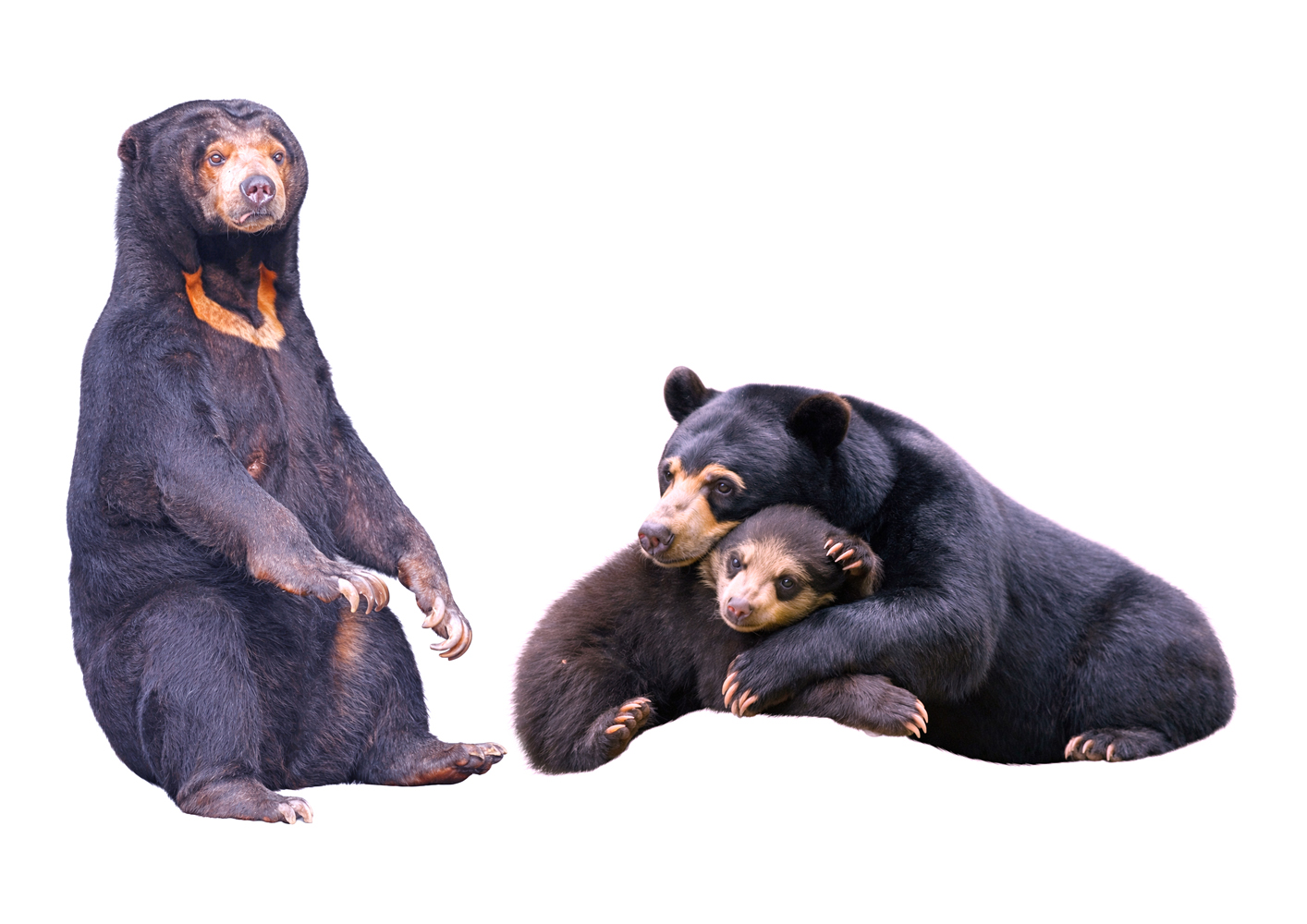
Malayan Sun Bear (Helarctos malayanus)
The World’s Smallest Bear
The Malayan sun bear is the smallest bear species in the world and one of Borneo’s most elusive forest mammals. In Sabah, including forested landscapes connected to Tawau, sun bears depend on healthy, continuous forests for food, shelter, and survival.
Species Overview
- Common Name: Malayan Sun Bear
- Scientific Name: Helarctos malayanus
- Family: Ursidae
- Conservation Status: Vulnerable (IUCN)
Sun bears are recognised by their short black fur and a distinctive pale chest patch, often shaped like a rising sun. They have powerful claws and a long tongue adapted for feeding.

Habitat & Distribution in Sabah
Sun bears inhabit a wide range of forest types, from lowland rainforests to hill forests. In Sabah, they are closely associated with intact forest ecosystems.
- Lowland dipterocarp forests
- Hill and montane forests
- Secondary forests with sufficient cover
Around Tawau, sun bears survive in protected forests such as Tabin Wildlife Reserve, Kalabakan Forest Reserve, and forest landscapes linked by forest corridors.

Behaviour & Adaptations
Sun bears are mostly solitary and are active during the day and night depending on conditions. They are excellent climbers and often forage in trees.
- Use strong claws to tear open logs and termite nests
- Feed on insects, fruits, honey, and small animals
- Climb trees to access fruit and escape danger
Ecological Role in the Forest
Sun bears contribute to forest health by controlling insect populations and dispersing seeds. Their feeding behaviour helps open up decaying wood, supporting nutrient cycling in rainforest ecosystems.
Threats to Survival
Sun bears face increasing threats across Borneo:
- Deforestation and habitat fragmentation
- Illegal hunting and wildlife trade
- Human–wildlife conflict
- Loss of forest food sources
Conservation Efforts in Sabah
- Protection of habitats within Tabin Wildlife Reserve and surrounding forest reserves
- Maintenance of forest corridors linking fragmented habitats
- Wildlife rescue and rehabilitation programmes
- Community education and awareness initiatives
These actions form part of Sabah’s broader conservation and environmental efforts, supporting long-term survival of forest wildlife.
Bornean Sun Bear Conservation Partners
In 2026, several key organizations and institutions are spearheading Borneo sun bear conservation in the East Coast of Sabah, with significant activity centered in the Sandakan, Tabin, and Tawau regions.
1. Bornean Sun Bear Conservation Centre (BSBCC)
Located in Sepilok, Sandakan, the BSBCC is the most prominent institution
dedicated to sun bear conservation on the East Coast.
Unique Achievements & Distinctions (2025–2026):
World’s Only Dedicated Facility: It remains the only conservation center in the
world exclusively for sun bear rescue and rehabilitation.
Visit Malaysia 2026 Mascot: The center’s work is at the forefront of national
awareness as the Bornean sun bear (mascots Wira and Manja) was chosen as the
official mascot for the Visit Malaysia 2026 campaign.
Tabin Sun Bear Project: Launched a specialized site at Tabin Wildlife Reserve (Lahad
Datu/East Coast) specifically for the "soft release" of rescued cubs and
long-term monitoring of wild populations.
New Infrastructure (2026): In January 2026, the center officially opened an
upgraded Entrance Foyer, improved observation platforms, and a new skywalk to
enhance ethical ecotourism experiences.
2. WWF-Malaysia (Sabah Landscapes Programme)
While not exclusively for bears, WWF-Malaysia operates the Sabah
Landscapes Programme (SLP), which covers the Tawau, Tabin, and Lower Sugut
areas.
Unique Achievements & Distinctions:
Landscape Connectivity in Tawau: Actively restoring ecological corridors in the
Tawau-Kunak landscape, including Mt Wullersdorf, to ensure sun bears and other
wildlife can move between fragmented forest patches.
Sabah Wildlife Action Plan: Co-leading the implementation of the 10-Year Bornean
Sun Bear Action Plan (2025–2034), which aims to eliminate illegal exploitation
and protect key habitats across the state.
3. Danau Girang Field Centre (DGFC)
A research institution based in the Kinabatangan region (East Coast),
collaborating with government and NGOs.
Unique Achievements & Distinctions:
State-Level Strategy: Played a critical role in developing the 2025–2034 Bornean
Sun Bear Action Plan for Sabah, focusing on evidence-based policy to combat
habitat loss and poaching.
Scientific Monitoring: Utilizes camera trap data and tracking technology to
monitor sun bear occupancy in unprotected areas, specifically studying their
survival in oil palm and industrial tree plantations.
4. Supporting NGOs & Partners
HUTAN-Kinabatangan Orang-utan Conservation Programme: Partners with BSBCC
on education and outreach programs in rural communities and plantations to
reduce human-bear conflict.
LEAP (Land Empowerment Animals People): A founding partner of the BSBCC that
continues to provide strategic support for wildlife conservation initiatives in
Sabah.
Bear Conservationists
In 2026, the global recognition of the Bornean sun bear has reached an all-time high, driven largely by several key individuals whose work in science, leadership, and media has transformed the species from a "forgotten bear" into a national icon.
These links showcase the remarkable achievements of scientists,
photographers, and leaders working to protect the endangered Bornean sun bear.
1. Dr. Wong Siew Te (Leader & Scientist)
Known internationally as "Papa Bear," Dr. Wong is the most influential
figure in sun bear conservation.
Scientific Breakthroughs: He conducted the first-ever ecological study of wild
sun bears in Sabah in 1998, laying the foundation for all modern research on the
species.
Unique Leadership: He founded the Bornean Sun Bear Conservation Centre (BSBCC)
in 2008, the world's only sanctuary dedicated exclusively to sun bears.
2026 Milestone: He successfully lobbied for the sun bear to be the official
mascot for the Visit Malaysia 2026 campaign, a massive leap in public awareness.
Awards: He is a CNN Hero and was awarded the President's Award by the
International Association for Bear Research and Management for over 27 years of
dedicated work.
2. Cede Prudente (Photographer)
A renowned wildlife photographer based in Sabah, Prudente is instrumental
in documenting the elusive life of sun bears on Borneo’s East Coast.
Achievements: His photography has been critical for BSBCC and Sabah Tourism,
capturing rare natural behaviors that are used globally to educate the public.
Distinction: In 2026, he continues to lead specialized "Wild Borneo Photo
Journeys," bringing international attention to the critical habitats of sun
bears in the Kinabatangan and Danum Valley regions.
3. Dr. Sarah Pye (Author & Storyteller)
While not a field scientist, Dr. Pye has achieved a unique distinction by
bringing the sun bear’s story to a global literary audience.
Achievement: Author of the award-winning biography Saving Sun Bears, which
chronicles Dr. Wong’s life and the plight of the species.
Distinction: She has successfully used "storytelling for conservation" to engage
non-scientists, significantly increasing international volunteerism and funding
for Borneo-based projects.
4. Brad Josephs (Conservationist & Photographer)
An expedition leader and professional photographer who has bridged the
gap between tourism and active field conservation.
Unique Achievement: He spearheaded one of the first major crowdfunded releases
of a rehabilitated bear (Lawa) into the Tabin Wildlife Reserve by raising the
critical funds needed for helicopter transport and GPS monitoring.
Role in 2026: He continues to use high-impact visual storytelling to support the
Tabin Sun Bear Project, specifically focusing on the East Coast's release
programs.