|
|
Last Updated on : Saturday, 07 October, 2017 01:58:12 PM
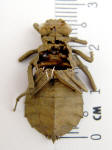
Exuviae - Larval Exoskeleton of Dragonflies
(empty cases of dragonfly nymphs, the larval skins left when a adults emerge)
Finding exuviae
Searching exuviae can be very rewarding as you often will find exuviae of
species which are difficult to find as adult. This is especially true for
species of the family Gomphidae and Corduliidae of which the adults seldom come
to the waterside while exuviae can be common.
Exuviae are always found near water. Look for them just above the surface to about 50 cm high. Some species may go further, even several metres far. Dragonflies prefer vertical substrates for emergence (e.g. plants, tree roots, steep banks, rock faces), but may also be found on horizontal substrates (floating plants, flat banks).
When
you chase up a freshly emerged adult (which is still very pale, soft and shiny)
from the waterside, try to catch it and look for the exuvia. Exuviae are nothing
more than dried skin, and are therefore vulnerable. The legs easily break off
when the exuvia is picked up: by splashing some water on it, the exuvia becomes
moist and more flexible. Notes about the emergence site (place, height,
substrate) can be useful.
Preserving exuviae
Exuviae must be stored dry. For storage, it is easiest to use photo film
containers, as these are small, close tightly and are easy to come by, although
their availability may diminish as the digital revolution progresses. Exuviae
will often be moist after collecting, and when put in a closed container may
become covered with fungi. Dry wet exuviae in the sun, or make a hole in the
lid, so moisture can escape through it. Never store exuviae in alcohol, as they
will become soft, soggy and battered.
Collecting larvae
Finding and catching larvae
Odonate nymphs are indicators of good water quality.
Many species are more easily found as larvae than as adult. An important purpose
of searching larvae is rearing them to adult . Rearing will give you the
opportunity to match the larva to the adult. A small metal kitchen sieve is
often most suitable to find larvae in standing waters (between water weeds,
small patches of leaf litter, under roots of riverside trees). In these
situations it can be handy to put the leaf litter and plants in a white plastic
container. This makes it easier to find the larvae among the litter. In running
water it is more convenient to have a larger net with a more sturdy frame. A
good method to catch larvae that live under rocks or burried in sand, is to
place the net on the bottom and disturb the substrate (stones, gravel, sand)
upstream from the net's opening with a rock or your feet. The disturbance will
dislodge and expose the larvae, the current carries them into the net. Another
good method is to put roots of riverside trees that hang in the water in the net
and shake them vigorously. Such clumps of wet roots often harbour larvae of the
family Calopterygidae.
Take notes on the larva's habitat: was it among aquatic plants, stones, buried
in the mud etc.? For both identification and rearing purposes it is important to
collect full-grown larvae. These can be recognised by the well-developed
wing-sheaths: the wing-venation is clearly visible in them.
Transporting larvae
If you want to keep a larva alive there are three problems: drying, drowning and
overheating. It is best to put the larva in a small, closed container. Do NOT
put a larva in water, but rather in moist cotton wool or toilet paper, without
or with very little free water and with plenty of air. Moss or other organic
material can also be used, but only shortly as it may rot. Keeping the larvae
cool (i.e. in a cool-box) at 5 to 10øC will extend their lifespan. Make sure
that the larva remains moist
and oxygenated.
Rearing (breeding) larvae
Basically a tray, basin or aquarium with water will suffice as habitat for the
larvae. Provide some substrate for the larvae (e.g. sand, detritus, water
plants) and for emergence of the adult (e.g. a stick). Feed it with small
aquatic invertebrates (mosquito larvae, cladocerans etc.). Keep the basin or
aquarium out of the full sun. After emergence, it is essential that adult and
exuviae are marked as belonging to the same individual!
Storing and labelling
Labelling is an important part of collecting (figure 7). It is important to make
notes and labels every evening as this often becomes difficult after two days in
the field. It is best to label with pencil as pen ink often fades.
Labelling
Essential information for any label or record is:
- name of collector/observer
- locality name (at least country, region and name of nearby town)
- collection/observation date
Other useful data are:
- coordinates
- habitat description (see box)
- altitude
- colours of living specimen
Describing habitats
The following list contains important factors to describe dragonfly habitats.
Taking photographs of habitats is a good
way to communicate about habitat types.
1) type (pool, lake, paddy, river, stream, waterfall, seepage etc)
2) running (slow-moving, torrential etc.) or standing water
3) temporary or permanent water
4) size (i.e. diameter, depth)
5) forest cover
6) amount of sun and shade
7) turbidity of water (e.g. clear, blackwater, murky, silt-laden, chalky)
8) presence and type of aquatic vegetation (green algae, water lilies, emergent
plants, water hyacinth)
9) presence and type of bank-side vegetation (reeds, bushes, grass etc.)
10) bottom substrate (e.g. mud, sand, gravel, rocks, detritus)
11) human disturbance (e.g. clearance of vegetation, erosion, damming, altered
course)
|
|
|
Exuviae of dragonflies are often found on vertical substrates like plants, tree roots, steep banks and rock faces.
|
All in the day of Awal Muharam 20th January 2007 a public holiday of Awal Muharam. A day for me away from office to nature. I was still figuring where to go for the day while walking pass a almost dried up drain. I saw a few gray dragonflies perching on the drain. few months ago I already notices the present of dragonflies in this drain. Today I squat down to see any things new or anything interesting for a few snap shoots. It was 8:00 am . I spot an small exuvia clinging on a grass above the water..... there another one near by.....look there is another one, a bigger one. As I start collecting these exuvia, I found more and more along this only 50 meters drain. It was a great surprised discovery for me as I never before realized this little drain is a home for such a great number of dragonflies. Now I got the answer for where to go for the day. I have been walking pass this drain almost every day for the last 7 years but I never observed it has such an active dragon colonies. When did these dragonflies started settled down here ? Where did they migrated from ? I do not know, but I know I discover a nature heritage........ a drain with active life. Back to my desk, I sorted these 24 empty cases of dragonfly nymphs and carefully lay them on an A4 size graph sheet. Most of these Larval Exoskeletons still clinked on to the grass stem where they emerged to the earth surface last night and perpher some from previous night. They came from 3 species of different sizes: 12 from Neurothemis terminata. a lovely shy red dragonfly rare to find in West Malaysia. 4 from Diplacodes trivialis. a cool homely dragonfly never fly to far away. 8 from Orthetrum sabina . a long slim dragonfly wide spread in tropical countries. |
 |
|
All in a day's work.
Just in one morning I collected these 24 exuvia from 3 species all along this 50 meters drain. The smallest is Neurothemis terminata. which is rare in West Malaysia but common in Sabah. The medium and larger size are Diplacodes trivialis and Orthetrum sabina common in Asia.
|
| The dragonfly's exoskeleton
is called an EXUVIA.
The dragonfly that came out of its larval exoskeleton is approximately three times the size of the exuvia left behind. The whitish strands sticking out of the hole through which the insect got out are the remains of the old tracheal linings. Usually a dragonfly's wingspan is longer than the body. Most dragonflies emerge at night, so we don't often get the chance to see. Dragonflies share the Earth with every of us, they entered the world stage way back in the warm and humid Jurassic era. This is why the more than 5,000 species of dragonfly today are mainly concentrated in tropical and subtropical regions, |