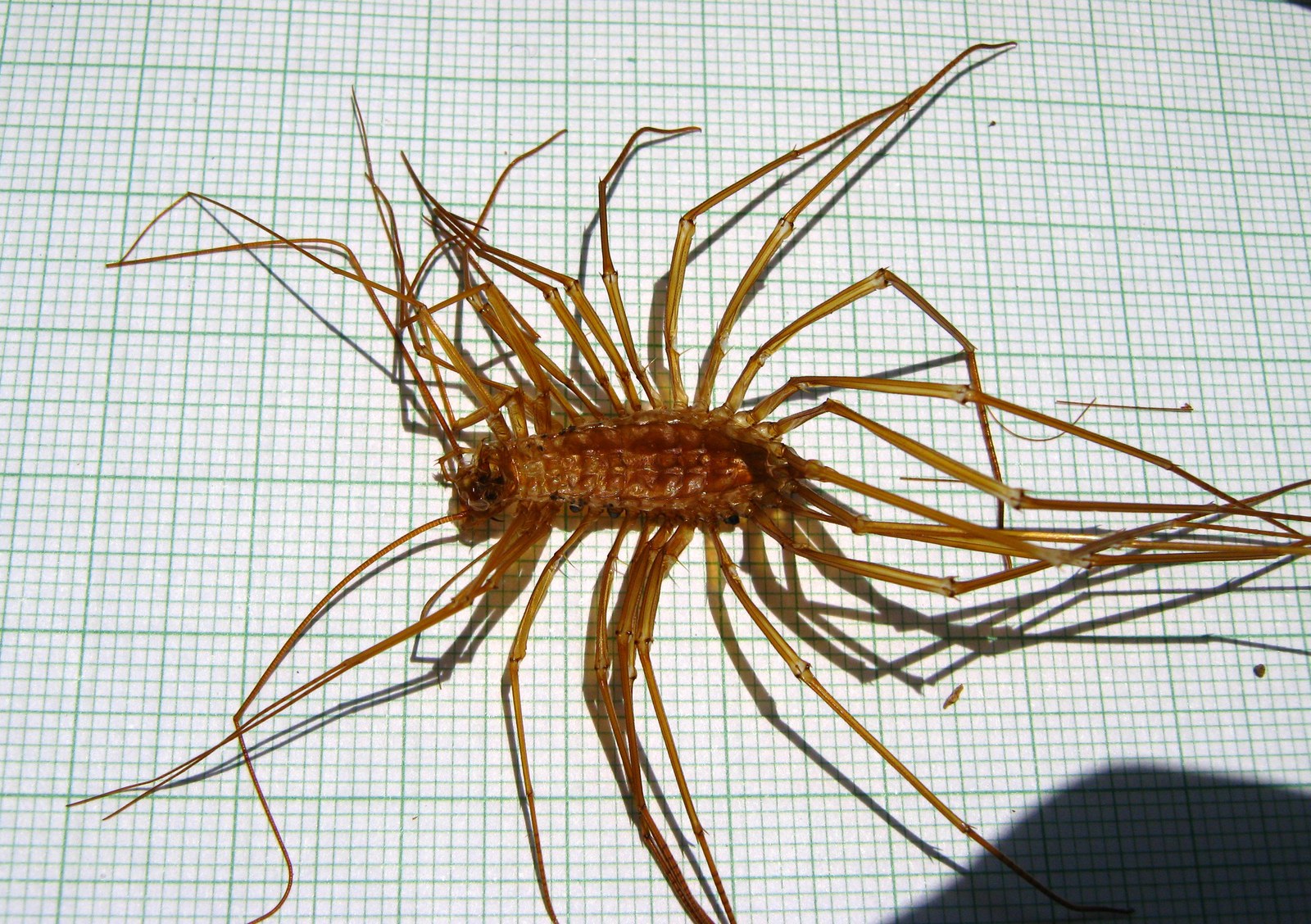
Provisional record. The class and the order are certain. The family is probable. The genus is not determined, and a shed skin is unlikely ever to settle it.
Phylum Arthropoda, subphylum Myriapoda, class Chilopoda, order Scutigeromorpha — the long-legged centipedes. Family probably Scutigeridae. Genus and species not determined.
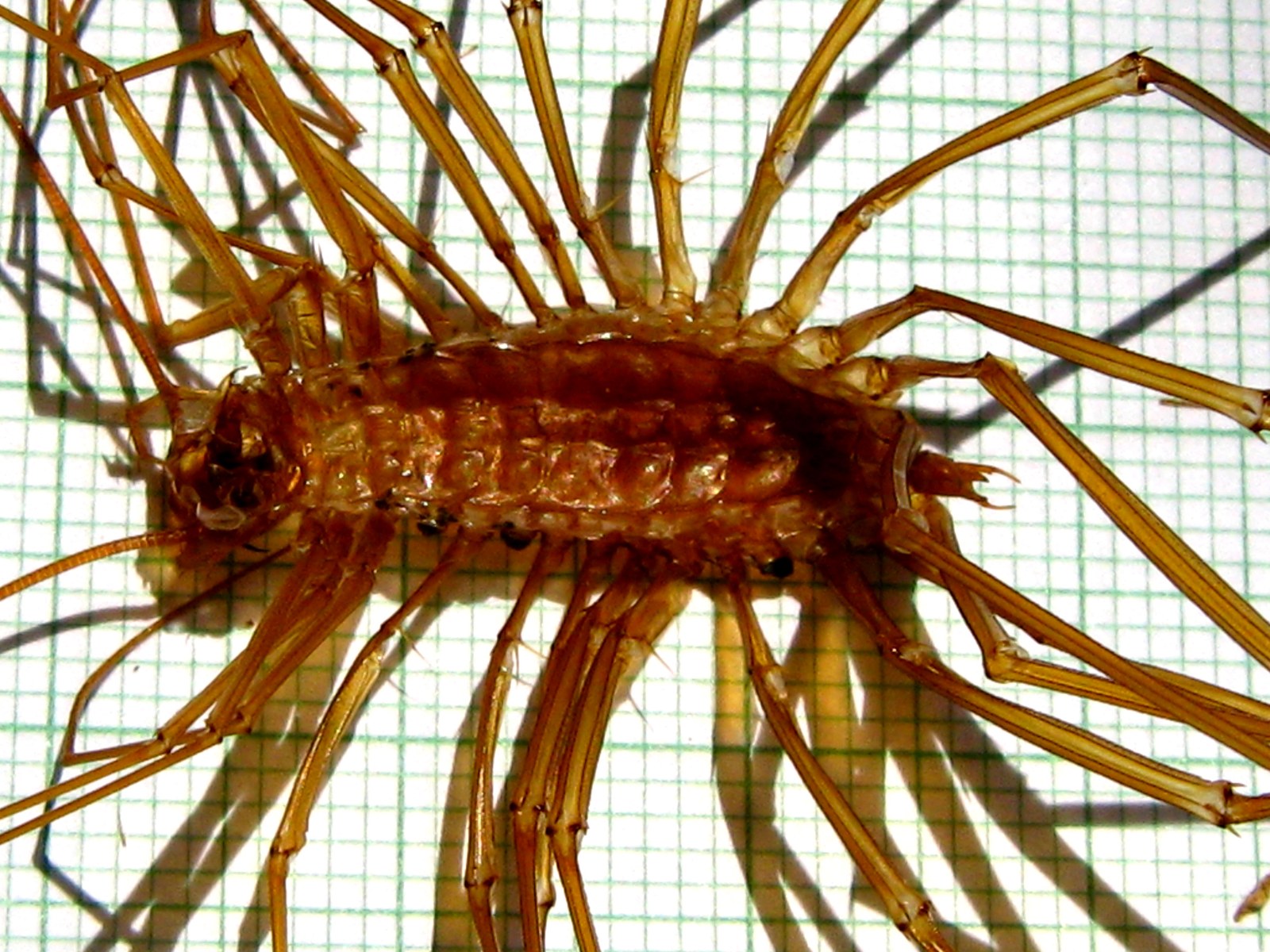
Found by Wong Fook Yee on the forest floor at the Bukit Gemok Recreation Centre, about 12 km from Tawau town, Sabah, and photographed there at 11:38 on 9 August 2009. The natural forest on Gemok Hill is protected; it carries commercial timber species along with a great deal of wild growth, including forest orchids.
Body 42 mm — head and trunk together. Longest intact legs at least 70 mm, well over one and a half times the body. Both figures were measured against the graph paper the skin is lying on, which is ruled in 2 mm squares; the two photographs, taken 93 seconds apart at different distances, give 41 mm and 42 mm independently. The total leg span is not given, because several legs run out of the frame — and a flattened skin with its legs splayed would not give an honest span in any case.
The most important thing about this record is what it is not. Nothing died here. This is an exuvia — a moult, the empty cuticle a centipede climbed out of and left behind. The head capsule at the left of the close view is hollow and crumpled, and the trunk plates are translucent and empty. A dried corpse looks quite different: it keeps its contents and it shrinks inward.
That changes what the record can honestly claim. It documents that a long-legged centipede of about this size was living on that patch of forest floor, and that it was growing there. It says nothing at all about what the animal was doing, because the animal had already walked away — possibly minutes before, possibly days.
It is worth saying plainly because moults are easy to mistake for deaths, and because a shed skin is in one way better evidence than a corpse: an animal only moults where it lives.
Look at the close photograph and try to match the dorsal plates to the legs. It cannot be done, and that is not a trick of the flattening. An adult scutigeromorph has fifteen pairs of legs but only eight plates covering its back. The plates do not correspond one-to-one with the leg-bearing segments the way they do in every other centipede — the first is short, and the seven behind it each roof over more than one segment.
About eight plates can be counted along this skin, which is what the order predicts. The leg pairs themselves cannot be counted reliably here: the legs are splayed, overlapping, broken in places, and some run out of the picture. The page does not claim a leg count it cannot demonstrate.
Several legs on this skin are short, broken or absent. Two explanations both apply to scutigeromorphs and neither can be separated from the other here.
A scutigeromorph does not hatch with its legs. It adds them, a few at a time, at successive moults — a pattern called anamorphic development. In the common house centipede, the species in which this has been described in detail, the sequence of leg pairs across the moulting stages runs 4, 5, 7, 9, 11, 13, 15, 15, 15, 15: four pairs on hatching, then more at each moult until the adult fifteen, and then several further moults at full leg count.
So a single animal leaves behind something like ten of these skins in the course of growing up. This one is one of them. Whether it came from an animal still adding legs or one already at fifteen cannot be told here, for the reason given above — but at 42 mm it was not a hatchling.
Scutigeromorpha is a small order — about 88 species in 27 genera and three families — and it is the odd one out among centipedes in almost every respect.
The obvious candidate genus is Thereuopoda, and it has a real claim here rather than a general one. Thereuopoda sandakana was described by Chamberlin in 1944 from a Sabah type locality — recorded in the original as British North Borneo: Sandakan, at "Mile 8". So the genus is not merely "south-east Asian"; it has a species named from this state. Thereuopoda longicornis, the long-legged centipede, ranges across southern and south-eastern Asia as far as Queensland, and is listed for Malaysia — though the Malaysian Biodiversity Information System record for it gives Perak, not Sabah.
A 42 mm body sits comfortably within Thereuopoda. That is not the same as evidence for it. Scutigerid genera are separated on characters — the form of the tergites, details of the antennae and the leg spines — that a flattened, sun-dried, partly broken skin photographed on graph paper does not show. The photographer's own note reached the same conclusion and asked for the genus to be left open, and this page follows it.
What would settle it: a living animal from the same forest, photographed from the side and from above with the head and the back of the trunk in focus. Bukit Gemok is fifteen minutes from town.
Gemok Hill is now the source of two records on this site, both from its forest floor and both animals that are routinely mistaken for something else:
It is also one of the two reliable places to watch cicada emergence in the Tawau district. For a protected patch of forest twelve kilometres from town, it repays walking slowly and looking down.
Page reviewed: 10 September 2026.