eTawau > Insects of Borneo > True bugs > White scale insects at The Flower Girl nursery
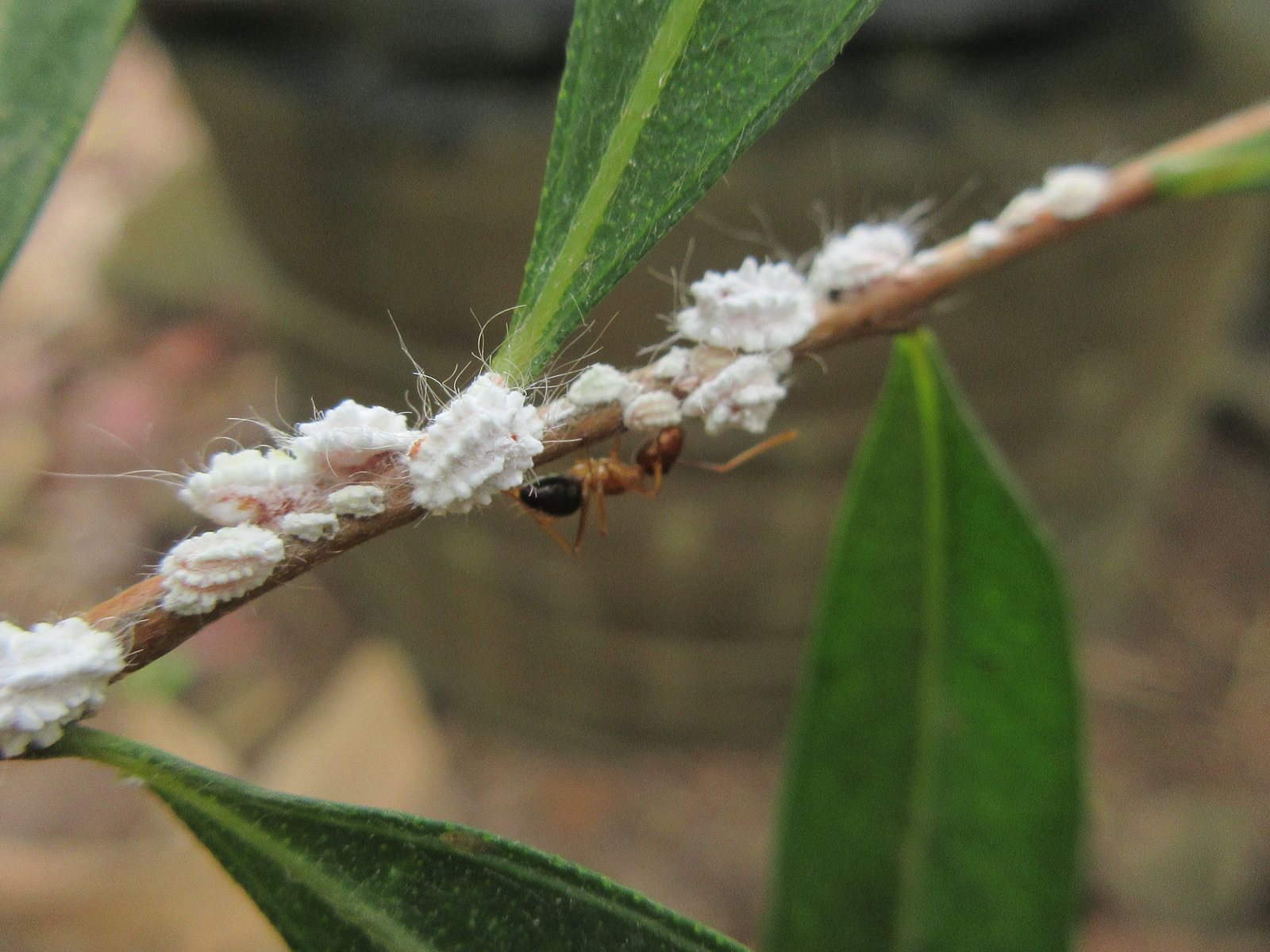
A cluster of wax-covered scale insects on a young sapling at The Flower Girl nursery, Taman New Asia, Tawau, in September 2026 — and the one ant that was looking after them
At first sight they look like a row of little white cotton buds stuck along a twig. Nothing in the row moves. Then an ant arrives, walks along the line from one end to the other and back again, and every so often stops over one of the white buds as if checking it. The white buds are insects — scale insects, which people in Tawau usually call mealybugs — and the ant is there because they feed it.
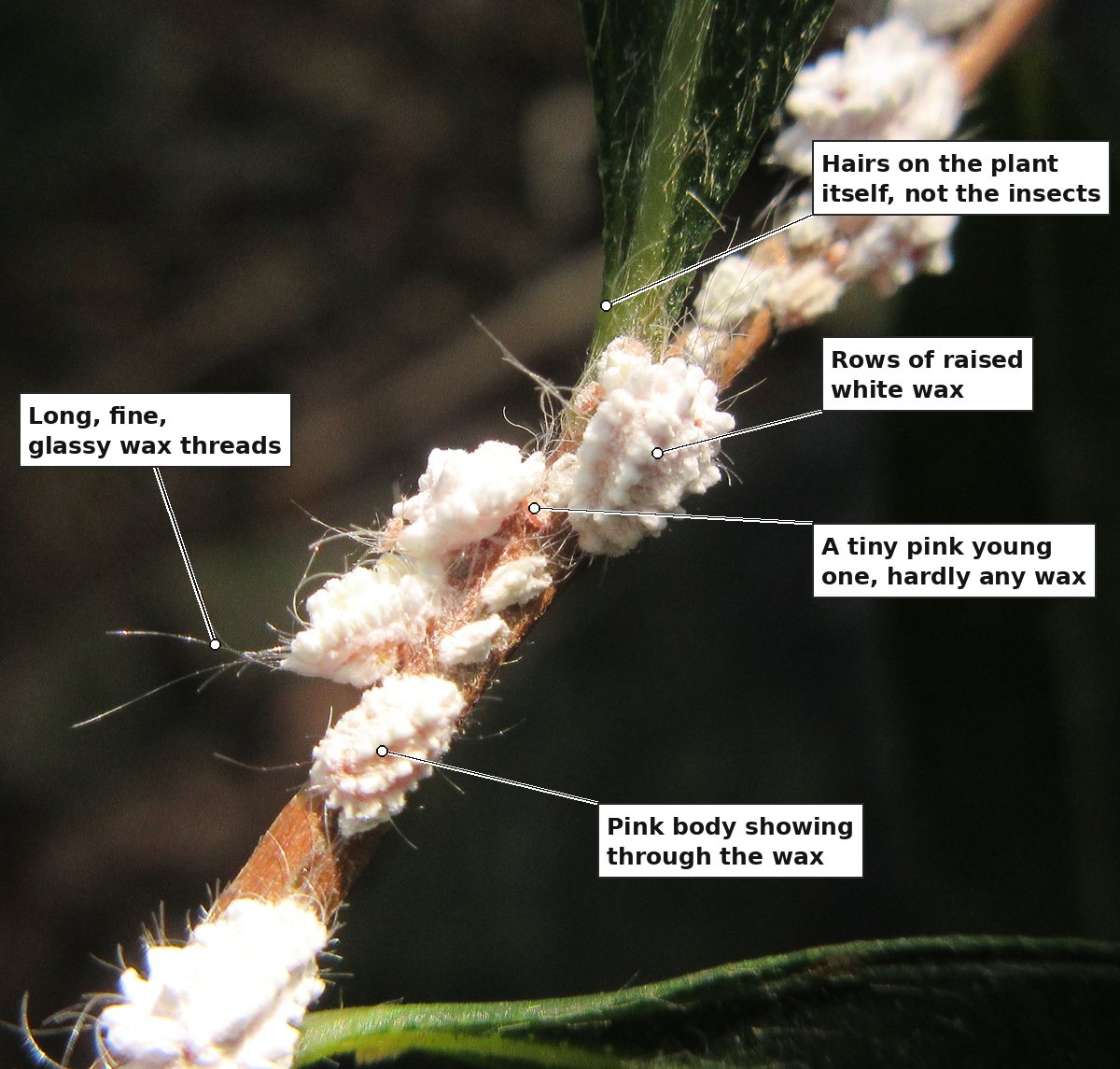
These are scale insects, the superfamily Coccoidea, relatives of the aphids and the cicadas in the true-bug order Hemiptera. Every one of them has its mouthparts pushed into the stem like a fine needle and is drinking the plant's sap. What makes them look so un-insect-like is the coat of wax they make themselves, which hides the body underneath.
On this cluster, the photographs show:
One warning when you look at the pictures: this plant is hairy. The young stem and the bases of the leaves carry fine hairs of their own, so not every thread in the photographs belongs to an insect. The long glassy threads coming out from under the wax do; the short fine hairs on the green leaf base do not.
In everyday speech any white waxy scale insect is a "mealybug". In the scientific sense mealybugs are one family, the Pseudococcidae, and there are other families that look similar. Two are the likely candidates here:
This time there is a ruler of sorts. The photographer pushed a pin into the stem beside the cluster and photographed them together, then measured the same pin with calipers at home: the head is 3.83 mm across and the shaft 0.58 mm thick. Against the pin head:
The pin shaft, measured the same way, comes out close to its caliper width, which is a useful check that the scale is right. These are estimates from photographs, not measurements of the insects themselves.
Sap is full of sugar and short of almost everything else an insect needs, so a sap-feeder has to drink a great deal of it to get enough protein. The surplus sugar comes out of the other end as a sweet, sticky liquid called honeydew. Ants love it. Many ants "farm" scale insects and aphids for honeydew, collecting the drops and in return keeping away the ladybirds, wasps and other enemies that would eat or parasitise them.
That is exactly what the field note describes. The scale insects stayed still the whole time. The ant moved actively backwards and forwards along the cluster and kept pausing over individual insects, as if inspecting them — which is how a tending ant checks for honeydew and gently prompts the insects to release it.
The ant itself is slender, with long legs and long antennae, an orange-red head, thorax and legs and a glossy black abdomen. It is recorded here only as an ant, family Formicidae; the photographs do not show the waist and head clearly enough to name the genus.
The Flower Girl
nursery, Taman New Asia, Jalan Air Panas, Tawau, Sabah. Many scale insects in a cluster
along a thin branch of an unidentified sapling growing in a nursery polybag: slender
reddish-brown stem, narrow pointed leaves arranged alternately. White wax in raised rows, a fringe of
short wax points round the edge, long glassy threads; pink bodies under the wax; a few tiny pink young
ones; no egg sacs. Largest about 2.5 to 3 mm, estimated against a pin measured with
calipers. The cluster did not move. One ant, orange-red with a black abdomen, roughly
4 to 5 mm, moved backwards and forwards over them, pausing to inspect individual insects.
Hemiptera: Coccoidea — scale insects. Family, genus and species not determined; the
ant recorded at Formicidae only. Frames taken between 10:06:46 and 10:22:13.
The pin was pushed into the stem for scale; the insects were not otherwise disturbed.
— iNaturalist observation
404366569
About the photographs. Two frames by Wong Fook Yee with a Canon IXUS 285 HS, 4.5 mm,
f/3.6, ISO 160, no flash: 10:09:04 (the cluster with the ant) and 10:16:48 (the close view) on
28 September 2026 at The Flower Girl nursery, Taman New Asia, Tawau, Sabah. Both are camera originals
that had not been opened in an editor. For this page they have been reduced, cropped and labelled;
nothing has been sharpened, recoloured, added or removed. Further frames of the ant, the sapling and
the pin, taken between 10:06 and 10:22, were used for identification and measurement; the pin was
measured with calipers afterwards.
The account of scale-insect families, honeydew and ant tending is from the general entomological
literature. The locality, date, times, behaviour and the pin measurements are the photographer's own.
The plant is not identified. All photographs © Wong Fook Yee. Page written 29 September 2026.