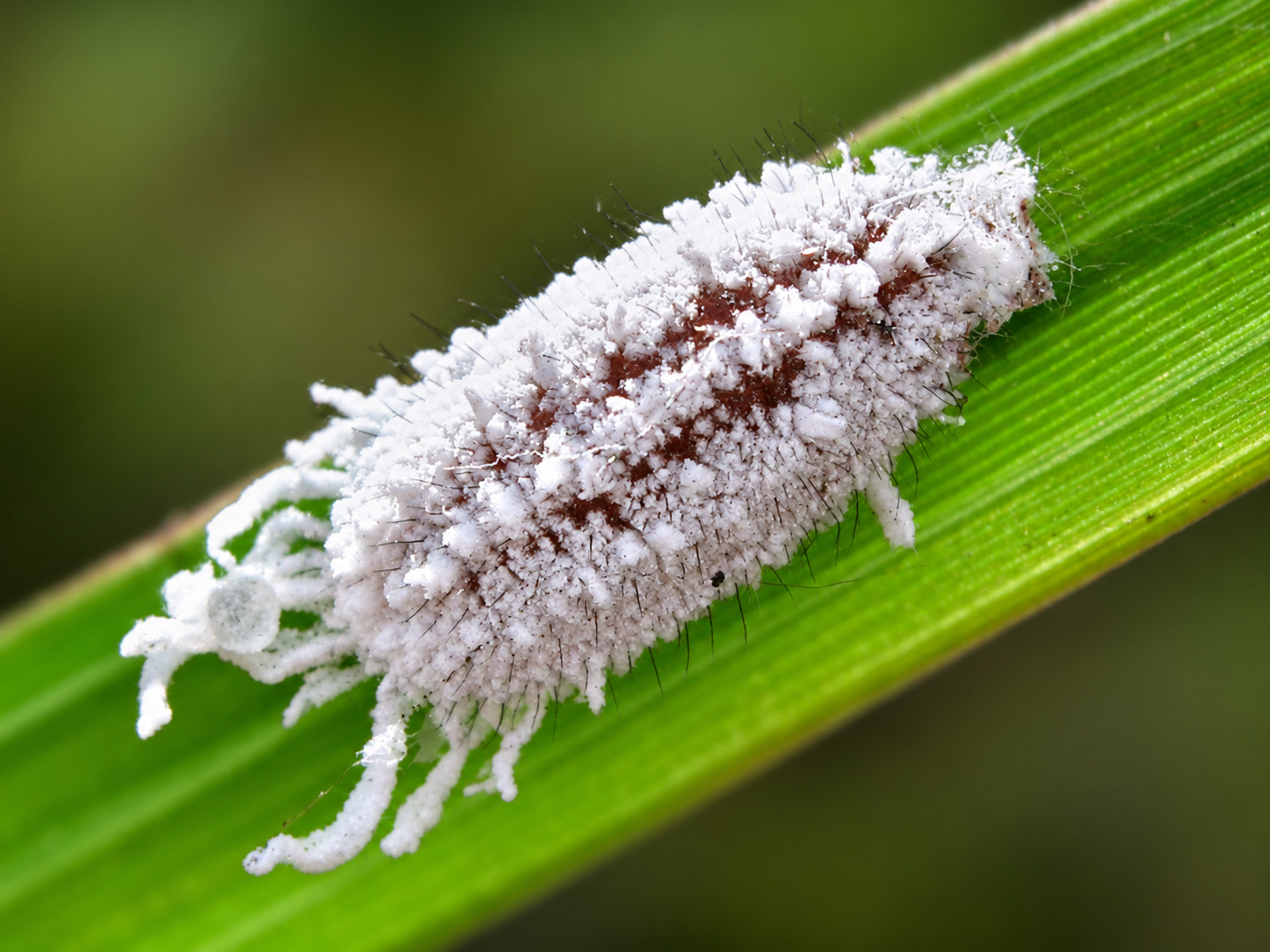
Provisional record. This page records an observation identified no further than family. It will be revised if a determination is made.
Class Insecta, order Hemiptera, suborder Sternorrhyncha, scale insects (Coccomorpha), family Pseudococcidae — the mealybugs. Genus not determined.
Photographed by Wong Fook Yee at 14:04 on 21 June 2009, in grassy scrub on the bank of the Tawau River, downstream and opposite Pasar Semarak (Semarak Market), about 7 km from Tawau town, Sabah.
The animal was under 10 mm long and snow white. It was not moving, and it was alone on the blade. It was resting on a long sharp-bladed grass known locally as lalang. Ants were present on the plant, though they were not photographed.
The photographer's own note on finding it is the best description of why records like this are rare: it is "easily skip attention because it look like a debris on the grass". That is exactly right, and it is not an accident. A coat of white wax on a green blade reads to the eye as a fleck of dust, a scrap of fungus, a bird dropping — anything but an animal. It takes someone looking very closely at a riverbank to notice one at all.
What is established: the animal is an insect — order Hemiptera, suborder Sternorrhyncha — and a scale insect. Within those, the evidence points firmly to the mealybugs, family Pseudococcidae: a soft, elongate-oval body under a powdery ("mealy") wax secretion clumped into low tufts, a scalloped margin of short wax tufts with several longer and thicker projections at one end, and dark body colour showing through along the midline where the wax is thin.
The clearer photograph also shows numerous fine dark setae — bristles — projecting through the wax across the whole upper surface. These are genuine and not an artefact of processing; they are present in the untouched camera file when it is examined at full resolution.
What is not established: the genus and species. This is not a close call. Mealybug genera are separated on microscopic characters — the arrangement of pores, ducts and setae on a specimen cleared and mounted on a slide. No photograph of a living mealybug, at any magnification, can give a genus. More than 2,000 species are described worldwide and the tropical Asian fauna is far from fully known.
Whether it is adult or immature is also not established, and here mealybugs behave differently from the rest of this section — see the note below.
There is a well-known trap with white waxy animals, and it is worth recording that it was considered. The larva of the mealybug destroyer ladybird, Cryptolaemus montrouzieri, coats itself in white wax and looks so like its prey that it is routinely mistaken for one — it is a predator disguised as its own dinner.
The wax settles it. A destroyer larva carries long filaments rising from the top of the body as well as the sides, has distinct legs and mouthparts, moves quickly, and reaches about 12 mm. A mealybug has short filaments around the margin only, sometimes with a few longer ones at the rear, and its legs are obscure.
The check was made against the untouched camera file at full resolution, not against the processed image. What that shows is a low granular carpet of wax lying close to the body, with the longer projections confined to the margin — nothing rises clear of the back. A destroyer larva looks quite different: it appears to be wearing a coat of long white curling hair standing well away from the body. The animal here was also stationary rather than moving quickly. It is a mealybug.
The recorded length is consistent but does not decide it on its own — "under 10 mm" is an upper bound, and most mealybugs are considerably smaller. The wax carries the identification.
Not resolvable in this photograph: the front end. At high magnification the head, the legs and the antennae are past the limit of what the lens recorded, so they have not been counted or described. That is a limit of the evidence, not a description of the animal.
What would settle the genus: a specimen, cleared and slide-mounted, examined by a coccidologist. Failing that, the observation stands at family, which for a photographic record of this group is the normal and honest ceiling.
This observation is on iNaturalist, where it is open to identification by specialists: observation 397184697. Any determination made there will be brought back to this page.
It is a fair reaction to look at this animal and doubt that it is an insect at all. The adult female mealybug is one of the least insect-like insects there is. She has no wings and never develops any. Her body is simplified and soft, she moves slowly or not at all, and she spends her life as a sap-feeder fixed to a plant under a blanket of wax she makes herself. What she does keep, unlike many of her scale-insect relatives, is her legs — which is why one can be found part-way along an open grass blade rather than cemented in place.
The male is a different animal entirely, and stranger. He is small and gnat-like, and he does have wings — a single pair. He also has no mouthparts at all. He cannot eat. He emerges, finds a female, mates, and dies. The two sexes of one species look so unalike that nothing about them is obviously shared.
Like all Hemiptera, the mealybug feeds through a rostrum — a beak of needle-like stylets — pushed into the plant to draw sap. Sap is rich in sugar and poor in what an animal actually needs, so a great deal must pass through, and the surplus sugar is excreted as honeydew. That single fact drives most of what is interesting about the group.
The bug section index carries a standing warning: a wingless
hemipteran in a photograph is usually a nymph, because most bugs are winged as adults.
Mealybugs are the exception, and they break the rule from both directions. A
female mealybug is wingless as a nymph and wingless as an adult, so winglessness here says
nothing at all about age — and the immature female and the adult female look much alike besides.
This record is filed under 0_Wing/ with confidence, and its maturity left open.
Ants were on the plant. They were not photographed, and no note was made of which ants they were or what they were doing — the photographer has said so plainly, and it is recorded here as a gap rather than quietly left out.
It is worth explaining what was missed, because it would have been the most interesting part of the record. Many mealybugs live in a mutualism with ants. The ants harvest the honeydew, and in exchange they guard the mealybugs, drive off predators and parasitoids, and in some species carry them to fresh plants. It is an old and well-documented arrangement, and it is one reason mealybugs prosper on plants that would otherwise be picked clean.
So ants on the same plant as a mealybug may mean nothing, or it may mean this. What would have settled it is a single further photograph: an ant actually in contact with the mealybug, or several ants clustered on it. Worth remembering for next time — with these insects, the ants are half the story.
The record comes from a stretch of the Tawau River bank that the photographer has worked for years: roughly one kilometre of riverside vegetation opposite Pasar Semarak, described as abundant in damselflies, dragonflies, spiders and small insects. Several other records on this site come from the same ground.
This one is dated June 2009 — seventeen years old at the time of writing. Riverside scrub 7 km from a growing town is not guaranteed to still be there, which is part of why an old dated photograph with a place attached is worth publishing rather than leaving in a folder.
Page reviewed: 4 September 2026.