Provisional record. This page records an observation that has not been identified below class. It will be revised when a determination is available.
Class Insecta. Order not determined. A planthopper nymph (Hemiptera: Fulgoromorpha) is the leading candidate and has not been confirmed.
Photographed by Wong Fook Yee at 17:05 on 10 September 2010, on a pale-barked tree in bush beside a homestay at Sukau, a village on the Kinabatangan River in eastern Sabah — the stretch of river best known for its wildlife cruises.
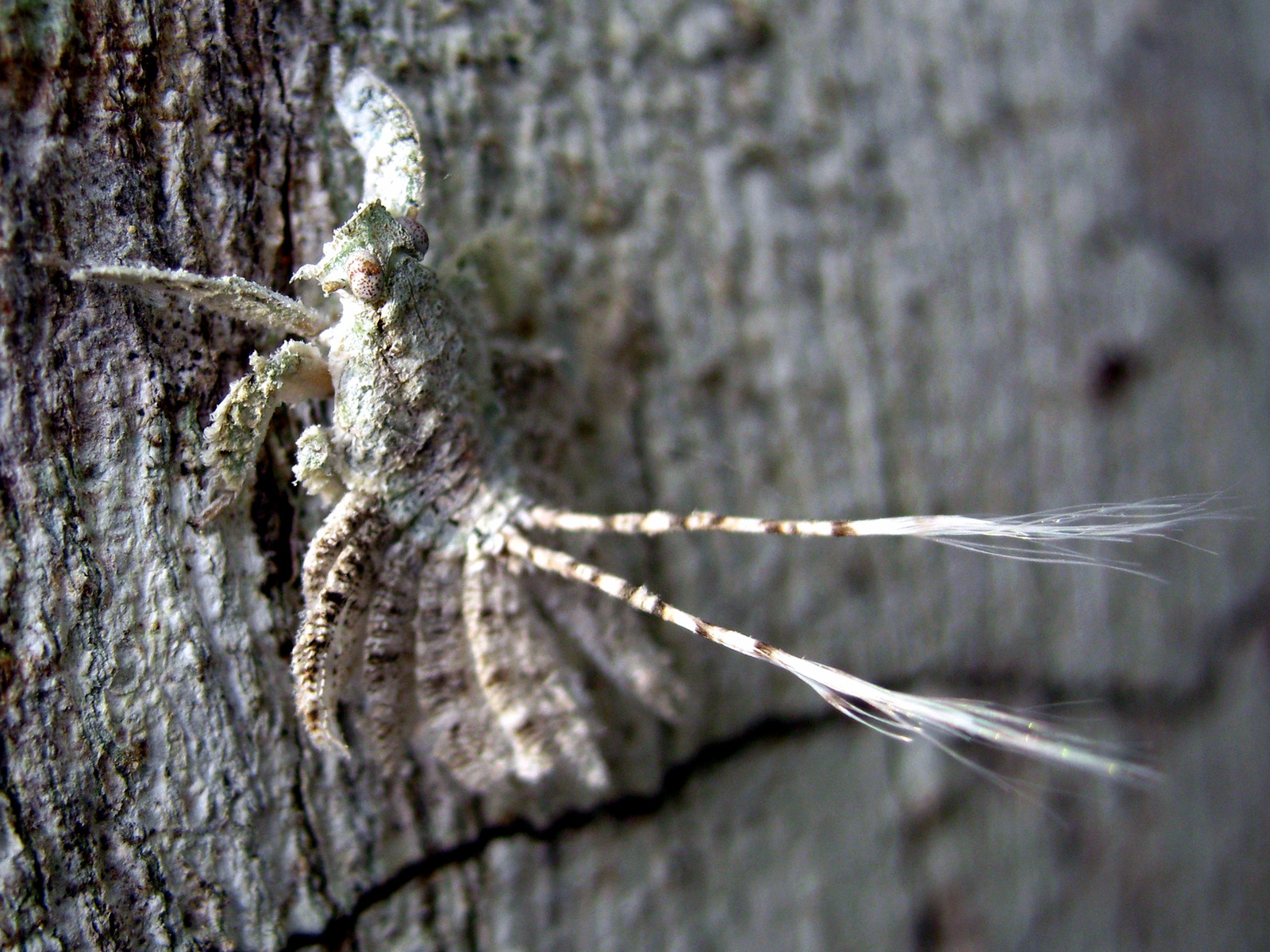
The animal was about 5 mm long, white and chocolate brown, and matched the lichen on the bark so well that it was very easy to walk past. It carried two long tails, banded brown and white, each ending in a spray of fine white filaments. It had no wings at all — the first impression was of a small moth, until the absence of wings became obvious.
It was alone. It stayed still for long periods, and when it did move it did not go far.
Established: a wingless insect about 5 mm long, on tree bark, patterned and textured to match lichen, with two long banded caudal appendages ending in plumes of fine white filaments.
Not established: the order, family, genus or species — and whether the animal is an adult or an immature. Nothing below class is claimed here.
The first thing to rule out — offered as a candidate to test, not as a determination — is a planthopper nymph (Hemiptera: Fulgoromorpha). Two things recommend it. Planthopper nymphs are wingless, so the missing wings would need no special explanation. And planthoppers feed on plant sap, which is rich in sugar and poor in most of what an animal needs, so a great deal must pass through them; rather than excrete the surplus sugar as honeydew, planthoppers convert it to wax, and the nymphs build that wax into tails. Several forms are recorded, including feather-like tails that act as a brake when the insect falls, and long antenna-like ones that distract a predator while the insect hops away in the other direction.
What the candidate does not explain. The tails in this photograph are regularly banded brown and white along their length. Secreted wax filaments are generally uniform. The banding suggests a structure rather than a simple wax thread, and it is not accounted for by the explanation above. It is recorded here because it is the sort of detail that tells a specialist something, and because a candidate that does not explain everything should say so.
What would settle it: examination by someone who knows the Bornean Auchenorrhyncha, or a reared adult. If this is a nymph, the adult may look nothing like it — which is itself a reason not to guess. The observation is posted to iNaturalist as observation 397603301, and any determination made there will be brought back to this page.
Whatever this animal turns out to be, the concealment is worth a paragraph on its own. It is not merely the colour. The body is textured — crusted and fringed along the legs and the front margin — so that it does not read as a smooth object sitting on rough bark. The pale eyes are speckled rather than plain, which breaks up the two shapes on the animal that would otherwise be unmistakably eyes. The overall pattern is not a copy of one lichen but of the general mottling of a lichen-covered trunk, which works from more angles than an exact copy would.
The behaviour completes it: staying still for long periods, and not going far when it moves. Camouflage of this kind fails the moment its owner travels, because a moving patch of bark is more conspicuous than a still animal of any colour. The stillness is part of the disguise, not a separate habit.
Page reviewed: 5 September 2026.