eTawau > Insects of Borneo > Beetles > The Three-horned Rhinoceros Beetle
Genus Chalcosoma — the biggest thing you will ever find lying on a floor in Sabah, and it is usually not dead
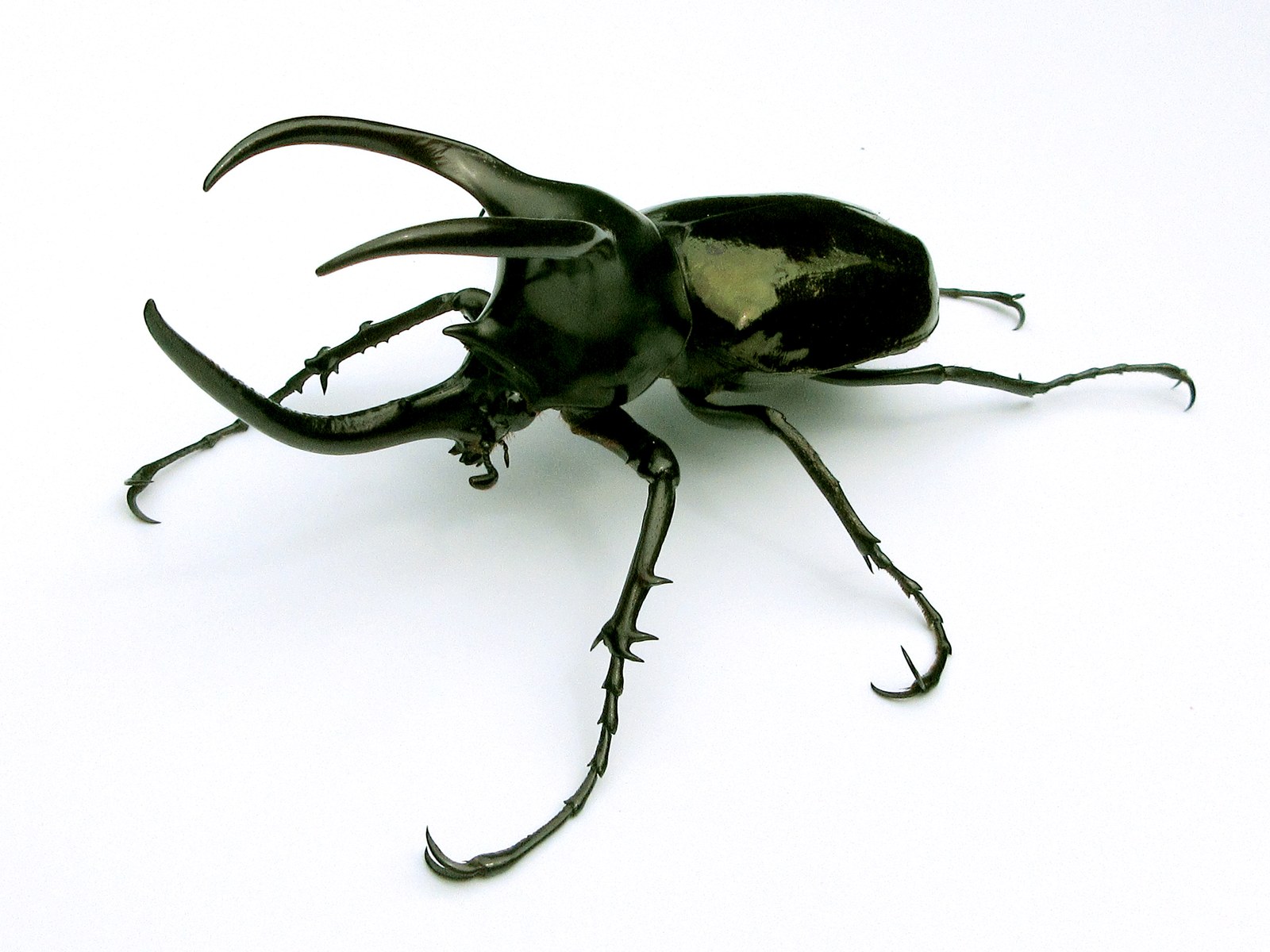
Christmas morning, 2022. My family was staying at Porohon Garden & Lodge in Kampung Sayap, a village in the Kota Belud district at the northern foot of the Kinabalu range, close to the Sayap substation of Kinabalu Park. When we came down in the morning there was a very large black beetle lying on the cement floor of the public hall.
It was still lying in the same place at midday. People walked past it all morning and took it for a dead one. It was not dead. When I picked it up to carry it to a white board so that I could photograph it, it made a soft rasping sound and moved its legs — and that sound turns out to be the most interesting thing on this page, so I will come back to it.
Sabah has two big rhinoceros beetles that a visitor is likely to meet, and you can separate them across a room without picking either of them up.
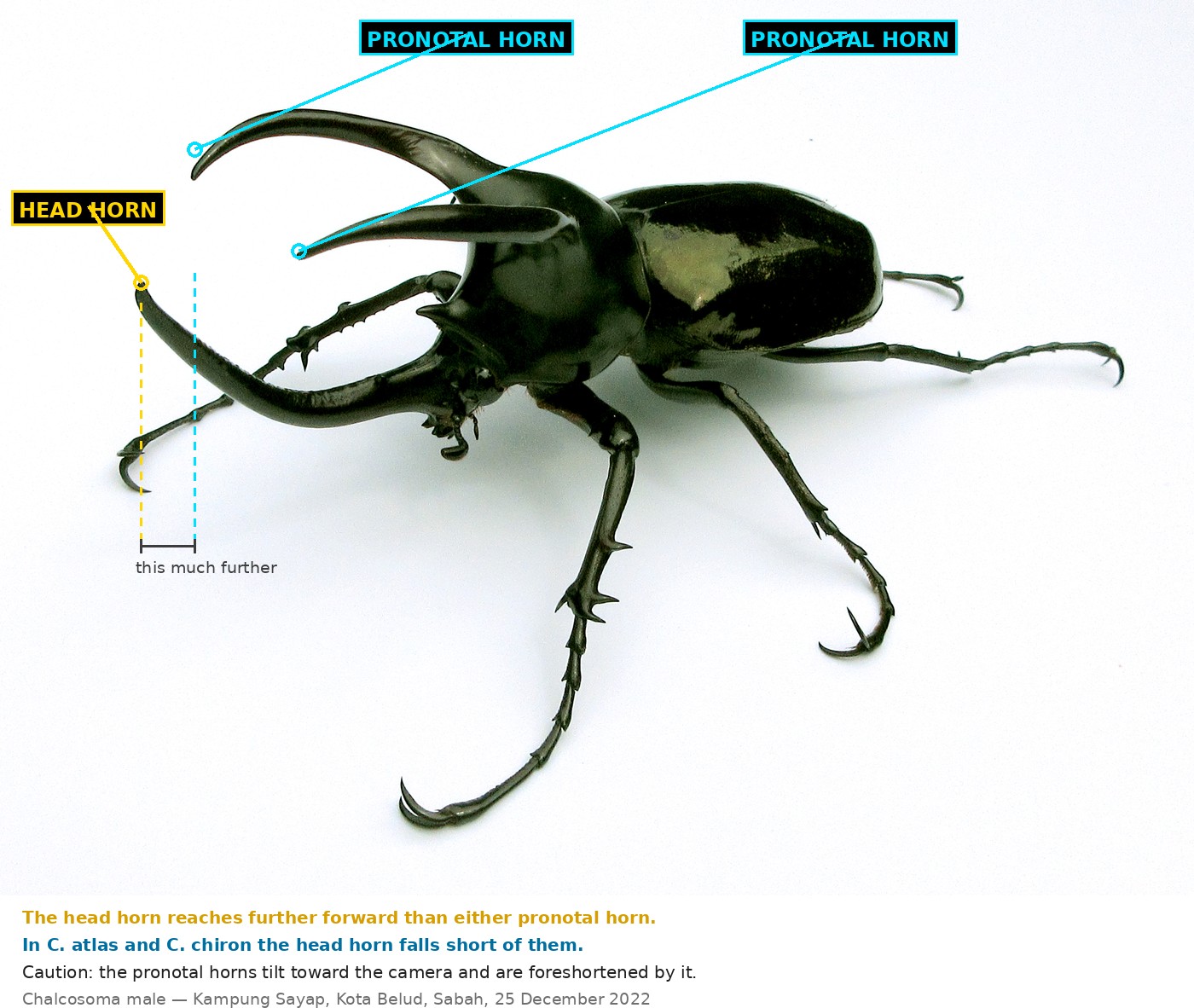
Three horns is the reason English-speakers call this one the three-horned rhinoceros beetle, and it is worth knowing because it is the only field mark you will ever need to get to the genus. Everything after that is harder.
This matters more than people expect, because it is the reason visitors think they have found two different animals.
The females of this genus have no horns at all, and they are a good deal smaller — roughly 45 to 60 mm against a male's 110 mm in the Bornean species. A hornless Chalcosoma is not a different beetle and it is not a young one. Beetles do not grow after they emerge; an adult is the size it is going to be for the rest of its life.
And the males are not all alike either. How big the horns get depends on how well the grub was fed in the rotting wood it grew up in. A male that had a good larval life comes out with the full set, long and smoothly curved, like this one. A male that had a poor one comes out with short stubs and a head horn that stands up rather than reaching forward. Same species, same age, completely different silhouette.
Three species of Chalcosoma are usually discussed for this part of the world: C. atlas, C. chiron (often written C. caucasus), and C. moellenkampi. They are separated on the shape and the proportions of the horns, and the differences are not large.
I first wrote this one down as Chalcosoma atlas, because that is the name everybody in Malaysia reaches for. Looking properly at my own photograph, I now think it is more likely to be C. moellenkampi, for three reasons:
And here is the weakness in my own argument, before anyone else finds it. I have one photograph, taken from in front and slightly above. In that view the two thoracic horns lean towards the camera, so they are foreshortened — which makes the head horn look longer by comparison, in exactly the direction that suits my case. The width of the thorax and the spacing of the horn bases, which are the other stated characters, cannot be judged from this angle at all.
So this page stops at the genus. The record is posted on iNaturalist as Chalcosoma, where identifiers who handle these beetles regularly can take it further. A record that stops at the right rank is never wrong — only unfinished — and somebody else can finish it. A record carrying a confident wrong name is much harder to undo.
Now the part worth carrying away from this page.
When I lifted the beetle off the floor it made a soft rasping squeak. Rhinoceros beetles do this when they are handled or disturbed: they rub the tip of the abdomen against the underside of the ends of the wing cases, and the friction produces a hiss or a squeak that is surprisingly loud for an insect. It is called stridulation, and it is a defence — it is what the beetle does instead of biting, because it cannot bite you.
For a visitor this is the practical lesson of the whole page. A big beetle lying still on a floor is very often alive. Ours lay motionless for hours and half a dozen people wrote it off. Touch it gently and it will tell you.
These beetles fly at night and they come to lights. A hall with lamps on in a village at the edge of the forest is exactly the sort of place one arrives at after dark, blunders about, and then settles when the sun comes up — because they are night animals and the day is for sitting still.
That is the likeliest explanation, and I want to be clear that it is my inference and not something I watched happen. I did not see it arrive. I only found it in the morning, already still. On this site I try to keep those two kinds of statement apart, because once they get mixed together nobody can tell which parts of a record can be relied on.
Fighting other males. Not defence, not digging, and not against you.
Male rhinoceros beetles compete over feeding sites — running sap on a tree, fallen fruit — because that is where the females come. The horns are levers. A male works the tips underneath a rival, grips him between the head horn and the thoracic horns, and prises him off the trunk. The loser is thrown down, not killed. It is a wrestling match with a fixed prize, and the beetle with the better equipment usually wins it, which is precisely why the well-fed grubs grow such extravagant horns.
None of that machinery is any use against a human hand. A Chalcosoma cannot sting, and it will not bite you. What it can do is grip, and the grip is the thing to respect — look at the claws on those long legs in the photographs. Each foot ends in a pair of hooks made for holding on to bark against another beetle's full strength.
One so far. If I find another I will add it to this page.
Porohon Garden & Lodge, Kampung Sayap, Kota Belud, Sabah — a village home stay
below the northern side of the Kinabalu range, near the Sayap substation of Kinabalu Park. One large
male, alone, lying motionless on the cement floor of the public hall from early morning until
midday, alive throughout. Photographed at 1:18 pm on a white board that I moved it
onto, then released alive on natural ground nearby. Size not measured. Stridulated
when handled.
— iNaturalist observation
399396355
This is not a Tawau record, and I am not going to pretend otherwise. Kampung Sayap is at the other end of Sabah, some five hundred kilometres from home. It sits on this site because it is a Sabah record, because the beetle is one every visitor to Borneo wants to see, and because a dated photograph of it is worth more in public than in my own drawer.
There is a second record from the same day, and it is worth putting the two side by side.
The beetle was photographed at 1:18 in the afternoon, on the hall floor. That evening, at a quarter to eight, up at the Sayap Substation of Kinabalu Park, I photographed a pair of wingless stick insects mating in the dark. Two records, one date, one small corner of Sabah, about six and a half hours apart — and between them they cover both halves of the day that the forest works in.
I was not on a survey. I was on a family holiday, carrying a compact camera. That is the whole point of this page and of the one next to it: the records that fill in a map are mostly made by people who were not looking for them.
The genus is famous. Its distribution in Borneo, species by species, is much less well recorded than its fame suggests — and the reason is exactly the difficulty set out above. Most photographs of these beetles are taken from whatever angle the beetle happened to be sitting at, which is usually not the angle that answers the question. Mine is a good example of the problem.
Dated, located photographs from ordinary people are what fill that in. Not expeditions; holidays. If you find one at a light, on a path, or lying on a floor in a village hall — photograph it, write down where and when, and put it somewhere a specialist can reach. You do not need to know what it is. That is their part of the job.
About the photographs. Taken by Wong Fook Yee with a Canon IXUS 285 HS at Kampung
Sayap, Kota Belud, on 25 December 2022 at 1:18 pm. For this page the frame has been cropped, its
background cleaned to white and its colour corrected in Adobe Photoshop, and a second copy has been
labelled — because a visitor wants to be shown what to look at. The unaltered camera
original is attached to the iNaturalist record above, which is where anyone working on the
identification should start.
Sizes and the distinction between the three species follow the published accounts of
Chalcosoma moellenkampi and Chalcosoma atlas; the stridulation mechanism follows
the published account of the Dynastinae. All photographs © Wong Fook Yee.
Page written 12 September 2026, and added to as further records are made.