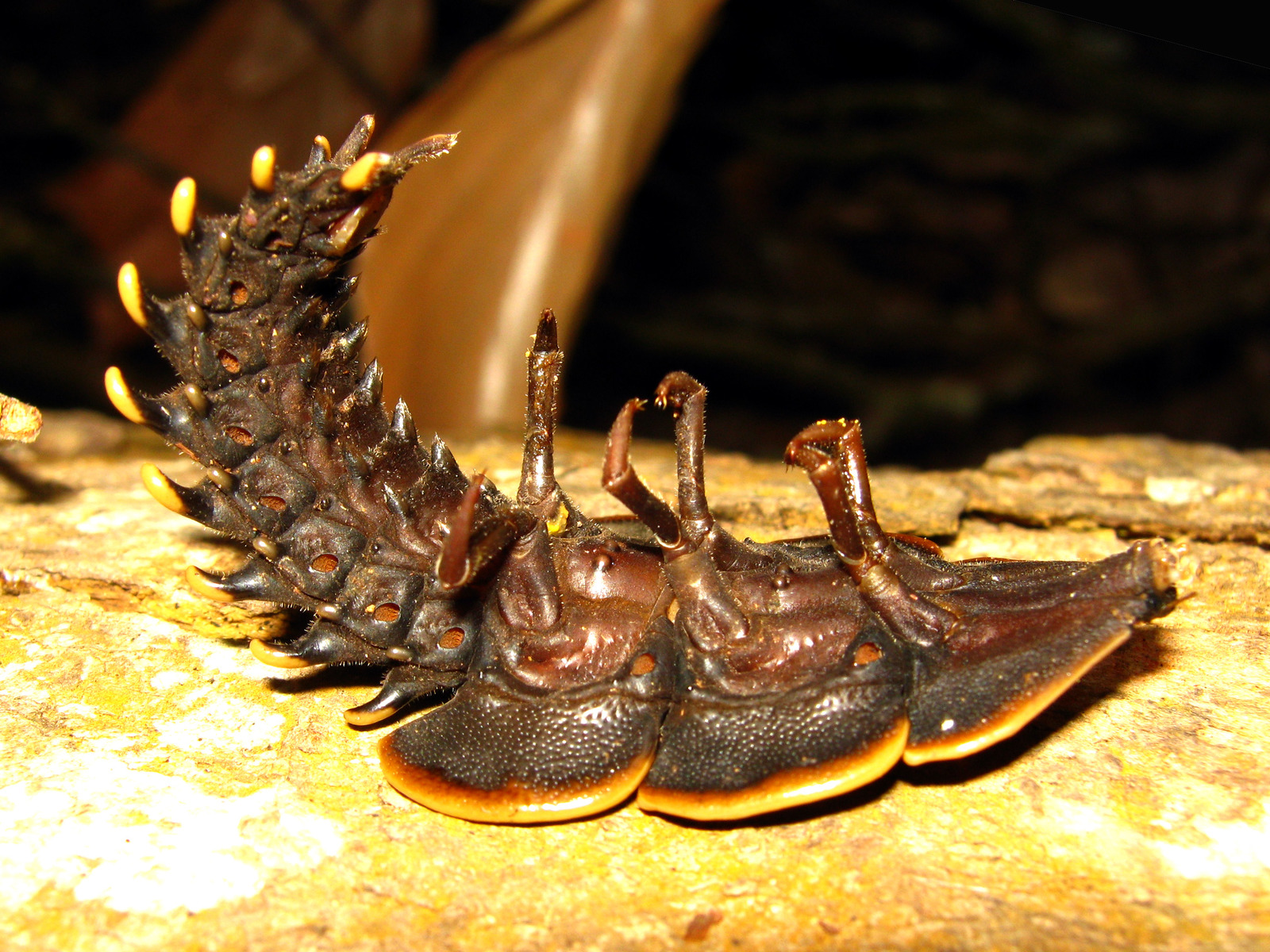
Provisional record. The family is established and the genus is near-certain. The species is not determined, and whether this individual is a larva or an adult female is an open question — see below.
Class Insecta, order Coleoptera, family Lycidae — the net-winged beetles. A trilobite beetle, almost certainly genus Platerodrilus. Species not determined.
Photographed by Wong Fook Yee at 17:04 on 8 August 2010, in an old abandoned oil palm plantation on the bank of the Tawau River, downstream and opposite Pasar Semarak, about 7 km from Tawau town, Sabah. It is the same one-kilometre stretch of riverside that produced the mealybug record of 2009.
The animal was about 40 mm long, dark, flattened, and built of overlapping plates in what the photographer's notes describe as "three segments" — the very feature the group is named for. It was found crawling on the ground among leaf debris, not on any plant, and was alone. It did nothing but crawl steadily forward.
The photograph shows the animal upside down, and that was deliberate. Turned on its back it stopped travelling long enough to be photographed clearly. It was moved onto a fallen branch for the picture. Both facts are recorded here because a reader is entitled to know how a photograph was obtained.
Established: a trilobite beetle — order Coleoptera, family Lycidae, the net-winged beetles — in the larviform state. The broad overlapping dorsal plates with pale margins, the strongly pitted sculpture, the tapering rear segments with paired lateral projections, and the small head concealed beneath the front plate are the characters of this distinctive group.
Near-certain: the genus Platerodrilus. This is the genus to which Bornean trilobite beetles belong. It is not confirmed from a photograph and is stated here as a strong expectation rather than a determination.
Not established: the species. Forty-two species of Platerodrilus are described, seven of them from Borneo, with further undescribed species known to exist. The 2015 molecular study of the genus found that larviform individuals frequently cannot be placed to species even from sequenced material — several of the specimens in that study were female larvae that had to be left unidentified. A photograph will not do it.
This is the strangest thing about the group, and it is why this record belongs in the wingless section of this site.
In Platerodrilus the female is neotenic. She never undergoes the transformation that other beetles undergo. She keeps the larval body — the plates, the flattened shape, the crawling life — for the whole of her life, breeds in that form, and never develops wings at all. Adult females reach 40 to 80 mm.
The male is a different animal in almost every respect. He is 8 to 9 mm long, winged, and looks like an ordinary net-winged beetle — nothing about him suggests any connection to the armoured creature above. He is thought to feed on nectar, enough to fly and find a mate.
The two sexes are so unalike that for many years science did not know what the males were. The females had been collected and described, but the males remained a mystery until the Swedish zoologist Eric Mjöberg published his account of them in 1925.
Because the adult female looks like a larva, the two cannot be told apart by shape. A larva of either sex looks much like this; so does a grown female. At about 40 mm this individual sits right at the lower edge of the adult female size range, so it could be a well-grown larva of either sex or a small adult female. The record does not say which, and the question is on the iNaturalist observation for anyone who can settle it.
The resemblance to a trilobite is pure coincidence, and a remarkably late one. Trilobites died out in the Permian extinction about 252 million years ago. These beetles are estimated to have arisen around 47 million years ago — roughly 200 million years after the last trilobite. Nothing was being imitated. Two lineages separated by an unimaginable gap arrived at a similar solution: a flattened, armoured, segmented animal that crawls over and under decaying matter.
Trilobite beetles are extreme local endemics. The 2015 phylogeny of the genus states that no Platerodrilus species has been found on more than a single island or mountain region, with complete species-level turnover between neighbouring mountains. A record of where one was found is therefore not incidental detail; it is close to being the point.
And the site has a history worth setting down, from the photographer's own knowledge of the ground:
A trilobite beetle lives on rotting wood, fungi, slime moulds and the other small organisms of decay. Finding one still crawling through leaf litter on ground that has been forest, then plantation, and is now neither, is a small piece of evidence about what survives conversion and how long it hangs on. That is not something a photograph shows. It is something the person holding the camera knew.
This site files insects by wing count, and the wingless folder now holds four records that are wingless for four entirely different reasons:
The same observation — "no wings" — means something different in each case. That is why the folder is a filing convention describing what was seen, and not a statement about classification.
Page reviewed: 6 September 2026.