| INDEX | Close Up | Bringing the pray home |
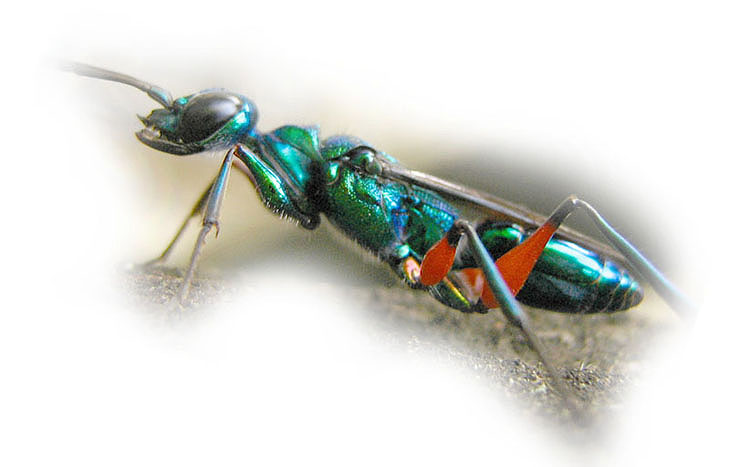
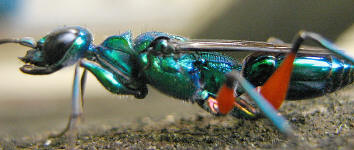
The Emerald Cockroach Wasp
(Ampulex compressa, also known as the jewel wasp)
Insect identification Source #1 : http://en.wikipedia.org
|
The wasp's venom blocks the octopamine, literally converting the cockroach into a zombie. This 'zombie'
cockroach is completely unable to fight back as it is pulled by the
wasp into its underground lair. If you're wondering why the wasp
would go through all this trouble to just eat a cockroach, here's
the really weird part -- the cockroach is meant to unwillingly play
the part of surrogate mother. The wasp lays an egg into the
cockroach's abdomen, and the larva later hatches and eats the live
cockroach from inside out. It takes 3 or 4 days for the larva to
hatch, after which it slowly feeds on the roach's internal organs,
keeping it alive the whole time. This process takes about 7-8 days,
during which the meat needs to be fresh for the larva. And because a
dead cockroach rots within a day, the wasp prefers the 'stun'
method. Once the roach is eaten up completely and it dies, the larva
forms a cocoon inside it. A fully-grown wasp emerges from the
cockroach carcass a month later.
For decades, scientists have tried to
understand the complex and gruesome relationship between the
parasitic emerald wasp Ampulex compressa and its much larger victim,
the common household cockroach Periplaneta americana. |
|
The emerald cockroach wasp or jewel wasp (Ampulex compressa) is a parasitoid solitary wasp of the family Ampulicidae. It is known for its unusual reproductive behavior, which involves disabling a live cockroach and using it as a host for its larva. Ampulex compressa thus belongs to the entomophagous parasite This wasp stings a cockroach in the brain to take away its
escape reflex and then steers it with its antennae into its burrow and lays its
larva on it. With it's escape reflex disabled, the cockroach will just rest
there while the wasp larva burrows into it's body, eats it internal organs and
then pupates inside its body. As early as the 1940s it was published that wasps of this
species sting a roach twice, which modifies the behavior of the prey. A recent
study using radioactive labeling proved that the wasp stings precisely into
specific ganglia. Ampulex compressa delivers an initial sting to a thoracic
ganglion of a cockroach to mildly paralyze the front legs of the insect. This
facilitates the second sting at a carefully chosen spot in the cockroach's head
ganglia (brain), in the section that controls the escape reflex. As a result of
this sting, the cockroach will now fail to produce normal escape responses. The wasp then saws off the tips of the roach's antennae and
drinks the hemolymph from them. It builds a nest - just a little funnel made of
soil and pebbles and leads the roach, by pulling at its anteanna as if it was a
dog-leash, into the funnel. It then lays an egg onto the leg of the roach,
closes off the antrance to the funnel with a rock and leaves. The roach remains
alive, but completely still in the nest for quite some time (around five weeks).
The venom, apart from eliminating all defense behaviors of the roach, also slows
the metabolism of the cockroach, allowing it to live longer without food and
water. After a while, the wasp egg hatches, eats its way into the body of the
roach, eats the internal organs of the roach, then pupates and hatches. What
comes out of the (now dead) cockroach is not a larva (as usually happens with
insect parasitoids) but an adult wasp, ready to mate and deposit eggs on new
cockroaches. |
| the Emerald Cockroach Wasp is free-living as an adult, but
chooses to give its young a head-start in life by parasitizing a living
cockroach. After mating, the female wasp seeks out a suitable host and paralyses
it with a quick sting to the thorax. This, however, is only the beginning of a
slow and (we must imagine) painful death as the cockroach is systematically
zombified, digested, and killed. The first sting serves only to buy A. compressa enough time to deliver a second, more precise sting, directly into the cockroach’s brain. Guided by sensors on the side of her sting, the wasp probes into the brain of the cockroach. Upon finding a particular spot, the wasp delivers a second venom, disabling the cockroach’s escape reflex. As the paralyzing venom wears off, the cockroach does not run away. Instead, passive and obedient, it allows the wasp to seize it by the antenna and lead it back to the wasp’s burrow, to meet its fate. Once there, the wasp lays an egg on the underbelly of the zombie roach, and seals the somnambulant victim in by blocking the entrance with pebbles. In time, the egg hatches and a tiny larva chews a hole in the side of the roach, worming its way into the host. Once there, the larva begins to digest the still-living cockroach, eating it from the inside. Once sated, the larva spins a cocoon inside the roach and develops into an adult. As a grim finale, the adult wasp bursts out of the cockroach and the life cycle of A. compressa begins once more. |
 |
|
 |
|
|
INDEX : Insects 24-1-2008 August 13, 2020 12:10:11 PM |
|