|
|
| AUSTRALIA | CAMBODIA | CANADA | CHINA | FRANCE | GERMANY | INDIA | INDONESIA | JAPAN | NEW ZEALAND | RUSSIA | SINGAPORE | UNITED KINGDOM | UNITED STATES |
|
|
 |
AUSTRALIA |
| Malaysian Students' Association in Australia : http://www.msda.org.au/index.php?p=1_7 |
| University of Western Australia |
| University of Sydney |
| Monash University |
| University of Southern Queensland, Brisbane |
| Australia is proud of the quality of its
education and training Students from all over the world come to Australia
for its world-class higher education. progressive vocational education and
training (VET), excellent schools an its international English courses.
All institutions and courses have to be registered by the Australian
Government, which takes a strong interest in maintaining the quality of
education for Australians and international students alike. With its very
sophisticated education and training system, students are not only exposed
to world-class courses of study but also specialist support services Over 200,000 Malaysians have attended Australian institutions to date and Australia continues to be the first choice destination of many Malaysian students |
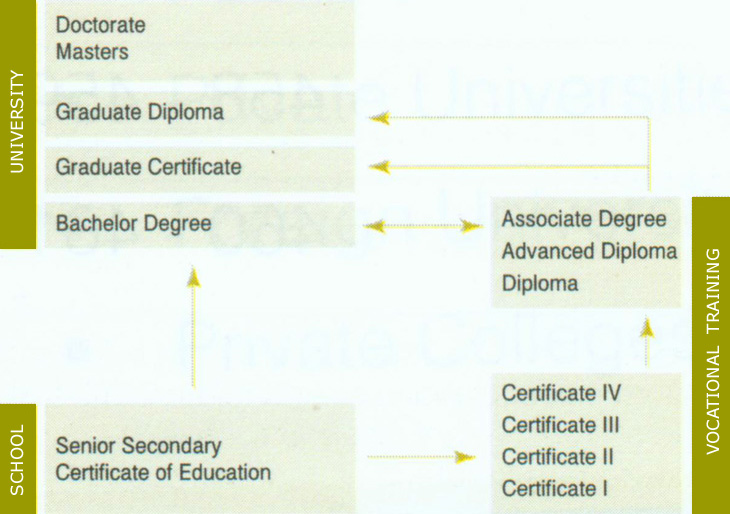
| Australian Qualifications Framework
(AQF) The Australian Qualifications
Framework (also commonly known as the AQF) is a unified system of national
qualifications. The Framework links qualifications including senior
secondary school education, vocational education and training and
university educator- Unlike in many other countries with unconnected
qualifications. Australia has a single comprehensive system of 13
qualifications The system is especially useful to international students,
because as long as students meet visa requirements, they can have their
prior learning recognized within the AQF and accredited to their course to
attain any of the 13 AQF qualifications. |
Australian Education Sectors
| Higher Education | Vocational Education and training (VET) | Schools |
| Australian
university awards have wide international acceptance Depending on courses
and current needs within the workforce of various industries. Australian
universities set their own academic requirements within legislative
guidelines. Additional to that, they structure their professional courses
to satisfy the requirements of the relevant professional bodies. The
Australian Government provides more than half the funds for the 39
public-funded universities in the Australian higher education system.
|
The Australian
government has worked together with various industrial sectors to build an
effective national vocational education and training (VET) system in
response to increased trade competition and the need for a
high-performance workforce. A wide variety of training, ranging from
preparatory and entry level through to operator, technician and
professional levels is available within the VET system.
|
There are two
broad categories of schools in Australia: government schools (which enrol
the majority of students) and non-government schools (which include
schools with and without religious affiliation) Government schools operate
under the direct responsibility of State Education Departments.
Non-governmental schools operate under conditions set by the State
government registration authorities lo ensure appropriate educational
standards and satisfactory premises.
|
EDUCATION SERVICES FOR OVERSEA STUDENTS
| English Language Intensive Courses for Overseas Students (ELICOS) | Foundation Studies |
| To live and
study in Australia, international students need a sound grasp of the
English language. Australia offers high-quality language services which
are word-renowned and at an affordable price The ELICOS system includes six major categories of language services: General English. English for Academic Purposes, Secondary School Preparation, Examination Preparation, English for Special Purposes and Study Tour Programs which runs between four and 40 weeks. ELICOS providers certify proficiency against the major internationally recognized tests, including Cambridge test. Test of English as a Foreign Language (TOEFL) and the International English Language Testing System (IELTS). The IELTS is the most popular test with students aiming at further education in Australia and the preferred test for entry into Australian universities. |
Foundation Studies is
a course designed to help international students make a successful
transition from school in their home country to universities in Australia
Foundation Studios are divided into streams such as Science. Commerce and
General Studies, with a balance of compulsory and elective subjects. The
subjects taught in these streams have been designed to prepare students
for studies at a tertiary level The standard length of Foundation Studies
is one-year full time However, some courses are offered at an accelerated
pace cf between 5 - 9 months. Principal intakes are at the beginning of
the year and mid-year. However, intakes can vary, so it is important to
check the availability and commencement dates with the individual
Australian institution. |
Average Tuition Fees
| The costs of studying in Australia compare favorably with those cf other countries that provide education and training services to international students. Australia offers advantages for international students in both tuition and living costs. |
| Lab Based Course | AUD13,000 - AUD40.000 per year |
| Non Lab Based Course | AUD8.500 - AUD25.000 per year |
| TAPE | AUD5.500 - AUD 18,000 per year |
| Foundation | AUD7.000 - AUD13.000 per course |
| Secondary School | AUD9.000 - AUD14,000 (not inclusive of boarding) |
| ELICOS | AUD2,500 - AUD3,000 per 10 week course |
|
Australian Academic Year The academic year varies from institution to institution and from sector to sector. Some institutions may have one or several intakes per year, while other's (particularly ELICOS and VET institutions) may have multiple / various entry. University courses begin early in March
and finish late in November. The year is divided into two semesters. Some
universities run summer schools from December to February. The secondary college and school academic year is divided into four terms and runs from late January / early February until December. |
|
Cost of Living As a guide, a single student will need between AUD9,000 to AUD12.000 per year (or AUDI.000 per month) for living expenses. This includes rent. food. local transport, telephone, gas / electricity, school stationery, a small clothing allowance and limited entertainment. The amount quoted is an average and does not include air fares and course / tuition fees. Bear in mind that living costs will be more in larger cities such as Melbourne and Sydney than in non-metropolitan areas. The amount of money required will also be affected by your lifestyle, interests and the type of accommodation chosen. If you are taking your family, then allow an extra AUD3.000 for your spouse and AUDI.700 per year ;or each child You may have to pay full lees for dependents attending school in Australia, which may vary from AUD8.000 to AUD12.000 per year. |
Accommodation
| Where you live and how comfortably you are accommodated will affect your stay in Australia and your studies. Careful selection of your accommodation will ease the pressure of a new and somewhat strange environment. The accommodation options are many and varied: |
| University Apartments | Home stay or Farm stay | Full Board and Meals | University Residential Colleges |
| University Apartments these arc generally reserved for postgraduate students, visiting faculty and married students. They are usually self-contained and fully furnished | Home stay or
Farm stay - an organized housing service which involves the student living
with an Australian family Rooms may be single or shared and the price will
range accordingly. This style of accommodation is popular with younger'
students who are attending school, those studying short-term English
courses and in other private colleges Farm stay offers the same services
in a rural setting. |
Full Board and
Meals - similar to Home stay, this is a less formal arrangement organized
through many university housing offices. Students will negotiate their
accommodation with the family or tenant with whom they are staying. |
University Residential
Colleges are usually on-campus and provide accommodation with meals. They
are slightly more expensive than university Halls of Residence. Sporting
and social 'facilities, tutoring, libraries and (generally) computer
access are also provided. |
|
Work International students are permitted to work on a casual basis (up to 20 hours per week during course time and tull-time during vacation periods) provided tins does net interfere with the study program. However, under new arrangements. overseas students and their dependents will be granted an initial student visa Doth onshore and offshore, with no work rights. Those who wish to access work rights will be required to apply for a visa with appropriate work rights at a cost of AUD60.00 alter the student has commenced his or her studies in Australia A letter from the institution confirming that the student has enrolled and commenced studies should also be submitted along with the application Casual work should NOT be used as a means for financing studies in Australia Not only are jobs difficult to find, there may be times when your study commitments mean you cannot afford the lime to work |
Scholarships
| Australian Scholarships is an initiative of the Australian Government to promote sustainable development and excellence in education in the Asia-Pacific region. The range of awards available will provide educational, research and professional development opportunities to support growth in the region and to build enduring links at the individual, institutional and country levels. Over five years, beginning in 2006. the number of awards available will double to 19.000 The initiative continues the spirit of the Colombo Plan which greatly enhanced common purpose and mutual understanding in the Asia-Pacific region. Malaysians are eligible to apply under the Endeavor Programme, which focuses on strengthening education linkages, skills and knowledge throughout the region and showcases Australia's excellence m education, science and training. For more information, please visit www.australianscholarships.gov.au |
|
|
More about Universities International September 08, 2016 01:58:38 PM |
|

