
Introduction
Daily life in Tawau reflects long-term relationships between people, environment, and routine. Housing, work, movement, food practices, and social interaction do not exist as separate activities, but operate together as a connected system shaped by geography, land use, and shared space.
Rather than presenting community life as tradition or lifestyle, this section examines how everyday routines - living, working, exchanging, and gathering - form the practical foundation of Tawau as a lived environment. From hinterland villages and coastal settlements to plantation estates and urban centres, different forms of community emerge through distinct relationships to land and labour.
By observing village life, plantation communities, livelihoods, food systems, and social spaces together, Tawau can be understood not as a single way of life, but as a network of interconnected environments. Community here is sustained through repeated use of space, shared routines, and daily interaction across diverse landscapes.

Community & Daily Life - Tawau as a Living System
Daily life in Tawau is shaped by interconnected systems of settlement, work, exchange, and shared space operating across land and sea. Hinterland villages, farming edges, oil palm plantation estates, market towns, and coastal areas form a continuous living environment rather than separate worlds.
Each landscape supports distinct routines and forms of work - domestic life in villages, cultivation at settlement edges, estate-based labour in plantations, trade and services in towns, and fishing along the coast. Through daily movement, the flow of goods, and repeated use of shared spaces, these systems remain closely linked.
Seen together, Tawau's community life reflects long-term adaptation to geography and resources. It is sustained not by a single tradition or activity, but by the ongoing interaction between place, routine, and collective presence over time.

A-Village Life in the Hinterland
Housing, paths, and daily activity as a living system
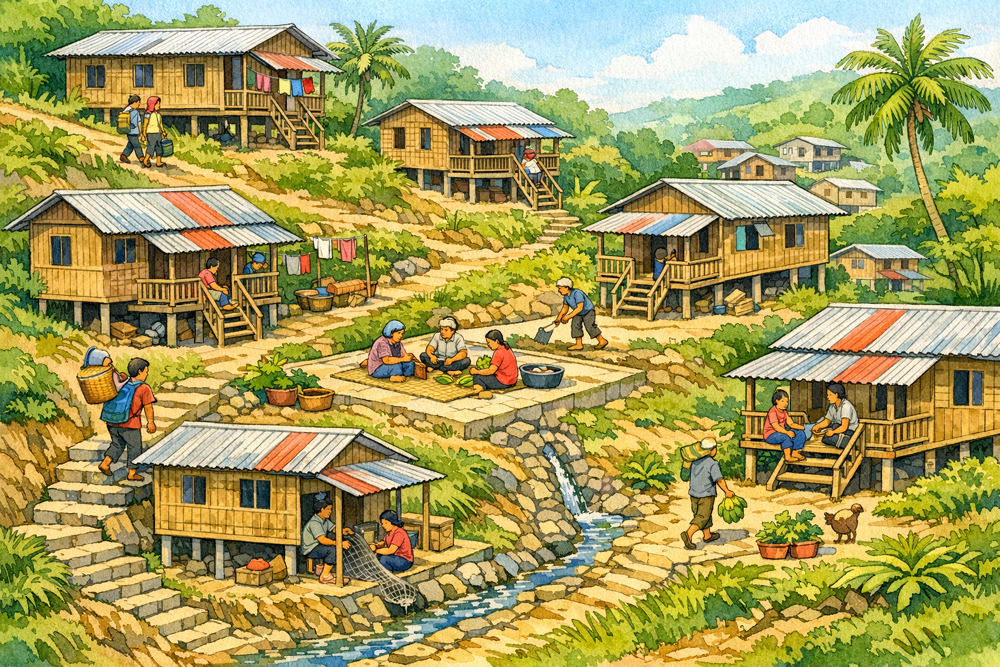
This illustration shows a present-day village in the hinterland, where homes, movement, and shared work are closely shaped by environment. Raised timber houses on stilts protect living spaces from ground moisture and flooding, allow air to circulate in the tropical heat, and create shaded areas below for storage and daily tasks. Informal dirt paths link homes to one another, forming natural routes for walking, carrying goods, and social interaction rather than fixed roads. Open shared spaces between houses support washing, food preparation, tool work, and conversation, making daily life visible and communal. Together, house form, pathways, and human activity function as a connected system - designed not by a single plan, but by long-term adaptation to climate, terrain, and available resources.

B-Oil Palm Plantation Communities
Labour, housing, and daily routines shaped by plantation landscapes
Since the 1970s, the large-scale introduction of oil palm as a cash crop has transformed vast areas of land in Tawau and the east coast of Sabah. Forests, small farms, and mixed-use landscapes were gradually reorganised into plantation systems, giving rise to a new form of community centred on plantation labour.
Oil palm plantation communities are typically organised around estates, worker housing lines, access roads, and processing facilities. Daily life follows work rhythms set by harvesting cycles, transport schedules, and estate maintenance rather than village-based subsistence patterns. Housing is functional and closely linked to workplaces, with shared facilities, informal social spaces, and movement routes shaped by plantation layout.
These communities brought together workers from diverse cultural and regional backgrounds, forming multi-ethnic social environments connected by shared labour rather than long-established settlement history. Over time, plantation settlements developed their own routines, social networks, and everyday practices, becoming a major component of Tawau's contemporary population and landscape.
Oil palm plantation communities demonstrate how livelihoods can extend beyond economic activity to shape housing patterns, movement, and social interaction. Here, daily routines are organised around work cycles, transport routes, and shared facilities, making labour a central structuring force of community life rather than a separate activity.
This close integration between work and living space provides an important context for understanding livelihoods in Tawau more broadly, where fishing, farming, trade, and service work similarly link households to surrounding environments and regional economic networks.

Livelihoods & Daily Work
Daily work in Tawau connects households to surrounding environments and wider economic networks, shaping not only income and production but also patterns of settlement, movement, and routine. Livelihoods here are closely tied to specific landscapes - coastal waters, farming edges, plantation estates, and urban spaces - each forming its own system of daily life.
Rather than existing as isolated occupations, these forms of work structure how people organise time, use space, and interact with one another, embedding labour directly into the lived environment.
Fishing and Coastal Life
Along the coast, fishing livelihoods are organised around tides, weather, and access to the sea. Homes, jetties, boat landings, and markets are positioned to support early departures, returning catches, and daily preparation of nets and equipment. Movement follows the shoreline, with paths and waterways linking houses to boats and trading points.
Here, daily life is shaped by marine rhythms rather than fixed schedules, creating a flexible pattern of work that connects households directly to coastal ecosystems and local markets.
Farming at the Settlement Edge
Farming livelihoods commonly occupy the transitional zone between homes and cultivated land. Small plots, gardens, and orchards sit alongside houses, allowing daily movement between domestic space and food production. Work routines follow seasonal cycles of planting, tending, and harvesting, often shared among family members.
This edge condition - neither fully residential nor purely agricultural - creates a blended landscape where living space and productive land remain closely connected, supporting both subsistence and small-scale trade.
Plantation Labour and Estate Systems
In oil palm plantation areas, livelihoods are organised through estate systems that integrate housing, transport routes, and work zones into a planned landscape. Daily routines follow harvesting cycles, shift schedules, and estate road networks, with movement patterns linking worker housing directly to plantation rows and shared facilities.
Unlike village-based livelihoods rooted in long-established settlement, plantation labour forms communities through shared work and proximity. Housing layouts, social interaction, and daily rhythms are shaped primarily by the organisation of labour, making work a central structuring force of everyday life.
Trade, Services, and Urban Work
In towns and market areas, livelihoods based on trade, services, and transport depend on access to roads, ports, and population centres. Shops, stalls, workshops, and service spaces cluster along streets and commercial nodes, shaping daily movement through repeated routes between home, workplace, and public space.
These forms of work link rural producers with urban consumers, connecting coastal, farming, and plantation systems into a wider network of exchange that sustains Tawau's economy and daily life.
Together, these livelihood systems demonstrate how work in Tawau is inseparable from place. Each form of labour - whether at sea, at the settlement edge, within plantation estates, or in urban centres - creates its own spatial logic, shaping how communities live, move, and interact on a daily basis.
Food & Markets
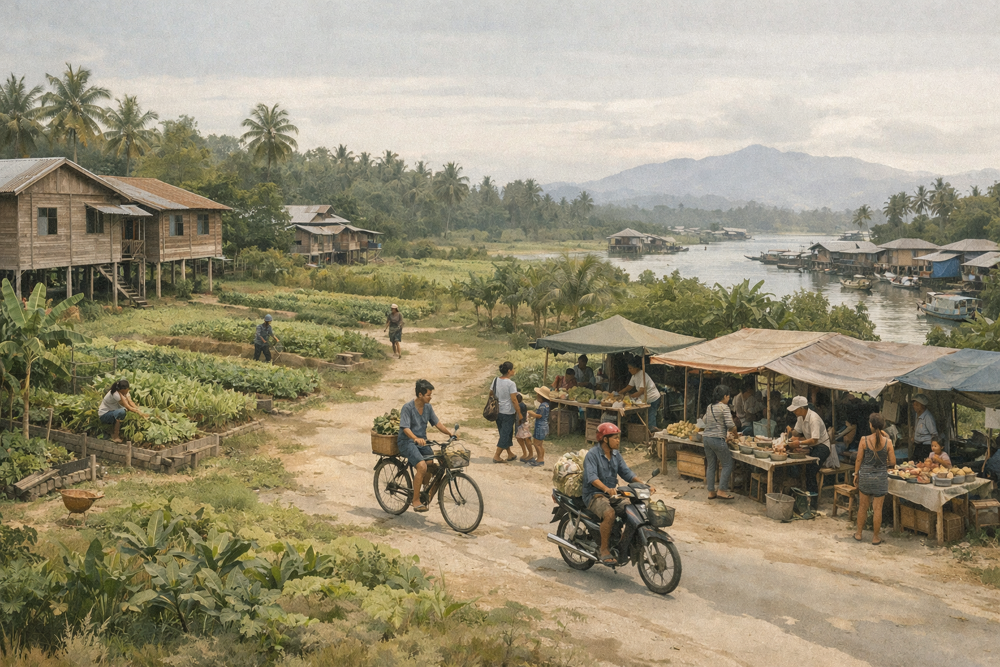
Food practices and markets in Tawau reflect the movement of people, goods, and resources across different environments. From coastal waters and farming edges to plantation estates and urban centres, food connects daily work to shared spaces of exchange.
Rather than functioning only as places of commerce, markets operate as everyday social environments where routines, interactions, and relationships are shaped through repeated use and proximity.
Coastal Supply and Marine Exchange
Along the coast, fishing activities feed directly into local food systems. Fresh catches move from boats to jetties, markets, and roadside stalls, often within the same day. Early-morning fish markets and informal selling points form critical links between marine livelihoods and household food preparation.
These exchanges are shaped by tides, weather, and timing, with daily rhythms organised around arrival and distribution rather than fixed opening hours.
Farming Produce at the Settlement Edge
Agricultural produce from farming edges enters food networks through small-scale selling, barter, and local markets. Vegetables, fruits, and other crops are often transported short distances from gardens and plots to nearby stalls or market spaces.
This close relationship between production and exchange reinforces the role of settlement edges as transitional zones, where domestic space, food cultivation, and market activity overlap.
Estate-Based Food Access
Within oil palm plantation areas, access to food is shaped by estate layouts and work routines. Small shops, mobile vendors, and scheduled market visits supply daily necessities to workers and their families. Food movement follows estate roads and transport routes, linking plantation communities to nearby towns and supply centres.
Here, food systems are closely tied to labour schedules, with purchasing and preparation organised around work shifts and shared facilities.
Urban Markets as Shared Social Space
In towns, markets bring together products from coastal, farming, and plantation systems. Wet markets, street stalls, and food courts function as convergence points where diverse communities interact through buying, selling, and eating.
These spaces support daily social contact, informal exchange, and cultural continuity, making markets central to Tawau's shared public life rather than purely economic infrastructure.
Together, food and market systems reveal how daily sustenance in Tawau depends on interconnected environments and routines. Through repeated movement and exchange, food links livelihoods to shared spaces, sustaining both households and community life.
Social Spaces & Festivals
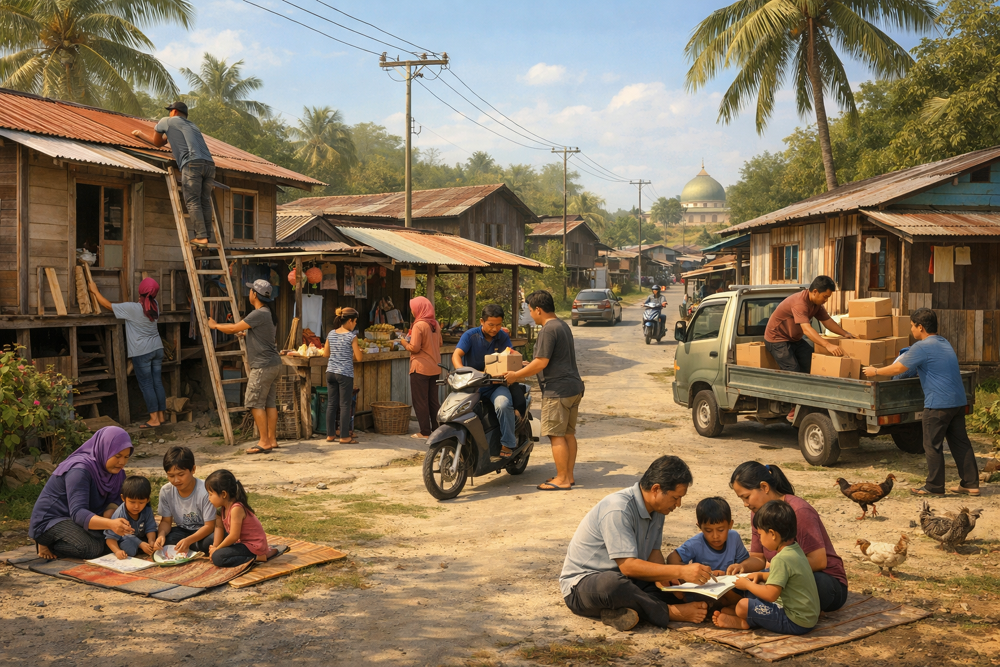
Social life in Tawau is shaped through repeated use of shared spaces rather than formal venues alone. Streets, markets, waterfronts, village open areas, and estate common spaces function as everyday settings where interaction, cooperation, and familiarity develop over time.
These environments support daily encounters - conversation, waiting, resting, observing - that quietly sustain social connection and community continuity.
Everyday Shared Spaces
In villages and settlement areas, open spaces between houses, shaded verandas, paths, and small junctions serve as informal gathering points. These spaces allow social life to unfold alongside routine activities such as food preparation, tool work, childcare, and rest.
Along the coast and in towns, waterfronts, jetties, streets, and market edges perform a similar role. Movement through these spaces brings people into regular contact, making social interaction part of daily circulation rather than a planned activity.
Estate and Workplace Social Environments
Within plantation communities, social spaces emerge around shared facilities, housing rows, roadside areas, and informal meeting points. Interaction is shaped by work schedules and proximity, with conversations and social ties forming during rest periods, after work hours, and through shared routines.
These environments demonstrate how social life adapts to planned landscapes, where communal presence develops through repeated use of limited shared space.
Markets as Social Nodes
Markets function as some of Tawau's most active social spaces. Beyond buying and selling, they provide places for greeting, exchanging news, and maintaining social visibility. Regular visits create familiarity among vendors, customers, and neighbours, reinforcing social bonds through routine.
As convergence points, markets bring together people from coastal, farming, plantation, and urban areas, making them key spaces of social mixing and shared experience.
Festivals as Extended Social Routine
Cultural events and festivals in Tawau grow out of these everyday social environments. Rather than standing apart from daily life, festivals temporarily intensify the use of familiar spaces - streets, open areas, markets, and community grounds - bringing larger groups together through shared timing and activity.
Understanding Daily Life in Tawau
Daily life in Tawau emerges from the close relationship between people, environment, and routine. Rather than existing as separate aspects of living, settlement patterns, work, food systems, and social interaction form an interconnected system shaped by geography and long-term human presence.
Village life in the hinterland reflects adaptive settlement, where housing, paths, and shared spaces develop gradually in response to climate, terrain, and communal needs. In contrast, oil palm plantation communities represent a more recent form of living environment, where work organisation reshapes land use, housing layouts, and daily movement. Together, these settlement types illustrate how different relationships to land produce distinct yet coexisting ways of life.
Livelihoods link these living environments to wider ecological and economic networks. Fishing ties households to the rhythms of the sea, farming connects homes to cultivated edges, plantation labour integrates daily life into estate systems, and trade and services anchor movement within towns. In each case, work structures time, routes, and routines, embedding labour directly into the spatial fabric of community life.
Food systems connect these livelihood landscapes through daily exchange. Marine catches, farm produce, estate-based supply, and urban distribution converge in markets and informal selling spaces, where movement and routine transform production into shared sustenance. Markets function not only as economic centres, but as everyday social environments that sustain interaction and familiarity.
Social spaces - villages, estates, streets, waterfronts, and markets - provide the settings where community life is continually reinforced. Through repeated presence, shared routines, and everyday encounters, social connection is maintained across diverse environments. Festivals and cultural events extend these routines, intensifying familiar uses of space rather than standing apart from daily life.
Viewed together, these elements reveal Tawau as a lived environment shaped by multiple systems operating at once. Daily life is not defined by a single tradition or activity, but by the ongoing interaction between place, work, exchange, and shared space - forming a dynamic community shaped through time.
Explore Tawau's Daily Life
Community life in Tawau is shaped through the interaction of settlement, work, exchange, and shared space. Each section below examines one part of this living system, showing how daily routines connect people to land, resources, and one another.
-
Village Life
Hinterland settlements shaped by housing form, paths, and shared routines. -
Oil Palm Plantation Communities
Estate-based living environments structured by plantation land use. -
Estate Housing Life
Daily routines and shared spaces around plantation housing areas. -
Urban Neighbourhood Life
Everyday life in Tawau town shaped by streets, housing, and services. -
Coastal Community Life
Shoreline settlements structured by marine access and daily movement.
Together, these sections reveal Tawau as a lived environment formed through repeated use of space, shared routines, and long-term adaptation to place.