Welcome to
Malacca (Melaka)
HOME > West Malaysia > Malacca (Melaka)
Welcome to
Malacca (Melaka)
Melaka is known for its historical prominence and its cultural appeal. In the
16th century, Melaka enjoyed a reputation as the foremost maritime trading
center in the region. So coveted was Melaka by the European powers that it was
ruled successively by the Portuguese, Dutch and the British until the Federation
of Malaya was formed on 31 st August 1957.
It is the place where those who are hunting for treasures of the past will be
rewarded if they look deep into its quaint shops for curios and antiques.
The rich multi-cultural heritage of Melaka's people is reflected in their unique
customs and traditions, food, festivals, dances, buildings and lifestyles.
Melaka cuisine is well-known for its lively flavors and aromas. The city's many
restaurants, cafes, food courts, pubs and fast food restaurants offer a range of
culinary options.
There is accommodation in these states to suit all tastes and budgets. Major
hotels are located in the main towns. Budget accommodation, hostels and bed and
breakfast inns are also available.
Malaysia has four World Heritage Sites recognized by the United Nations Educational, Scientific and Cultural Organization's (Unesco) World Heritage List.
1) Archaeological Heritage of the Lenggong
Valley (AHLV) in Perak
2) Historic cities of Melaka and George Town along the
Straits of Melaka
3)
Gunung Mulu National Park in Sarawak
4)
Kinabalu Park in Sabah
Places of Interest

Malacca Interstates Bus Terminal
(Melaka Sentral bus terminal)

MUZIUM SASTERA
(Musium of Literature)
Located on the shoulder of St. Paul Hill, up a steep incline from the Tourist
Police Headquarters, the Muzium Sastera (Literary Museum) chronicles the history
of Malay literature since its inception to the modern period. It is the only one
of its kind in Malaysia. Among the exhibits are paintings depicting important
events excerpted from the Malay Annals and gruesome capital punishments of the
old days. Also showcased are the different forms of Malay traditional
literature.

Christ Church
One of the sought after tourist destinations.
This oldest church and the Stadhuys next to each other are two of the most
prominent structures still functional today in Malacca.
Christ Church was built in 1753 by Dutch as the oldest Protestant church in
Malaysia.
Last Supper painting made of glazed tiles is visibly over the altar inside the
church. The ceiling in the church is the most notable feature, whereby the beams
over 15 meters long each was made from a single tree!
On the right hand side of Christ Church is the Stadthuys.
On the left hand side of Christ Church (view blocked by the big tree) is
Malaysia Youth Museum & Art Gallery. Built in 1784 as Dutch Administrative
Complex. In 1826, it was turned into a school (Malacca Free School). In 1920s,
the building was renovated to be double-storey building and later used as a post
office before converting into museum as what we see today.
On the left side of Youth Museum & Art Gallery is Laksamana Road where we came
with the Rickshaw.
More on Christ Church
Situated adjacent to the Stadthuys, this bright red structure is testimony to
Dutch architectural ingenuity.
Interesting features include the church's handmade pews, ceiling beams
(constructed without joints), brass bible, tombstone and 'The Last Supper' in
glazed tiles.

The Stadthuys
History Museum of Malacca
Entrance of The Stadthuys, a group of Malaysian students
post for a group photo.
November and December is holiday season in Malaysia. All
these places of interest are groups and groups of young
students guided by their teachers in holiday outing.
Stadthuys Another major landmark in the state, the Stadthuys was built in
1650 as the official residence of Dutch governors and their officers. Originally
white, it was given a striking salmon-red color to match the nearby Christ
Church.
The Stadthuys was built in 1650 as the official residence of Dutch Governors and their officers, the edifice is a example of Dutch architecture. Preserved in its original structure and form, it now houses the History Museum and Ethnography Museum. On display daily are traditional bridal costumes and relics from Malacca's glorious past.
After visiting the Christ Church, we visited The History Museum housed in The Stadthuys which is just on the right hand side of Christ Church. This red old building was 400 years ago the municipal town hall of the Dutch during the 1650’s after having taken over Malacca from the Portuguese in 1641.
More about History Museum of Malacca

St. Paul's Church St. Francis Xavier was buried in the open grave here in
1553 before his body was transferred to Goa in India. The church has a
commanding view of Melaka.
St. John's Fort The fort is located on St. John's Hill and was originally a
private Portuguese chapel dedicated to St. John the Baptist. The fort has an
interesting feature; cannons face inland as during that time attacks on Melaka
came mainly from the hinterland instead of from the sea.

Bukit Cina As the name implies, 'Chinese Hill' was the official settlement of
the entourage that arrived with the Chinese Princess Hang Li Po. She was sent to Meiaka by the Ming emperor to marry the Sultan, marking the advent of diplomatic
relations between Meiaka and China.
Hang Li Po's Well Built by the followers of Hang Li Po, the well was the only
source of water during great droughts. The Dutch enclosed it with stout walls to
reserve it for their exclusive use. Today, it enjoys a reputation as a wishing
well.
Hang Tuah's Mausoleum This famous Malay warrior served as the admiral of Melaka's naval forces and defended successfully countless attacks against Meiaka. The outstanding military exploits of Hang Tuah and his four comrades, made him a legend in the history of Meiaka.
Baba and Nyonya Heritage Museum This museum was the ancestral home of three
generations of a Baba-Nyonya (descendants of the Chinese who arrived in Meiaka
and married locals) family. An open-air courtyard is situated in the middle of
the house. Furniture is made of Chinese rosewood in a mixture of Chinese,
Victorian and Dutch designs.
Meiaka Sultanate Palace (Cultural Museum) At the foot of St. Paul's Hill,
lies the wooden replica of a 15th century Malay palace. The building has been
turned into a cultural museum with main exhibits relating to Meiaka culture.
Portuguese Square The Portuguese Square is located within the Portuguese
Settlement, 3km from the city. Built in the late 1980s, the square is inspired
by the Portuguese mercado. It is the venue for local cultural shows performed
every Saturday evening.
A'Famosa Resort Located in the vicinity of Alor Gajah, is the award-winning
A'Famosa Resort which boasts several themed attractions which include the
A'Famosa Water World, A'Famosa Animal World Safari and A'Famosa Cowboy Town.
Traditional Meiaka House A typical traditional Meiaka house stands on 12 to 16 main pillars, usually two meters high. The decorative flower-motif tiled steps are its most striking feature. Traditional Meiaka houses can still be seen in rural communities with the most famous located in Bukit Paloh.
Mini Malaysia This themed complex showcases 13 life-size authentic and
traditional houses of Malaysia crafted by master builders.
Melaka Zoo The Melaka Zoo is home to more than 200 species of animals found
in Southeast Asia and Africa.
Cheng Ho Cultural Museum This museum located in Bandar Hilir is filled with
artifacts related to Admiral Cheng Ho who sailed to Melaka from China in the
15th century. There are about 2,000 historical items related to Cheng Ho and the
Ming Dynasty being displayed at the museum, including crockery, coins, the Cheng
Ho Well, clothing and a replica of Cheng Ho's ship.
Tanjung Tuan The westernmost tip of Peninsular Malaysia, Tanjung Tuan was
formerly known as Cape Rachado. The 18th century lighthouse there was built at
its promontory to guide sailing ships safely to Melaka. The cape consists of a
65ha coastal forest cum recreational forest which serves as a sanctuary for
migratory raptors from colder climes.
Islands Off the Melaka coast are a cluster of islands, the largest being
Pulau Besar and Pulau Upeh. Pulau Besar offers sandy beaches, beachfront
chalets, beach activities and golfing. Pulau Upeh is a quiet island getaway for
nature lovers and provides visitors the opportunity to see the rare Hawksbill
turtle.
Antiques Jonker Street (renamed Jalan Hang Jebat) in the older section of the city is a haven for antique collectors and bargain hunters. Authentic artifacts and relics, some dating as far back as 300 years, can be found among a host of interesting collectibles, each with its own history and mystery.

Melaka River
Once the ‘Venice of the East’ of European seafarers, is today a popular tourist
attraction.
The 45-minute River Cruise takes you all the way to Kampung Morten, past Malacca
town and the settlements and bridges along the riverbank.
Melaka River spans a distance of 10 km. said to be the birthplace of Melaka
because the Sumatran prince Parameswara founded Malacca sultanate here and built
his palace on the east-bank of the river (at the foot of St. Paul’s Hill) in the
1400s.
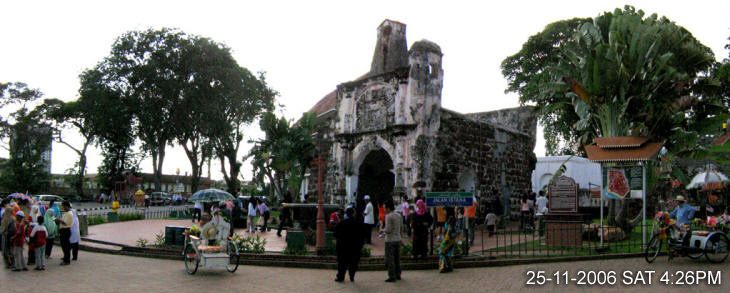
Porta de Santiago
This prominent landmark synonymous with Melaka, was a fortress built by the
Portuguese admiral, Alfonso d' Albuquerque in 1511. It was badly damaged during
the Dutch invasion in 1641. Timely intervention by Sir Stamford Raffles, a
British official, in 1808 saved what remains of the A'Famosa today.

GURDWARA SAHIB MALACCA
'Sikh Temple Melaka'
SANT BABA SOHAN SINGH JI COMPLEX
No.150-A Jalan Temenggong, 75000 Malacca
Maritime Museum
This unique museum is housed in a replica of the Flor de la Mar, a Portuguese
vessel that sank off the Melaka coast. Inside the museum are models of ships,
authentic maps, old iron chests and charts.

Melacca's rich cultural heritage comes from its various ethnic groups who are
proud of their historical links to the past.
The Malays
The Malays constitute the largest group of Melaka's population. Islam
pervades their whole way of life, including their customs or adat. The social
system of the Malays in Melaka is based on adat temenggong, which embraces a
patriarchal tradition. This custom spread subsequently to other states in the
peninsula.
The Chinese
The Chinese community forms the second largest ethnic group in Melaka and
most of them are involved in business and trading activities. The Peranakan or
Straits- born Chinese form a unique sub- group. Also known as Baba-Nyonya, they
are descendants of the Chinese who arrived in Melaka and married locals.
Described as 'Chinese in spirit and Malay in form', they retain many Chinese
customs but Malay is their mother-tongue. They have adopted the Malay-style of
dressing.
The Indians
The Indians are another important group in Melaka's colorful racial mix.
Within this group are the Melaka Chittys, descendants of wealthy traders from
South India's Coromandel Coast who visited Melaka during the 15th century and
married local women. This resulted in a unique culture where they speak and
dress like the Malays but retain their religious practices. A small community,
there are only about 250 of them in Gajah Berang.
The Portuguese-Eurasians
The Portuguese-Eurasian community number about 10,000 in Malaysia. About
2,600 live in Melaka in the Portuguese Settlement which dates to 1930. They
speak cristang, an archaic Portuguese dialect, and are Roman Catholics. The
settlement is a hive of activity during the Festa San Juang and Festa San Pedro
celebrations.
Festa San Juang or Feast of St. John begins with a candlelight procession at St.
John's Hill. It proceeds downhill to the Portuguese Settlement where a bonfire
would be lit, food served and cultural performances held. A performance to look
out for is the branya, a lively Portuguese dance where performers recite poems
while dancing.
Festa San Pedro or the Feast of St. Peter is a major annual celebration of the
Portuguese fishing community. The event honours St. Peter, the patron saint of
fishermen. The community celebrates the occasion with traditional games,
cultural performances, food fairs, blessing of fishing boats and the best
decorated boat contest.
Getting There
For those arriving by air at the Kuala Lumpur International Airport, you can get
to Melaka by taxi or air-conditioned coaches. Melaka is a 2-hour drive from
Kuala Lumpur and 2 hours from Johor Bahru. Melaka is a popular stop-over
destination for cruise ships. Ferries also ply between Melaka and Dumai in
Sumatra. The Batu Berendam airfield also receives flights from Indonesia.
Useful Contacts
Tourist Police Tel: 606-285 4114
Immigration Office Tel: 606-282 4958
Melaka Tourist Information Center Tel: 606-281 4803
Tourism Malaysia Melaka Tel: 606-288 3304 /1549 / 3785
RELATED TOPICS
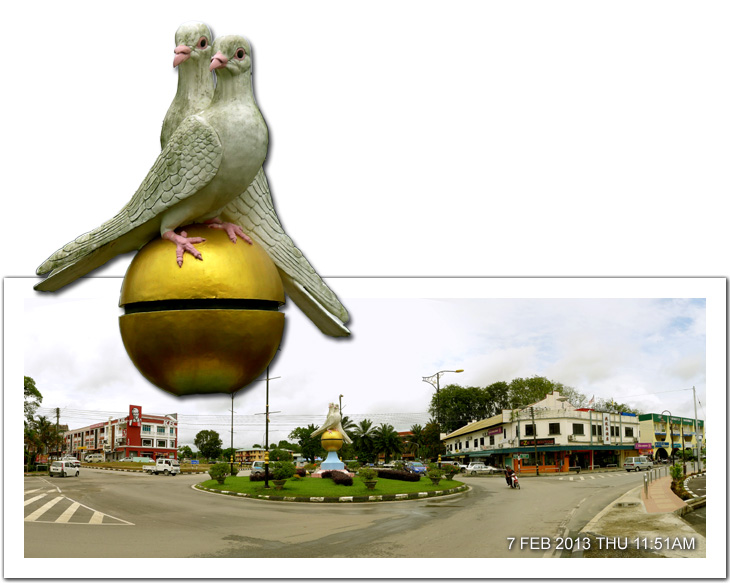
Sri Aman Town
詩里阿曼
SARAWAK
|
GO FURTHER SABAH SARAWAK THAILAND Pan Borneo
Highway
|
|
|
South East Asia |