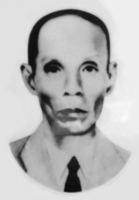
Wong Shin Chiang
黃承青
1887-1939
Age 52
Wong Family History > Family of Wong Shin Chiang 黃承青 1887-1939 Age 52
Brief History of Wong Shin Chiang 黃承青 1887-1939 Age 52 :
Wong Shin Chiang
黃承青
1887-1939
Age 52
Born : 17th December 1887 China
RIP : 3rd March 1939 Age 52 Malaysia
Hometown: 「Bu-ji」 Town, China (廣東省 寶安縣 深圳市 布吉鎮)
|
|
 |
? |
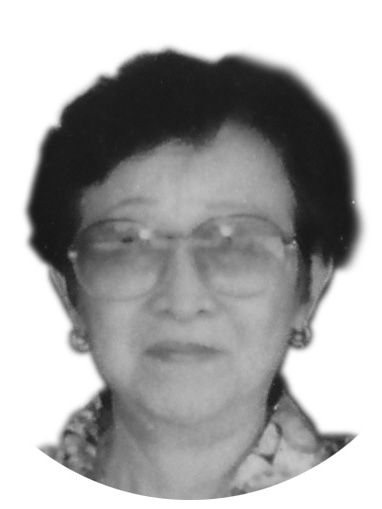
| Wong Shin Chiang 黃承青 1887-1939 |
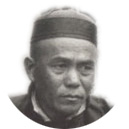
Wong Schin Khim 黃承斂/黃承謙 Image found in 2013 in Basel Mission Archives, Switzerland |
Wong ? Adaption to someone in China |

彭蓮英 PANG Len Yin (Wong Shin Chiang's wife)
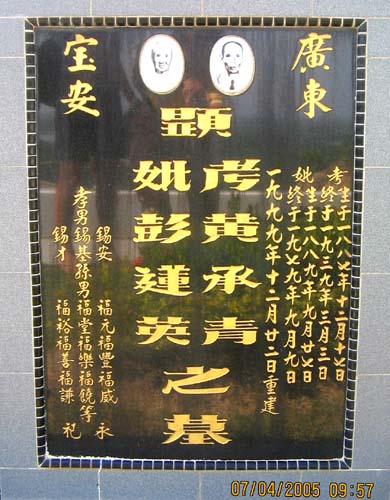
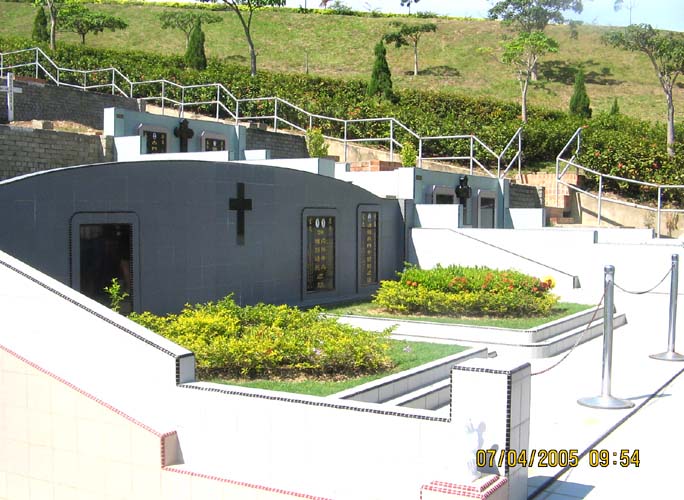
The new burial ground of Wong Shin Chiang constructed in 1999 December
22nd with remain transferred from the old grave yard in Signal Hill
Wong Shin Chiang passed away on 3rd March 1939 at age 52 in Jesselton (Today Kota Kinabalu. Local name Api) and originally buried in Basel Church Cemetery on signal hill road. In 1999 family member transfer his remain to a Tuaran cemetery in a combined grave yard with his wife Pang Len Yin吃粗米飯,長期的營養不良,致黃承青病亡

| Splendor | Glory | ||||||||
| Fook | Chun | Róng | Huá | Liàng | Yào | Guāng | Ēn | Dào | |
| MALE: | 福 | 春 | 榮 | 華 | 亮 | 耀 | 光 | 恩 | 道 |
| FEMALE: | 秀 | 美 | 熒 | 雍 | 麗 | 雅 | 姯 | 慈 |
Wong Shin Chiang 黃承青 1887-1939 has six children (3 Male and 3 Female)
 |
 |
 |
 |
 |
||
| DOB | 25-9-1911 Jesselton |
23-10-1915 Jesselton |
20-7-1919 Jesselton |
29-7-1921 Jesselton |
19-1-1924 Jesselton |
28-9-1927 Jesselton |
| RIP | 4-8-1950 Singapore Age 39 |
April 2011 Perth Age 96 |
1997-09-8 Philippines Age 75 |
19-6-2008 Kuching Age 87 |
客家人與太平天國運動(1851年—1864年)
研究太平天國的人有些困惑, 太平天國的後人很多在歷史上消失下落不明.
太平天國在清朝動亂14年 (1851年—1864年). 事實上曾經佔領了南方蠻大的一塊土地 他們的後人很多在歷史上消失,下落不明
沙巴有少數的客家人老者會承認說: "我們是太平天國的後代."
原來當年太平天國失敗後 巴色會的牧師幫助他們逃走. 一批跑來沙巴,一批到砂拉越 一批遠到夏威夷.
Hakka factitively took part in the Boxer Rebellion (Taiping Rebellion). After the movement failed many of them escape to Sabah, Malaysia and started a new life with new identity.....Since young till now I never heard any talk among the family elderly about 太平天國Taiping Rebellion. To the extend that it seems the family eldery were ignorant know nothing about this 太平天國Taiping Rebellion in China. It may not be so.
A same situation in Malaysia in modern time. During the WW2 in the 1940s, there were several revolts and battles against the Japanese in North Borneo including the Jesselton revolt, the Battle of North Borneo, and the Battle of Beaufort. When historian tracked down the revolutionist's descendents and interviewed them for history documentation, almost all the descendents of the revolution hero have the same response that they do not know the activities and happening of their forefathers. A few express surprise that their forefathers were regards as heroes.
Taiping Rebellion 1851-1864 lasted only 14 years. Yet it was one of the largest wars in Chinese history and one of the deadliest civil wars in world history. The total number of casualties is inconclusive, estimates ranging from 10 million to 70 million missing, emigrated, dead or injured.
Wong Shin Chiang (1887-1939), my grandfather, was born 20 years after Taiping Rebellion. He definitely too late to have any directly involvement in the rebellion.
Wong Shin Chiang's father, my great grandfather who is unknown with no name, most probably have has his first son, Shin Chiang, at the age around 30, making his year of birth around 1857. When Taiping Rebellion ended in 1864, this great grandfather was only 7 years old. He was also definitely too young to joint the rebellion. But what is his name? what happened to him? It remain a mystery. Someone may need to make a trip to China to find the answer.
Wong Shin Chiang's Chinese pigtail (剃髮) (“剃髮留辮”)
In WONG FAMILY HISTORY by F.S. Wong 2002 , Wong Shin Chiang wears a pony tail ( a requirement in China at that time because China was ruled by the Munchus).
He should have still wearing the pony tail by the time he landed on Kuching river bank in 1905 or 1906, because Qing Empire ended only in 1911. So after landed in Kuching with a pony tail, he continue travel to Jesselton (now K.K.) with his pony tail, got a clerical job in Jesselton Rail Way Station with his pony tail, married his wife in 1910 with the pony tail and when his first son was born in 1911 he was most probably keeping his pony tail but not for too long.But when did he and all the Chinese in Borneo had their ponytails cut off?
After China was conquered by Manchu tribesmen in 1644, Chinese men were forced to adopt the Manchu hairstyle, long hair, braided to one long braid, shaven forehead, from ear to ear.
This was the only style, until the 1911 revolution ended the rule of the Qing Empire. Young men, eager to adopt European ways, began to cut their hair after that. Long hair was regarded feudalistic and backwards in Communist China, and is still today.This unique hairstyle was originally worn by the Manchus of central Manchuria in China and later imposed on the Han Chinese. The hairstyle consisted of the hair on the front of the head being shaved off above the temples and the rest of the hair braided into a long ponytail queue.
The queue (Chinese: Biànzi) was a male hairstyle worn by the Manchus from central Manchuria and later imposed on the Han Chinese during the Qing dynasty. The hairstyle consisted of the hair on the front of the head being shaved off above the temples every ten days and the rest of the hair braided into a long ponytail. The hairstyle was compulsory for all males and the penalty for not having it was execution as it was considered treason. In the early 1910s, after the fall of the Qing dynasty, the Chinese no longer had to wear the queue. The last Emperor of China, Puyi, cut off his queue in 1922.
According to 'Wong Family History' by Christopher Wong 2002 :
"...Shin Chiang had an older missionary brother: Shin Kim in Hong Kong/Malaysia and a younger brother in China who was given away for adoption. No recorded nor verbal information on Shin Chiang’s father or why only he and his mother went to Kuching ... Shin Chiang did try to look for his older brother Shin Kim in Malaysia/Hong Kong twice but was unsuccessful...."
In between 1975-1977 one day I had a casual conversation with Grandma, Phang Lien Yin, she mentioned something about one of Wong Shin Chiang's long lost brother "....you have a Suk-Kong (Grand-uncle) Wong Shin Kiam in Fiji Island............(before he went to Fiji Island) many years we received his letters from China ....we wrote letters to him in China ............latter (after the WW2) we lost contact with each other........"
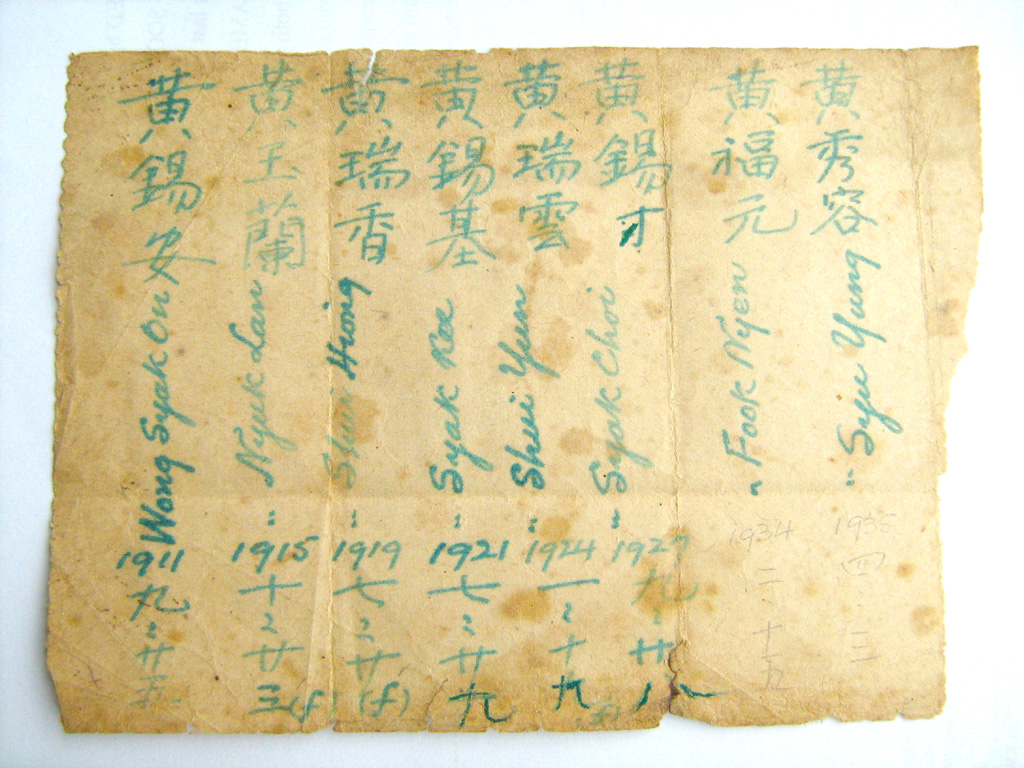
Hand written note of birthday of eight children and grand children by Wong Shin Chiang. Photographed on 22nd March 2008 in Kuching. On 22nd March 2008, Siew Don shown me this piece of paper.
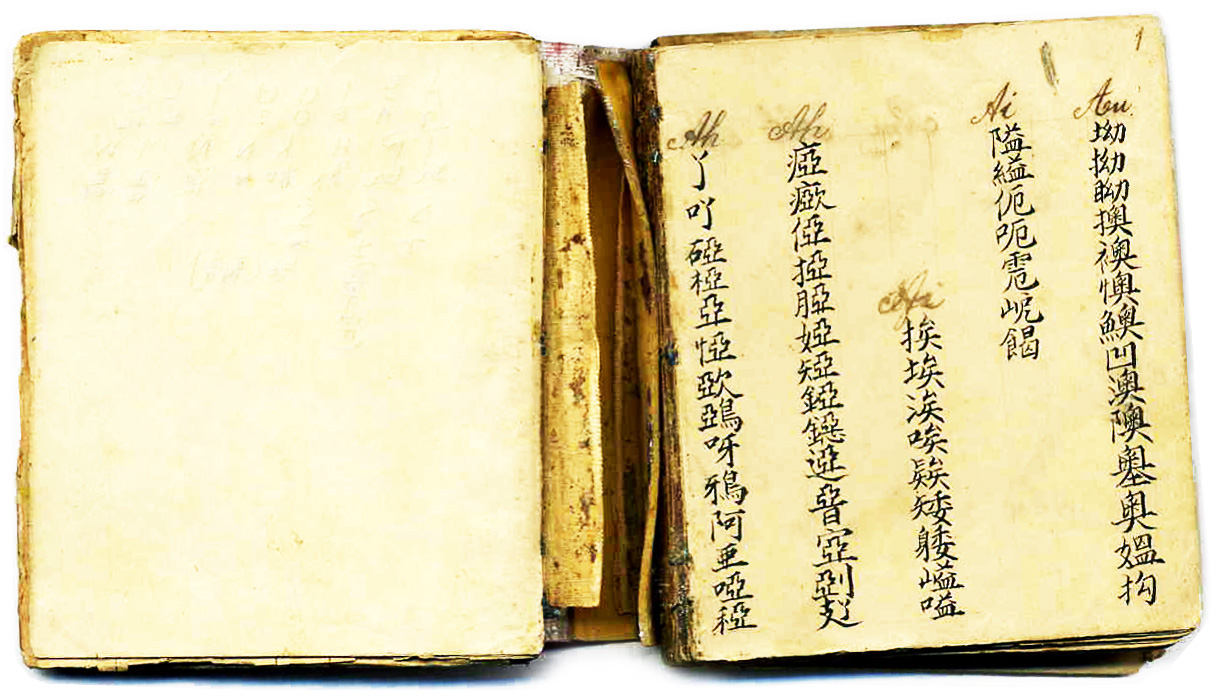
A hand copied HAKKA SYLLABARY by Wong Shin
Chiang
羅馬字注音(羅馬拼音)
A Chinese Syllabary Pronounced According to the Dialect of
Hakka (客家音韻彙)
The original HAKKA SYLLABARY was believed to be started by Christian Missionaries from Switzerland who came to China and started to compile a HAKKA SYLLABARY in order to master the Hakka dialect and to translate the Bible into Chinese.
Wong Shin Chiang's wife Phang used to relate that when Chiang first arrived in Jesselton in early 1900 looking for job in the railway station, the station master tested him to write something to show his ability. It was Chiang's neat and nice hand writings that won him to a clerical job in the Jesselton Railway Station till his passing in 1939.
Remote and mountainous Longyan has long been known as an ancestral Hakka homeland. About 1.2 million overseas Hakka trace their roots to Longyan, and 700,000 to 800,000 Hakka of Longyan origin live in Taiwan.
The Hakka, a subgroup of the Han people, live predominantly in the provinces of Guangdong, Jiangxi and Fujian. Their ancestors are thought to have arrived centuries ago from what is today's central China.
According to statistics released at the 12th World Hakka Convention in 1994, there are more than 65 million Hakka around the world, with 61 million in China's mainland and Taiwan.Wong Shin Chiang has nice hand writing. According to his wife, it was because he has good hand writing that he got the clerical job in the railway office in Jesselton in the 1910s
This hand copied HAKKA SYLLABARY by Wong Shin Chiang has a unwritten story behind:
1880s. It is believed that this was a project originated by the German speaking Christian Missionaries from Basel of Switzerland in the 1880s in Southern China. With the purposes for foreigners to learn the Hakka Dialect in order to preach the bible among the Hakka villagers in Southern Guangzhou.
In preparing this HAKKA DICTIONARY, the German speaking missionaries from Switzerland enroll local Hakka speaking assistants. Wong Schin Khim 黃承斂/黃承謙 as a local missionary of the church might have involved in the editing of this Hakka Dictionary.
1900s Wong Schin Khim 黃承斂/黃承謙 has a young brother Wong Shin Chiang 黃承青study in the same Missionary's Boy School. With this Hakka Dictionary available from the elder brother Schin Khim , this younger brother Shin Chiang might have copied by hand a complete set from the main book. In around 1905, the 18 years old young brother Shin Chiang leave China to Borneo Island. Among the few valuable he carried with him was this his hand copied Hakka Dictionary ......... he eventually became my grand father and his hand copied dictionary was seen by me.
Mean while Wong Schin Khim 黃承斂 remind in China in his missioner post involving the Switzerland's project of editing and compiling the Hakka Dictionary. His young son Wong Shik Ling 黃錫凌 was also studying in the same missionary school and grew up in this Western scholarly environment............and became a prominent scholar in another dialect Cantonese.
1940s Wong Shik Ling 黃錫凌, the son of Schin Khim published his book of A Chinese Syllabary Pronounced According to the Dialect of Canton 粵音韻彙 in the 1940s.
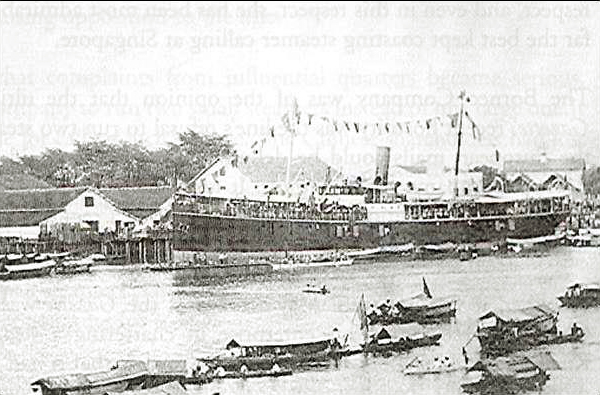
Kuching 1905 / 1906
Some photographs of Kuching around the year
1905 and 1906. These photographs were from internet resources.
RELATED TOPICS
-
|
|
History |

