eTawau > Insects of Borneo > Wasps > A sand wasp at the Semarak football fields
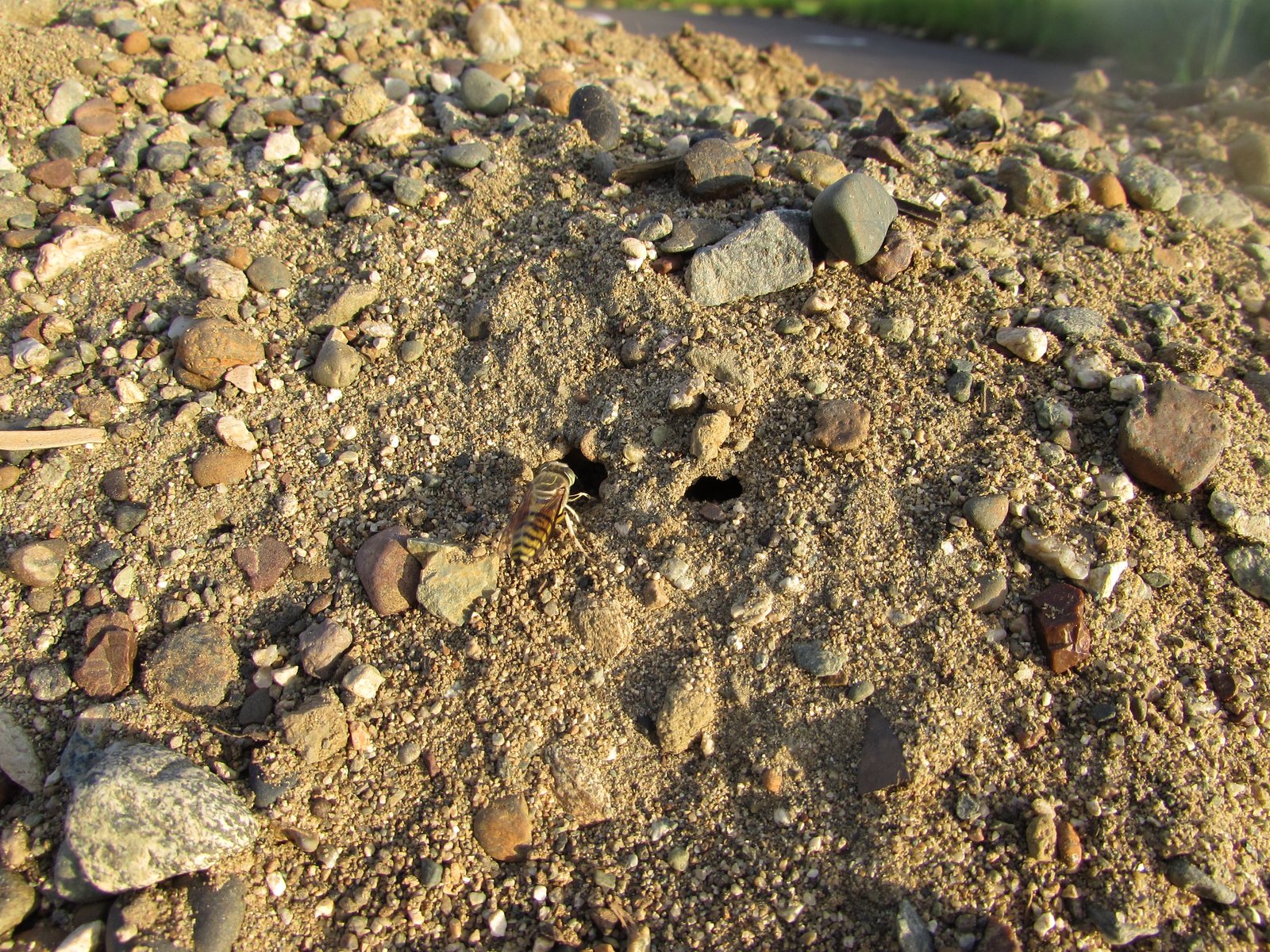
A sand wasp digging its burrow in a heap of building sand beside the public football fields opposite Pasar Semarak, on a warm June evening in 2016
I often walk round the two public football fields opposite the Semarak Fresh Market in the evening. In June 2016 a heap of sand and gravel had been left beside them for building the new toilet, and on it a yellow-and-black insect was digging a hole. It dug at the entrance, flew off, came back a few seconds later and dug again, flew off for longer, came back, and kept on repeating it. I had seen wasps dig holes in the ground before, but I took this one for a fly, and I had never seen a fly dig. It turns out I had not seen one this time either.
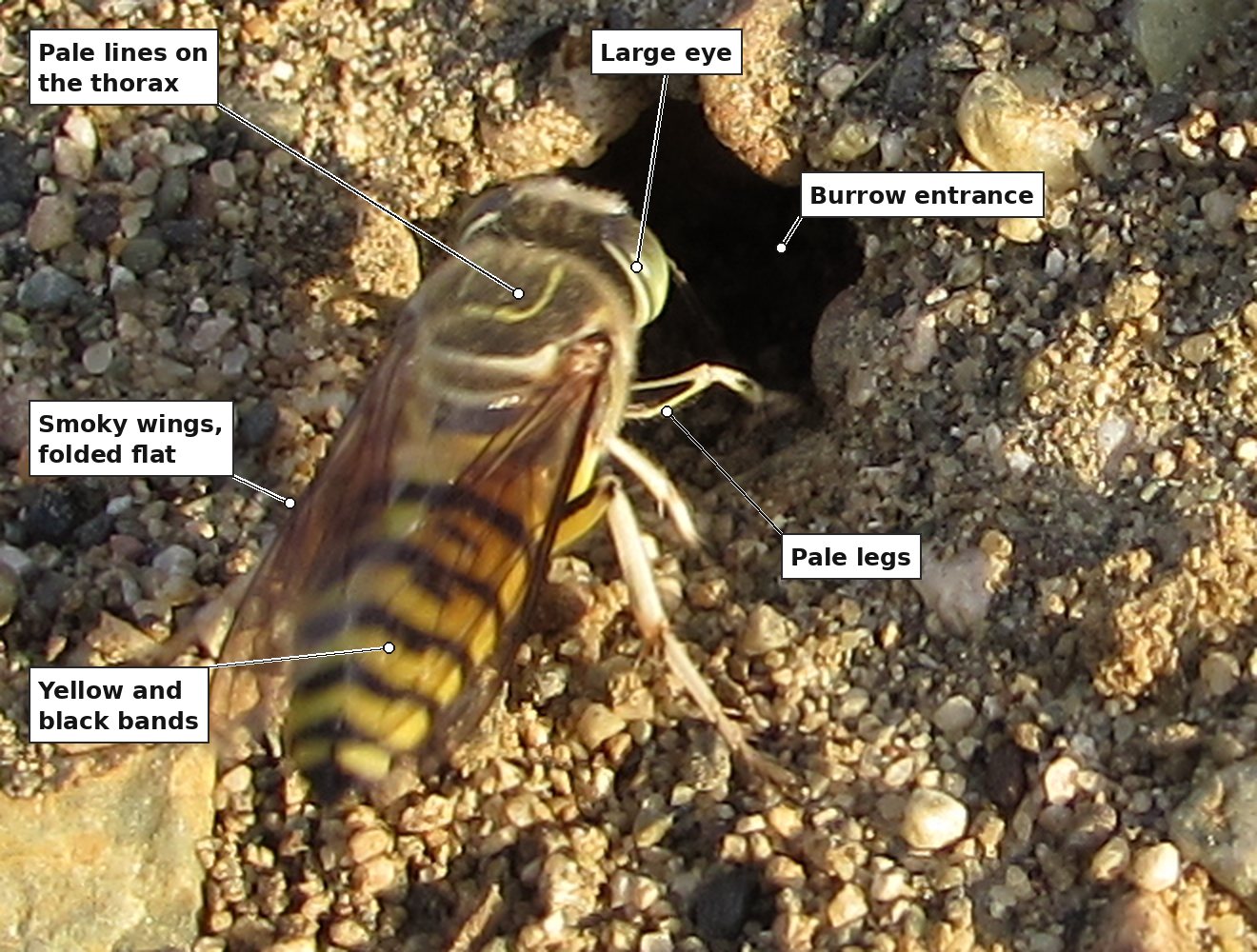
It is easy to see why it passed for a fly. It has big eyes, a stout body, and it moves in quick, darting flights. But look at the other photograph, taken two minutes earlier from above:
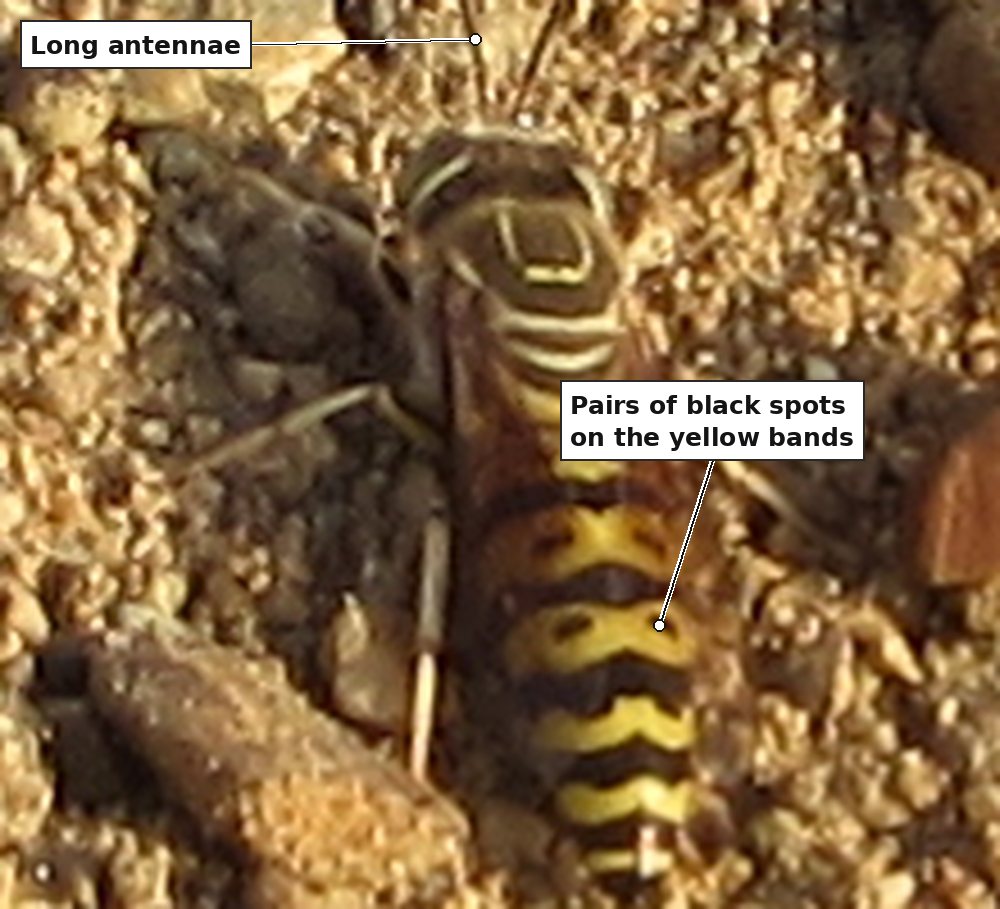
Sand wasps, tribe Bembicini, are solitary wasps that nest in bare sand. The yellow bands with pairs of black spots, the pale lines on the thorax, the big pale-green eyes and the habit of digging in loose sand all fit the genus Bembix.
A female sand wasp digs a burrow for each young one and lays a single egg in it. Many Bembix species then do something unusual for a solitary wasp: instead of stocking the burrow all at once and leaving, the mother keeps feeding the larva as it grows. She hunts flies, stings them, carries them home and pulls them into the burrow, one after another, for days. Each time she leaves she closes the entrance with sand, and each time she comes back she digs it open again, often within seconds.
That is what the photographs and the video show: dig, go in, come out, fly off, come back, dig again. The short trips may have been checks or orientation flights; the longer ones, hunting. So the insect I took for a fly makes its living catching flies.
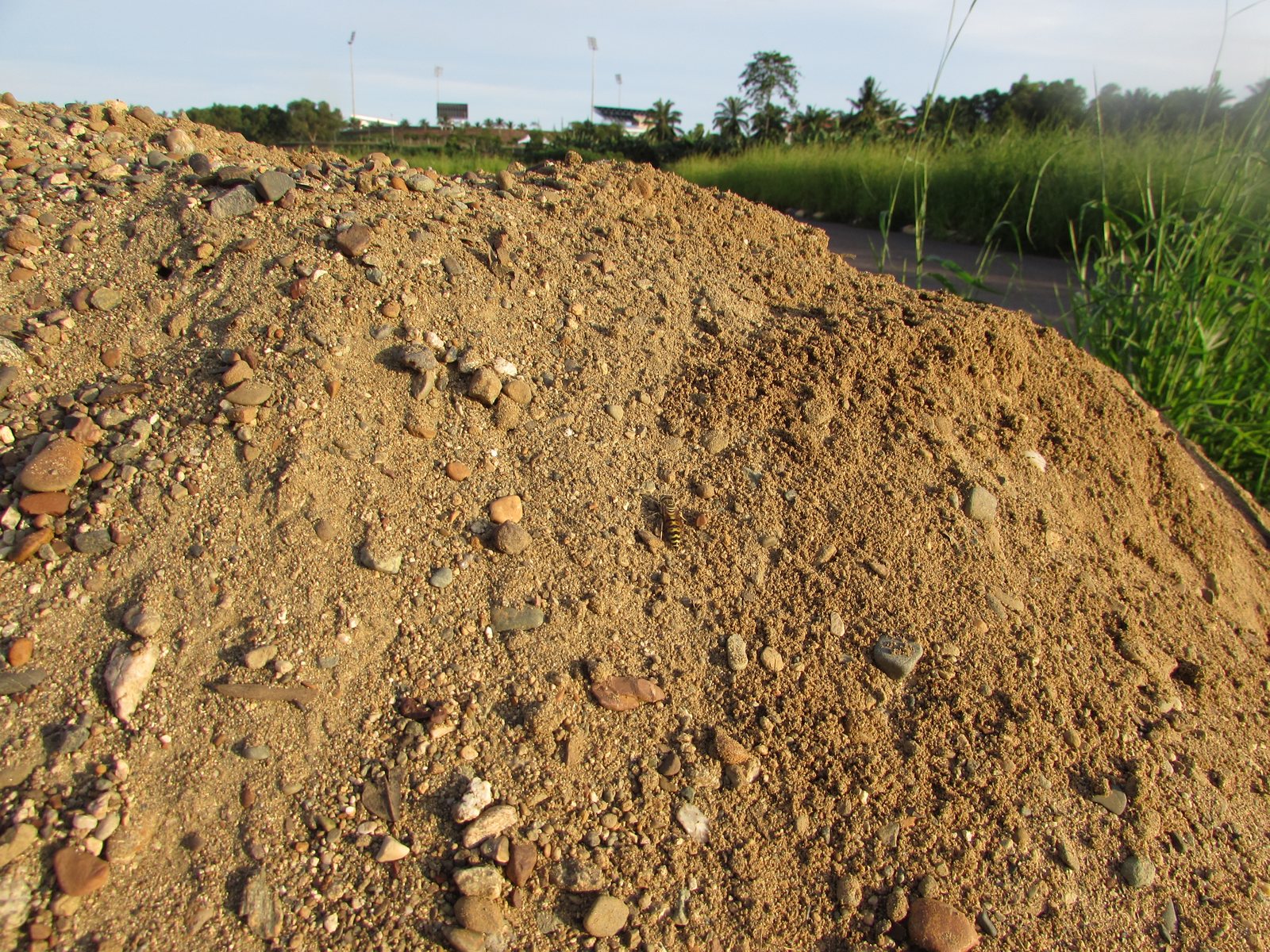
There was nothing beside it to give a scale, so this record has no size. The pebbles in the heap are a rough guide only, because they vary so much. Sand wasps of this kind are usually somewhere between about 1 and 2.5 cm long.
The two public football fields opposite Pasar Semarak, Jalan Kuhara, Tawau, Sabah —
inside the Tawau River Triangle, on ground
that has been cleared and built over. The fields belong to the sports facilities of the
Tawau Sports Complex; they lie outside the complex's compound, about fifteen
minutes' walk from it. The wasp was on a heap of sand and gravel left beside the fields for building
their new toilet. One wasp, not measured, alone, digging at the entrance of a burrow,
with a second entrance a few centimetres away; flying off and returning again and again.
Hymenoptera: Bembicidae: Bembicini — a sand wasp, probably Bembix; genus
and species not determined. Two photographs, 17:38:50 and 17:40:38, and a
10.6-second video at 17:40.
— iNaturalist observation
404617783
About the photographs and the video. Two photographs and one video by Wong Fook Yee
with a Canon PowerShot SX510 HS, no flash, at 17:38:50 and 17:40:38 and 17:40 on 26 June 2016 beside
the public football fields opposite Pasar Semarak, Tawau, Sabah. The photographs are camera originals
that had never been opened in an editor; for this page they have been reduced, cropped and labelled,
and nothing has been sharpened, recoloured, added or removed. The video has been shortened from 10.6
to 8.3 seconds at the end, reduced from 1920 × 1080 to 1280 × 720, and its sound removed. The still
used as its poster is a frame from the video.
The account of sand wasp nesting and feeding is from the general entomological literature on
Bembix, including Evans & O'Neill, The Sand Wasps (2007). The locality, date,
weather and behaviour are the photographer's own. All photographs and video © Wong Fook Yee. Page
written 30 September 2026.