eTawau >
Environment > Tawau River Triangle
Tawau River Triangle
The abandoned plantation by the Tawau River, opposite Pasar Semarak — a fifty-year-old oil
palm estate, given back and left alone, and what is living in it now
About seven kilometres from Tawau town, at Km 7 of Jalan Kuhara, there is a wedge of
ground on the bank of the Tawau River, downstream and opposite
Pasar Semarak. From the road it looks like nothing at all: ragged old oil palms,
undergrowth coming up between them, leaf litter, and the river alongside.
I have been walking it on Sunday afternoons for years with a camera. It is one of the most
productive pieces of ground I know, and the reason is its history.
About the name. Tawau River Triangle is my own name for this block,
and I have started using it on this site because the block needs a name and had none. It is not an
official name and you will not find it on a map or in a land office file. Until now I have called it
the abandoned plantation by the Tawau River, which is a description rather than a name and
is still the right description. If you are looking for this ground on a map, use the roads below.
Where the Triangle is
The block is a triangle, and its three sides are roads. That is the easiest way to find it:
- The tip, at the north — the big roundabout on Merotai Road.
- One side — Jalan Kuhara (Kuhara Road) running down from the
roundabout.
- The other side — Jalan Utara Baru (Hill Top Road), also running
down from the roundabout.
- The base — an unnamed road that links Jalan Kuhara to Jalan Utara
Baru and closes the triangle.
The map. I have drawn the Triangle on a Google map:
Tawau River Triangle — my map.
Inside those three roads was one old oil palm plantation, converted to development land for the
township more than thirty years ago. It has not gone all at once. The lower part, towards
the base, has been built over during those thirty years. The northern part, towards
the tip, is still standing as abandoned plantation, and that is where three of the ten
records below were made: old palms, undergrowth, dead wood and the river. A fourth comes from the
river bank at the White Bridge, where Jalan Kuhara crosses the Tawau River and the
river enters the Triangle, and a fifth from the
built-over part, beside the public football fields. Roughly one
kilometre of it is walkable riverside, and that is the ground I know.
Inside, outside, near. The value of a boundary made of roads is that it lets me say
exactly where something was. From now on every record from this part of Tawau is placed as one of
three things:
- Inside the Triangle — within the three roads.
- Outside the Triangle — across one of them. The papaya garden,
for instance, is on the far side of Jalan Kuhara, so it is outside.
- On the boundary — on one of the three roads themselves. The bus stop on Jalan
Kuhara opposite Pasar Semarak is on the boundary: neither inside nor outside.
- Near the Triangle — close enough to be the same country, not close enough to
claim.
Records made before I had this boundary are placed the same way now, by where they actually were.
That is why four of the ten below sit outside a page named after the Triangle: the records have not
moved, only the accuracy of the description.
It will not last. The southern half went in thirty years. There is a great deal
still living in the northern half, and on present form it will not be there in another thirty, when
construction reaches it. That is the whole reason for dating and placing the records below. Nobody
can photograph this ground after it is gone.
What happened to this land
Three layers, and only the top one is visible:
- Today — an abandoned oil palm plantation. The palms are about
fifty years old and past productive age. As I understand the history of this block, the owner
chose not to replant, and transferred the land back to the government for rural
development.
- Fifty years ago — secondary forest, cleared to plant it.
- A hundred years ago — primary forest.
So this is neither plantation nor forest. It is ground in between: old palms going
over, undergrowth returning, dead wood accumulating where nobody clears it, and a river running past.
That combination is the whole explanation for what follows.
An abandoned plantation is not a forest, and I am not going to pretend it is one.
Fifty years of oil palm leaves ground that is nothing like the primary forest that stood here in my
grandparents' time, and it will not be like it again in my lifetime or my children's. What it is
instead is ground that has been let alone — and letting ground alone turns out to
be enough for a surprising number of animals. That is worth documenting while it lasts, because the
land is now in public hands, and what happens to it next is a public decision.
What is living there
Ten records so far, made between 2007 and 2016 — five inside the Triangle, four just
outside it across Jalan Kuhara in the papaya garden, and one on the boundary,
on Jalan Kuhara itself. They are on this site because each one is dated and
placed, and because together they say something the individual records do not.
7 July 2007 · 3:55 pm · the river bank at the White Bridge — inside the Triangle
An antlion resting by the river

Not measured. Long, grey-brown and perfectly still on a dry stem on the bank, where
the Tawau River comes into the Triangle under the White Bridge on Jalan Kuhara. I
moved it onto a leaf for the photographs. For years this site listed it as a dobsonfly; the short
antennae curling into clubs make it an antlion (Neuroptera: Myrmeleontidae), an adult
that spends the day resting on stems and is active after dark. Its larva is the "lion": in many species it
digs a pit in dry sand and waits at the bottom for ants.
The earliest of the records on this page.
— Not a
dobsonfly — an antlion
29 July 2007 · 3:35 pm · the papaya garden — outside the Triangle
A black butterfly caterpillar with blue spines
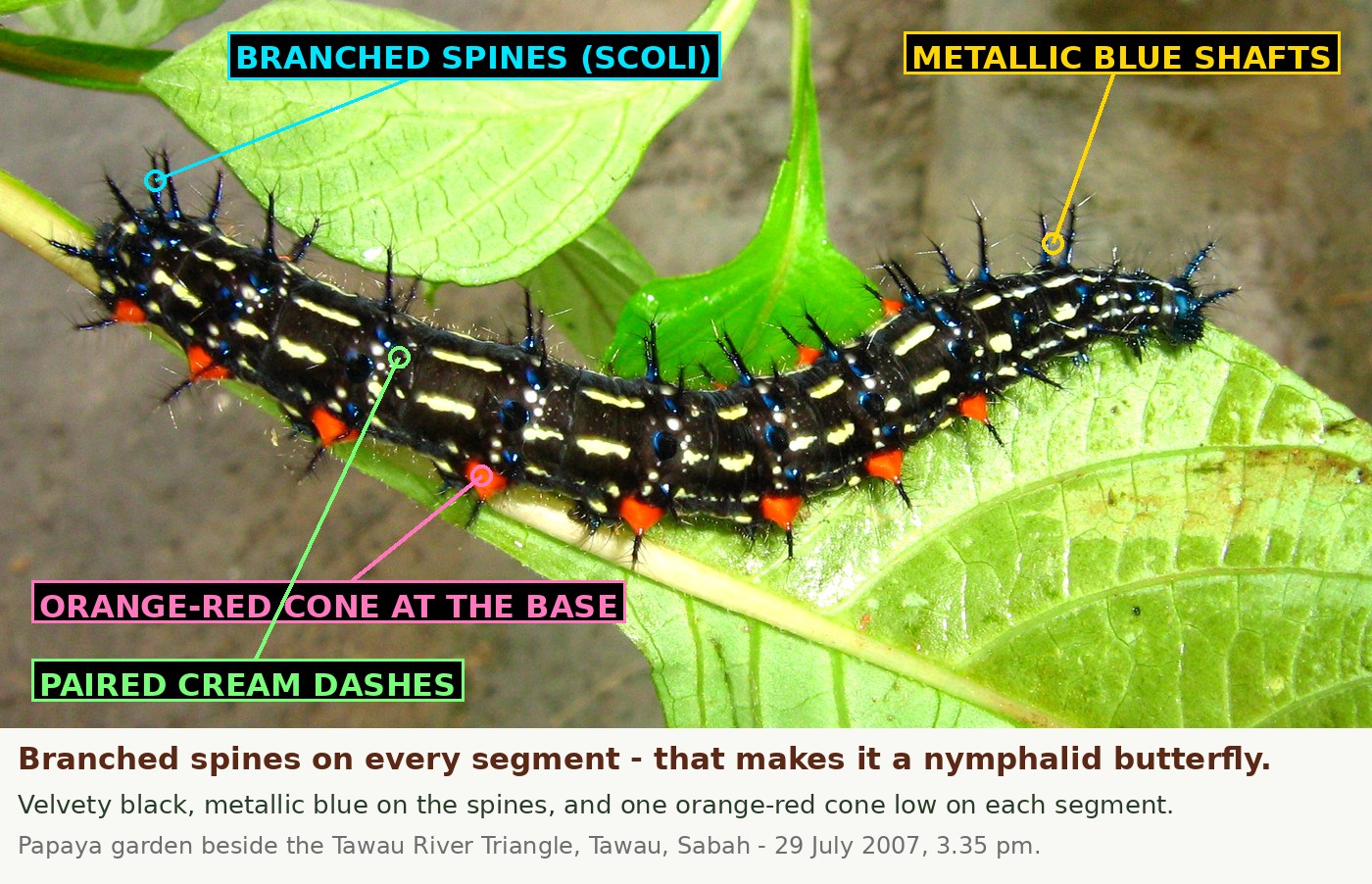
Not measured. Velvety black, with branched spines whose shafts
flare iridescent blue, two broken rows of cream-yellow dashes down the back, and one orange-red cone
low on each segment. Branched spines like these — scoli — make it a
butterfly caterpillar: Lepidoptera: Nymphalidae, the brush-footed
butterflies. Genus not determined, and it cannot be from one photograph.
The earliest record on this page, and the third from the papaya garden outside the
Triangle. It is also a single snapshot taken before I kept series, scales and host plants — which is
exactly why it has no name.
— Black,
spined, and blue in the right light
1 October 2008 · 3:41 pm · the papaya garden — outside the Triangle
A caterpillar with its bristles in bunches
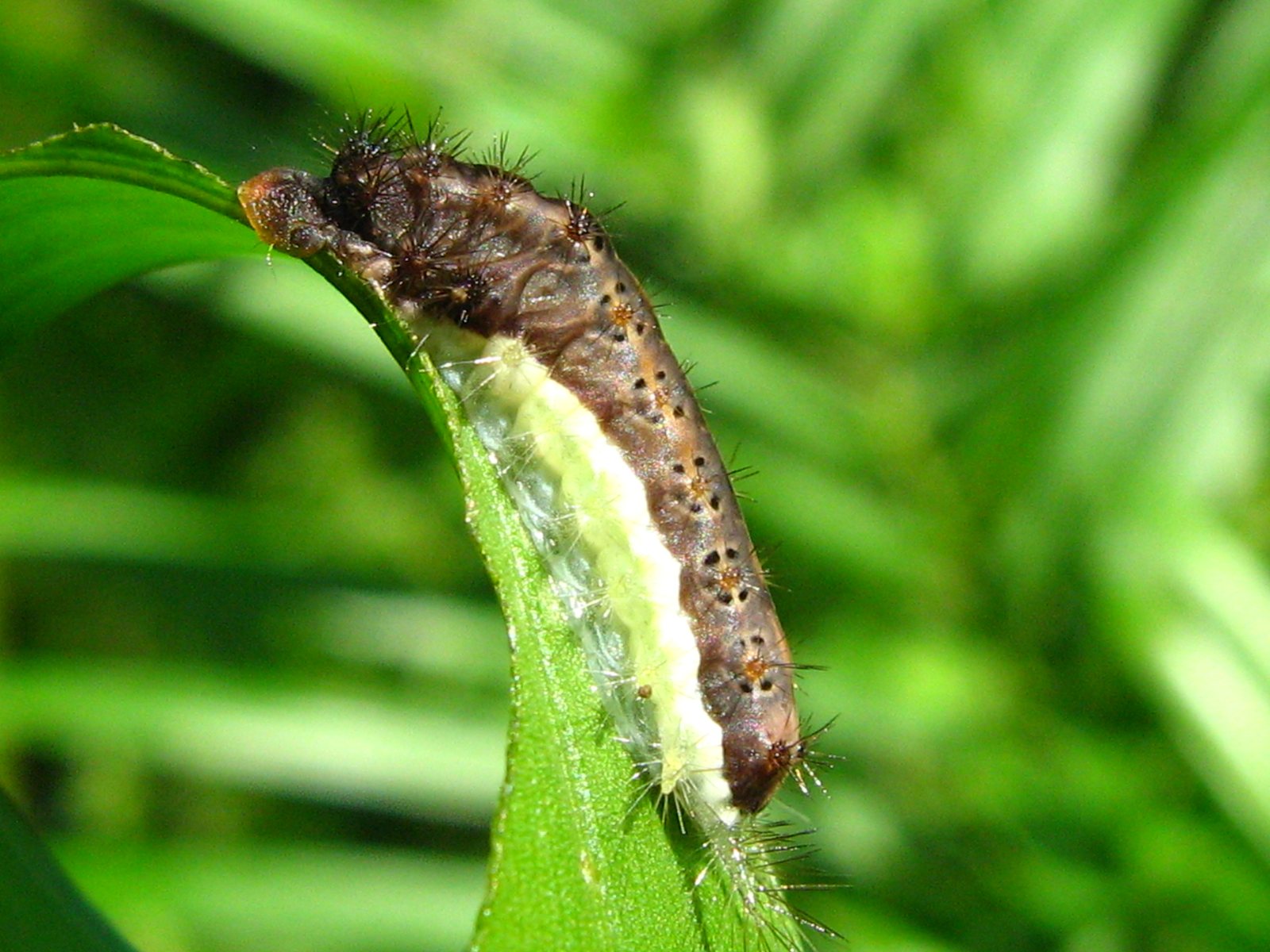
Not measured, and no longer than about 55 mm. Lying still along the edge of a leaf I did not identify. Its bristles grow in
bunches from raised warts, which points towards the tiger moth and tussock moth
family, Erebidae. But it has none of the four back brushes of a tussock, so the name stops at
Lepidoptera.
Found on an afternoon walk along the farm path. My note on the garden:
"The drain near by keep small insects population thriving."
— Bristles in bunches
8 August 2010 · 5:04 pm · among the palms
A trilobite beetle in the leaf litter
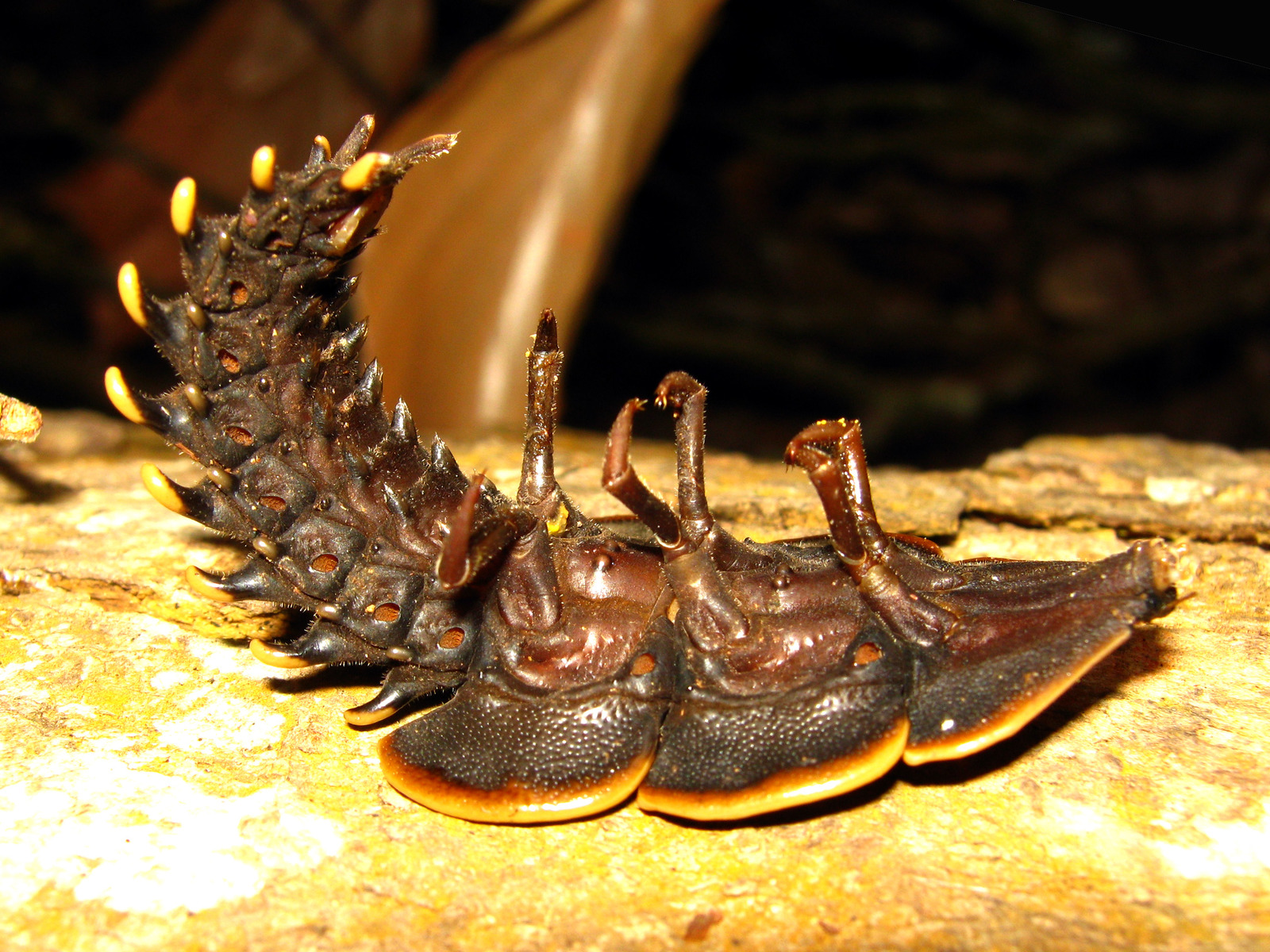
About 40 mm, dark, flattened, and built of overlapping plates — crawling steadily
through ground debris among the old palms. A trilobite beetle (Lycidae, almost
certainly Platerodrilus), and an animal of rotting wood, fungi and slime
moulds. In this group the female never grows up: she keeps the larval body for life and
never develops wings.
Turned on its back so that it would stop travelling, and moved onto a fallen branch for the
picture — both facts are on its own page, because a reader is entitled to know how a photograph was
obtained.
— Trilobite beetle — Tawau
River
21 June 2009 · 2:04 pm · grassy scrub on the bank
A white mealybug on a blade of lalang
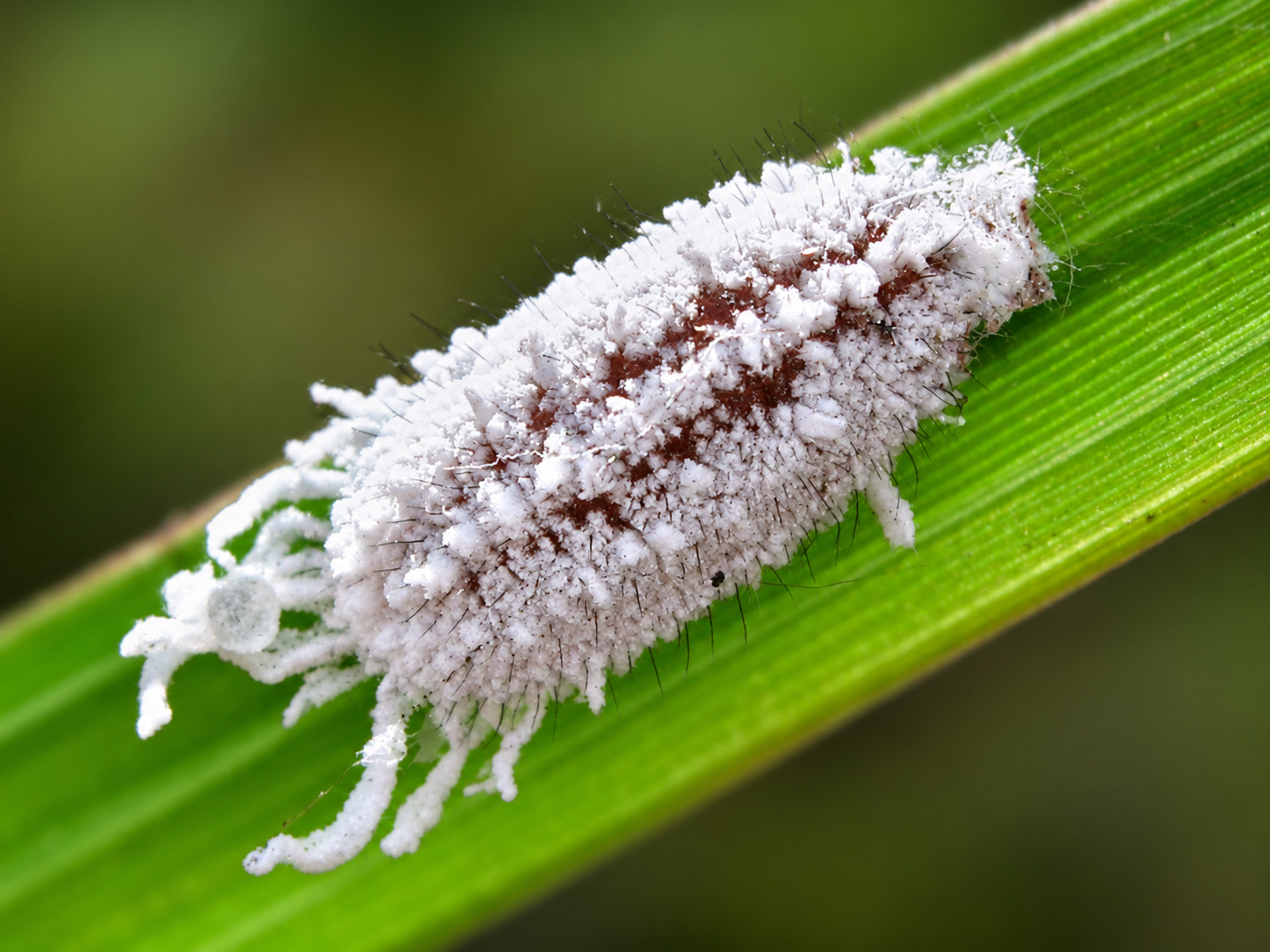
Under 10 mm, snow white, alone and motionless on a blade of the long sharp-bladed
grass we call lalang, with ants on the same plant. A mealybug
(Hemiptera: Pseudococcidae), genus not determined.
My own note on finding it is the best thing about the record: it was
"easily skip attention because it look like a debris on the grass". That is exactly
right. A coat of white wax on a green blade reads to the eye as dust, or fungus, or a bird dropping
— anything but an animal.
— White mealybug on a grass
blade
19 July 2009 · 5:31 pm · the papaya garden — outside the Triangle
A dead weaver ant queen with fly larvae
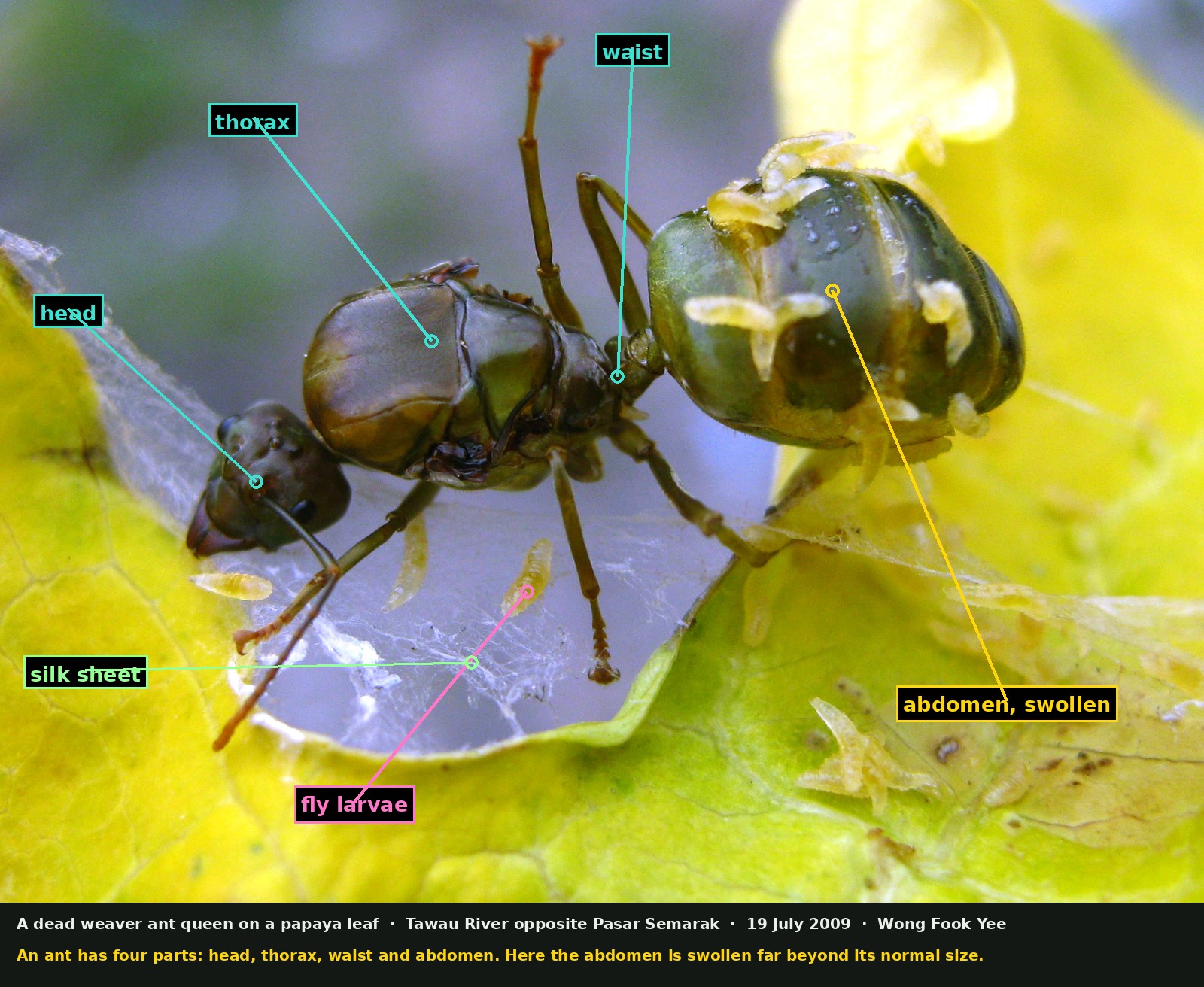
About 15 mm and green, lying on a sheet of fine white silk across a dying papaya
leaf with pale fly larvae on her. A queen weaver ant — most probably
Oecophylla smaragdina, the kerengga, whose workers everyone knows as red
and whose queens are green.
This one came from the papaya garden across Jalan Kuhara, like the two
caterpillars above, so it is outside the Triangle. It is here because the garden and the plantation are
the same piece of country with a road drawn through it, and a weaver ant colony does not read road
signs. But the boundary is worth respecting in the description, so: outside.
— The green queen and the
maggots
26 June 2011 · 4:24 pm · on bare ground among the palms
A jewel beetle that could not fly
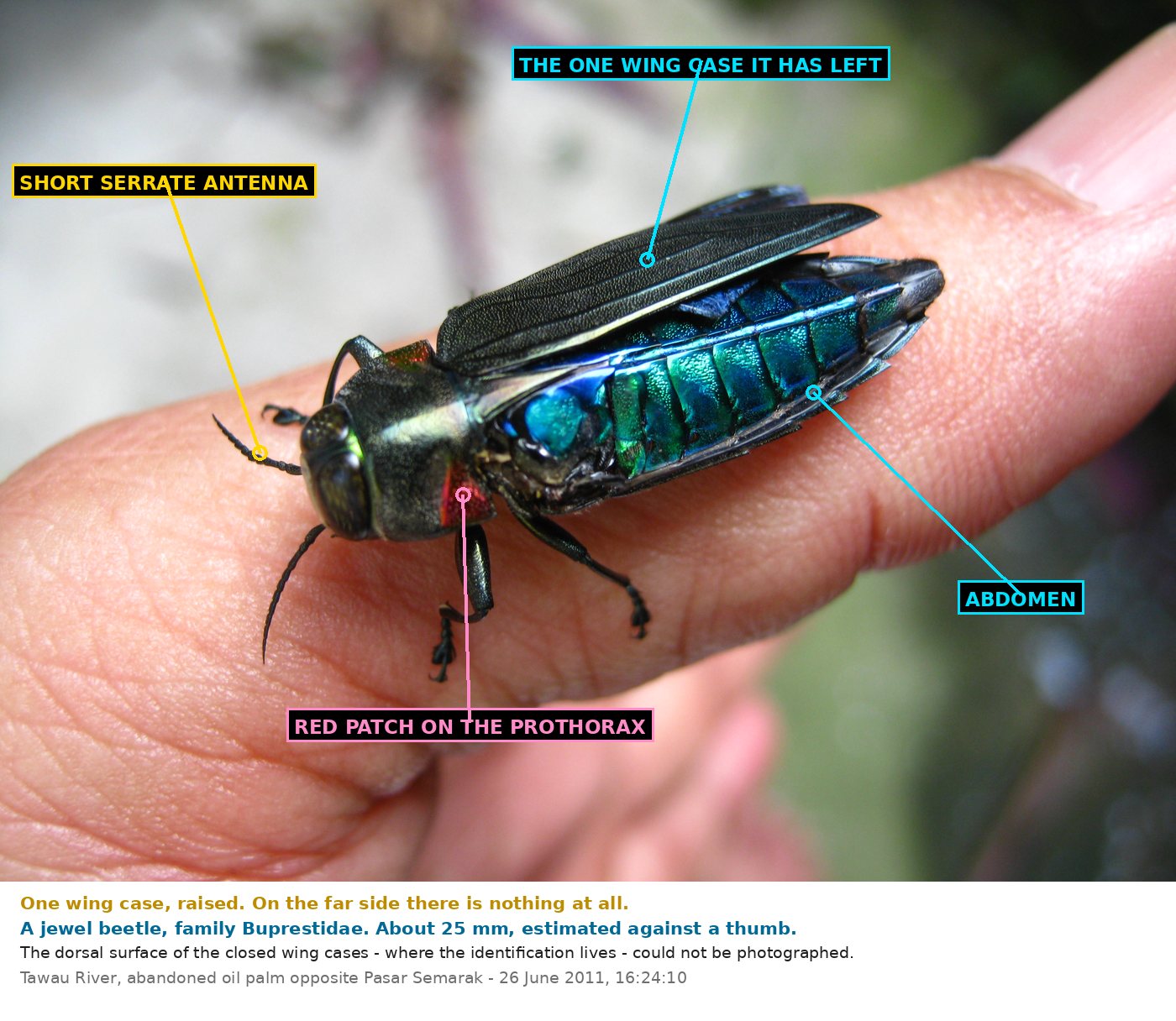
About 25 mm, with blackish wing cases and an abdomen of brilliant metallic blue and
green, and a bright red patch at each corner of the prothorax. A jewel beetle
(Coleoptera: Buprestidae) — the family whose larvae are flat-headed borers,
tunnelling in dying and dead wood.
I found it on the earth, unable to fly, and the reason was plain once I had it in my hand:
the whole left side of its flight equipment was gone — wing case and hindwing
together, off the same shoulder. One hindwing cannot lift a beetle, and it cannot balance one
either. On my thumb it raised the wing case it still had, beat its one wing, and stayed exactly
where it was.
— The jewel beetle with
one wing
23 December 2011 · 3:41 pm · the papaya garden — outside the Triangle
A tussock moth caterpillar eating a palm
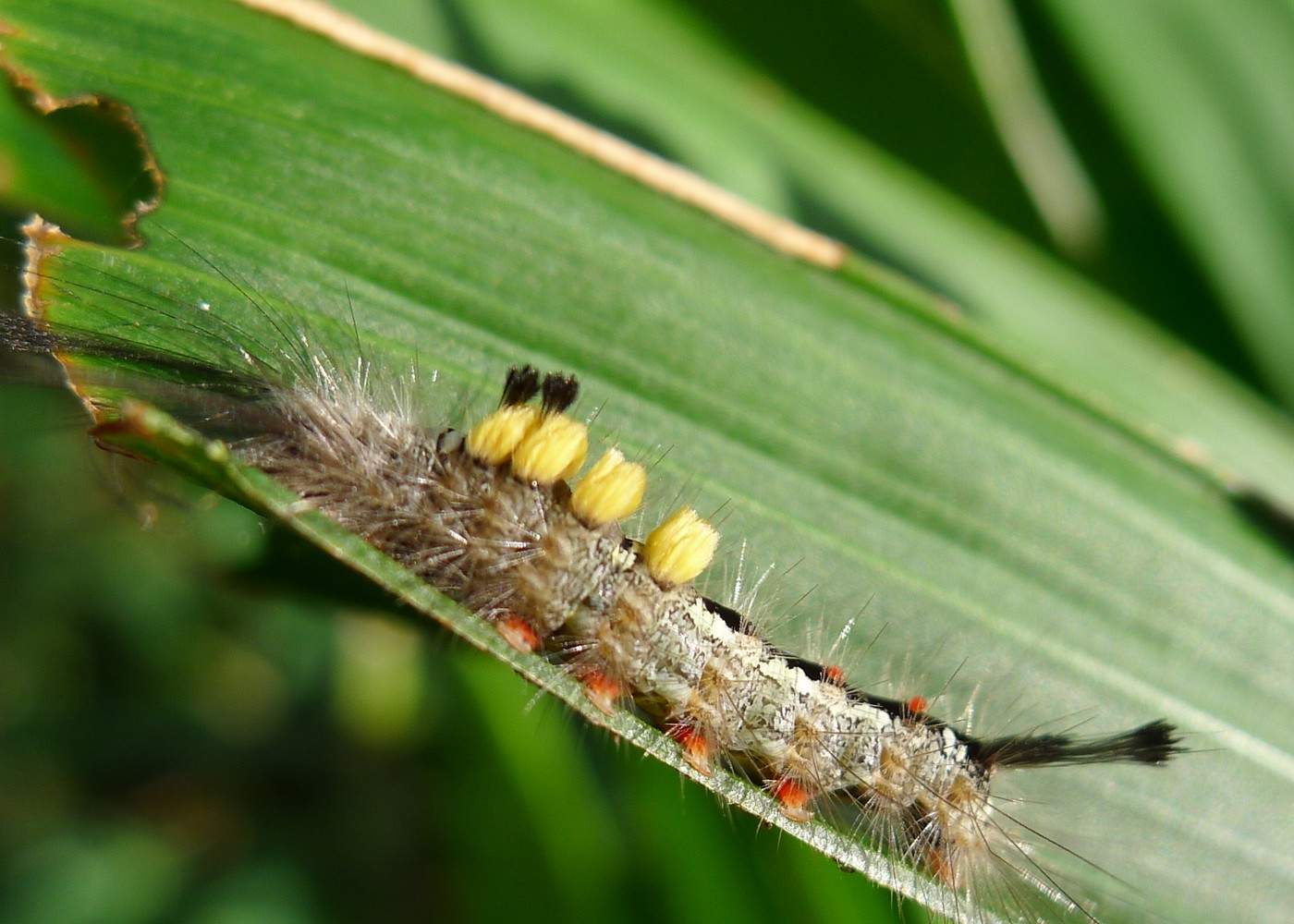
Not measured, and this one cannot be measured afterwards either — the camera that
took it does not record a focus distance. Four short cream-yellow brushes standing up on the back,
two long black hair pencils forward and one behind: a tussock moth caterpillar
(Lepidoptera: Erebidae, subfamily Lymantriinae), lying along the cut edge of a palm leaflet
at the point where it had been feeding.
Another record from the papaya garden, outside the Triangle.
Worth noticing, and no more than noticing: a palm-eating caterpillar in a garden across the road
from a kilometre of unmanaged oil palm. Do not pick these up — the hairs are urticating.
— Four
brushes and three pencils
27 July 2013 · 7:09 am · the bus stop on Jalan Kuhara — on the boundary
A pair of stink bugs mating on the road
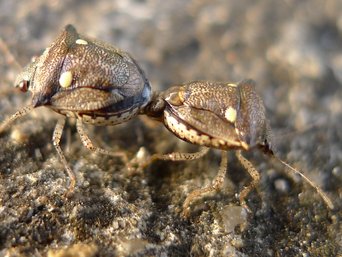
Not measured. Two small brown shield bugs, finely dotted, joined end to end on the
road surface beside the bus stop opposite Pasar Semarak, where I waited in the
mornings for the company van to work. Beside the road is the old oil palm, overgrown with bushes;
they had probably flown out of it and landed on the tar. A stink bug pair
(Hemiptera: Pentatomidae); the cream spot at each front corner of the scutellum
suggests Eysarcoris, not yet confirmed.
Jalan Kuhara is one side of the Triangle, so this record is on the boundary, and it
is the only morning record on this page.
— Stink
bugs mating on the road
26 June 2016 · 5:38 pm · the football fields — inside the Triangle
A sand wasp digging in a heap of building sand
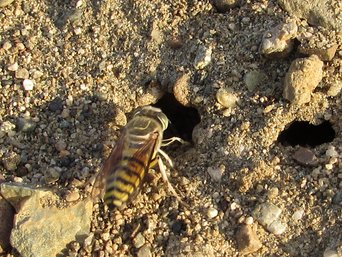
Not measured. Yellow and black, with big pale eyes, digging a burrow in a heap of
sand and gravel left beside the public football fields opposite Pasar Semarak for
building their new toilet — the fields belong to the
Tawau Sports Complex. It dug, flew off, came back and dug again, over and over. I took it for a
fly. It is a sand wasp (Hymenoptera: Bembicidae, tribe Bembicini — probably
Bembix), a mother digging a nest for her young and flying off to hunt the flies she feeds
them on. There is a short video of it at work on its page.
The only record here from the built-over part of the Triangle: a heap of building
sand is not habitat anyone would plan, but to a sand wasp it is as good as a river bank.
— The wasp
that looked like a fly
What the ten records say about the land
Taken one at a time they are ten small animals. Taken together they describe the ground.
- Two of the ten depend on dead wood. The trilobite beetle lives on rotting wood,
fungi and slime moulds; jewel beetle grubs tunnel in dying and dead timber. An abandoned
plantation accumulates exactly that, because nobody is clearing the fallen palms or the scrub
that comes up between them. Neglect is the habitat.
- No two are in the same place. Leaf litter among the palms; open grass on the
bank; bare earth; plants on the river bank where the river comes in under the White Bridge — four
habitats inside the Triangle, lying side by side, which is another way of saying that nobody has
tidied it. The fifth inside record is on the other
kind of ground entirely: a heap of building sand beside the football fields, on the part that has
already been built over. The other four are all in the papaya
garden across Jalan Kuhara: cultivated ground next door, which is what most of
the Triangle will become. The tenth is on the road between them: a pair of stink bugs that had
probably flown out of the bushes beside it.
- Nearly half of everything here comes from outside the boundary. A weaver ant
queen founding a colony, a moth caterpillar eating a palm seedling, another resting on a leaf, and
a butterfly caterpillar on a shrub — four records, all in a garden a road's width from a kilometre of unmanaged oil palm.
The garden is not a separate place; it is the edge of this one. Which is the
argument for recording outside a boundary as well as inside it, and for always saying which is
which.
- Nothing here is rare or spectacular, and that is the point. It is the ordinary
invertebrate life of recovering ground, which is precisely the thing nobody photographs, and
therefore precisely the thing nobody can show later.
Ten records is not a survey, and this list says as much about me as about the place.
Look at the times: 2:04, 3:35, 3:41, 3:41, 3:55, 4:24, 5:04, 5:31 and 5:38 — nine of the ten in the
afternoon or early evening. The tenth, at 7:09 in the morning, is there only because I was standing
at the bus stop waiting for my transport to work. That is not when the animals are out — that is when I go. I walk this strip on Sunday afternoons, so Sunday afternoons are what the list
records. A proper picture of this ground would need early mornings and nights with a torch, and
somebody to walk it who is not me.
Why I keep going back
Because this is the commonest kind of land in Tawau district now, and almost nothing is written down
about it. We have accounts of the forest reserves and accounts of the working plantations. The
in-between ground — worked out, handed back, left — is everywhere, and it is invisible.
If this strip is developed, the record on this page is what there was. If it is left, the record is a
baseline that somebody can come back and measure against. Either way it cost nothing but a camera and
a Sunday afternoon, and it cannot be reconstructed afterwards.
Photographed and left. Every animal on this page was photographed where it was found
and left there. Nothing on this site is collected, and I would ask visitors to do the same. Several
of the animals recorded around Tawau belong to groups with very small natural ranges, and a few are
wanted by collectors. A photograph is worth more than a specimen and does no harm.
Related pages