eTawau > Insects of Borneo > Caterpillars > A tussock moth at Ikutmaju Saw Mill
A tussock moth caterpillar on a grass blade at Ikutmaju Saw Mill — the characters that name it at subfamily, and what three photographs can settle
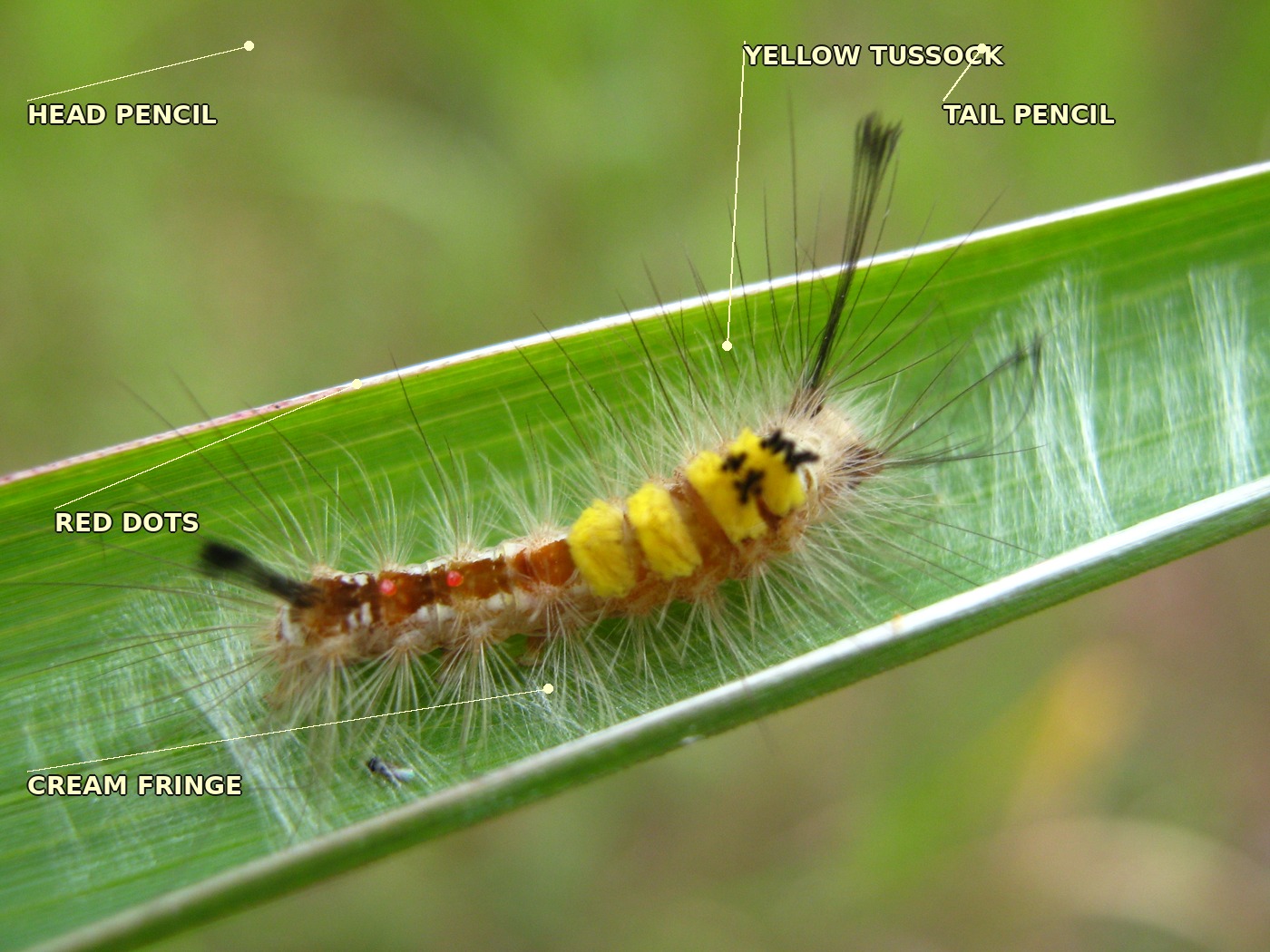
It was about ten millimetres long and it was not moving. It sat in a loose web of silk it had spun around itself on a grass blade, and it gave no sign of noticing the camera. That is the complete field note: one small caterpillar, one silk retreat, one grass blade, not moving, in the late afternoon at Ikutmaju Saw Mill.
Ten millimetres is not much to work with. What the photographs give you is a set of characters on the back and the sides, and those characters are enough to name it to subfamily — which, for a caterpillar this size in a single brief encounter, is a reasonable result.
Five characters, all visible here:
Taken together — one dorsal tussock, hair pencils fore and aft, lateral warts — these are the characters of Erebidae, subfamily Lymantriinae: the tussock moths.
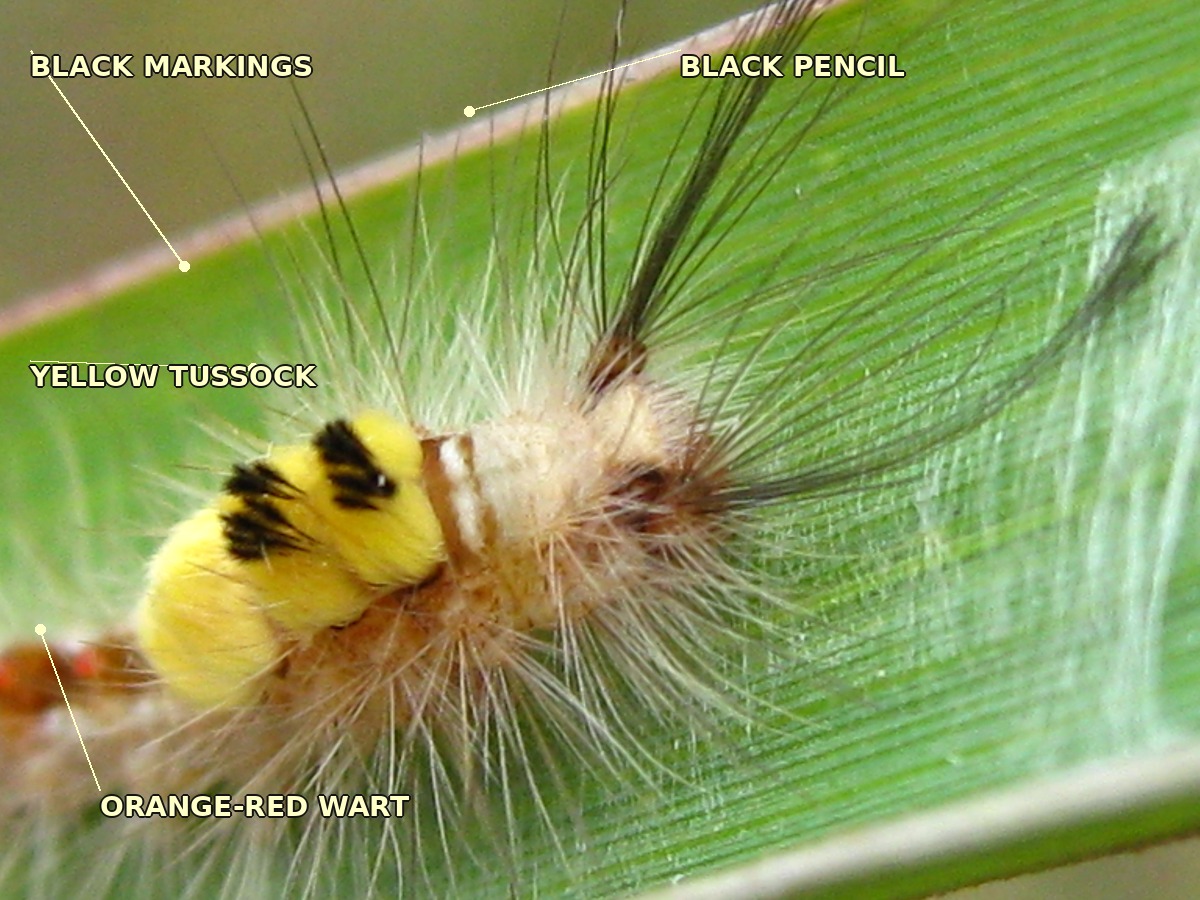
The black markings on the tussock are worth noting because they are easy to overlook at ten millimetres and at arm’s length. In the photograph they are clear, and they matter: a plain yellow tussock and a yellow-with-black-markings tussock are not the same, and that distinction can matter to an identification. The camera settles things the eye misses.
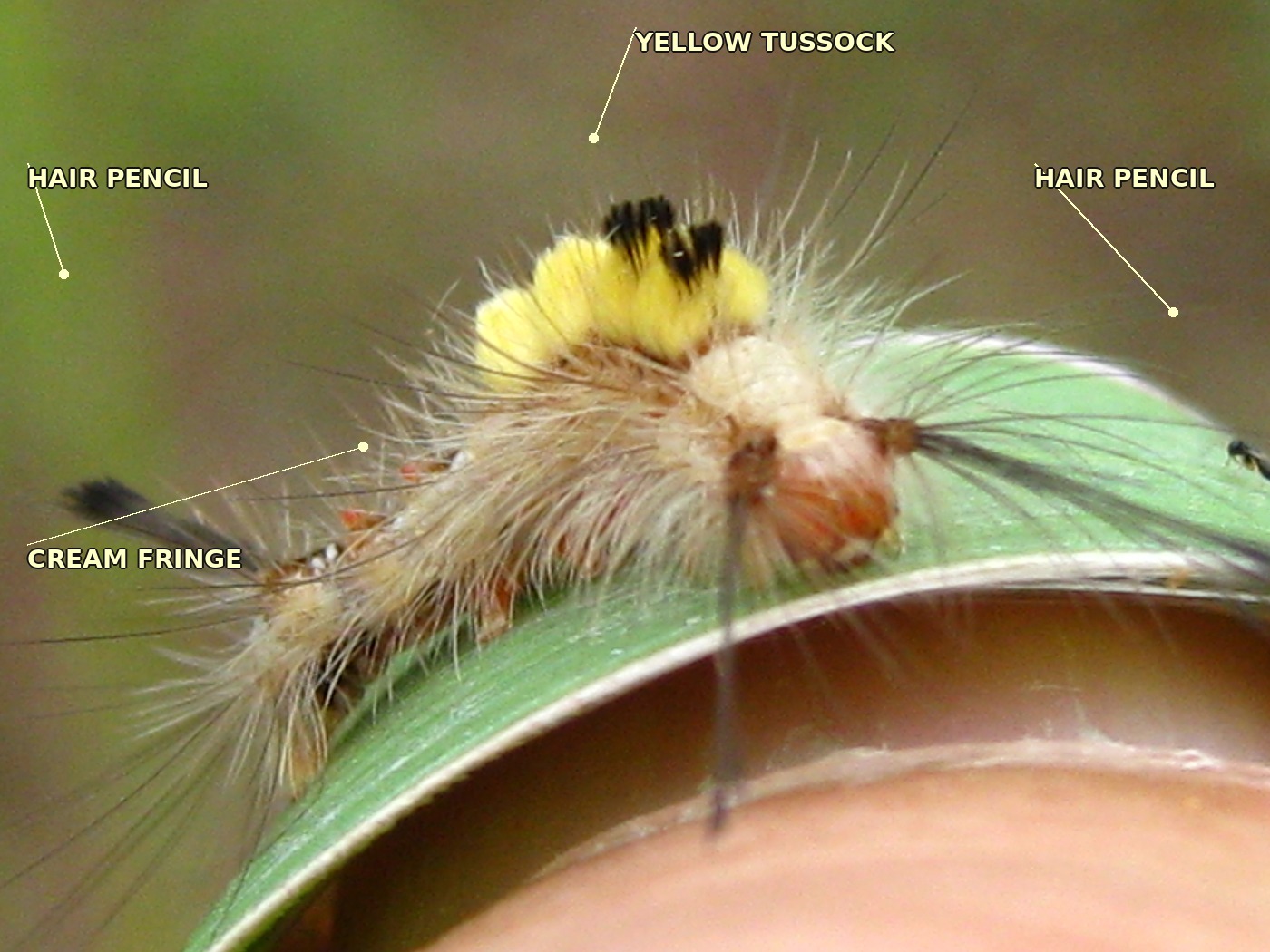
The head-on view gives a third angle on the same animal, and it confirms three things. The tussock sits on the centreline, the hair pencils are paired (one on each side, projecting symmetrically), and the cream fringe wraps all the way around the lower body. None of this adds to the identification, but it removes doubt about what was there.
The caterpillar was sitting inside a loose web of silk it had laid across the grass blade. This is common behaviour in Lymantriinae: the larvae often spin a thin open shelter of silk where they rest during the day, leaving it at night to feed and returning before dawn.
The retreat here is not a cocoon. A cocoon is a tightly woven structure built just before pupation, and a ten-millimetre caterpillar is not near that stage — it is early in its growth, with several moults still ahead of it. What you are looking at is a resting tent, not a departure lounge.
The grass blade it was on has not been identified below family (Poaceae). Tussock moths feed on a very wide range of plants, and a grass-feeding Lymantriinae larva is not unusual. Whether this caterpillar was feeding on the grass it sat on, or had simply chosen a convenient blade to rest against, the photographs do not say.
The site now holds two tussock moth caterpillars, photographed two years and twelve kilometres apart, and they look nothing alike except in the characters that name the subfamily.
Same subfamily, different species — and possibly a different genus. The four-brush plan and the one-dome plan both occur in Lymantriinae, and recognising them as the same family does not mean confusing them with each other. The field characters that separate the two are visible without magnification, and the difference would not be missed.
Ikutmaju Saw Mill, Merotai, Tawau, Sabah. One caterpillar, about 10 mm,
in a loose silk retreat on a grass blade (Poaceae — genus not identified), not moving. Bright
yellow dorsal tussock with black markings on its surface; long black hair pencils at the head and
tail ends; cream-beige lateral hair fringe; reddish-brown body with small orange-red lateral warts.
Lepidoptera: Erebidae, subfamily Lymantriinae — a tussock moth. Genus and
species not determined. Three frames, 16:55:12, 16:57:33 and 16:58:34. Not touched;
photographed where it sat and left there.
— iNaturalist observation
402676226
Ikutmaju Saw Mill is a timber yard at Merotai, on the coastal flat south of Tawau. The mill runs under lights after dark, which draws flying insects from the surrounding country, and arriving timber brings bark fauna in from forests across Sabah — but neither of those routes puts a caterpillar on a grass blade in the yard. This one was almost certainly feeding on vegetation growing at the site.
The mill has now turned up five records on this site, spread across seven years. The lappet moth caterpillar found on the gate post in March 2012 goes into the arithmetic of how the mill gathers its insects, and that page is the place to read about the site in more detail.
About the photographs. Three frames by Wong Fook Yee with a Canon PowerShot A470,
f/3.0, ISO 100, 6.3 mm, no flash, at 16:55:12, 16:57:33 and 16:58:34 on 22 February 2009 at
Ikutmaju Saw Mill, Merotai, Tawau, Sabah. Cropped, resized and labelled for this page; nothing has
been sharpened, recoloured, added or removed. The unmarked originals are attached to the iNaturalist
record above.
The subfamily characters and the account of silk retreat behaviour follow the general entomological
literature. The locality, the date, the times and the field description are the photographer’s
own observations. The grass is Poaceae, genus not identified; the plant identification goes no
further. All photographs © Wong Fook Yee. Page written 23 September 2026.
Note: the field record says September 2009; the EXIF date in all three image files
is 22 February 2009, a Sunday. The page uses the EXIF date.