eTawau > Insects of Borneo > Caterpillars > The caterpillar that came to the gate post

The caterpillar that came to the gate post

Sixty millimetres of cracked porcelain, sitting on painted concrete at a quarter to eight in the morning — and waiting for something

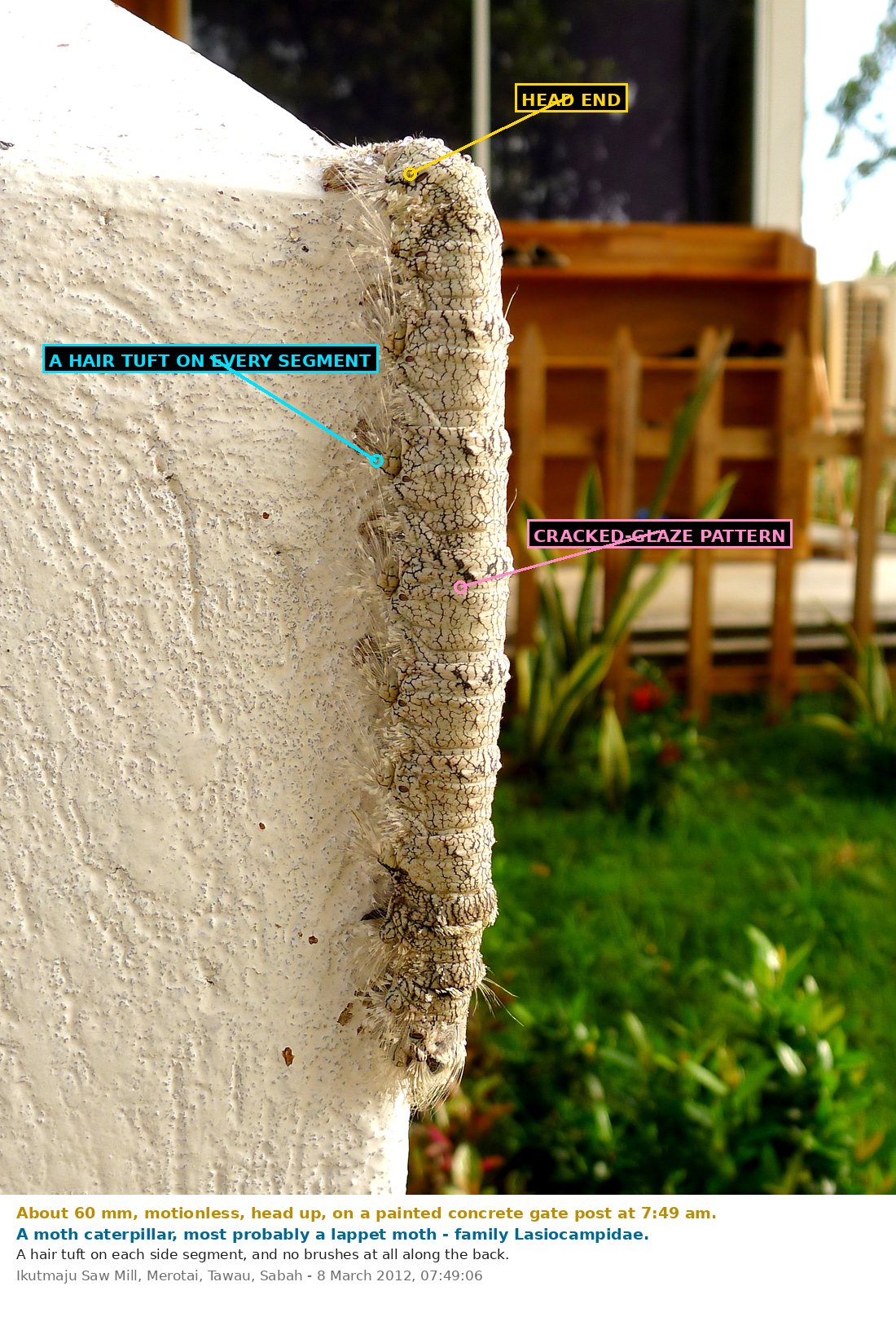
The gate post to the Multipurpose Hall at Ikutmaju Saw Mill, Merotai, is a plain concrete pillar painted white. On the morning of 8 March 2012 there was a caterpillar on the corner of it, head upwards, about 60 millimetres long — one of the longest I have ever found — and completely still.

It was not on a plant. It was not moving. And there was dew still lying on its head.

A large pale caterpillar clinging vertically to the corner of a white-painted concrete post, head upwards. Its body is bone-white finely cracked all over with black like crazed glaze, with a dense tuft of long pale hair low on each segment forming a fringe against the concrete, and a smooth bare back. A garden and a wooden shelter are out of focus behind.
Head upwards on the corner of the post, 7:49 in the morning. The tufts of hair along the side lie against the concrete, so the animal casts almost no shadow at its edges — the oldest trick in camouflage, and the reason it is easy to walk past.

Why a caterpillar leaves its plant

A caterpillar on bare concrete is a caterpillar that has stopped eating. They do not cross open ground for fun; there is nothing out there for them and everything can see them.

The usual reason is that the animal has finished growing and is looking for somewhere to change — somewhere dark, solid and dry, out of the rain and away from ants. That is the reading I would put first, and a painted concrete post beside a building is exactly the sort of place a wandering caterpillar settles on.

But I did not see what happened next, so here are the other two possibilities. Plenty of large caterpillars feed at night and spend the whole day sitting still on a trunk or a wall, which is precisely what this looked like. And a caterpillar about to moult also stops, grips hard, and stays put for a day or more.

The dew tells me it had been there since before dawn. It does not tell me why.

Cocoon, not chrysalis

This is worth getting right, because it changes what you go back and look for.

A chrysalis is the naked, bare-skinned pupa of a butterfly — the smooth hanging thing everyone pictures. Moths of this family do something quite different. They spin a closely woven cocoon of silk and their own body hairs, and hide it in a crevice or against bark.

So if I was right about this animal, what would have appeared a few days later is not a hanging chrysalis but a felted grey pod wedged into a corner of that gate — and the very hairs in these photographs would have been woven into its wall. That is what I should have gone back for.
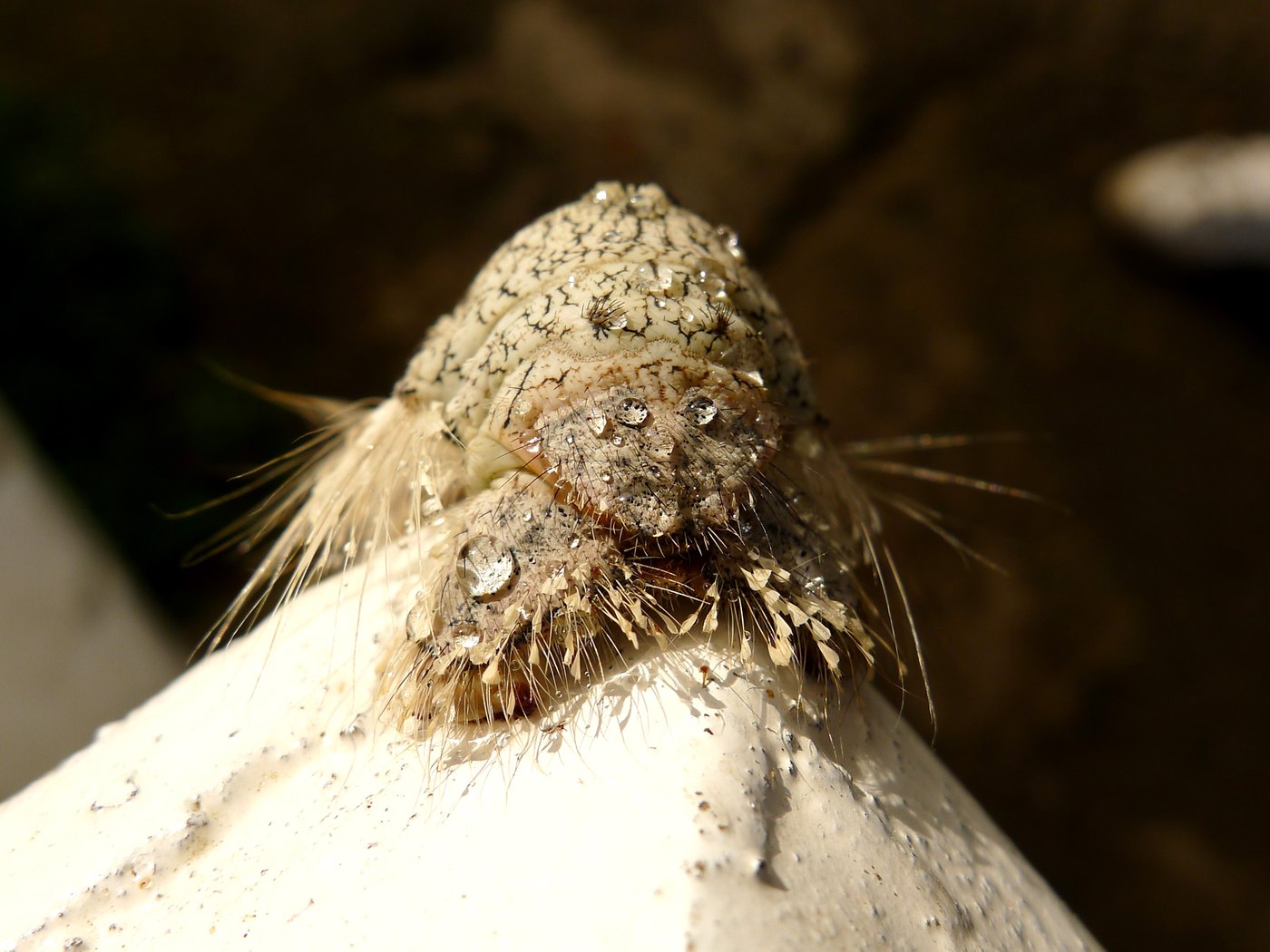
Close view of the front end of the same caterpillar, wet with dew. A smooth cream domed segment, finely cracked with black, overhangs a grey-brown granulose head. Long pale hairs sweep out sideways, and among them are rows of short flattened translucent hairs shaped like paddles. Water drops sit on the head and body.
The front end, without labels. This is what it actually looks like: the head is the grey granular knob underneath, half hidden by the smooth cream segment above it, and everything is beaded with dew. Photographed at 7:50 am, ninety-six seconds after the picture at the top of this page.

Lappet or tussock? How to tell them apart

Two families of big hairy caterpillars turn up on walls and posts in Sabah, and a visitor can learn to separate them in about five seconds. Look at the back.

A correction to the paragraph above, made in September 2026. "The back is smooth and bare" is true of this animal, and it is a fair way of telling it from a tussock moth. It is not true of Lasiocampidae as a family: plenty of lappet moths are hairy over the back as well, including the hundred-strong mass at Bako, which is also a lappet.

What survives the correction is the narrower half of the test, and it still works: tussock moths have four short dense brushes standing up on the back, and lappet moths never do. Look for the brushes. Do not rely on the back being bare.

A field test is a way of telling two animals apart. It is not a description of a family, and this page said more than it was entitled to.
The site now holds both halves of this test. When this page was written it set out the comparison with only the lappet to show for it, so a reader had to take my word for the other side. It no longer does: a tussock moth caterpillar photographed at the Tawau River Triangle in December 2011 has the four brushes standing up on its back, and that page carries a side-by-side figure of the two backs — this animal on the left, the tussock on the right. Both were photographed within the Tawau district, a year apart.

This one has a bare back and a skirt of side tufts, so it is most probably a lappet moth. It also carries its head tucked back under the smooth front segment, which is another habit of the family.
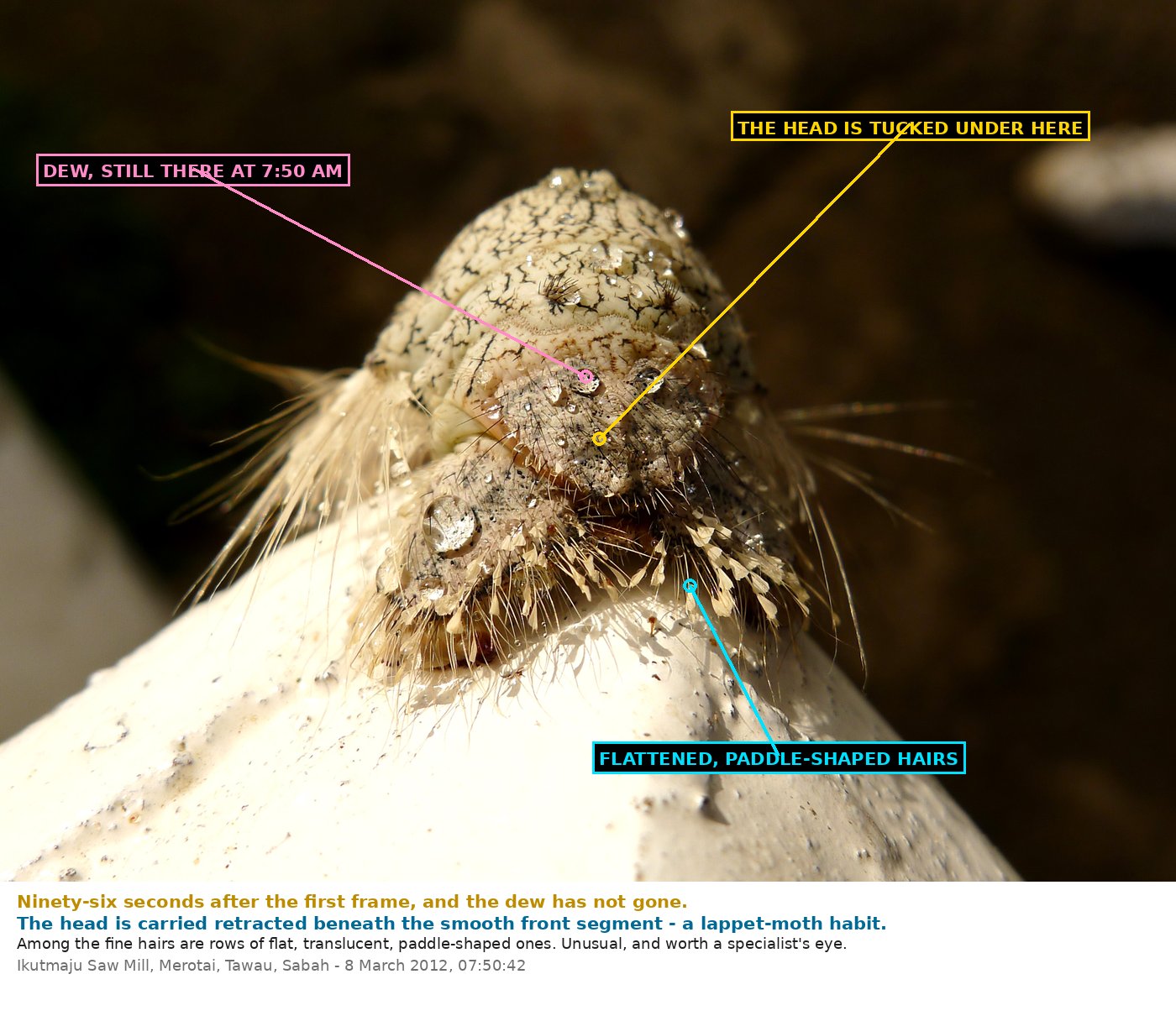
The same front end with labels. One label points to the head, tucked under the smooth front segment; another to rows of flattened, paddle-shaped hairs among the fine ones; another to a dew drop still lying on the head.
The same view, labelled. The head does not stick out in front the way a picture-book caterpillar's does — it is carried retracted, under the segment behind it.

The paddle-shaped hairs

Look closely at the fringe around the head in the pictures above. Most of the hairs are what you expect — long, fine, pale. But mixed in with them, in rows, are short flat translucent ones shaped like tiny paddles or spoons.

I do not know what they are for, and I am not going to invent a reason. They are unusual enough that I have pointed them out on the labelled picture, in the hope that somebody who works on these moths will look.

Why it has no name

The family is as far as this record goes, and even that is probably rather than certainly.

Lasiocampidae holds roughly 1,950 species in 224 genera worldwide, a great many of them large and bark-patterned as larvae and extremely hard to tell apart. A caterpillar like this is normally named by rearing it through to the adult moth and identifying the moth. I did not keep it, so that road is closed for this individual, and the record is posted at family level on iNaturalist for anyone who can take it further.

If you ever find one, this is the record worth making. Photograph it where it sits; note the date, the place and what it is on. Then go back the next day, and the day after. If it pupates, the cocoon is the thing that names it — and if you can watch a cocoon until the moth comes out, you have done something that almost nobody does and settled a question that a photograph alone cannot.

The dew is a clock

One small thing, because it is the kind of detail that turns a photograph into a record.

There was dew on the head at 7:49 am, and it was still there at 7:50. Dew forms overnight and burns off after sunrise. So the animal did not walk up that post while I was watching, or an hour before: it had been sitting there since some time in the night, long enough to get wet and not yet long enough to dry.

I was not there to see it arrive. The water told me anyway.

The record

8 March 2012 · 7:49 am · Ikutmaju Saw Mill, Merotai

On the concrete gate post to the Multipurpose Hall

Ikutmaju Saw Mill, Merotai, in the Tawau district of Sabah. One caterpillar, alone, about 60 mm, held vertically head-upwards on the white-painted concrete of the gate post, completely motionless, with dew still lying on its head. Bone-white to cream, finely cracked all over with black; a dense pale hair tuft low on each segment; the back bare. Lepidoptera — most probably Lasiocampidae, the lappet moths. Genus and species not determined. Two frames, 07:49:06 and 07:50:42. Not touched; photographed where it sat and left there.
— iNaturalist observation 400093624

The saw mill, again — and a question

This is the fifth record on this site from Ikutmaju Saw Mill, spread across seven years:

I have written elsewhere on this site that the mill gathers its insects two ways: by night from the air, because it runs after dark under bright lights that pull in insects from the surrounding coastal country; and by day by lorry, because raw timber arrives from forests all over Sabah with its own bark fauna riding in it.

Neither of those explains a caterpillar. A caterpillar does not fly to a light, and it does not live under bark on a log. Which leaves the simplest answer: this one grew up on a plant close by, in the yard or on its edge, ate its fill there, and walked to the nearest solid dry thing it could find.

That is worth noticing. It means the scrappy vegetation around a working industrial yard was feeding a moth larva sixty millimetres long. Nobody planted anything for it and nobody protected it. It was simply not cleared.
Do not pick up a big hairy caterpillar you cannot name. I did not touch this one, and that was the right choice. In several moth families the hairs break off in the skin and itch for days, and the ones that look softest and most harmless are often the worst of them. Photograph it and leave it where it is — it is going somewhere, and it has very little time left to get there.

Words you may meet

Lasiocampidae
The lappet moths and eggars. Named for the small skin flaps — lappets — on the prolegs of the caterpillars. About 1,950 species worldwide.
Lymantriinae
The tussock moths, whose caterpillars carry short dense brushes on the back. Not this animal.
Cocoon
A case of silk — here mixed with the caterpillar's own hairs — spun around the pupa. Moths make these.
Chrysalis
The bare, unwrapped pupa of a butterfly. Not what this animal was going to make.
Moult
To shed the old skin and grow a new one. A caterpillar does this several times, and sits still for a day or so each time.
Wandering phase
The last stage of a caterpillar's life, when it stops feeding and travels to find a place to pupate. This is when most large caterpillars are seen by people.

Related pages

About the photographs. Taken by Wong Fook Yee with a Panasonic DMC-LX5 at Ikutmaju Saw Mill, Merotai, Tawau, Sabah, on 8 March 2012 at 07:49:06 and 07:50:42. For this page they have been reduced, and two of them labelled, because a visitor wants to be shown what to look at. The unmarked originals are attached to the iNaturalist record above, which is where anyone working on the identification should start.

The family characters and figures follow the published summary of the Lasiocampidae. The size, the position, the dew and the account of the saw mill are the photographer's own field observations. All photographs © Wong Fook Yee. Page written 14 September 2026.