eTawau > Insects of Borneo > Caterpillars > A tussock moth at the Tawau River Triangle
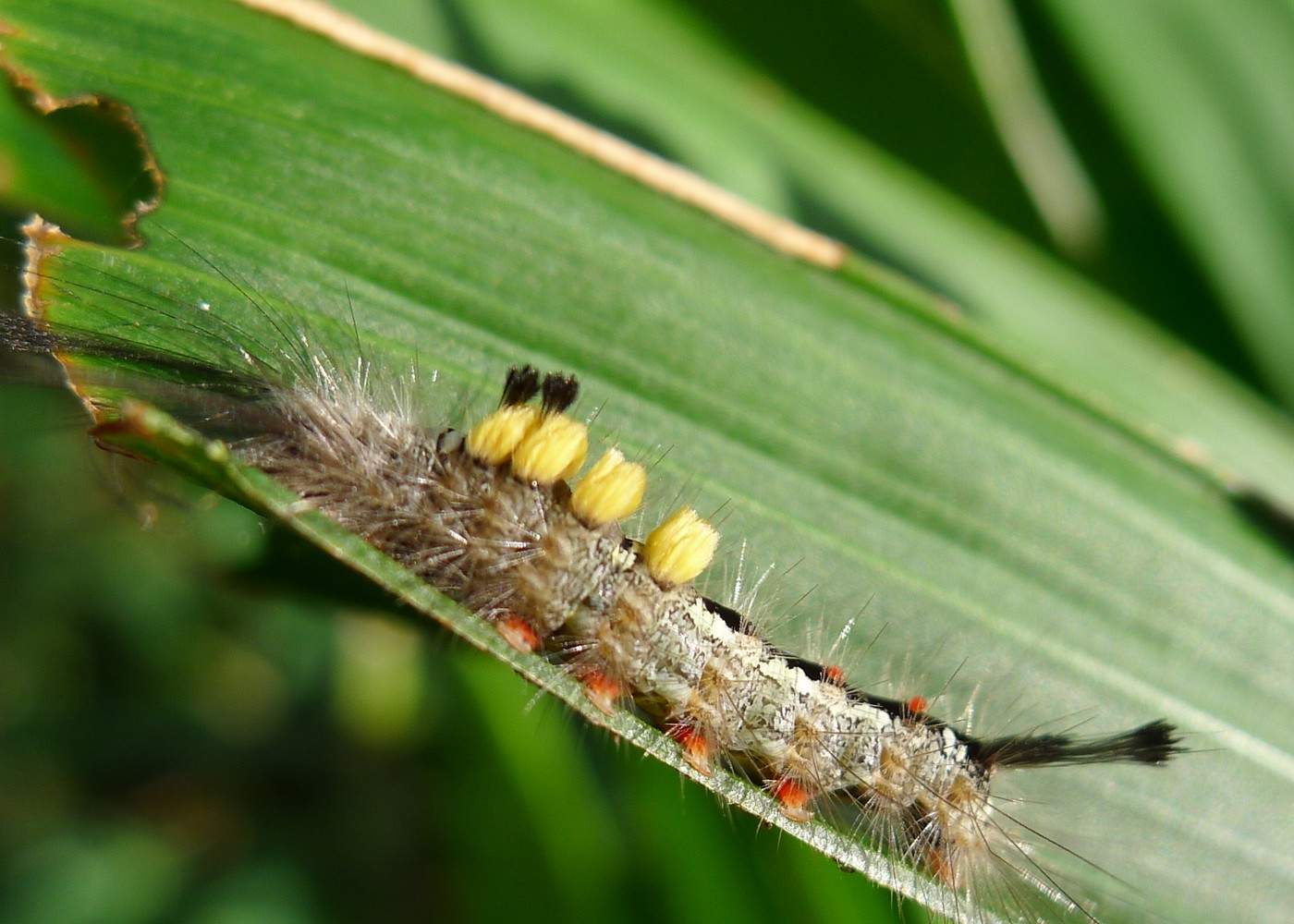
A tussock moth caterpillar on a palm leaflet, Tawau River Triangle — and the five-second test that names it from two metres away
Most caterpillars have to be caught, held and turned over before anyone can say what they are. This one does not. Everything you need is on its back, it is arranged in a pattern nobody else uses, and you can read it standing up.
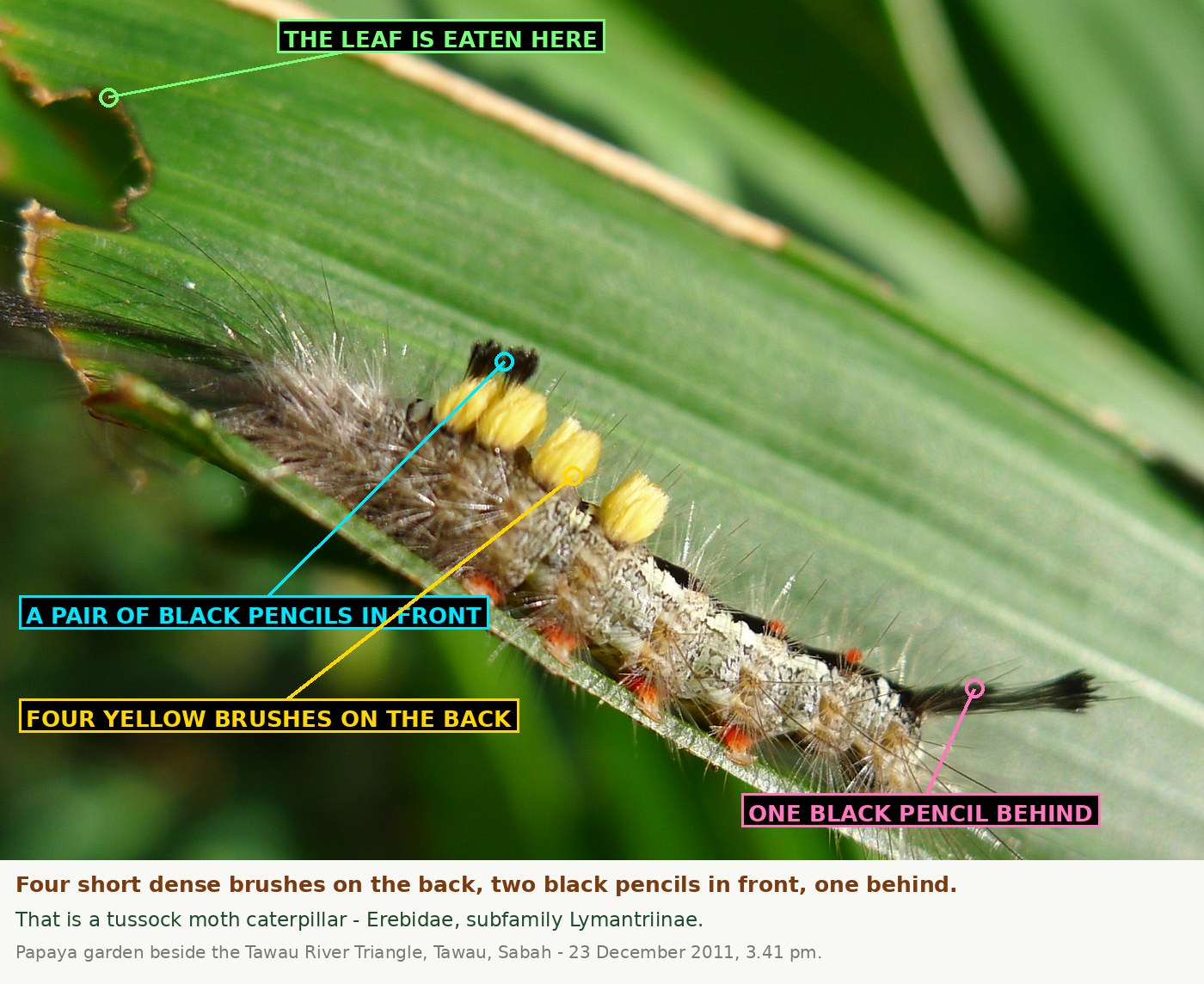
Five characters, and they are all visible in the photograph above:
The head is at the front end, hidden under the dense mane of long grey-brown hair.
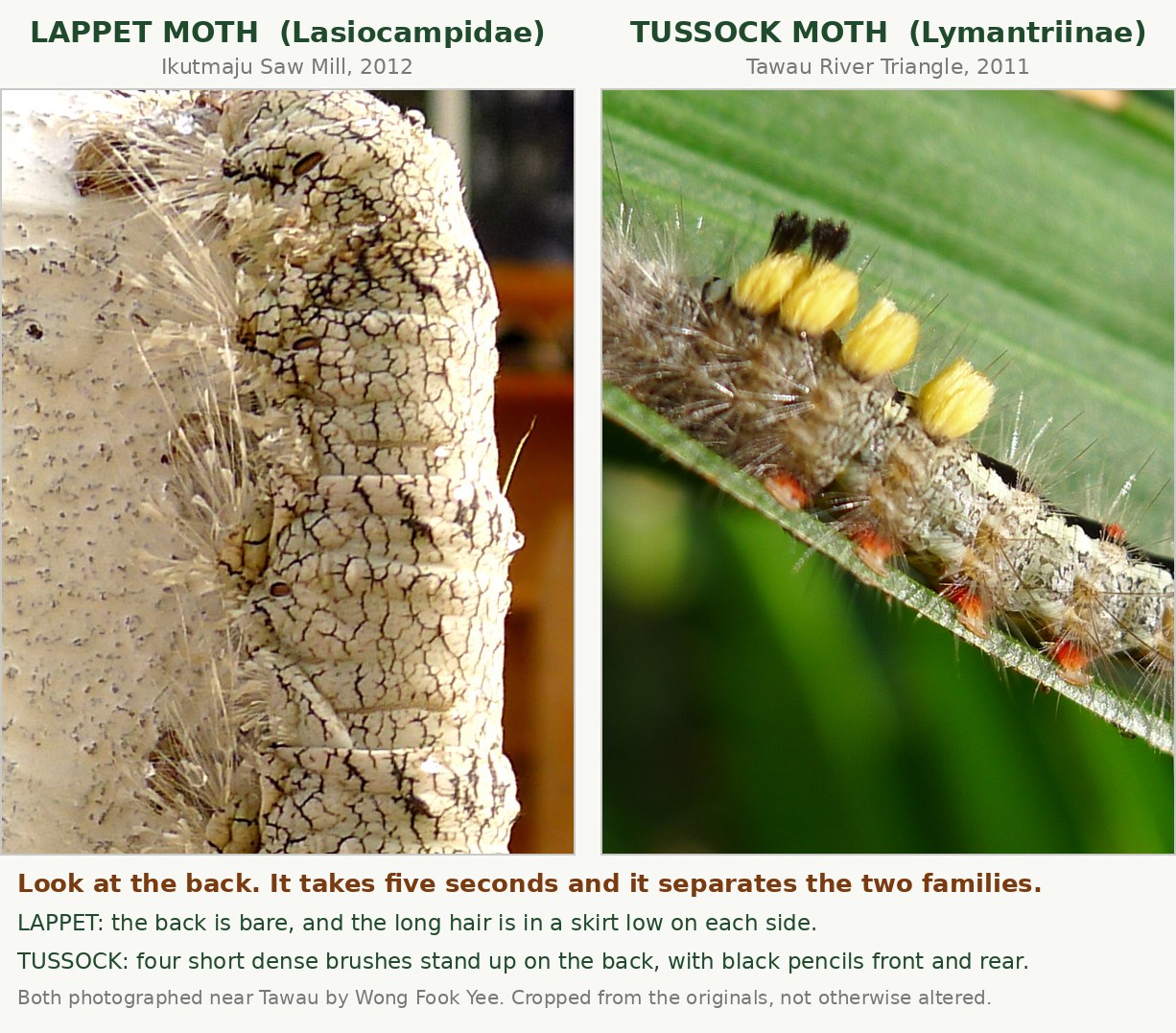
Around Tawau there are two families of big hairy caterpillars you actually meet, and people mix them up constantly. The site now holds one of each, photographed a year apart, so here they are side by side.
The leaflet is eaten away immediately in front of the animal, and the caterpillar is lying along the cut edge. That is where you find them, because that is where the next mouthful is.
It makes this a feeding record rather than a photograph of a caterpillar sitting on a plant, and the difference matters: a caterpillar resting on a leaf tells you nothing about what it eats, and caterpillars wander. This one was at the table.
It was not measured in the field, and — unusually for this site — it cannot be recovered from the photographs either. That is worth explaining, because it changes what to do next time.
On the Canon compacts used for most of the recent records, the camera writes the focus distance into the file. With that, plus the focal length and the sensor width, the photograph measures itself — which is how the Bombalai cotton stainer and the Bukit Gemok caterpillar were sized without a ruler.
The Panasonic DMC-LX5 that took these two frames does not record a focus distance. The fields exist in the maker note and are empty. So for LX5 photographs there is no arithmetic to fall back on, and a scale object in the frame is the only route to a size — a pin, a coin, a ruler, or a thumb held at the animal's distance from the lens.
Papaya garden beside the
Tawau River Triangle, Tawau, Sabah.
Across Jalan Kuhara from the Triangle itself, so outside it, and about as close to
it as you can stand. One caterpillar, not measured, lying still along the edge of an
unidentified palm leaflet at a point where the leaf had been eaten away. Body chalky grey-white,
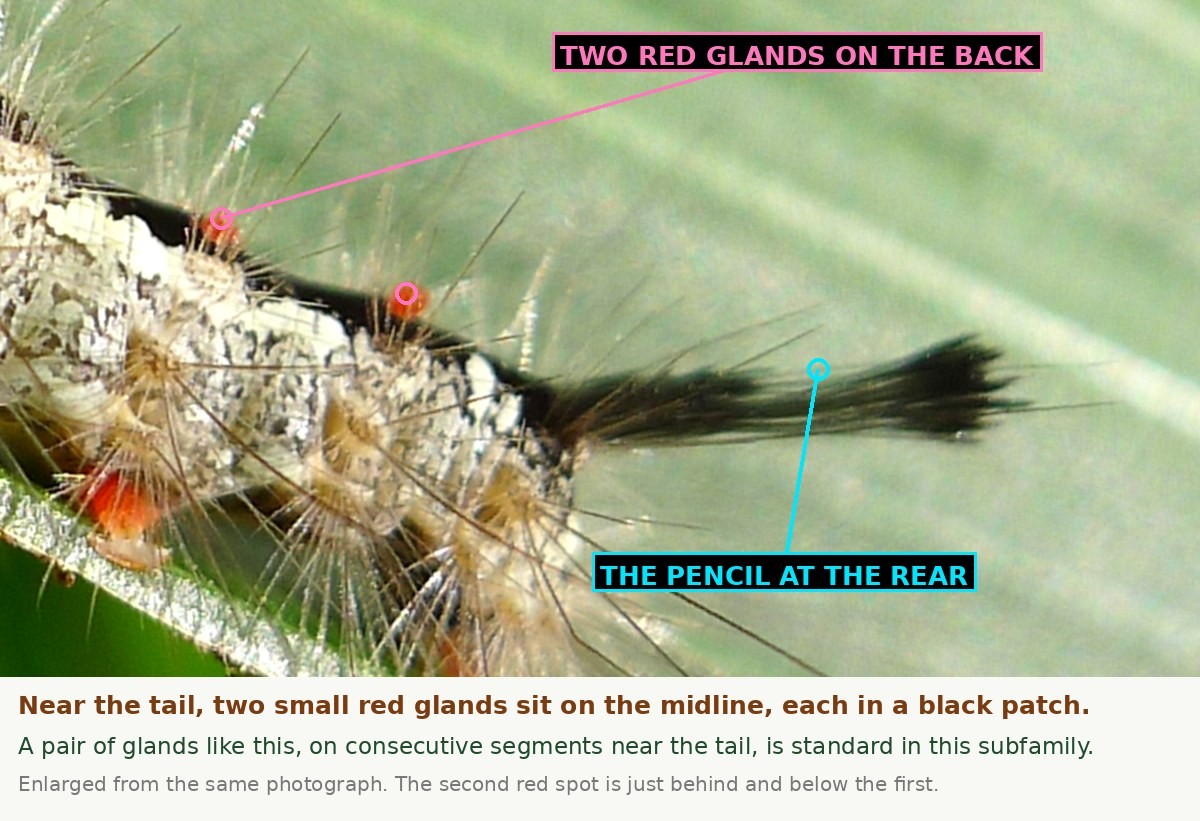
finely reticulated with dark grey, a black dorsal line towards the rear; four dense flat-topped
cream-yellow brushes on the back; a pair of long black hair pencils forward and one backward; two
small red dorsal glands near the tail, each in a black patch; a row of orange-red lateral warts, one
per segment. Head hidden under a mane of long grey-brown hair.
Lepidoptera: Erebidae, subfamily Lymantriinae — a tussock moth. Genus and species
not determined. One only; no others seen. Two frames, 15:41:11 and 15:41:25. Not
touched; photographed where it sat and left there.
— iNaturalist observation
400969806
Lymantriinae is a large subfamily — about 350 genera and more than 2,500 species — and a great many of them share this same four-brush plan. The brushes, the pencils and the paired red glands are subfamily characters, not genus characters.
To go further you generally need the adult moth, or the caterpillar in the hand under magnification, or both. No genus is offered here, and a confident-sounding name on this page would be worth less than the honest blank.
About the photographs. Two frames by Wong Fook Yee with a Panasonic DMC-LX5 in
square 1:1 mode, no flash, f/2.8 at 1/320 s, ISO 80, 5.1 mm, taken at 15:41:11 and 15:41:25 on
23 December 2011 in a papaya garden beside the Tawau River Triangle, Tawau, Sabah. Both are camera
originals that have never been opened in an editor. For this page they have been cropped, enlarged
and labelled; nothing has been sharpened, recoloured, added or removed. The unmarked full frames are
attached to the iNaturalist record above.
The subfamily characters, the number of genera and species in Lymantriinae, the account of
urticating hairs and the status of tussock moths as oil palm pests are from the general
entomological literature; the locality, the date, the times, the behaviour and the eaten leaf are
the photographer's own field observations, and the palm is not identified. All photographs
© Wong Fook Yee. Page written 17 September 2026. This is the first page on this site
filed by scientific classification rather than by the old pairs-of-wings scheme.