eTawau > Insects of Borneo > Caterpillars > Lappet moths at Bako
Lappet moth caterpillars in a resting mass at Bako National Park, Sarawak — and the reason nothing was eating them
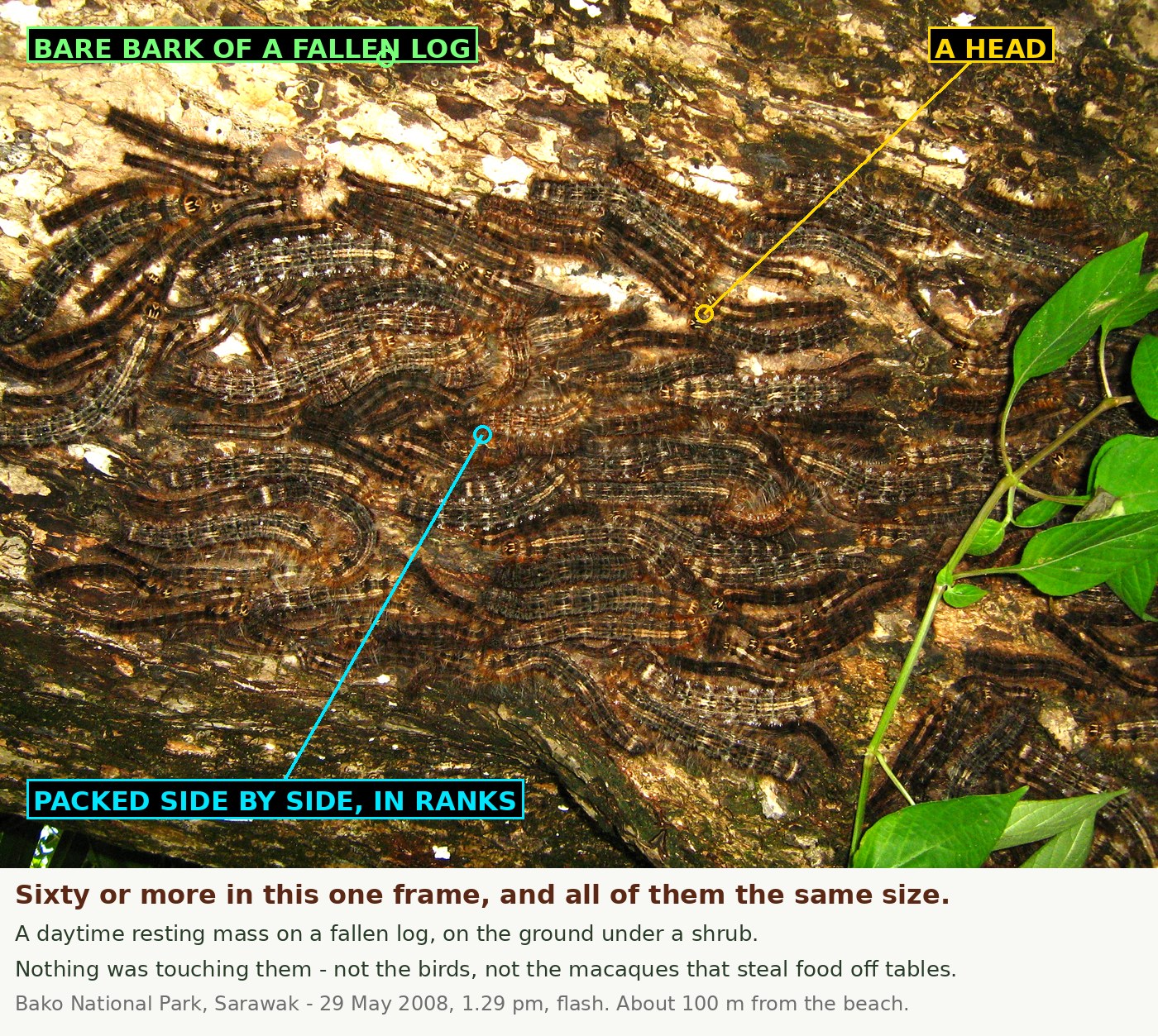
On the forest floor at Bako, about a hundred metres in from the beach, a fallen log was covered with caterpillars. Not a few. More than a hundred can be counted in a single photograph, packed side by side in curving ranks, every one of them the same size, and none of them moving.
The first thing to say about them is that they are hard to see. Their colour and pattern match the bark closely enough that a person can walk straight past. Shirley Wong saw them; I did not.
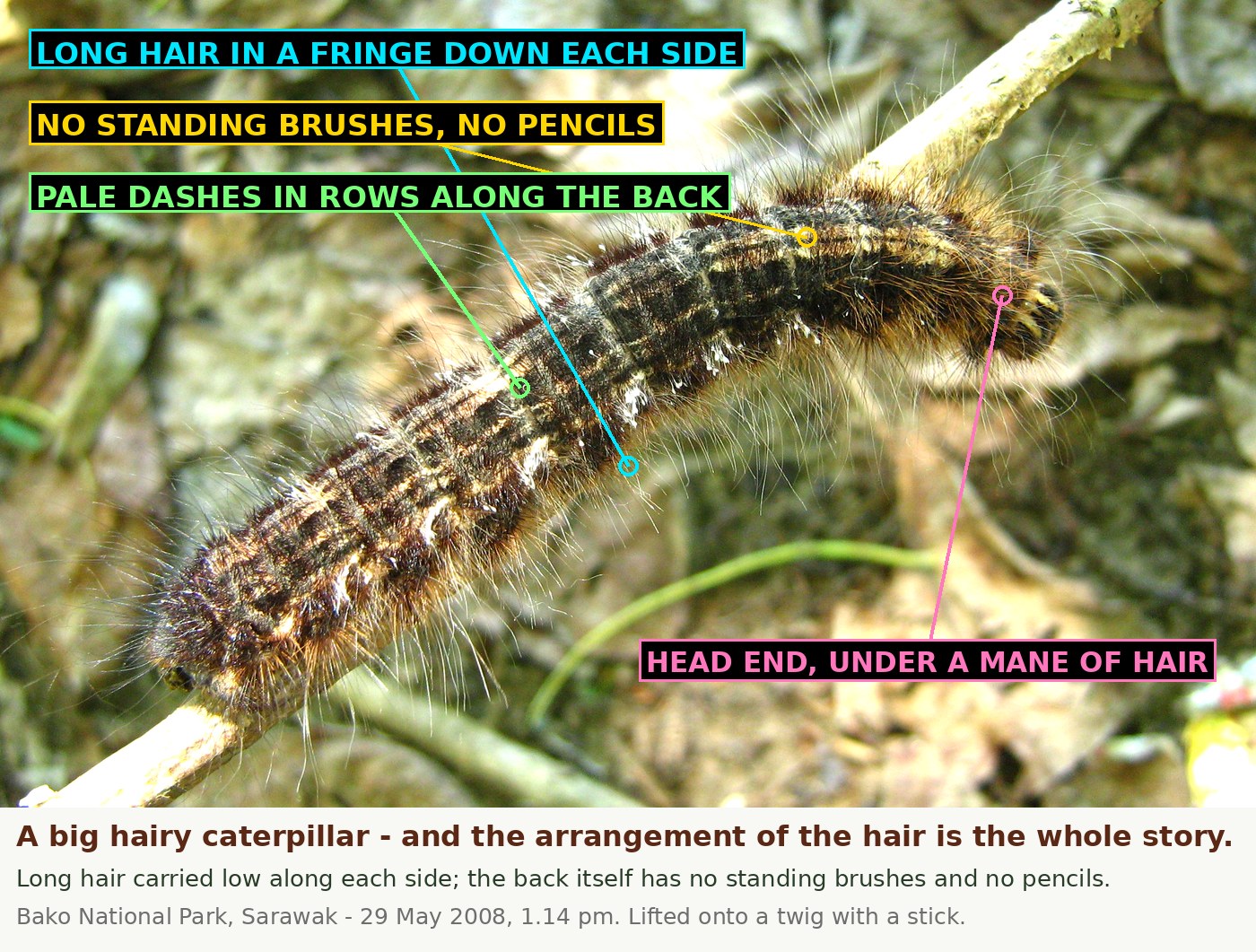
Lappet moths — Lasiocampidae. The characters are all in the photograph above:
No genus is offered. Several Oriental lappet moths form exactly this kind of dense daytime mass and disperse to feed, but the family is large and the caterpillars of most Bornean species have never been described. The record stops at family, and that is the honest place for it to stop.
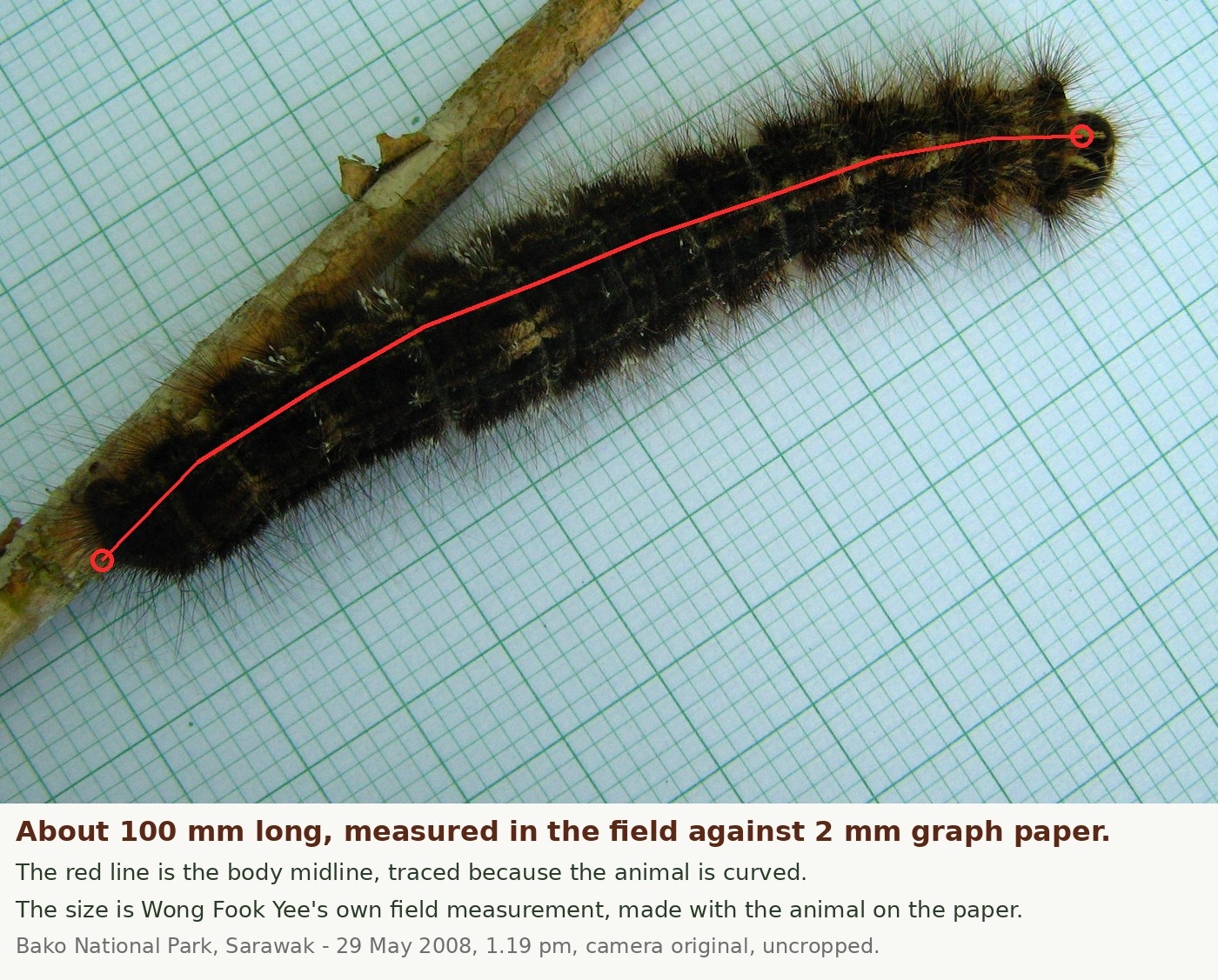
About 100 millimetres — ten centimetres. That is the photographer's own field measurement, made with the animal lying on the paper, and it is the figure this page uses.
A hundred large, soft, slow, stationary caterpillars lying in the open is, on the face of it, a free meal. Nothing took it. No bird came near them, and the long-tailed macaques — which at Bako will lift food straight off a visitor's table — kept away.
There are two explanations, and this record cannot separate them.
Bako National Park, Kuching Division, Sarawak, Malaysian Borneo. On the ground about
100 m in from the beach, on sandy soil under a layer of dry leaves and fallen branches. A dense
resting mass of hairy caterpillars on bark, more than a hundred separable in one frame and the mass
running past the edge of it, all the same size, packed side by side in curving ranks. Each about
100 mm. Body dark chocolate-brown to black with rows of small cream-white dashes and
a rust-brown band low along each side; long fine pale-golden hair as a lateral fringe; no tussocks,
no hair pencils; head under a dense ochre mane.
Lepidoptera: Lasiocampidae — lappet moths. Genus and species not determined.
Stationary throughout; not feeding, not dispersing. No bird or macaque showed any interest.
Found by Shirley Wong. One individual lifted onto a twig with a stick, photographed,
laid on graph paper, photographed, and left. Nothing collected.
— iNaturalist observation
401219361
Bako is Sarawak's oldest national park — 2,727 hectares on a peninsula north of Kuching, reached by road to Kampung Bako and then a twenty-minute boat ride along the coast. It is small, and that is the point of it: the wildlife is concentrated and easy to meet. Sixteen colour-coded trails, more than 150 recorded bird species, and most of the vegetation types of Borneo inside one short walk — mangrove, peat swamp, padang scrub, dipterocarp forest, cliff and beach vegetation.
This is the first record from Sarawak on the insect pages of this site. Everything else here is from Sabah.
The three days that produced it are written up as a visitor's diary: the crossing and the first afternoon, proboscis monkeys, silver leaf monkeys and these caterpillars, and the macaques, the cicadas and a dragonfly at the stream.
About the photographs. Taken by Wong Fook Yee with a Canon PowerShot A460 at Bako
National Park, Sarawak, on 29 May 2008 at 13:14:43 (the animal on a twig), 13:19:47 (on graph paper)
and 13:29:21 (the mass, with flash). All three are camera originals that have never been opened in an
editor. For this page they have been cropped, brightened and labelled; nothing has been sharpened,
recoloured, added or removed. Further frames from the same fifteen minutes appear on the
diary page for that day, and the
unmarked full frames are attached to the iNaturalist record above.
The length of about 100 mm is the photographer's own field measurement against 2 mm graph paper. The
family characters and the account of urticating hairs are from the general entomological literature;
the locality, the date, the times, the behaviour of the mass and the absence of predators are field
observations made at the time. The caterpillars were found by Shirley Wong. All photographs
© Wong Fook Yee. Page written 18 September 2026.