eTawau > Spiders of Borneo > Non-web spiders > Salticidae > Thiania > Thiania sp. BRONZE

Thiania sp. BRONZE (working label)

A flat jumping spider with a bronze abdomen speckled with gold scales, met on the hand rail of a walking platform at Kinabalu Park Headquarters. Genus Thiania; the species is not identified.

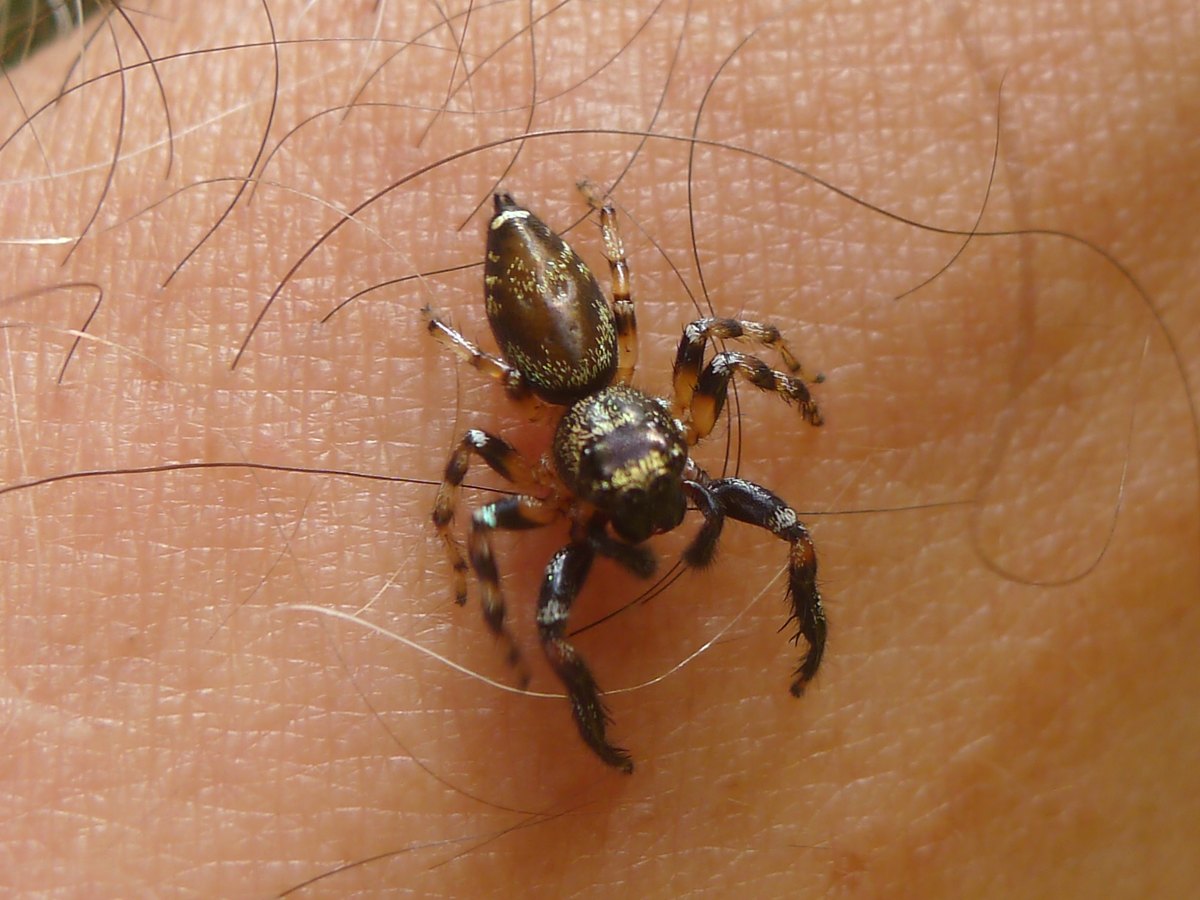
Thiania sp. BRONZE seen from above on the photographer's arm: a bronze abdomen speckled with gold scales and a white tip, a dark carapace with green-gold scales, a stout dark first pair of legs and the other legs banded orange and black.
From above, on the photographer's arm. Kinabalu Park Headquarters, 20 October 2026, 12:02.
Classification
Order Araneae · Family Salticidae (jumping spiders) · Subfamily Salticinae · Tribe Euophryini · Genus Thiania C. L. Koch, 1846 · species not identified
Working label
"BRONZE" is the photographer's own label, for filing and sorting, after the bronze colour of the abdomen. It is not a scientific name.
Identification
Genus Thiania, by the photographer, on iNaturalist (observation 411120936). As of 27 October 2026 no one else has added an identification, and the photographer could not find close-matching photographs there.
Records on this site
One: Kinabalu Park Headquarters, 20 October 2026.
Size
About 8 mm body length (7–9 mm), estimated from photographs; not measured. See the record.

How to recognise it

The low flat body, the shining scales and the dark, stout first legs are the marks of the genus Thiania. It does not look like the three other Thiania on this site: T. bhamoensis (blue-green scales and a red-brown abdomen), T. latefasciata (a black abdomen with a pale band, legs banded black and cream) and T. subopressa? (name not confirmed). To name the species, a specialist would need to see the palps (male) or the epigyne (female) under magnification.

Male or female? Probably a male, from the long, dark, fringed first legs; the palps are not clear enough in these photographs to confirm it.

Records

Record 1 · 20 October 2026 · Kinabalu Park Headquarters NEW
A busy spider on a sunny hand rail

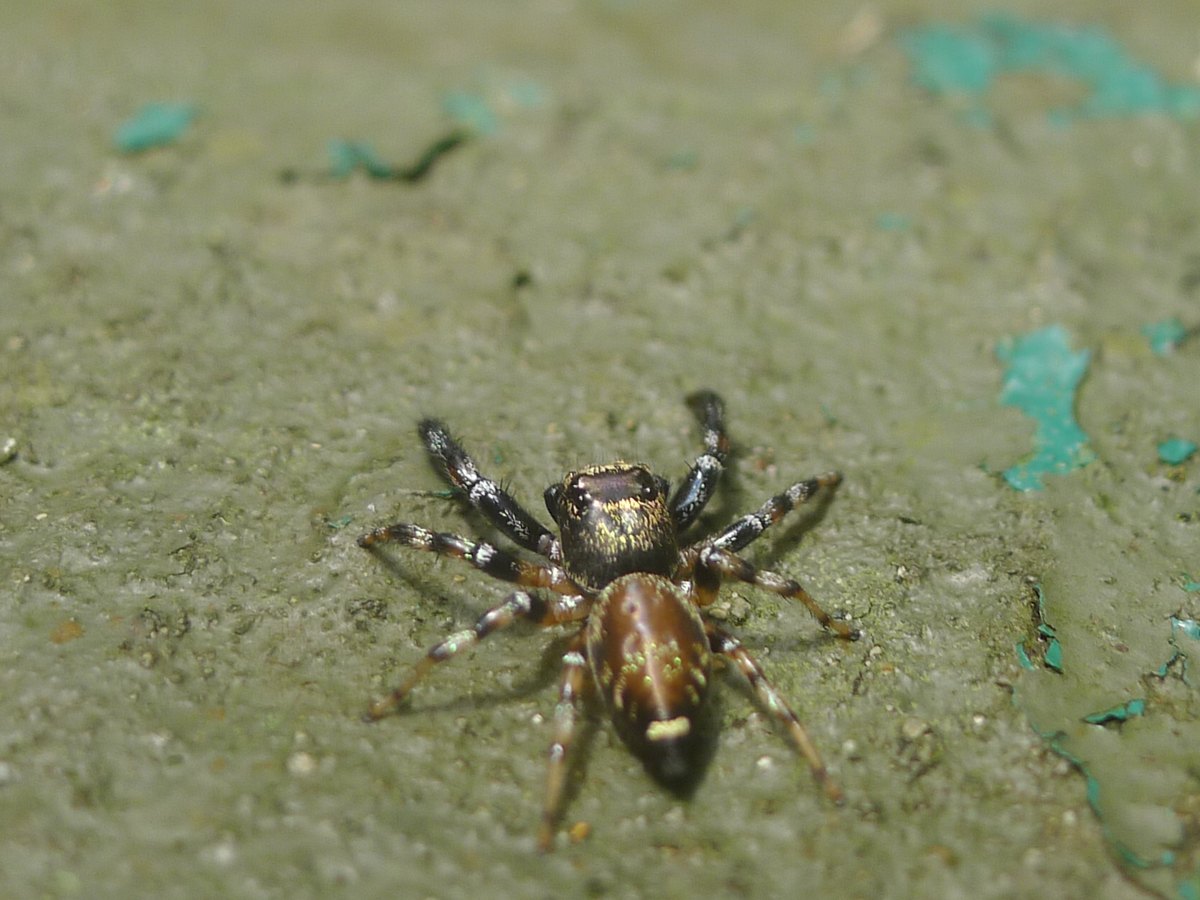
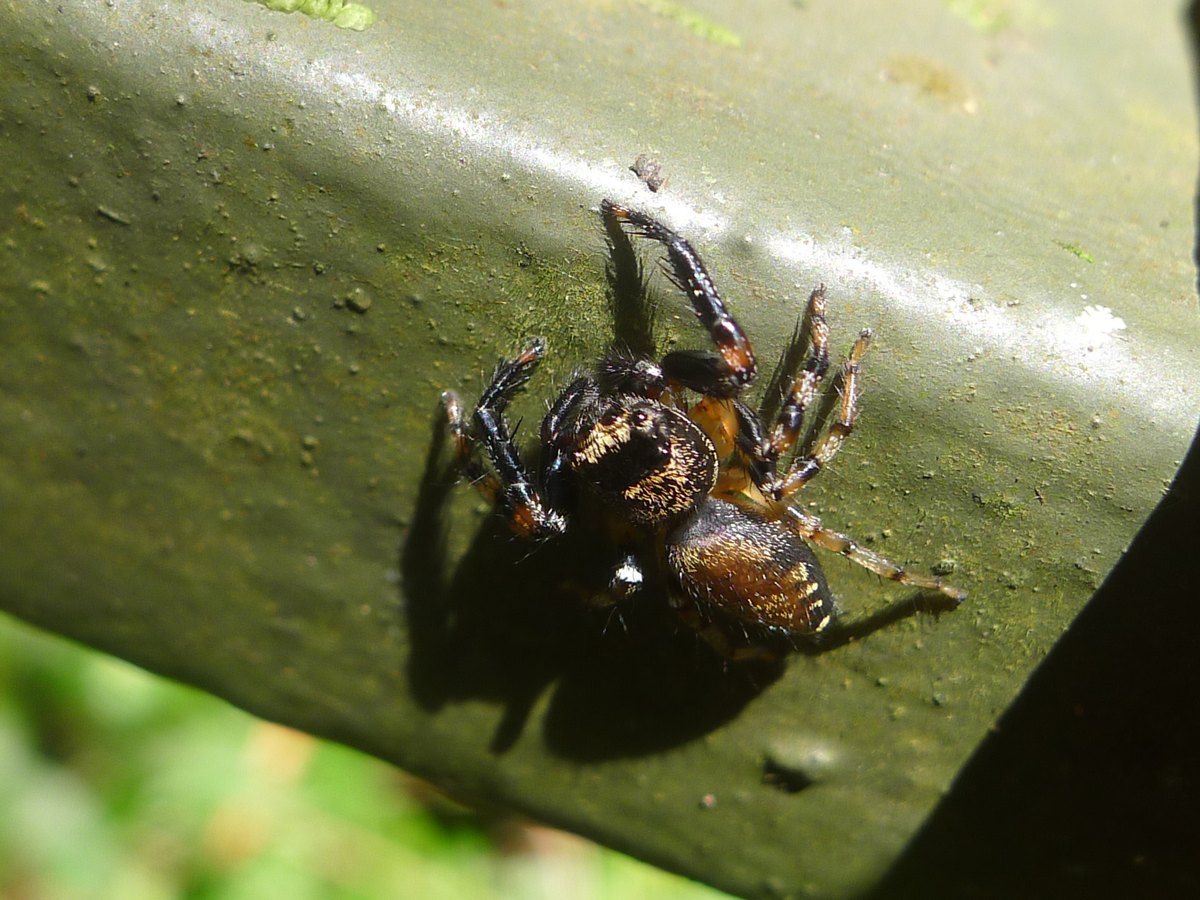
The spider on the olive-green hand rail in full sun, seen from the front and above, its dark first legs raised and a sharp shadow beside it.
12:07, on the hand rail in full sun.
The spider from above on the flat top of the hand rail, legs spread, the bronze abdomen with its white tip.
11:58, on top of the rail.
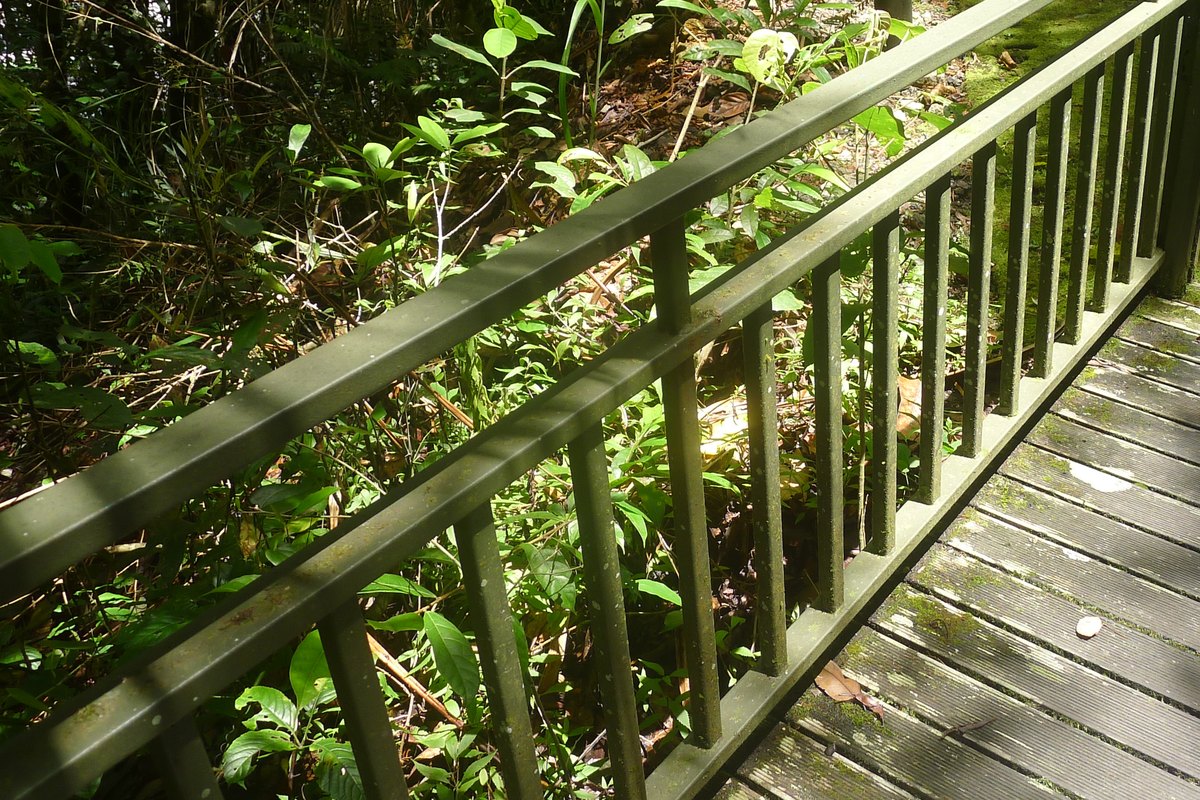
The wooden walking platform with its olive-green hand rail, beside forest plants.
12:08, the walking platform and its hand rail.
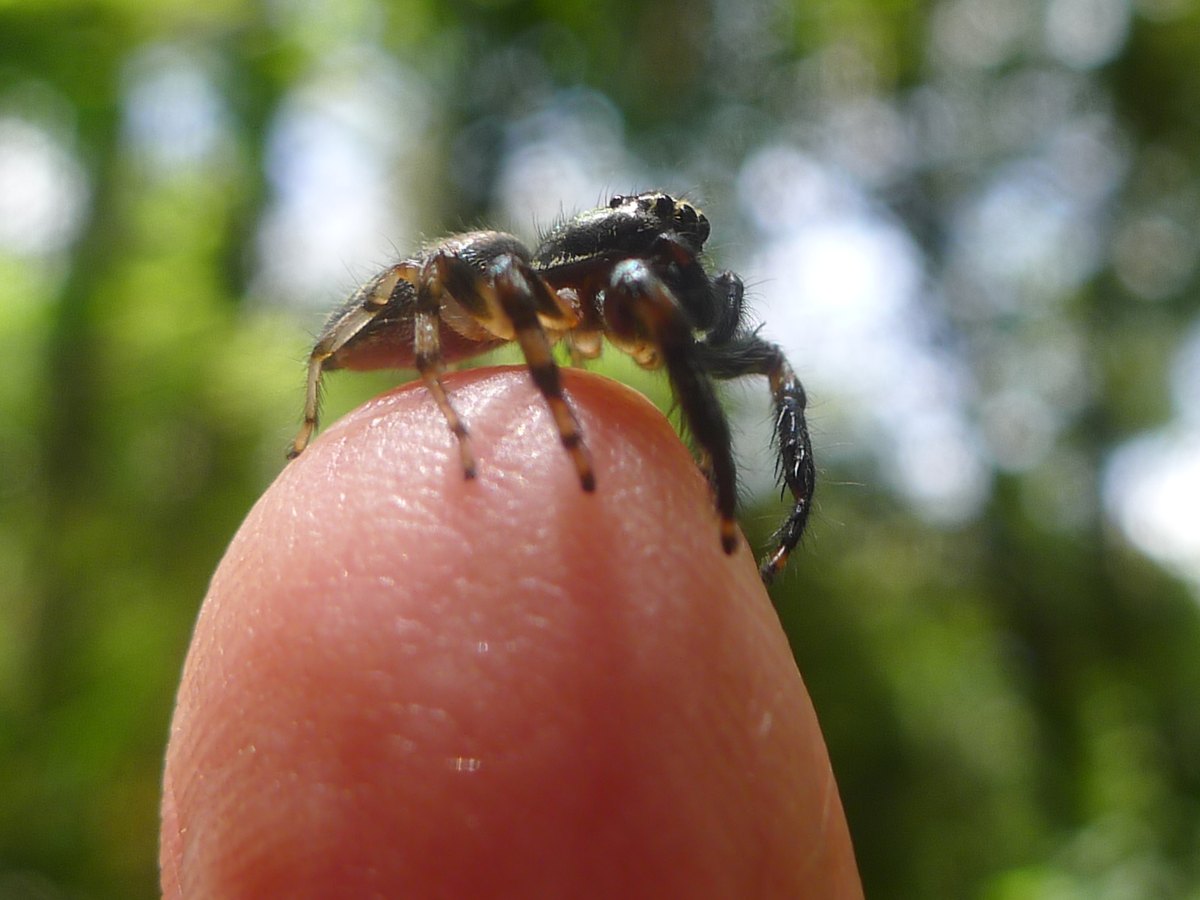
The spider from the side on the tip of the photographer's finger, against blurred forest.
12:00, on the fingertip (15.5 mm wide).
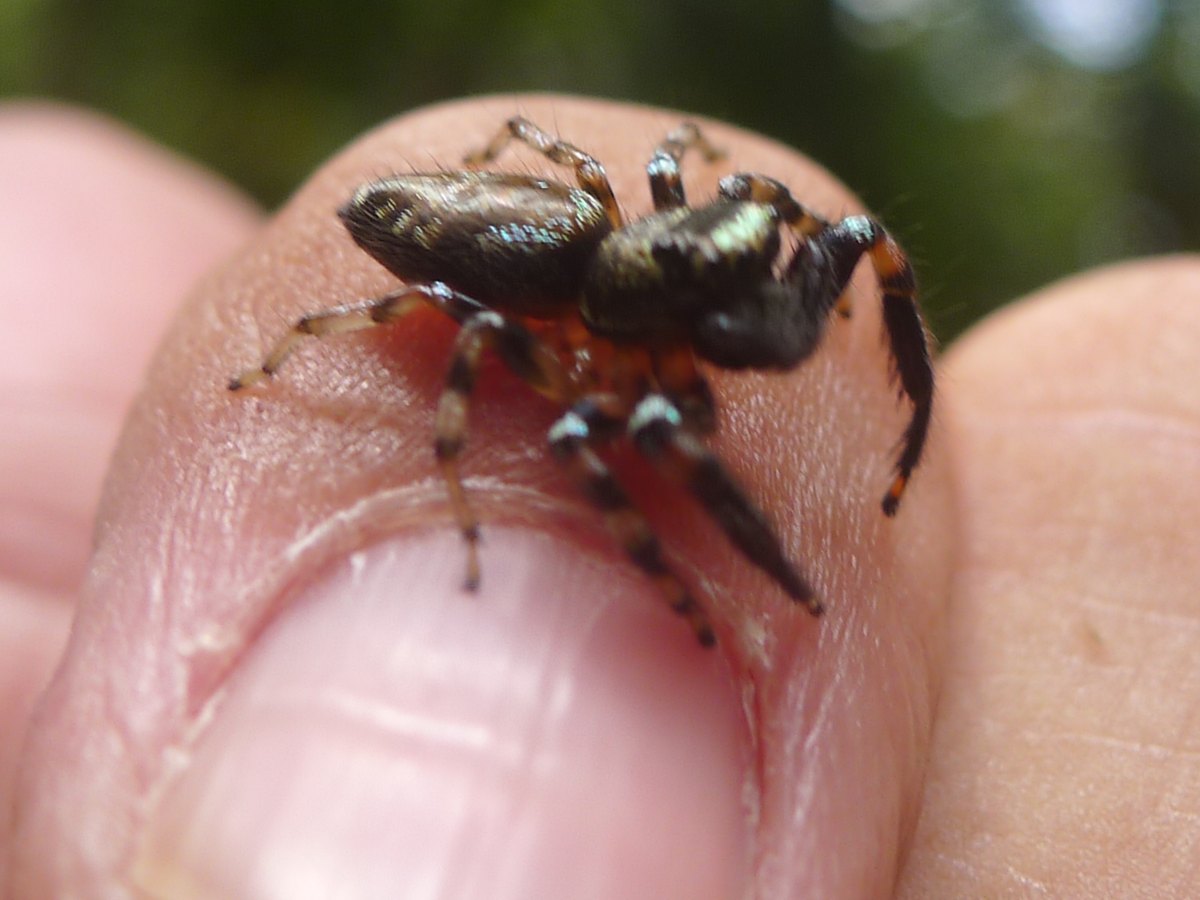
The spider on the photographer's thumbnail, seen from the side and front: the long flat body, the dark first legs and the banded other legs.
12:01, on the fingernail (10.1 mm wide).
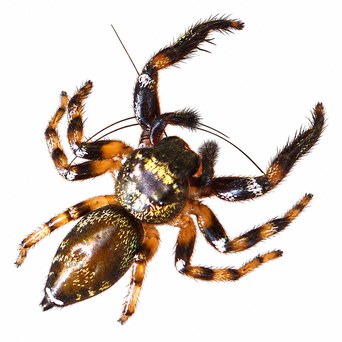
The spider from above with the background removed: bronze abdomen with gold speckles, dark carapace, banded orange and black legs.
Frame 29 with the background cleaned (used as the thumbnail).
DateTuesday 20 October 2026, 11:58–12:08 (camera clock), sunny
PlaceKinabalu Park Headquarters, Ranau District, Sabah: the wooden walking platform beside the road
OnThe hand rail of the walking platform, in open sunlight
NumberOne
SexProbably male (not confirmed)
SizeAbout 8 mm body length (7–9 mm); not measured, estimated from photographs (see below)
CamerasPanasonic DMC-LX5; one frame with a Canon IXUS 285 HS
ObserverWong Fook Yee
iNaturalistobservation 411120936 (genus Thiania)

What it was doing. It never stopped moving forward. It kept jumping to the nearest higher point, and jumped onto the photographer's close-up camera. From the camera he guided it onto his fingertips to photograph it, and then onto his arm. Spiders of this genus, he notes, like to stay in open, sunny places; they are easy to see in Sabah's forest parks.

How the size was estimated. The width of the photographer's fingertip in the 12:00 photograph is 15.5 mm, and the width of his fingernail in the 12:01 photograph is 10.1 mm (both measured by him). Scaled against these, the spider's body (front of the carapace to the tip of the abdomen) is close to 8 mm in both photographs. Because the spider and the finger are not exactly the same distance from the lens, allow 7–9 mm. Not measured.

Related pages

Photographs © Wong Fook Yee. Date and times from the cameras; the place, the behaviour, the finger and nail widths and the working label are the photographer's own. Genus identification: the photographer, on iNaturalist. Classification: World Spider Catalog (Natural History Museum Bern). Page built 27 October 2026.