Last Updated on Saturday, 23 September, 2023 11:50:29 AM
INDEX > Dragonflies of Borneo > Family Libellulidae > Genus Oligoaeschna > Oligoaeschna foliacea
Family Libellulidae
Oligoaeschna foliacea
Common Name: Leaftail
Found in Asia: Brunei Darussalam, Borneo, China, Indonesia, Malaysia, Peninsular Malaysia

Ovipositor of a female dragonfly Oligoaeschna foliacea
♀60mm
2008-06-02 SRI AMAN, SARAWAK
Ovipositor Structure:
1- Valves with stylus
2- Stylus with sensing hairs at tip
3- Cutting Basal blades
Spiky Anal Base
Paired long Cerci (Anal appendage)

Bottom view of the terminal segments of an adult female Oligoaeschna foliacea.
1) Lam - the basal plate of ovipositor (lamina valvarum)
2) V2 - second valves of ovipositor (valvulae 2)
3) V3 - third valves of ovipositor (valvulae 3)
4) Stylus - a pair of thin needle like stylus that serves as sensor in egg
positioning;
5) Spiky Anal Base - Anal base at the last segment with sharp spike that perhaps
serves as anchor to stabilize the abdomen while the ovipositor is inserting eggs
into plant.
Oligoaeschna foliacea
Male ♂63mm
body length = 63mm
hind wing = 40mm
wingspan = 87mm
Female ♀60mm not including the paddle-shaped appendage
body length = 60mm + 6mm appendage
hind wing = 44mm
wingspan = 90mm
Oligoaeschna foliacea is a very rare species of dragonfly which inhabit wooded
swampy forests .
It is crepuscular where it rests in the forests during the day, and forages for
insects during dusk and dawn. This species like to rest vertically on twigs or
leaves, generally slightly above an observer’s eye-level.
The male is rather rare but may appear in numbers during the breeding seasons.
It can be told apart from the similar Oligoaeschna amata by the shape of
it’s anal appendages. It’s superior appendages has a leaf-like profile view and
it’s inferior appendage is longer than that of Oligoaeschna amata.
The wings are uniformly covered in amber-brown. Eyes are dark green in young
individuals.
Oligoaeschna foliacea is one species of Aeshnidae that is seldom seen by the
dragonfly enthusiast as not only it is rare, but also it is crepuscular黃昏的,
which means it is active during dawn and dusk. During the day, it rests deep in
the wooded swampy forests, normally hanging vertically on leaf or twig.
A medium size Aeshnidae species. Total body length is 60mm and longer, which is
slightly smaller than the more common G.dohrni and G.subinterrupta. Striking
green eyes and thorax and abdomen are black with strong green markings.
The wings are slightly tinted with pale amber. Notice it has only three cells in
the discoidal triangle on both wings.

Male Oligoaeschna foliacea is a heavily built dragonfly. Their thorax color
range from dark reddish-brown to black and marked darkly with green

The male O. foliacea wings are uniformly colored in pale amber, but females
often have extensive semi-hyaline reddish-brown patches.
This species of Oligoaeschna most frequently found in swampy country and
alluvial forests in the lowlands. This one I found at the bank of Lupar River (a
river famous for it's crocodile)
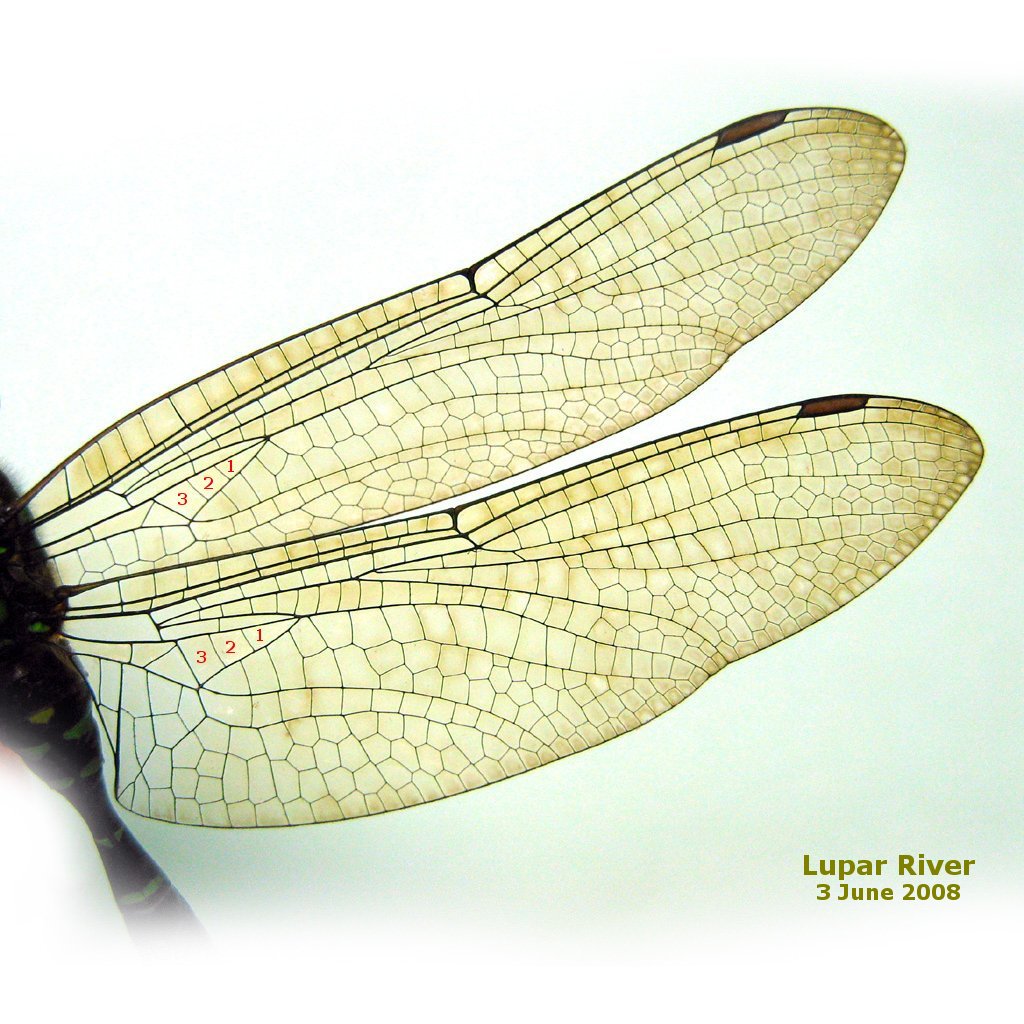
Male O. foliacea wings have fewer cross veins in the discoidal triangle, which
is usually divided into only three cells in both wings. Whereas in most other
genera it is usually divided into five or more cells.
Female's hindwing base is round.


The leaf-like anal appendages
Male O. foliacea superior appendages are moderately long and robust, flattened
and expanded.
Oligoaeschna species are similar in their body marking and can only be separated by structure of their anal appendages.
Ref: Dr. Orr’s guide book page 71
 |
Oligoaeschna
foliacea most frequently found in swampy alluvial forests in the
lowlands. |
 |
Oligoaeschna
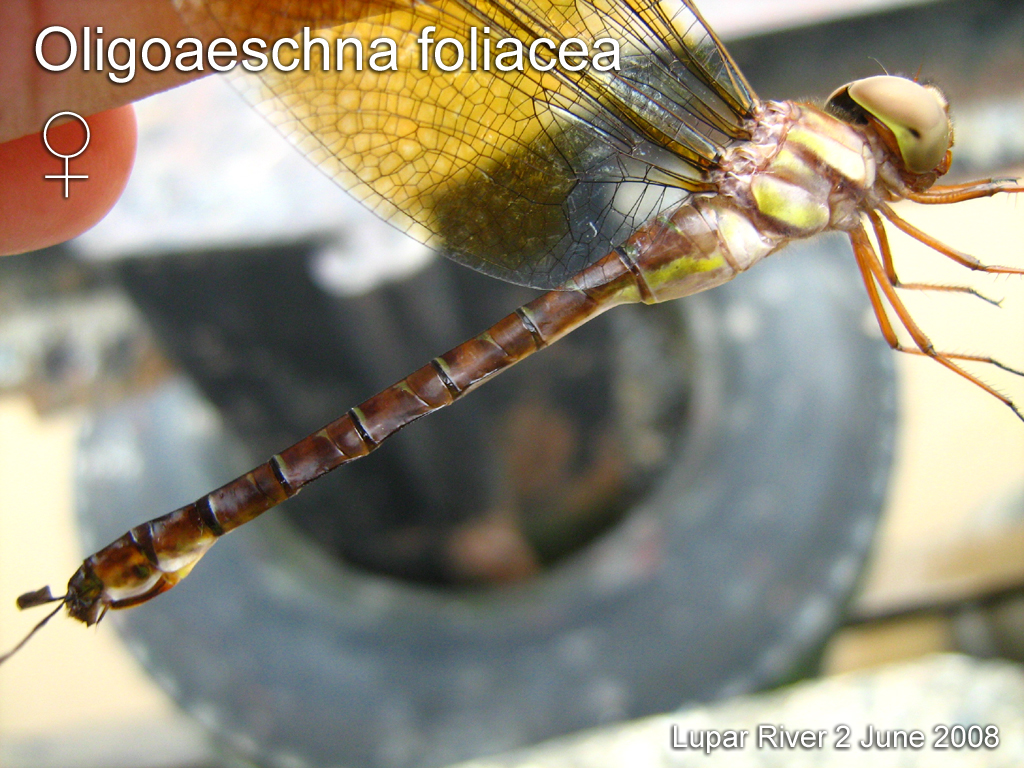
foliacea has a heavily built thorax with color range from dark
reddish-brown to black and marked darkly with green similar to the male. |
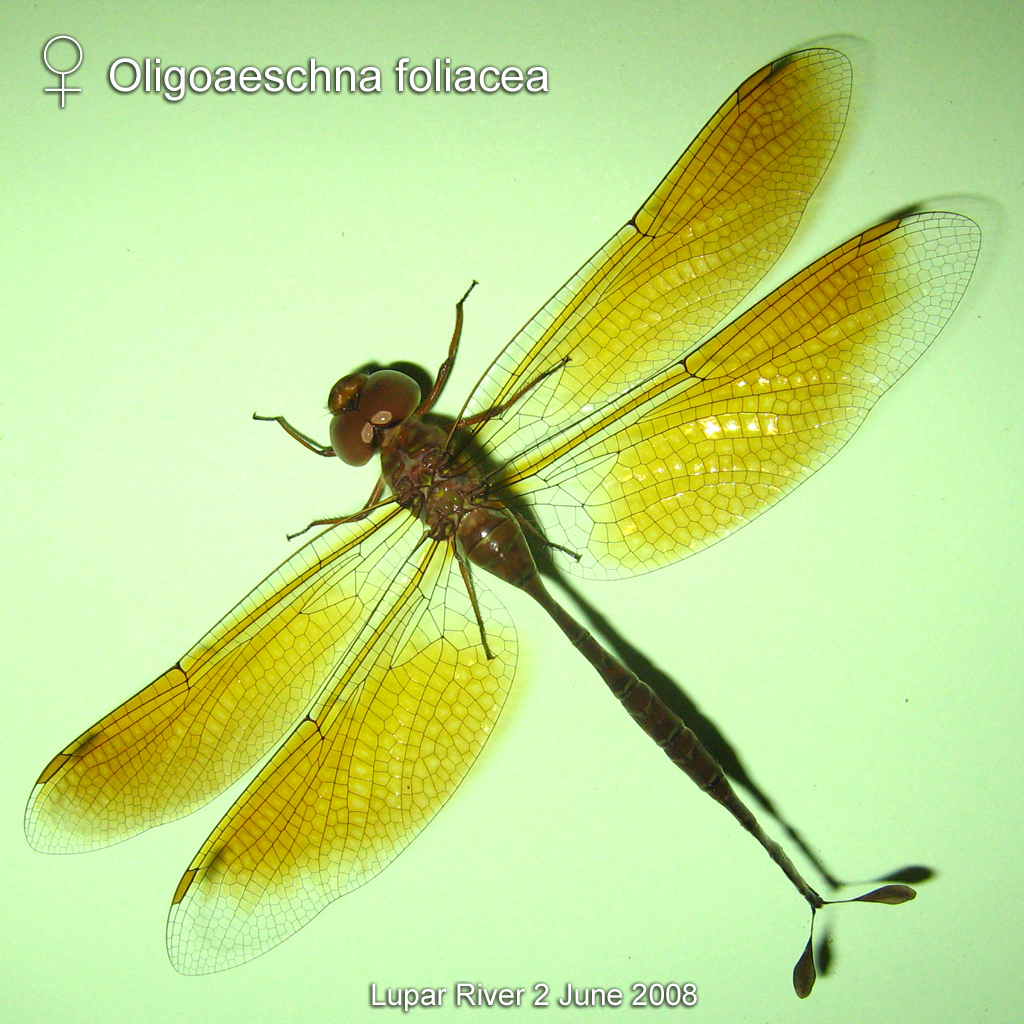 |
Female Oligoaeschna foliacea. |
 |
This Female
Oligoaeschna foliacea's appendages still intact. |
|
|
Bottom view of the
terminal segments of an adult female Oligoaeschna foliacea. |
A comparison of 2 females found just 50 meters from the location the above male found.
| Female 1 Found on 2 June 2008 |
Female 2 Found on 3 June 2008 |
 |
 |
 |
 |
|
The superior appendages is leaf-shape like.
|
 Female appendages already broken off with mating |
 |
When intact the female appendages are long and very broadly paddle-shaped with a thin stalk. The function of these long racquet like appendage curious structures is unknown. |

O. foliacea wings have fewer cross veins in the discoidal triangle,
which is usually divided into only three cells in both wings. Whereas in
most other genera it is usually divided into five or more cells. |

This O. foliacea female has only 2 cells on the front wing. |
The 3 families of dragonflies found in Borneo Island:
1 Family of Aeshnidae

CHART OF DRAGONFLIES OF BORNEO
RELATED TOPICS
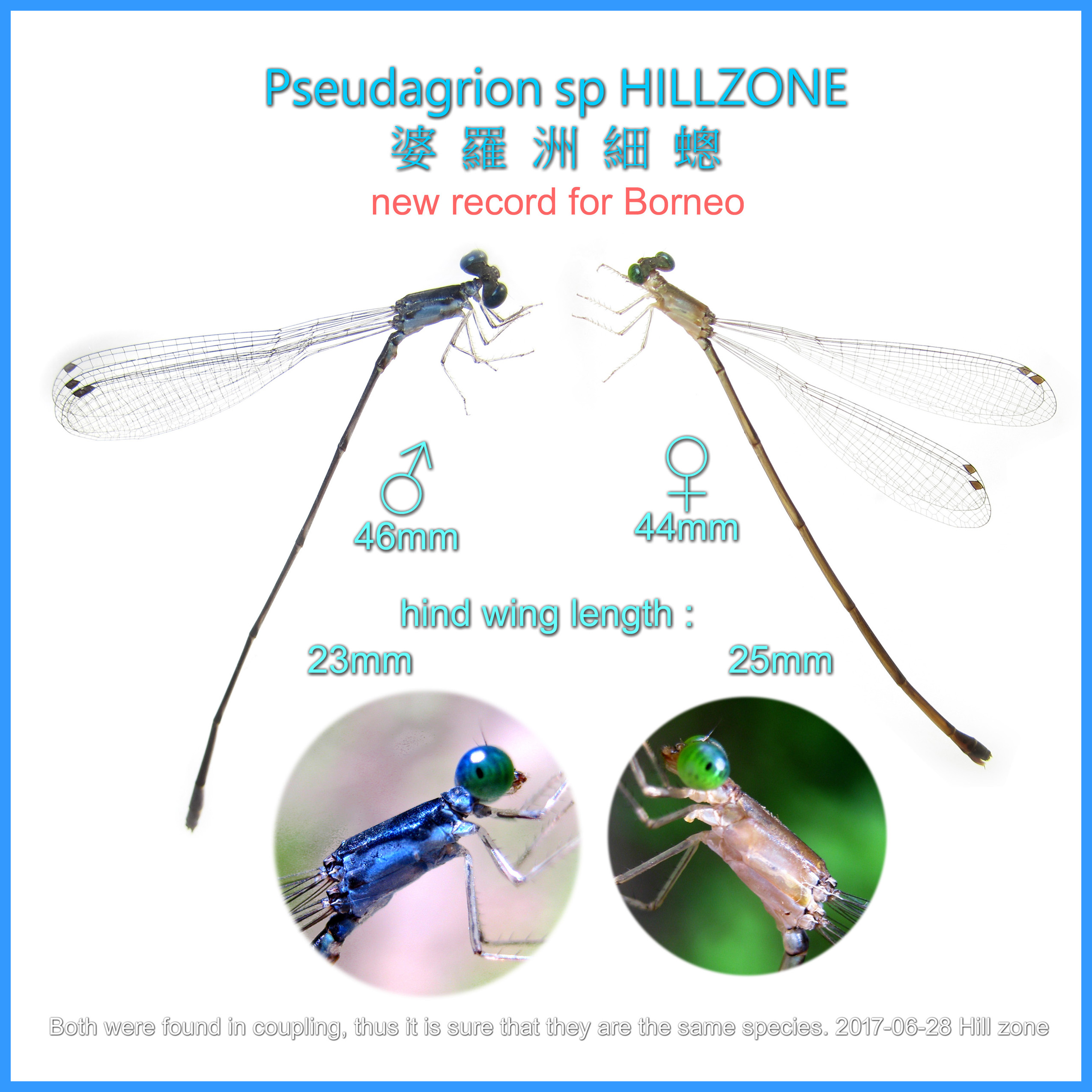
INTRODUCTION TO THE DAMSELFLIES OF SABAH, BORNEO ISLAND
Insects are diverse and dominant inhabitants of the tropical rainforests in Borneo Island. New species are discovered too often. Entomologists are still struggling to cope with the documentation of tropical insect diversity.
Most of the common dragonflies in Sabah are red coloured, especially from the family Libellulidae. Some red pecies are even confused as same species, for example the three species of Genus Neurothemis.

The compound eyes of dragonflies
Dragonflies and damselflies have large compound eyes that can see in all directions. When the compound eye is magnified several hundred times, each individual facet (ommatidium) is shown to be hexagonal in shape.
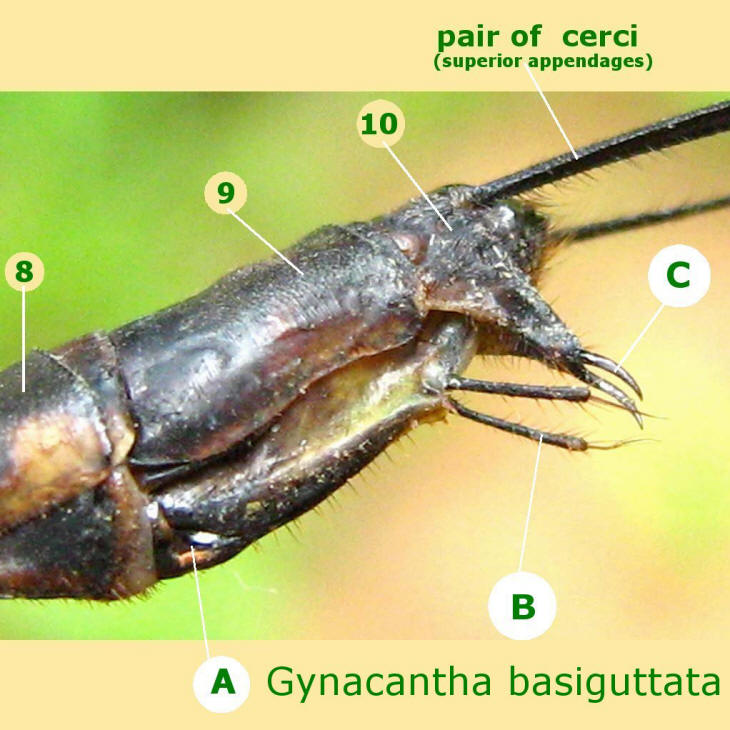
Ovipositor (Vulvar Lamina)
of Female Dragonflies and Damselflies
Female dragonflies have either one of the two method of depositing eggs from
the abdomen:
1- using Ovipositor Structure
2- using Vulvar Lamina
Male do not have an ovipositor. Instead male dragonfly and damselfly have appendages.
|
GO FURTHER FLORA Borneo has 150 species of wild fig trees. Most of them are found in forests of Sabah. FISHERIES Prawn farming is a main commercial activities in Tawau. Spawners from Tawau are graded the best in Malaysia. For decades, Tawau has been exporting high-grade tiger prawns to several countries such as Korea, Japan, Taiwan, China, Vietnam, Singapore, Egypt and Australia. |
|
|
Damselflies of Borneo |