From the Visayas and the Holy Child of Cebu — by coal mine, estate and church — to the Sinulog drums of Tawau
來自米沙鄢群島和宿霧聖嬰──經由煤礦、園坵和教堂──來到斗湖的Sinulog鼓聲中
Dari Visayas dan Kanak-kanak Suci Cebu — melalui lombong arang, ladang dan gereja — ke gendang Sinulog di Tawau
Stream B · sea lanes源流B · 海路Aliran B · laluan laut
1905Filipino Catholics among the workers at the Silimpopon coal mine near Tawau斗湖附近實林蓬蓬煤礦的工人中有菲律賓天主教徒Penganut Katolik Filipina antara pekerja lombong arang Silimpopon dekat Tawau
1955Manila and North Borneo sign an agreement to recruit Filipino workers馬尼拉與北婆羅洲簽署招聘菲律賓工人的協定Manila dan Borneo Utara menandatangani perjanjian mengambil pekerja Filipina
1985The Filipino Pastoral Community is founded at Holy Trinity Church, Tawau斗湖聖三堂成立菲律賓牧靈團體Komuniti Pastoral Filipina ditubuhkan di Gereja Holy Trinity, Tawau
1998The first Santo Niño feast in Tawau — kept every January since斗湖第一次慶祝聖嬰節──此後每年1月都舉行Pesta Santo Niño pertama di Tawau — diadakan setiap Januari sejak itu
1
Who are the Filipinos and Visayans of Tawau?
斗湖的菲律賓人和米沙鄢人是誰?
Siapakah orang Filipina dan Visaya di Tawau?
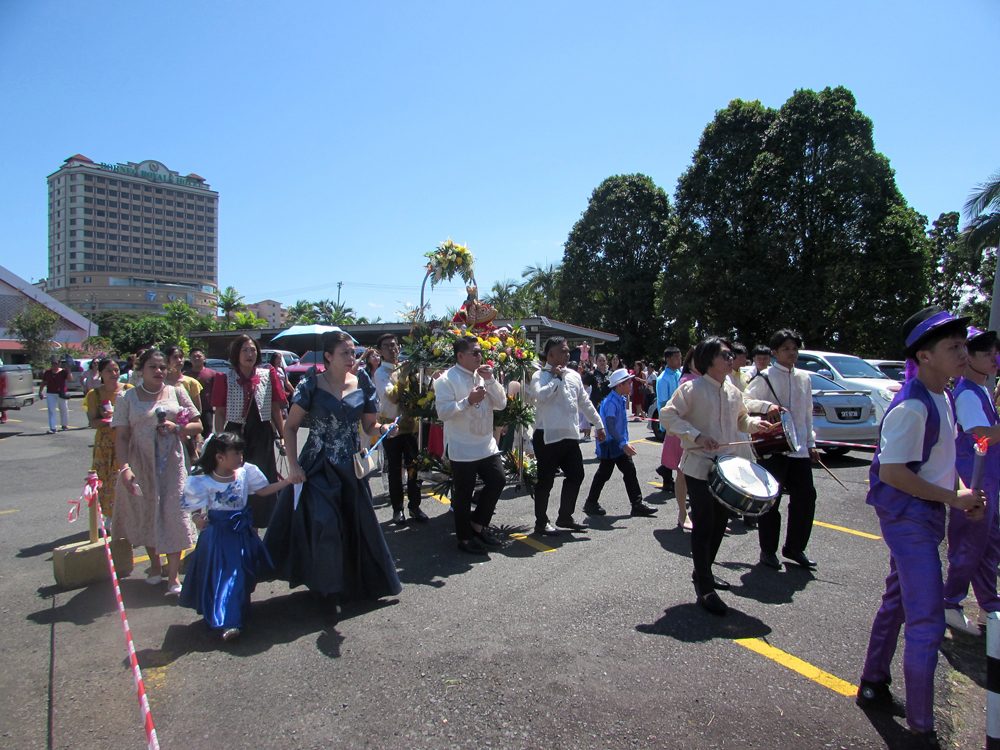
The Santo Niño procession at Holy Trinity Church, Tawau, 18 January 2026.聖嬰像遊行,斗湖聖三堂,2026年1月18日。Perarakan Santo Niño di Gereja Holy Trinity, Tawau, 18 Januari 2026.
Filipinos have lived in Sabah for as long as there have been boats on the Sulu Sea. This page tells mainly the story of the Christian Filipinos of Tawau — Visayans from Cebu, Panay, Negros, Leyte and Samar, and others from Luzon and Mindanao — who came as workers from the early 20th century onwards, and whose community life centres on Holy Trinity Church. Every January they carry the Santo Niño, the Holy Child of Cebu, through the church grounds to the drums of the Sinulog. The Muslim peoples of the southern Philippines who are Sabah’s oldest neighbours — Tausug, Sama-Bajau, Iranun — have their own eTawau pages.
Orang Filipina telah tinggal di Sabah selama adanya perahu di Laut Sulu. Halaman ini terutamanya menceritakan kisah orang Filipina Kristian di Tawau — orang Visaya dari Cebu, Panay, Negros, Leyte dan Samar, serta yang lain dari Luzon dan Mindanao — yang datang sebagai pekerja sejak awal abad ke-20, dan kehidupan komuniti mereka berpusat di Gereja Holy Trinity. Setiap Januari mereka mengarak Santo Niño, Kanak-kanak Suci Cebu, di kawasan gereja diiringi gendang Sinulog. Bangsa Islam di selatan Filipina yang menjadi jiran tertua Sabah — Tausug, Sama-Bajau, Iranun — mempunyai halaman eTawau sendiri.
Stream B · sea lanes源流B · 海路Aliran B · laluan lautLanguages: Cebuano, Hiligaynon, Waray, Tagalog, Ilocano — all Austronesian語言:宿霧語、希利蓋農語、瓦萊語、他加祿語、伊洛卡諾語──全屬南島語系Bahasa: Cebuano, Hiligaynon, Waray, Tagalog, Ilocano — semuanya Austronesia
Names you will meet
您會遇到的名字
Nama yang akan anda temui
Filipino · Pinoy
a person from the Philippines; Pinoy is the friendly everyday word菲律賓人;Pinoy是親切的日常說法orang dari Filipina; Pinoy ialah perkataan mesra harian
Visaya · Bisaya
people of the central Philippine islands — not the same as the Bisaya of Borneo菲律賓中部島嶼的人──與婆羅洲的比沙亞人不同penduduk pulau-pulau tengah Filipina — tidak sama dengan Bisaya Borneo
Cebuano · Ilonggo · Waray
the three largest Visayan peoples and languages米沙鄢三大民族和語言tiga bangsa dan bahasa Visaya terbesar
Santo Niño
the Holy Child of Cebu, an image of the Child Jesus宿霧聖嬰,聖嬰耶穌像Kanak-kanak Suci Cebu, patung Kanak-kanak Yesus
Sinulog
the prayer-dance for the Santo Niño: two steps forward, one back獻給聖嬰的祈禱舞:前進兩步、後退一步tarian doa untuk Santo Niño: dua langkah ke depan, satu ke belakang
the light, embroidered Filipino man’s shirt worn on special days菲律賓男士在特別日子穿的輕薄刺繡襯衫baju lelaki Filipina yang nipis bersulam, dipakai pada hari istimewa
IMM13
the pass given to Filipino war refugees in Sabah from the 1970s1970年代起發給沙巴菲律賓戰爭難民的通行證pas yang diberi kepada pelarian perang Filipina di Sabah sejak 1970-an
Visaya or Bisaya?
Visaya還是Bisaya?
Visaya atau Bisaya?
The Bisaya of Beaufort, Limbang and Brunei are an indigenous people of Borneo. The Visaya of Tawau are a community from the Philippines. The names look alike, and a 1907 legend tells of Bornean chiefs sailing to the Visayas, but no link between the two peoples has been proven. eTawau has a separate page for the Bisaya of Borneo.
Orang Bisaya di Beaufort, Limbang dan Brunei ialah bangsa peribumi Borneo. Orang Visaya di Tawau ialah komuniti dari Filipina. Nama-namanya kelihatan serupa, dan satu legenda 1907 mengisahkan datu Borneo belayar ke Visayas, tetapi tiada hubungan antara kedua-dua bangsa itu yang pernah dibuktikan. eTawau mempunyai halaman berasingan untuk Bisaya Borneo.
Sources: eTawau, TrinityHistory.htm, CFPC.htm, SantoNino pages and Visaya.htm (2018); Diocese of Sandakan; Wikipedia, “Filipinos in Malaysia”, “Visayans” and “Bisaya (Borneo)”; Azizah Kassim (2009); team photos.
資料來源:eTawau, TrinityHistory.htm, CFPC.htm, SantoNino pages and Visaya.htm (2018); Diocese of Sandakan; Wikipedia, “Filipinos in Malaysia”, “Visayans” and “Bisaya (Borneo)”; Azizah Kassim (2009); team photos.
Sumber: eTawau, TrinityHistory.htm, CFPC.htm, SantoNino pages and Visaya.htm (2018); Diocese of Sandakan; Wikipedia, “Filipinos in Malaysia”, “Visayans” and “Bisaya (Borneo)”; Azizah Kassim (2009); team photos.
2
The Philippines and the Visayas
菲律賓與米沙鄢群島
Filipina dan Visayas
The Visayas, Mindanao, the Sulu Archipelago and Sabah, with the old barter lanes to Tawau. Schematic, not to scale.米沙鄢群島、棉蘭老、蘇祿群島和沙巴,以及通往斗湖的舊易貨航線。示意圖,非按比例。Visayas, Mindanao, Kepulauan Sulu dan Sabah, dengan laluan barter lama ke Tawau. Skematik, tidak berskala.
The Philippines is an archipelago of more than seven thousand islands, with 109 million people at the 2020 census, in three parts: Luzon, the Visayas and Mindanao. The Visayas in the centre had 20.6 million people in 2020. Its largest language, Cebuano, is the mother tongue of about 20 million people in Cebu, Bohol, eastern Negros and much of Mindanao; Hiligaynon (Ilonggo) and Waray follow. From Tawau, the nearest Philippine islands are Sitangkai and Bongao in Tawi-Tawi, a short sea crossing away.
Filipina ialah kepulauan lebih tujuh ribu pulau, dengan 109 juta penduduk pada banci 2020, dalam tiga bahagian: Luzon, Visayas dan Mindanao. Visayas di tengah mempunyai 20.6 juta penduduk pada 2020. Bahasa terbesarnya, Cebuano, ialah bahasa ibunda kira-kira 20 juta orang di Cebu, Bohol, Negros timur dan sebahagian besar Mindanao; diikuti Hiligaynon (Ilonggo) dan Waray. Dari Tawau, pulau Filipina terdekat ialah Sitangkai dan Bongao di Tawi-Tawi, hanya satu pelayaran pendek.
🏝️
Three island groups
三大島群
Tiga kumpulan pulau
Luzon in the north, the Visayas in the centre, Mindanao in the south.
北部呂宋、中部米沙鄢、南部棉蘭老。
Luzon di utara, Visayas di tengah, Mindanao di selatan.
⛪
A Catholic nation
天主教國家
Negara Katolik
78.8 per cent Roman Catholic in 2020; over 90 per cent in Central Visayas.
2020年78.8%是天主教徒;中米沙鄢超過90%。
78.8 peratus Roman Katolik pada 2020; lebih 90 peratus di Visayas Tengah.
🌊
Close to Sabah
鄰近沙巴
Dekat dengan Sabah
The Sulu Archipelago reaches almost to Semporna and Tawau.
蘇祿群島幾乎延伸到仙本那和斗湖。
Kepulauan Sulu hampir sampai ke Semporna dan Tawau.
Sources: Philippine Statistics Authority, 2020 Census (population, ethnicity, religion); PhilAtlas, “Visayas”; Wikipedia, “Philippines” and “Bisayan languages”.
資料來源:Philippine Statistics Authority, 2020 Census (population, ethnicity, religion); PhilAtlas, “Visayas”; Wikipedia, “Philippines” and “Bisayan languages”.
Sumber: Philippine Statistics Authority, 2020 Census (population, ethnicity, religion); PhilAtlas, “Visayas”; Wikipedia, “Philippines” and “Bisayan languages”.
3
The Holy Child of Cebu
宿霧聖嬰
Kanak-kanak Suci Cebu
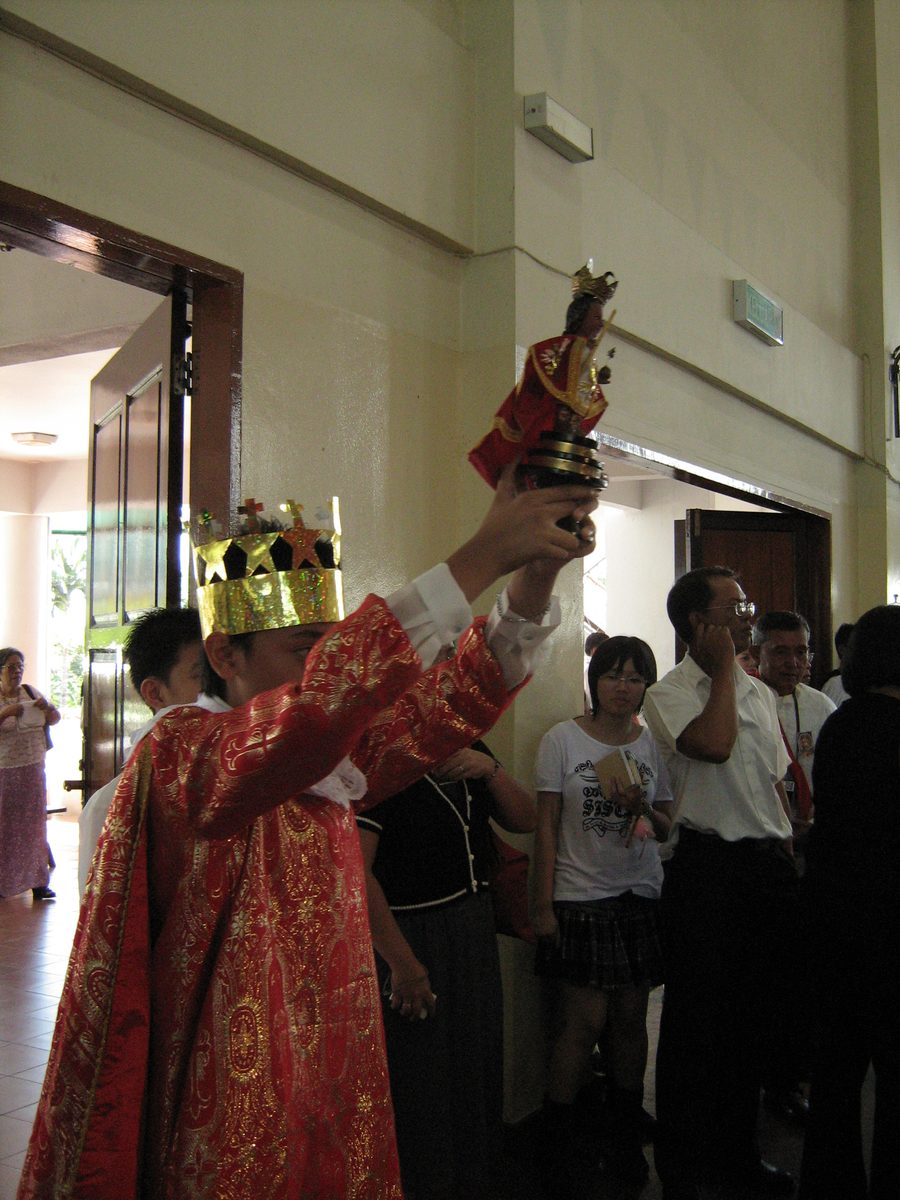
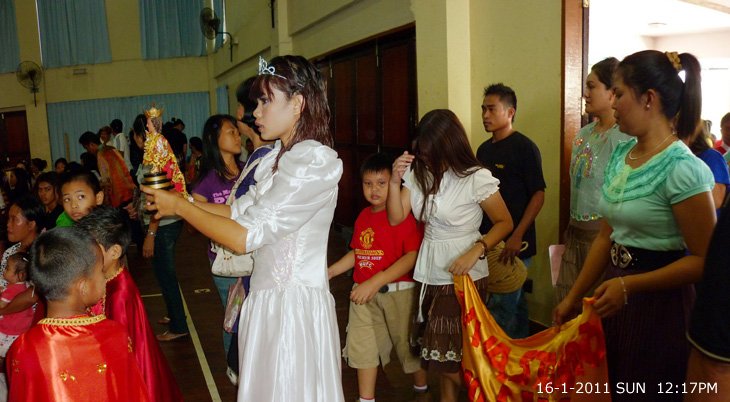
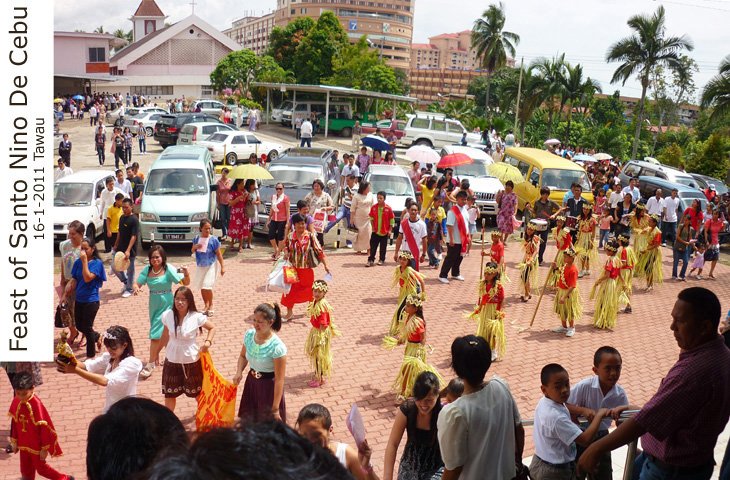
A devotee in royal costume lifts the Santo Niño, Holy Trinity Church, Tawau, 20 January 2008.一位身穿王袍的信徒高舉聖嬰像,斗湖聖三堂,2008年1月20日。Seorang penganut berpakaian raja mengangkat Santo Niño, Gereja Holy Trinity, Tawau, 20 Januari 2008.Carrying the Santo Niño, Tawau, 16 January 2011.捧著聖嬰像前行,斗湖,2011年1月16日。Membawa Santo Niño, Tawau, 16 Januari 2011.
In April 1521 Ferdinand Magellan’s expedition reached Cebu. Its ruler, Rajah Humabon, and his wife Hara Humamay were baptised as Carlos and Juana, and Magellan gave them a small wooden image of the Child Jesus. Magellan was killed at Mactan on 27 April 1521. When the next Spanish expedition under Legazpi came in 1565 and the settlement was burned, a sailor named Juan Camus found the image in a pine box in the ruins on 28 April 1565. Kept today in the Basilica Minore del Santo Niño in Cebu City, the Santo Niño de Cebu is honoured on the third Sunday of January — and wherever Cebuanos live, the feast goes with them.
Pada April 1521 ekspedisi Ferdinand Magellan sampai ke Cebu. Pemerintahnya, Rajah Humabon, dan isterinya Hara Humamay dibaptiskan sebagai Carlos dan Juana, dan Magellan memberi mereka patung kayu kecil Kanak-kanak Yesus. Magellan terbunuh di Mactan pada 27 April 1521. Apabila ekspedisi Sepanyol seterusnya di bawah Legazpi datang pada 1565 dan penempatan itu dibakar, seorang kelasi bernama Juan Camus menemui patung itu dalam peti kayu pain di celah runtuhan pada 28 April 1565. Kini disimpan di Basilica Minore del Santo Niño di Bandaraya Cebu, Santo Niño de Cebu dimuliakan pada hari Ahad ketiga Januari — dan di mana sahaja orang Cebuano tinggal, pesta itu turut bersama mereka.
Two views
兩種觀點
Dua pandangan
For many Filipino Catholics, 1521 and 1565 mark the beginning of the faith in their islands. Other writers stress that the same years began Spanish conquest, and many Filipinos also honour Lapulapu, who fought Magellan at Mactan. eTawau records both without taking sides.
Bagi ramai penganut Katolik Filipina, 1521 dan 1565 menandakan permulaan iman di pulau-pulau mereka. Penulis lain menegaskan tahun-tahun yang sama memulakan penaklukan Sepanyol, dan ramai orang Filipina juga memuliakan Lapulapu, yang memerangi Magellan di Mactan. eTawau merekodkan kedua-duanya tanpa memihak.
Sources: Wikipedia, “Santo Niño de Cebú” and “Lapulapu”; Cultural Center of the Philippines, Encyclopedia of Philippine Art; Philippine Daily Inquirer (2015); Columban Mission; team photos.
資料來源:Wikipedia, “Santo Niño de Cebú” and “Lapulapu”; Cultural Center of the Philippines, Encyclopedia of Philippine Art; Philippine Daily Inquirer (2015); Columban Mission; team photos.
Sumber: Wikipedia, “Santo Niño de Cebú” and “Lapulapu”; Cultural Center of the Philippines, Encyclopedia of Philippine Art; Philippine Daily Inquirer (2015); Columban Mission; team photos.
4
Spain, America and the Republic
西班牙、美國與共和國
Sepanyol, Amerika dan Republik
Spain ruled the Philippines from 1565, naming the islands after King Philip II. For 250 years the Manila galleons sailed between Manila and Acapulco. The Catholic faith spread across Luzon and the Visayas, while the Muslim sultanates of Sulu and Mindanao resisted Spain for centuries. Independence was declared on 12 June 1898, but the United States took over after the Spanish–American War. After the Japanese occupation of 1942–1945, the Republic of the Philippines became independent on 4 July 1946. From 1977 the Philippine government built a welfare system for its overseas workers, and today Filipinos work all over the world.
Sepanyol memerintah Filipina dari 1565, menamakan kepulauan itu sempena Raja Philip II. Selama 250 tahun galleon Manila belayar antara Manila dan Acapulco. Iman Katolik tersebar di Luzon dan Visayas, manakala kesultanan Islam Sulu dan Mindanao menentang Sepanyol berabad-abad. Kemerdekaan diisytiharkan pada 12 Jun 1898, tetapi Amerika Syarikat mengambil alih selepas Perang Sepanyol–Amerika. Selepas pendudukan Jepun 1942–1945, Republik Filipina merdeka pada 4 Julai 1946. Sejak 1977 kerajaan Filipina membina sistem kebajikan untuk pekerja luar negaranya, dan hari ini orang Filipina bekerja di seluruh dunia.
⛵ 1565⛵ 1565年⛵ 1565Spanish rule begins at Cebu.西班牙在宿霧開始統治。Pemerintahan Sepanyol bermula di Cebu.
📜 1898📜 1898年📜 1898Independence declared; the United States takes over.宣布獨立;美國接管。Kemerdekaan diisytiharkan; Amerika Syarikat mengambil alih.
🇵🇭 1946🇵🇭 1946年🇵🇭 1946The Republic of the Philippines, 4 July.7月4日,菲律賓共和國成立。Republik Filipina, 4 Julai.
✈️ 1977✈️ 1977年✈️ 1977A welfare fund for overseas Filipino workers.設立菲律賓海外工人福利基金。Tabung kebajikan untuk pekerja Filipina di luar negara.
Sources: Wikipedia, “History of the Philippines”, “Manila galleon”, “Philippine Declaration of Independence” and “Overseas Workers Welfare Administration”; OWWA.
資料來源:Wikipedia, “History of the Philippines”, “Manila galleon”, “Philippine Declaration of Independence” and “Overseas Workers Welfare Administration”; OWWA.
Sumber: Wikipedia, “History of the Philippines”, “Manila galleon”, “Philippine Declaration of Independence” and “Overseas Workers Welfare Administration”; OWWA.
5
Filipinos in North Borneo, Sabah and Tawau
北婆羅洲、沙巴與斗湖的菲律賓人
Orang Filipina di Borneo Utara, Sabah dan Tawau
Two Filipino histories meet in Tawau. Schematic.兩段菲律賓歷史在斗湖交會。示意圖。Dua sejarah Filipina bertemu di Tawau. Skematik.
Malaysian researchers trace Filipino movement into Sabah to barter trade between Bongao, Jolo and Sitangkai and the towns of Tawau and Lahad Datu. Christian Filipinos appear in Tawau’s own records early: the history of Holy Trinity Parish says the workforce of the Silimpopon coal mine, opened west of Tawau in 1905, included many Filipino Catholics — one reason the Catholic mission began visiting Tawau, made an outstation in 1915. Wikipedia says Ilonggo, Waray, Tagalog, Cebuano and other Filipinos came to work in North Borneo in the 1920s and 1930s. In 1954 the British estimated 6,000–7,000 Filipinos in the colony, and on 29 August 1955 Manila and London signed an agreement to recruit Filipino workers, “preferably Ilocanos”, for its estates and forests. By 1968 there were about 13,000 Filipino workers in Sabah, 25,000 with their families.
Penyelidik Malaysia menjejak penghijrahan orang Filipina ke Sabah kepada perdagangan barter antara Bongao, Jolo dan Sitangkai dengan bandar Tawau dan Lahad Datu. Orang Filipina Kristian muncul awal dalam rekod Tawau sendiri: sejarah Paroki Holy Trinity menyatakan tenaga kerja lombong arang Silimpopon, dibuka di barat Tawau pada 1905, termasuk ramai penganut Katolik Filipina — antara sebab misi Katolik mula melawat Tawau, yang dijadikan stesen luar pada 1915. Wikipedia menyatakan orang Filipina Ilonggo, Waray, Tagalog, Cebuano dan lain-lain datang bekerja di Borneo Utara pada 1920-an dan 1930-an. Pada 1954 British menganggarkan 6,000–7,000 orang Filipina di tanah jajahan itu, dan pada 29 Ogos 1955 Manila dan London menandatangani perjanjian mengambil pekerja Filipina, “lebih baik orang Ilocano”, untuk ladang dan hutannya. Menjelang 1968 terdapat kira-kira 13,000 pekerja Filipina di Sabah, 25,000 bersama keluarga.
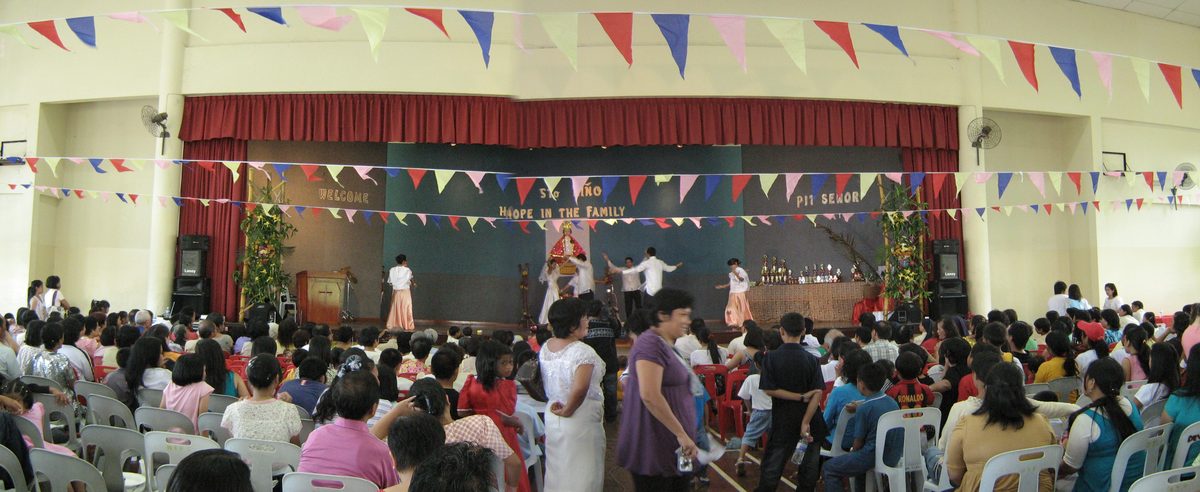
The parish hall full for the Santo Niño feast, Holy Trinity, Tawau, 20 January 2008.聖嬰節時座無虛席的堂區禮堂,斗湖聖三堂,2008年1月20日。Dewan paroki penuh untuk pesta Santo Niño, Holy Trinity, Tawau, 20 Januari 2008.Sinulog dancers lead the procession, 16 January 2011.Sinulog舞者引領遊行,2011年1月16日。Penari Sinulog mengetuai perarakan, 16 Januari 2011.
In 1985 the Filipino Pastoral Community of Holy Trinity Church was founded to care for the Catholic Filipinos who had come to Tawau for a better livelihood, and since 1998 it has kept the Feast of the Santo Niño every January — with about 500 at Mass in 2011, and 800 or more at Mass and some 1,000 in the hall in 2017. The war refugees who came to Sabah from Mindanao and Sulu in the 1970s were a separate and much larger movement, almost entirely Muslim; among their settlements was Kampung Hidayat, at Mile 4, Jalan Apas, in Tawau.
Pada 1985 Komuniti Pastoral Filipina Gereja Holy Trinity ditubuhkan untuk menjaga penganut Katolik Filipina yang datang ke Tawau mencari kehidupan lebih baik, dan sejak 1998 ia menyambut Pesta Santo Niño setiap Januari — kira-kira 500 di Misa pada 2011, dan 800 atau lebih di Misa serta kira-kira 1,000 di dewan pada 2017. Pelarian perang yang datang ke Sabah dari Mindanao dan Sulu pada 1970-an ialah aliran berasingan yang jauh lebih besar, hampir semuanya Islam; antara penempatan mereka ialah Kampung Hidayat, di Batu 4, Jalan Apas, Tawau.
What we still do not know
我們仍不知道的事
Apa yang kita masih belum tahu
Who were the first Filipino families of Tawau town, and where did they live? How many Ilocanos came under the 1955 Agreement, and to which estates? How many Filipinos live in Tawau today? Malaysian statistics do not count them separately. Please share your family’s story with eTawau.
Siapakah keluarga Filipina pertama di bandar Tawau, dan di mana mereka tinggal? Berapa ramai orang Ilocano datang di bawah Perjanjian 1955, dan ke ladang mana? Berapa ramai orang Filipina tinggal di Tawau hari ini? Statistik Malaysia tidak mengira mereka secara berasingan. Sila kongsikan kisah keluarga anda dengan eTawau.
Sources: Mohammad Azzam Manan, Jati 11 (2006); eTawau, TrinityHistory.htm and CFPC.htm; Wikipedia, “Filipinos in Malaysia”; UK Parliament, Hansard (26 May 1954); Agreement of 29 Aug 1955 (Supreme Court E-Library); The Press (20 Nov 1968); Diocese of Sandakan (2010, 2011, 2017); Azizah Kassim (2009); DAP Sabah (2017); team photos.
資料來源:Mohammad Azzam Manan, Jati 11 (2006); eTawau, TrinityHistory.htm and CFPC.htm; Wikipedia, “Filipinos in Malaysia”; UK Parliament, Hansard (26 May 1954); Agreement of 29 Aug 1955 (Supreme Court E-Library); The Press (20 Nov 1968); Diocese of Sandakan (2010, 2011, 2017); Azizah Kassim (2009); DAP Sabah (2017); team photos.
Sumber: Mohammad Azzam Manan, Jati 11 (2006); eTawau, TrinityHistory.htm and CFPC.htm; Wikipedia, “Filipinos in Malaysia”; UK Parliament, Hansard (26 May 1954); Agreement of 29 Aug 1955 (Supreme Court E-Library); The Press (20 Nov 1968); Diocese of Sandakan (2010, 2011, 2017); Azizah Kassim (2009); DAP Sabah (2017); team photos.
6
Through the ages
歷代變遷
Sepanjang zaman
1521Magellan reaches Cebu; Rajah Humabon and Hara Humamay are baptised and receive the Santo Niño.麥哲倫抵達宿霧;胡馬汶王和胡馬梅受洗並獲贈聖嬰像。Magellan sampai ke Cebu; Rajah Humabon dan Hara Humamay dibaptiskan dan menerima Santo Niño.
1565Juan Camus finds the Santo Niño at Cebu (28 April); Spanish rule begins.胡安·卡穆斯在宿霧找到聖嬰像(4月28日);西班牙統治開始。Juan Camus menemui Santo Niño di Cebu (28 April); pemerintahan Sepanyol bermula.
1878The Sulu sultanate’s grant of North Borneo’s east coast to the British company.蘇祿蘇丹國把北婆羅洲東海岸授予英國公司。Geran kesultanan Sulu ke atas pantai timur Borneo Utara kepada syarikat British.
1898Philippine independence declared (12 June); the United States takes over.菲律賓宣布獨立(6月12日);美國接管。Kemerdekaan Filipina diisytiharkan (12 Jun); Amerika Syarikat mengambil alih.
1905The Silimpopon coal mine opens west of Tawau; many of its Filipino workers are Catholics.斗湖以西的實林蓬蓬煤礦開採;許多菲律賓工人是天主教徒。Lombong arang Silimpopon dibuka di barat Tawau; ramai pekerja Filipinanya Katolik.
1915Tawau becomes an outstation of the Catholic mission in Sandakan.斗湖成為山打根天主教傳教團的傳教站。Tawau menjadi stesen luar misi Katolik Sandakan.
1920s–1930sIlonggo, Waray, Tagalog, Cebuano and other Filipinos come to work in North Borneo.伊朗戈、瓦萊、他加祿、宿霧等地的菲律賓人來北婆羅洲工作。Orang Filipina Ilonggo, Waray, Tagalog, Cebuano dan lain-lain datang bekerja di Borneo Utara.
1946The Republic of the Philippines becomes independent (4 July).菲律賓共和國獨立(7月4日)。Republik Filipina merdeka (4 Julai).
19546,000–7,000 Filipinos estimated in North Borneo.估計北婆羅洲有6,000至7,000名菲律賓人。6,000–7,000 orang Filipina dianggarkan di Borneo Utara.
1955Agreement on Filipino labour for North Borneo signed in Manila (29 August).菲律賓勞工赴北婆羅洲協定在馬尼拉簽署(8月29日)。Perjanjian buruh Filipina untuk Borneo Utara ditandatangani di Manila (29 Ogos).
1962The Philippines lodges its claim to North Borneo (22 June).菲律賓提出對北婆羅洲的主權要求(6月22日)。Filipina mengemukakan tuntutan ke atas Borneo Utara (22 Jun).
1968About 13,000 Filipino workers (25,000 with families) in Sabah.沙巴約有13,000名菲律賓工人(連同家屬25,000人)。Kira-kira 13,000 pekerja Filipina (25,000 bersama keluarga) di Sabah.
1972–1984Refugees from the war in Mindanao and Sulu cross to Sabah.棉蘭老和蘇祿的戰爭難民越海來到沙巴。Pelarian perang Mindanao dan Sulu menyeberang ke Sabah.
1980The first Sinulog festival in Cebu (20 January).宿霧第一屆Sinulog節(1月20日)。Festival Sinulog pertama di Cebu (20 Januari).
1985The Filipino Pastoral Community is founded at Holy Trinity Church, Tawau.斗湖聖三堂成立菲律賓牧靈團體。Komuniti Pastoral Filipina ditubuhkan di Gereja Holy Trinity, Tawau.
1998The first Santo Niño feast at Holy Trinity, Tawau.斗湖聖三堂第一次慶祝聖嬰節。Pesta Santo Niño pertama di Holy Trinity, Tawau.
200220,009 IMM13 holders are given permanent residence.20,009名IMM13持有人獲得永久居留權。20,009 pemegang IMM13 diberi taraf penduduk tetap.
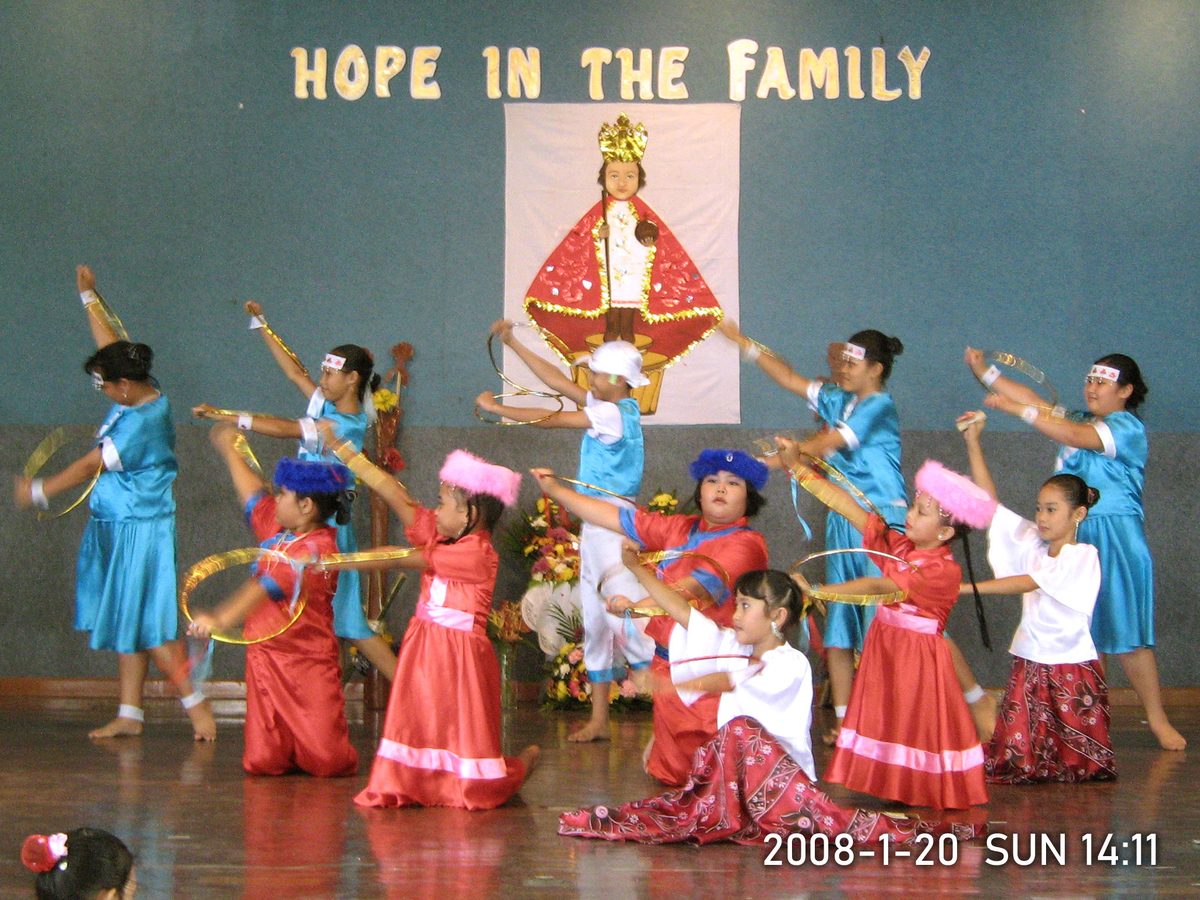
2008The Santo Niño feast in Tawau: “Hope in the Family” (20 January).斗湖聖嬰節:「家庭中的希望」(1月20日)。Pesta Santo Niño di Tawau: “Hope in the Family” (20 Januari).
2010The FPC’s 25th anniversary, with Filipino groups from across the diocese (17 January).FPC 25週年,有來自全教區的菲律賓團體參加(1月17日)。Ulang tahun ke-25 FPC, dengan kumpulan Filipina dari seluruh keuskupan (17 Januari).
2012Philippine consular mobile teams work in Kota Kinabalu and Tawau.菲律賓領事流動小組在亞庇和斗湖服務。Pasukan mudah alih konsular Filipina bertugas di Kota Kinabalu dan Tawau.
2017Fire at Kampung Hidayat, Tawau; 1,960 people registered as victims (July).斗湖希達亞村大火;1,960人登記為災民(7月)。Kebakaran di Kampung Hidayat, Tawau; 1,960 orang didaftarkan sebagai mangsa (Julai).
2018“Visaya of Borneo” at the Tawau International Cultural Festival (7 April).「婆羅洲的米沙鄢人」參加斗湖國際文化節(4月7日)。“Visaya of Borneo” di Festival Kebudayaan Antarabangsa Tawau (7 April).
2022Philippine consular outreach in Tawau serves more than 1,000 people (April).菲律賓領事外展服務在斗湖服務1,000多人(4月)。Jangkauan konsular Filipina di Tawau melayani lebih 1,000 orang (April).
2024The FPC’s 40th anniversary, with a Sinulog competition (21 January).FPC 40週年,舉行Sinulog舞比賽(1月21日)。Ulang tahun ke-40 FPC, dengan pertandingan Sinulog (21 Januari).
2026The Santo Niño procession at Holy Trinity, Tawau (18 January).斗湖聖三堂聖嬰像遊行(1月18日)。Perarakan Santo Niño di Holy Trinity, Tawau (18 Januari).
Sources: Wikipedia (“Santo Niño de Cebú”, “History of the Philippines”, “Filipinos in Malaysia”, “Sinulog”); eTawau, TrinityHistory.htm, CFPC.htm, SantoNino pages, Visaya.htm and Understanding Tawau (2026); Hansard (1954); Agreement of 1955; The Press (1968); Philippine Daily Inquirer (2018); Azizah Kassim (2009); MindaNews; Diocese of Sandakan; Philippine Embassy Kuala Lumpur; DAP Sabah (2017).
資料來源:Wikipedia (“Santo Niño de Cebú”, “History of the Philippines”, “Filipinos in Malaysia”, “Sinulog”); eTawau, TrinityHistory.htm, CFPC.htm, SantoNino pages, Visaya.htm and Understanding Tawau (2026); Hansard (1954); Agreement of 1955; The Press (1968); Philippine Daily Inquirer (2018); Azizah Kassim (2009); MindaNews; Diocese of Sandakan; Philippine Embassy Kuala Lumpur; DAP Sabah (2017).
Sumber: Wikipedia (“Santo Niño de Cebú”, “History of the Philippines”, “Filipinos in Malaysia”, “Sinulog”); eTawau, TrinityHistory.htm, CFPC.htm, SantoNino pages, Visaya.htm and Understanding Tawau (2026); Hansard (1954); Agreement of 1955; The Press (1968); Philippine Daily Inquirer (2018); Azizah Kassim (2009); MindaNews; Diocese of Sandakan; Philippine Embassy Kuala Lumpur; DAP Sabah (2017).
7
Sinulog, barong and the fiesta
Sinulog舞、Barong與節慶
Sinulog, barong dan fiesta
The Sinulog step: two forward, one back, like the current of a river. Schematic drawing.Sinulog舞步:前進兩步、後退一步,如河水流動。示意圖。Langkah Sinulog: dua ke depan, satu ke belakang, seperti arus sungai. Lukisan skematik.
💃 Sinulog💃 Sinulog舞💃 SinulogFrom Cebuano sulog, “like water current”: two steps forward, one back, to the drums.源自宿霧語sulog(「如水流」):隨鼓聲前進兩步、後退一步。Daripada Cebuano sulog, “seperti arus air”: dua langkah ke depan, satu ke belakang, mengikut gendang.
👑 Santo Niño bearer👑 聖嬰捧持者👑 Pembawa Santo NiñoIn Tawau, a competition for those who carry the image in the procession.在斗湖,有捧持聖像遊行者的比賽。Di Tawau, pertandingan bagi mereka yang membawa patung itu dalam perarakan.
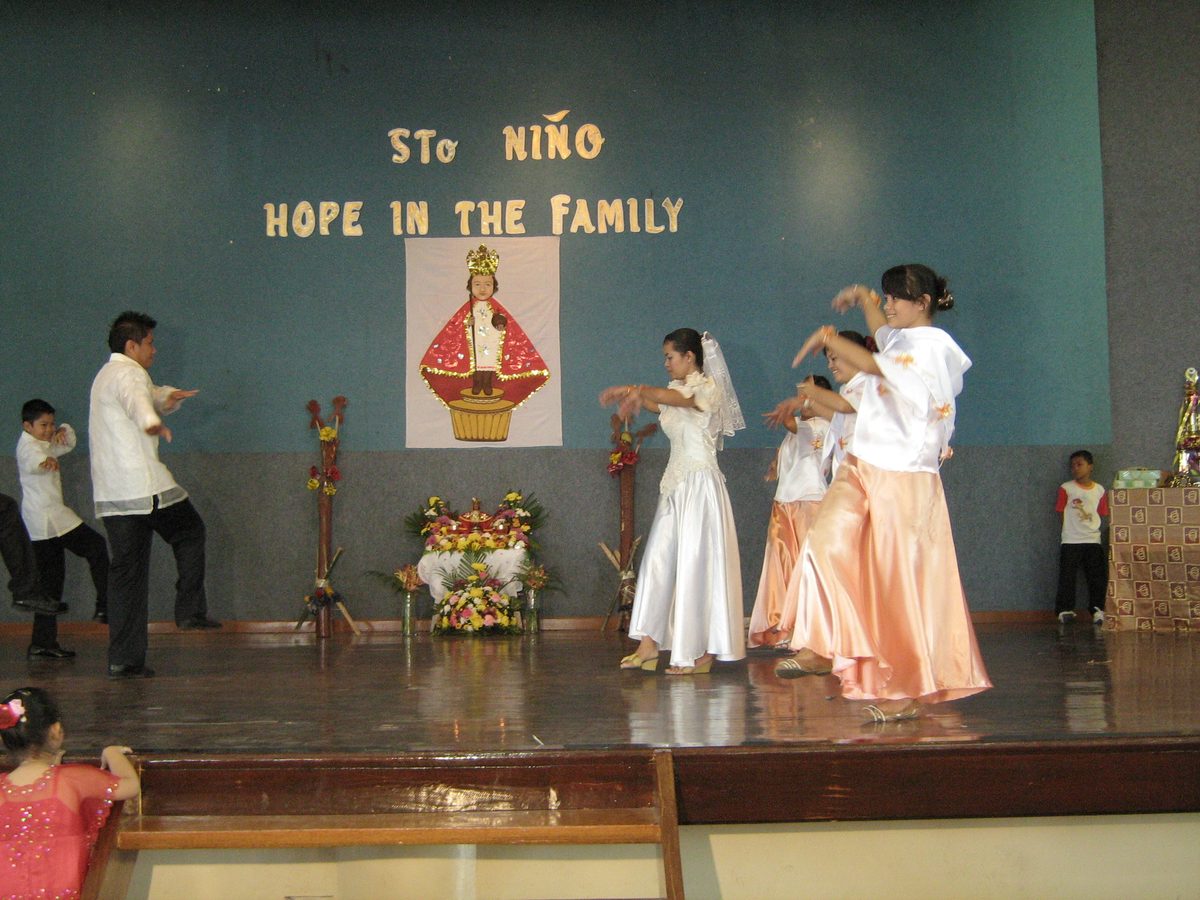
👔 Barong👔 Barong👔 BarongThe light embroidered shirt worn by men; women wear long Filipiniana dresses.男士穿的輕薄刺繡襯衫;女士穿菲律賓式長裙。Baju bersulam nipis yang dipakai lelaki; wanita memakai gaun panjang Filipiniana.
🎉 Fiesta🎉 節慶🎉 FiestaAfter Mass: lunch in the Parish Hall, songs, folk dances, games and prizes.彌撒之後:在堂區禮堂午餐、唱歌、跳民族舞、遊戲和頒獎。Selepas Misa: makan tengah hari di Dewan Paroki, lagu, tarian rakyat, permainan dan hadiah.
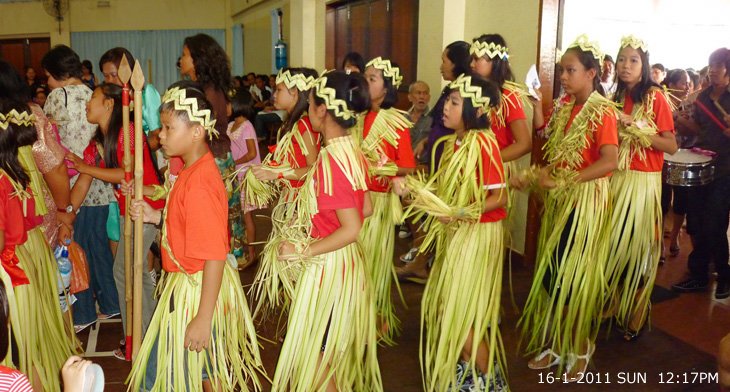
Children dance under the theme “Hope in the Family”, 20 January 2008.孩子們在「家庭中的希望」主題下跳舞,2008年1月20日。Kanak-kanak menari di bawah tema “Hope in the Family”, 20 Januari 2008.Couples in barong and long gowns, 20 January 2008.穿著barong和長裙的舞伴,2008年1月20日。Pasangan berbaju barong dan gaun panjang, 20 Januari 2008.Dancers in leaf costumes, 16 January 2011.穿著葉子服裝的舞者,2011年1月16日。Penari berpakaian daun, 16 Januari 2011.
Sources: Wikipedia, “Sinulog”; SunStar Cebu; The Philippine Star (2007); The Freeman (2024); eTawau, SantoNino.htm and SantoNino2011.htm; Diocese of Sandakan (2017, 2024); team photos.
資料來源:Wikipedia, “Sinulog”; SunStar Cebu; The Philippine Star (2007); The Freeman (2024); eTawau, SantoNino.htm and SantoNino2011.htm; Diocese of Sandakan (2017, 2024); team photos.
Sumber: Wikipedia, “Sinulog”; SunStar Cebu; The Philippine Star (2007); The Freeman (2024); eTawau, SantoNino.htm and SantoNino2011.htm; Diocese of Sandakan (2017, 2024); team photos.
8
The Filipino community today
今日的菲律賓社群
Komuniti Filipina hari ini
Today the Filipino community is, in the words of a 2017 diocesan report, the community with the largest number of Catholics in Holy Trinity Parish. Its Filipino Pastoral Community reaches out to lapsed parishioners, honours its elders, rewards students who do well in national exams, and welcomes Filipino groups from Semporna, Kunak and Lahad Datu to the January feast. Community leaders also run an informal learning centre for Filipino children in Tawau. Because the Philippines has no consulate in Sabah, its embassy in Kuala Lumpur sends consular teams to Tawau to issue passports and birth papers, including special missions for plantation workers in 2022.
Hari ini komuniti Filipina, menurut laporan keuskupan 2017, ialah komuniti yang mempunyai penganut Katolik paling ramai di Paroki Holy Trinity. Komuniti Pastoral Filipinanya menjangkau umat yang renggang, menghormati warga emas, memberi anugerah kepada pelajar yang cemerlang dalam peperiksaan kebangsaan, dan mengalu-alukan kumpulan Filipina dari Semporna, Kunak dan Lahad Datu ke pesta Januari. Pemimpin komuniti juga menjalankan pusat pembelajaran tidak formal untuk kanak-kanak Filipina di Tawau. Kerana Filipina tiada konsulat di Sabah, kedutaannya di Kuala Lumpur menghantar pasukan konsular ke Tawau untuk mengeluarkan pasport dan dokumen kelahiran, termasuk misi khas untuk pekerja ladang pada 2022.
Two views
兩種觀點
Dua pandangan
Some Sabah leaders want the Philippines to open a consulate in Kota Kinabalu, and want undocumented Filipinos and IMM13 holders sent home; a federal minister said in 2019 that many IMM13 holders are Sabah-born with no family left in the Philippines. In Manila, a Foreign Secretary called a consulate in Sabah “treason” in 2019 because of the Philippine claim. Many Sabah employers, especially plantations, rely on Filipino workers, and the embassy now holds missions on the estates to give them papers. eTawau records these views without taking sides.
Sebahagian pemimpin Sabah mahu Filipina membuka konsulat di Kota Kinabalu, dan mahu orang Filipina tanpa dokumen serta pemegang IMM13 dihantar pulang; seorang menteri persekutuan berkata pada 2019 bahawa ramai pemegang IMM13 lahir di Sabah tanpa keluarga lagi di Filipina. Di Manila, seorang Setiausaha Luar menyebut konsulat di Sabah “pengkhianatan” pada 2019 kerana tuntutan Filipina. Ramai majikan Sabah, terutamanya ladang, bergantung kepada pekerja Filipina, dan kedutaan kini mengadakan misi di ladang untuk memberi mereka dokumen. eTawau merekodkan pandangan ini tanpa memihak.
Sources: Diocese of Sandakan (6 Feb 2017); The Borneo Post (Oct 2018; 4 Nov 2022); Philippine Embassy Kuala Lumpur (2012, 2022); Free Malaysia Today (25 and 27 Nov 2019); The Philippine Star (22 Apr 2019); Malay Mail (28 Jun 2023).
資料來源:Diocese of Sandakan (6 Feb 2017); The Borneo Post (Oct 2018; 4 Nov 2022); Philippine Embassy Kuala Lumpur (2012, 2022); Free Malaysia Today (25 and 27 Nov 2019); The Philippine Star (22 Apr 2019); Malay Mail (28 Jun 2023).
Sumber: Diocese of Sandakan (6 Feb 2017); The Borneo Post (Oct 2018; 4 Nov 2022); Philippine Embassy Kuala Lumpur (2012, 2022); Free Malaysia Today (25 and 27 Nov 2019); The Philippine Star (22 Apr 2019); Malay Mail (28 Jun 2023).
9
The Filipino Story, in eight chapters
菲律賓人的故事(共八篇)
Kisah Filipina, dalam lapan bab
A light-reading series for visitors, students and families, in three languages. These are short first drafts that eTawau will develop into full articles as more information and photos arrive.
Siri bacaan ringan untuk pelawat, pelajar dan keluarga, dalam tiga bahasa. Ini draf pertama yang pendek yang akan dikembangkan oleh eTawau menjadi artikel lengkap apabila lebih banyak maklumat dan foto diterima.
A ruler and his queen, a chronicler, a sailor, a festival-maker, a statesman, two miners, the leaders of a Tawau church community, and a scholar of Sabah’s refugees.
Seorang pemerintah dan permaisurinya, seorang pencatat, seorang kelasi, seorang pencipta festival, seorang negarawan, dua pelombong, pemimpin sebuah komuniti gereja Tawau, dan seorang sarjana pelarian Sabah.
HJ
Rajah Humabon & Hara Humamay
Rulers of Cebu, 15211521年宿霧的統治者Pemerintah Cebu, 1521
Baptised as Carlos and Juana in April 1521, they received the Santo Niño from Magellan, according to Pigafetta’s account.
1521年4月受洗,取名卡洛斯和胡安娜;據皮加費塔的記載,他們從麥哲倫手中接受了聖嬰像。
Dibaptiskan sebagai Carlos dan Juana pada April 1521, mereka menerima Santo Niño daripada Magellan, menurut catatan Pigafetta.
Wikipedia, “Santo Niño de Cebú”
AP
Antonio Pigafetta
Chronicler of Magellan’s voyage麥哲倫航行的記錄者Pencatat pelayaran Magellan
His journal of the voyage is the main source for the events at Cebu and Mactan in 1521, including the gift of the image of the Holy Child.
他的航海日誌是1521年宿霧和麥克坦事件的主要資料來源,包括贈送聖嬰像一事。
Jurnal pelayarannya ialah sumber utama bagi peristiwa di Cebu dan Mactan pada 1521, termasuk hadiah patung Kanak-kanak Suci.
Pada 28 April 1565 dia menemui Santo Niño dalam peti kayu pain di celah runtuhan rumah terbakar di Cebu. Penemuan itu dikenang sebagai Kaplag.
Wikipedia; Philippine Daily Inquirer (2015)
DO
David S. Odilao Jr.
“Father of the Sinulog”「Sinulog之父」“Bapa Sinulog”
As regional director of the Ministry of Youth and Sports Development, he organised the first Sinulog parade in Cebu on 20 January 1980, turning an old prayer-dance into a great festival.
Sebagai pengarah wilayah Kementerian Belia dan Pembangunan Sukan, dia menganjurkan perarakan Sinulog pertama di Cebu pada 20 Januari 1980, menjadikan tarian doa lama sebuah festival besar.
Cebu Daily News; The Philippine Star (2007)
CG
Carlos P. Garcia
Signed the 1955 Agreement; later President簽署1955年協定;後來出任總統Menandatangani Perjanjian 1955; kemudian Presiden
He signed, for the Philippines, the 29 August 1955 agreement on Filipino labour for North Borneo, and was President of the Philippines from 1957 to 1961.
Dia menandatangani, bagi pihak Filipina, perjanjian 29 Ogos 1955 tentang buruh Filipina untuk Borneo Utara, dan menjadi Presiden Filipina dari 1957 hingga 1961.
Supreme Court E-Library (1955 Agreement); Wikipedia
DB
Crescencio & Beningo Domingo
Catholic workers at Silimpopon實林蓬蓬的天主教工人Pekerja Katolik di Silimpopon
The parish history of Holy Trinity names the Domingo brothers among the Catholic workers who went from Sandakan to the Silimpopon coal mine — part of the reason the Church came to Tawau.
Sejarah paroki Holy Trinity menamakan adik-beradik Domingo antara pekerja Katolik yang pergi dari Sandakan ke lombong arang Silimpopon — sebahagian sebab Gereja datang ke Tawau.
From Sylvester Matthew Alberto (1985–1987) and Nellie Sarmiento-Chok to Rufino Pontillas, Joel Monasque and Belen Nokiah, lay leaders have run the community and its January feast for four decades.
從Sylvester Matthew Alberto(1985–1987)和Nellie Sarmiento-Chok,到Rufino Pontillas、Joel Monasque和Belen Nokiah,平信徒領袖四十年來帶領這個團體和它的1月節慶。
Dari Sylvester Matthew Alberto (1985–1987) dan Nellie Sarmiento-Chok hingga Rufino Pontillas, Joel Monasque dan Belen Nokiah, pemimpin awam telah memimpin komuniti dan pesta Januarinya selama empat dekad.
eTawau, CFPC.htm; Diocese of Sandakan (2010, 2017, 2024)
AK
Azizah Kassim
Scholar, Universiti Malaysia Sabah馬來西亞沙巴大學學者Sarjana, Universiti Malaysia Sabah
Wrote a careful 2009 study of Filipino refugees in Sabah: when they came, how the state responded, and the stereotypes they face.
Menulis kajian teliti pada 2009 tentang pelarian Filipina di Sabah: bila mereka datang, bagaimana kerajaan bertindak balas, dan stereotaip yang mereka hadapi.
Southeast Asian Studies 47(1) (2009)
Do you know Filipino families of Tawau who should be here — early settlers, Sinulog dancers, teachers, church leaders? Please tell eTawau.您知道有哪些斗湖的菲律賓家庭應該列在這裡嗎──早期移民、Sinulog舞者、教師、教會領袖?請告訴eTawau。Adakah anda mengenali keluarga Filipina di Tawau yang patut disenaraikan di sini — peneroka awal, penari Sinulog, guru, pemimpin gereja? Sila beritahu eTawau.
Philippine Statistics Authority, 2020 Census of Population and Housing: population 109,035,343 (via Cebu Daily News, 7 Jul 2021); “Ethnicity in the Philippines” (Tagalog 26.0%, Bisaya/Binisaya 14.3%) — link
Philippine Statistics Authority, “Roman Catholics account for 78.8 percent of the household population” (2023) — link
PSA Region V special release on religious affiliation (Central Visayas 90.5% Catholic), 18 May 2023 — link
The Philippine Star, “Philippines still overwhelmingly Catholic” (22 Feb 2023) — link
D. P. Sonza, “The Bisayas of Borneo and the Philippines: A new look at the Maragtas”, Southeast Asia Journal 7(2) (1974) 38–48 (7,866 Bisaya in Sabah, 1951) — link
Wikipedia, “Santo Niño de Cebú” (1521 baptism and gift; 27 Apr 1521 Mactan; 28 Apr 1565 Juan Camus; canonical coronation) — link
Cultural Center of the Philippines, Encyclopedia of Philippine Art, “Santo Niño de Cebu” — link
Ambeth Ocampo, “Santo Niño in the Louvre”, Philippine Daily Inquirer (2015; Kaplag 450th, Augustinians) — link
santonino500.com, “Kaplag sparked formal evangelization of the Philippines” (1 Jun 2020) — link
Columban Mission, on the Santo Niño and the Sinulog — link
Cebu Daily News, “A deep dive into Sinulog’s origins” and interviews with David “Boy” Odilao Jr. — link
Consulate-General of Japan in Cebu, “Letter from Cebu (12): How has Sinulog been succeeded over 400 years?” (seven schools; about 4 million) — link
Wikipedia, “Overseas Workers Welfare Administration” (Letter of Instruction No. 537, 1 May 1977); OWWA — link
eTawau, “The History of Holy Trinity Parish Tawau” (Silimpopon; Domingo brothers; outstation 1915; Fr A. Stotter 1920)
eTawau, Catholic Filipino Pastoral Community (CFPC.htm): vision, mission and chairpersons 1985–2005 — link
eTawau, Feast of Santo Niño de Cebu pages: SantoNino.htm (2026), SantoNino2006.htm, SantoNino2008.htm, SantoNino2011.htm (programme) — link
eTawau, Understanding Tawau, “Filipino Community in Tawau” and “Community Celebrations” (18 Jan 2026) — link
eTawau, People/Visaya/Visaya.htm (“Visaya of Borneo”, 7 Apr 2018) and People/Philippino.htm (old page, 2018)
eTawau, Culture/Festival_Kebudayaan_2017.htm (Philippines delegation, National Commission for Culture and the Arts)
Diocese of Sandakan, FPC 25th anniversary, Holy Trinity Tawau (17 Jan 2010) — link
Diocese of Sandakan, Feast of Santo Niño, Tawau (16 Jan 2011) — link
Diocese of Sandakan, Feast of Sto Niño de Cebu, 14th celebration since 1998 (15 Jan 2012) — link
Diocese of Sandakan, “Sto Nino de Cebu celebration: Be the instrument of love” (15 Jan 2017) — link
Diocese of Sandakan, “Feast of Sto Nino de Cebu & 40th FPC anniversary 2024” (21 Jan 2024) — link
Archdiocese of Kota Kinabalu, “Tawau Filipino parishioners celebrate Feast of Sto Nino” (17 Jan 2016) — link
Wikipedia, “Filipinos in Malaysia” (1920s–30s arrivals; Zamboangueño in Semporna) — link
Mohammad Azzam Manan, “Perkembangan Penghijrahan Masuk Buruh Perikanan Asing ke Sabah”, Jati 11 (2006) (barter trade Bongao, Jolo, Sitangkai – Tawau, Lahad Datu) — link
Directory and Chronicle for China, Japan … the Philippines, North Borneo pages (c. 1920: “natives of the Sulu Archipelago”; c. 1931: Sandakan 1921 census, 105 Filipinos; Cowie Harbour Coal Co.) — link
Wikipedia (German), “Silimpopon” (concession 1904; mining 1905–1931; over 3,000 people) — link
Info Tawau, “Silimpopon: A Borneo Coal Mine” (book notice, 2012) — link
UK Parliament, Hansard, HC Deb 26 May 1954 vol 528 c27W, “North Borneo (Filipinos)” — link
Agreement between the Republic of the Philippines and the United Kingdom … acting on behalf of North Borneo concerning Migration of Filipino Labor for Employment in British North Borneo, Manila, 29 Aug 1955 (Supreme Court E-Library; 239 UNTS 271) — link
Philippine Senate, Resolution No. 226, s. 1955 — link
UK Parliament, Hansard, HC Deb 26 Oct 1955 vol 545 cc174-5, “North Borneo (Philippino Settlers)” — link
The Press (Christchurch), 20 Nov 1968, on Sabah’s labour shortage (13,000 Filipino workers), via Papers Past — link
Philippine Daily Inquirer, “This Week’s Milestones: June 17–23, 2018” (claim of 22 June 1962) — link
University of Michigan Deep Blue, study of the North Borneo claim (diplomatic note of 22 Jun 1962) — link
Azizah Kassim, “Filipino Refugees in Sabah: State Responses, Public Stereotypes and the Dilemma Over Their Future”, Southeast Asian Studies 47(1) (2009) — link
The Star, “73,000 Filipinos fleeing civil strife accorded refugee status” (15 Jan 2013, RCI) — link
MindaNews, report citing The Borneo Post (61,314 IMM13; 20,009 PR in 2002) — link
Wikipedia, “Refugees of the Philippines” (five settlements incl. Kampung Hidayat, Tawau) — link
Aizat Khairi, “Pelarian Cina Indonesia dan Pelarian Moro di Sabah: Penelitian dari Aspek Pensejarahan”, Jurnal Perspektif (UPSI) 8(1) — link
DAP Sabah, Chan Foong Hin, “Relocate the Kg Hidayat refugee settlement scheme” (Tawau, 4 Jul 2017) — link
Free Malaysia Today, “Former Philippine refugees want to stay in Sabah” (25 Nov 2019) and “Send IMM13 holders back” (27 Nov 2019) — link
The Philippine Star, “Sabah consulate proposal treason – Locsin” (22 Apr 2019) — link
Malay Mail, “A Philippines consulate in Sabah will put an end to further claims, says former CM” (28 Jun 2023) — link
MindaNews, “387 deportees from Sabah arrive in Zamboanga City” (4 Nov 2022; Tawau Immigration Deportation Center) — link
The Vibes, “As MCO ends, Sabah deports Filipinos for first time this year” (7 Mar 2021) — link
Philippine Embassy Kuala Lumpur, consular mobile teams in Kota Kinabalu and Tawau (2012) — link
Philippine Embassy Kuala Lumpur, consular outreach mission to Tawau, 2–6 Apr 2022 (8 Apr 2022) — link
Philippine Embassy Kuala Lumpur, special consular missions to palm oil plantations in Tawau (17 Jun 2022) — link
The Borneo Post, Philippine Embassy completes special consular missions to Sabah plantations (4 Nov 2022) — link
The Borneo Post, “Signature drive for Philippine consular office in KK” (Oct 2018; Vicente Moran, Stairway to Success Alternative Learning Centre, Tawau) — link
Malay Mail, “CM: 23.7pc of Sabah residents are non-citizens” (24 Mar 2022; 810,443 in the 2020 census) — link
eTawau Santo Niño photos, 2008 (photo note: taken on 20 Jan 2008 during the Feast of Santo Niño de Cebu, Holy Trinity Church, Tawau), 2011 and 2026 (team)
Is your family Filipino or Visayan, in Tawau or elsewhere in Sabah? Corrections, family stories and photos are welcome: please email eTawau@yahoo.com.
Adakah keluarga anda orang Filipina atau Visaya, di Tawau atau di tempat lain di Sabah? Pembetulan, kisah keluarga dan foto dialu-alukan: sila e-mel eTawau@yahoo.com.