Three shops at the river mouth in 1893, coal at Silimpopon, the shophouses of Dunlop Street, a town burnt and rebuilt in 1953, schools, associations and temples: the Chinese of Tawau, mostly Hakka, from 1893 to today
Tiga kedai di kuala sungai pada 1893, arang batu di Silimpopon, rumah kedai Jalan Dunlop, bandar yang terbakar dan dibina semula pada 1953, sekolah, persatuan dan tokong: orang Cina Tawau, kebanyakannya Hakka, dari 1893 hingga hari ini
Stream C · newcomers源流C · 新移民Aliran C · pendatang
1893three Chinese shops stand at the mouth of the Tawau river斗湖河口已有三間華人商店tiga kedai Cina di kuala Sungai Tawau
1926the Tawau Chinese Chamber of Commerce is founded斗湖中華商會成立Dewan Perniagaan Cina Tawau ditubuhkan
149shops burnt in 37 minutes on 7 March 1953 — and rebuilt1953年3月7日,149間店在37分鐘內燒毀──然後重建kedai terbakar dalam 37 minit pada 7 Mac 1953 — dan dibina semula
1964the Sabah Chinese High School opens in Tawau斗湖巴華中學創辦Sekolah Tinggi Cina Sabah dibuka di Tawau
1
Who are the Chinese of Tawau?
斗湖的華人是誰?
Siapakah orang Cina Tawau?
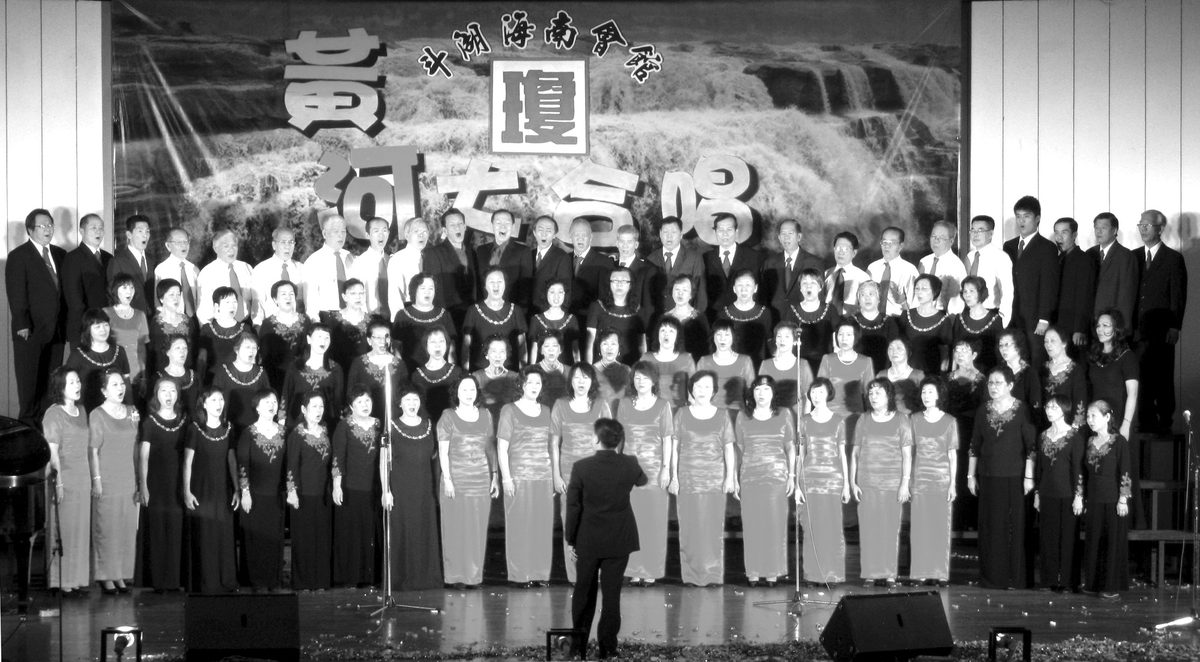
The Tawau Hainan Association’s performance of the Yellow River Cantata at the Sabah Chinese High School, 10 December 2010, raising funds for the school. Team photo.斗湖海南會館在巴華中學演出《黃河大合唱》,為學校籌募教育基金,2010年12月10日。團隊照片。Persembahan Kantata Sungai Kuning oleh Persatuan Hai Nam Tawau di Sekolah Tinggi Cina Sabah, 10 Disember 2010, untuk mengumpul dana sekolah. Foto pasukan.
The Chinese of Tawau are Malaysians whose families came mostly from the southern Chinese provinces of Guangdong and Fujian and from Hainan island. They came as shopkeepers, coal miners, farmers and traders from the 1890s on, built the shophouses of Dunlop Street, founded schools and associations, and rebuilt the town twice — after the bombing of 1945 and after the great fire of 1953. Most Chinese in Sabah are Hakka, and Hakka is the most widely spoken Chinese language in Sabah and commonly heard in Tawau; Cantonese, Hokkien, Teochew, Hainanese and other groups live here too.
Orang Cina Tawau ialah rakyat Malaysia yang keluarganya kebanyakannya berasal dari wilayah Guangdong dan Fujian di selatan China serta Pulau Hainan. Mereka datang sebagai pekedai, pelombong arang batu, petani dan pedagang dari 1890-an, membina rumah kedai Jalan Dunlop, menubuhkan sekolah dan persatuan, dan membina semula bandar dua kali — selepas pengeboman 1945 dan selepas kebakaran besar 1953. Kebanyakan orang Cina di Sabah ialah Hakka, dan bahasa Hakka ialah bahasa Cina yang paling meluas di Sabah dan biasa didengar di Tawau; orang Kantonis, Hokkien, Teochew, Hainan dan lain-lain juga tinggal di sini.
Huaren (華人) · Orang Cina華人 · Orang CinaHuaren (華人) · Orang Cina
“Chinese people” — the usual word in Chinese for Chinese Malaysians.「華人」──華文對馬來西亞華人的一般稱呼。“Orang Cina” — perkataan biasa dalam bahasa Cina bagi orang Cina Malaysia.
Hakka (客家)客家Hakka (客家)
“Guest families” — a people of the hills of Guangdong and Fujian, the largest Chinese group in Sabah. Many came as Christian farming families.「客家」──廣東、福建山區的族群,是沙巴最大的華人方言群。許多人以基督徒農戶的身分南來。“Keluarga tetamu” — orang dari kawasan bukit Guangdong dan Fujian, kumpulan Cina terbesar di Sabah. Ramai datang sebagai keluarga petani Kristian.
Kapitan (甲必丹)甲必丹Kapitan (甲必丹)
A headman appointed to look after Chinese affairs. Tawau has an association of Chinese Kapitans.受委任處理華人事務的領袖。斗湖至今仍有華人甲必丹聯誼會。Ketua yang dilantik untuk menguruskan hal ehwal orang Cina. Tawau masih mempunyai persatuan Kapitan Cina.
An association for people of the same home district or dialect — Hakka, Teochew, Hokkien, Hainan, Foochow, Sze Yap.同鄉或同方言的社團──客家、潮州、福建、海南、福州、四邑等。Persatuan orang dari daerah asal atau dialek yang sama — Hakka, Teochew, Hokkien, Hainan, Foochow, Sze Yap.
Sino-native華裔土著混血Sino-native
Sabah families of mixed Chinese and native descent — for example Sino-Kadazan and Sino-Murut.華人與沙巴土著通婚的後代,例如華裔卡達山人、華裔姆律人。Keluarga Sabah berketurunan campuran Cina dan anak negeri — contohnya Sino-Kadazan dan Sino-Murut.
How many?
有多少人?
Berapa ramai?
Census tables give 284,049 Chinese in Sabah in 2010 (9.1% of the people) and 248,920 in 2020 (7.3%). eTawau’s page on Buddhism in Tawau gives about 42,000 Chinese in Tawau in 2010. The old version of this page said the Chinese were “about 20%” of Tawau; we found no source for that number and have left it out.
Jadual banci memberi 284,049 orang Cina di Sabah pada 2010 (9.1% penduduk) dan 248,920 pada 2020 (7.3%). Halaman eTawau tentang Buddha di Tawau memberi kira-kira 42,000 orang Cina di Tawau pada 2010. Versi lama halaman ini menyebut orang Cina “kira-kira 20%” penduduk Tawau; kami tidak menemui sumbernya dan tidak menggunakannya.
Wikipedia, “Demographics of Sabah”; eTawau, “斗湖佛教概況”
Many dialects, one community
方言不同,同屬一個社群
Banyak dialek, satu komuniti
In Tawau each dialect group has its own association, and the groups come together in the Chinese Chamber of Commerce and the United Chinese Association. The Chamber also runs three schools.
Di Tawau setiap kumpulan dialek mempunyai persatuan sendiri, dan mereka bersatu dalam Dewan Perniagaan Cina dan Persatuan Cina Bersatu. Dewan Perniagaan juga mengendalikan tiga sekolah.
eTawau, association and Chamber pages
Sources: Wikipedia, “Tawau” (languages; Hakka; Apas Road) and “Demographics of Sabah” (census table; Hakka majority; Sino-native); eTawau, “斗湖佛教概況”, “斗湖縣華人甲必丹聯誼會”, “斗湖華人社團聯合會”; eTawau, Tawau Hainan Association (Yellow River Cantata, 10 Dec 2010).
資料來源:Wikipedia, “Tawau” (languages; Hakka; Apas Road) and “Demographics of Sabah” (census table; Hakka majority; Sino-native); eTawau, “斗湖佛教概況”, “斗湖縣華人甲必丹聯誼會”, “斗湖華人社團聯合會”; eTawau, Tawau Hainan Association (Yellow River Cantata, 10 Dec 2010).
Sumber: Wikipedia, “Tawau” (languages; Hakka; Apas Road) and “Demographics of Sabah” (census table; Hakka majority; Sino-native); eTawau, “斗湖佛教概況”, “斗湖縣華人甲必丹聯誼會”, “斗湖華人社團聯合會”; eTawau, Tawau Hainan Association (Yellow River Cantata, 10 Dec 2010).
2
Coming to North Borneo, 1882–1938
南來北婆羅洲,1882–1938年
Datang ke Borneo Utara, 1882–1938
From southern China to North Borneo. Schematic map.從中國華南到北婆羅洲。示意圖。Dari selatan China ke Borneo Utara. Peta skematik.
Chinese traders sailed to Borneo for many centuries, but large-scale settlement in Sabah began with the British North Borneo Company. In 1882 it asked Walter Medhurst, its immigration commissioner in China, to send settlers, with free passage for anyone who wanted work. The Company also made an agreement with the Basel Mission, a Swiss Protestant mission working among the Hakka of Guangdong. A first group of 100 Hakka Christian labourers landed at Kudat. More followed: 150 Hakka men, women and children in 1905, and in March 1913 whole families to Inanam, Menggatal and Telipok, each family promised land of its own.
Pedagang Cina telah belayar ke Borneo selama berabad-abad, tetapi penempatan besar-besaran di Sabah bermula dengan Syarikat Borneo Utara British. Pada 1882 syarikat meminta Walter Medhurst, pesuruhjaya imigresennya di China, menghantar peneroka, dengan tambang percuma bagi sesiapa yang mahu bekerja. Syarikat juga membuat perjanjian dengan Misi Basel, misi Protestan Switzerland yang bekerja dalam kalangan orang Hakka di Guangdong. Kumpulan pertama 100 buruh Kristian Hakka mendarat di Kudat. Lebih ramai menyusul: 150 lelaki, wanita dan kanak-kanak Hakka pada 1905, dan pada Mac 1913 keluarga-keluarga ke Inanam, Menggatal dan Telipok, setiap keluarga dijanjikan tanah sendiri.
In 1913 the Company also brought a group of northern Chinese from Tianjin and Hebei, whose descendants in Sabah still call themselves Tianjin people. In the 1920s a free-passage scheme let settled Chinese send for their wives and relatives. One account counts about 70,000 Chinese who came to Sabah from 1881 onwards, about 30,000 of them women. In Tawau, eTawau’s town history says the government gave every settled Chinese resident between 1921 and 1938 a pass to send home, so that a wife or relative could sail out free.
Pada 1913 syarikat juga membawa sekumpulan orang Cina utara dari Tianjin dan Hebei, yang keturunannya di Sabah masih menggelar diri mereka orang Tianjin. Pada 1920-an skim tambang percuma membolehkan orang Cina yang sudah menetap memanggil isteri dan saudara mereka. Satu catatan mengira kira-kira 70,000 orang Cina datang ke Sabah dari 1881, kira-kira 30,000 daripadanya wanita. Di Tawau, sejarah bandar eTawau menyatakan kerajaan memberi setiap penduduk Cina yang menetap antara 1921 dan 1938 sekeping pas untuk dihantar ke kampung, supaya isteri atau saudara boleh belayar ke sini secara percuma.
Sources differ: the first Basel group
各方說法不一:第一批巴色移民
Sumber berbeza: kumpulan Basel pertama
The English Wikipedia says the first 100 Hakka Christian labourers landed at Kudat in December 1882. A Taiwanese online exhibition on Sabah’s Hakka Christians says the first group sailed in January 1883. Either way, Kudat — the Company’s first capital — was where the organised Hakka settlement began.
Wikipedia Inggeris menyatakan 100 buruh Kristian Hakka pertama mendarat di Kudat pada Disember 1882. Sebuah pameran dalam talian Taiwan tentang orang Kristian Hakka Sabah menyatakan kumpulan pertama belayar pada Januari 1883. Walau bagaimanapun, Kudat — ibu negeri pertama Syarikat — ialah tempat penempatan Hakka yang teratur bermula.
Wikipedia, “Basel Christian Church of Malaysia”; openmuseum.tw
Sources: Wikipedia, “Basel Christian Church of Malaysia”, “Kudat” and “Demographics of Sabah”; 張德來 (Chong Tet Loi), 「沙巴早期的客家移殖史」, Malaysian Journal of Chinese Studies / New Era University College; openmuseum.tw, 「渣打公司的客家移民計劃:沙巴客家基督徒的移民史」; Borneo History, “Chinese Migration to Sabah”; Danny Wong Tze Ken, “Sustaining the Hakka Chinese Identity in Sabah: The Role of the Basel Church” (Springer, 2021); eTawau, “斗湖簡史” (History 1898).
資料來源:Wikipedia, “Basel Christian Church of Malaysia”, “Kudat” and “Demographics of Sabah”; 張德來 (Chong Tet Loi), 「沙巴早期的客家移殖史」, Malaysian Journal of Chinese Studies / New Era University College; openmuseum.tw, 「渣打公司的客家移民計劃:沙巴客家基督徒的移民史」; Borneo History, “Chinese Migration to Sabah”; Danny Wong Tze Ken, “Sustaining the Hakka Chinese Identity in Sabah: The Role of the Basel Church” (Springer, 2021); eTawau, “斗湖簡史” (History 1898).
Sumber: Wikipedia, “Basel Christian Church of Malaysia”, “Kudat” and “Demographics of Sabah”; 張德來 (Chong Tet Loi), 「沙巴早期的客家移殖史」, Malaysian Journal of Chinese Studies / New Era University College; openmuseum.tw, 「渣打公司的客家移民計劃:沙巴客家基督徒的移民史」; Borneo History, “Chinese Migration to Sabah”; Danny Wong Tze Ken, “Sustaining the Hakka Chinese Identity in Sabah: The Role of the Basel Church” (Springer, 2021); eTawau, “斗湖簡史” (History 1898).
3
The first Chinese of Tawau, 1893–1903
斗湖最早的華人,1893–1903年
Orang Cina pertama Tawau, 1893–1903
When the Dutch post at Tawau was withdrawn in 1892, Tawau was a fishing village of about 200 people at the mouth of the Tawau river. eTawau’s Tawau history — a Chinese-language account written for the town’s centenary in 1998 — says that by 1893 there were already three Chinese shops at the river mouth, the first shops in the town. Some Chinese farmed land at Apas and near the lighthouse; others fished or worked as labourers. Before 1893 a Teochew firm from Sandakan, 榮順號, had opened a branch here.
Apabila pos Belanda di Tawau ditarik balik pada 1892, Tawau ialah kampung nelayan kira-kira 200 orang di kuala Sungai Tawau. Sejarah Tawau di eTawau — catatan berbahasa Cina yang ditulis untuk ulang tahun ke-100 bandar pada 1998 — menyatakan menjelang 1893 sudah ada tiga kedai Cina di kuala sungai, kedai pertama di bandar itu. Sesetengah orang Cina bertani di Apas dan berhampiran rumah api; yang lain menangkap ikan atau menjadi buruh. Sebelum 1893 sebuah firma Teochew dari Sandakan, 榮順號, telah membuka cawangan di sini.
In 1894 the Company recruited Kee Kim Swee, a Hainanese born in Labuan in 1863, as Tawau’s customs examiner and revenue collector; a year later the development of the settlement was put in his hands. He married a Suluk–Tidung woman of Tawau, became a Muslim as Kee Abdullah, and was Tawau’s first Penghulu (OKK). His many descendants — the Kee family — are part of Tawau’s Suluk and Tidung story too. The 1998 history names 林雲從, who moved here from Lahad Datu, as Tawau’s first Chinese Kapitan.
1894年,渣打公司聘請1863年生於納閩的海南人Kee Kim Swee擔任斗湖的海關檢查員和稅收員;一年後,斗湖的開發也交到他手中。他娶了一位斗湖的蘇祿–提東混血女子,皈依伊斯蘭教,改名Kee Abdullah,成為斗湖第一位村長(OKK)。他的眾多後代──Kee家族──也是斗湖蘇祿人和提東人故事的一部分。《斗湖簡史》則說,從拿篤移居斗湖的林雲從是斗湖第一任華人甲必丹。
Pada 1894 Syarikat mengambil Kee Kim Swee, orang Hainan yang lahir di Labuan pada 1863, sebagai pemeriksa kastam dan pemungut hasil Tawau; setahun kemudian pembangunan penempatan itu diserahkan kepadanya. Beliau berkahwin dengan wanita Suluk–Tidung dari Tawau, memeluk Islam sebagai Kee Abdullah, dan menjadi Penghulu (OKK) pertama Tawau. Keturunannya yang ramai — keluarga Kee — juga sebahagian daripada kisah Suluk dan Tidung Tawau. Sejarah 1998 itu menamakan 林雲從, yang berpindah dari Lahad Datu, sebagai Kapitan Cina pertama Tawau.
In 1898 Tawau became a district and the site of a new town was chosen, then called Tanjong — today’s old shop area of Dunlop Street. By 1903 Tawau had more than 1,000 people and about 60 Chinese shops and homes. Later Chinese settlers moved inland to farm along a new road; because most of them came from Bao’an, whose old name was Xin’an (新安), the road was named Sin On Road (新安路).
Pada 1898 Tawau menjadi daerah dan tapak bandar baharu dipilih, ketika itu dinamakan Tanjong — kawasan kedai lama Jalan Dunlop hari ini. Menjelang 1903 Tawau mempunyai lebih 1,000 penduduk dan kira-kira 60 kedai dan rumah Cina. Peneroka Cina yang datang kemudian berpindah ke pedalaman untuk bertani di sepanjang jalan baharu; kerana kebanyakan mereka dari Bao’an, yang nama lamanya Xin’an (新安), jalan itu dinamakan Jalan Sin On (新安路).
Sources differ: who led first?
各方說法不一:誰是第一位領袖?
Sumber berbeza: siapa pemimpin pertama?
Wikipedia, citing The Star and Nicholas Chung’s “Under the Borneo Sun: A Tawau Story”, makes Kee Kim Swee Tawau’s first civil servant and first Penghulu, and calls him a Kapitan. The 1998 Chinese-language history calls 林雲從 the first Chinese Kapitan. The two may have held different posts — one for the government, one for the Chinese community.
維基百科引用《星報》和Nicholas Chung的《Under the Borneo Sun: A Tawau Story》,說Kee Kim Swee是斗湖第一位公務員和第一任村長,並稱他為甲必丹。1998年的華文《斗湖簡史》則說林雲從是第一任華人甲必丹。兩人可能擔任不同的職務──一個為政府服務,一個為華社服務。
Wikipedia, memetik The Star dan “Under the Borneo Sun: A Tawau Story” oleh Nicholas Chung, menjadikan Kee Kim Swee penjawat awam dan Penghulu pertama Tawau, dan menyebutnya Kapitan. Sejarah berbahasa Cina 1998 menyebut 林雲從 sebagai Kapitan Cina pertama. Mereka mungkin memegang jawatan berbeza — seorang untuk kerajaan, seorang untuk masyarakat Cina.
Wikipedia, “Kee Kim Swee”; eTawau, “斗湖簡史”
Sources: eTawau, “History of Tawau 1898” and its Chinese “斗湖簡史” (written for the 1998 centenary); Wikipedia, “Kee Kim Swee” (citing Bernama in The Star, 25 Sep 2008; the North Borneo Herald, 1 Jul 1883; Nicholas Chung, “Under the Borneo Sun: A Tawau Story”, 2005).
資料來源:eTawau, “History of Tawau 1898” and its Chinese “斗湖簡史” (written for the 1998 centenary); Wikipedia, “Kee Kim Swee” (citing Bernama in The Star, 25 Sep 2008; the North Borneo Herald, 1 Jul 1883; Nicholas Chung, “Under the Borneo Sun: A Tawau Story”, 2005).
Sumber: eTawau, “History of Tawau 1898” and its Chinese “斗湖簡史” (written for the 1998 centenary); Wikipedia, “Kee Kim Swee” (citing Bernama in The Star, 25 Sep 2008; the North Borneo Herald, 1 Jul 1883; Nicholas Chung, “Under the Borneo Sun: A Tawau Story”, 2005).
4
Coal at Silimpopon, 1905–1931
實林蓬蓬的煤,1905–1931年
Arang batu di Silimpopon, 1905–1931
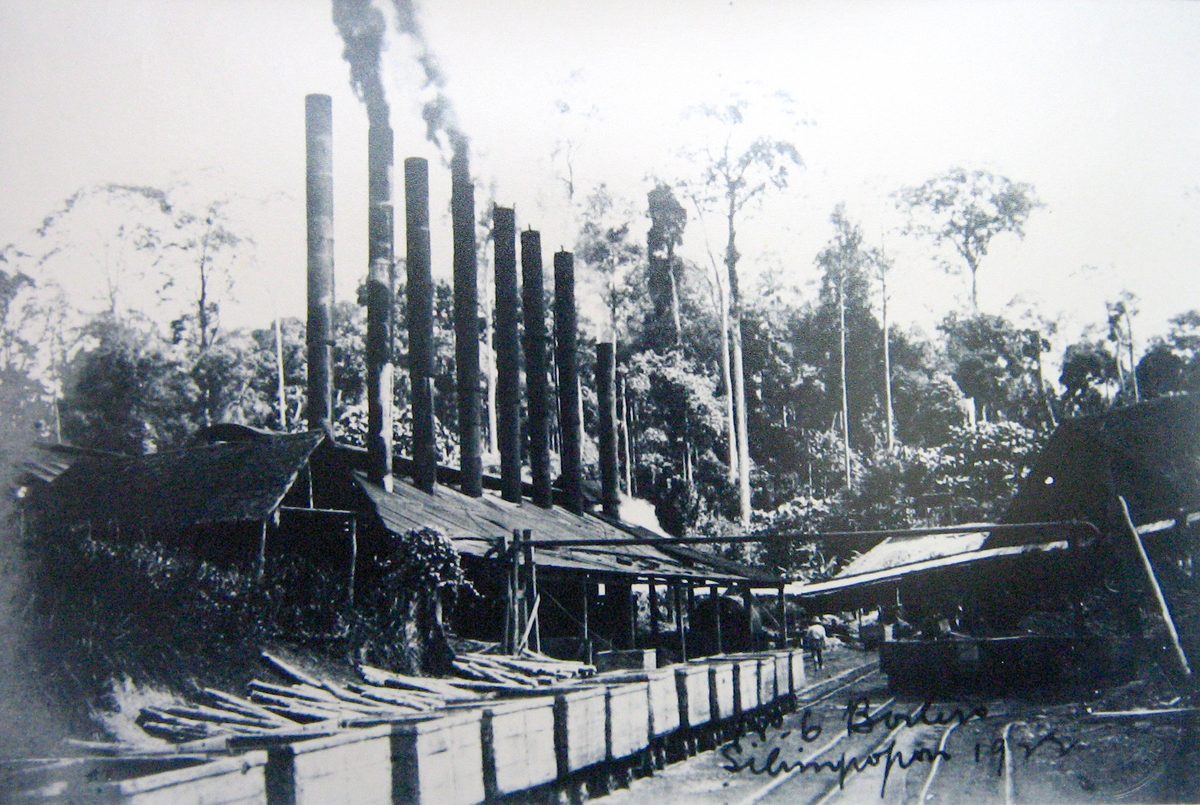
No. 6 boilers at the Silimpopon coal mine camp, 1922. From eTawau’s Tawau history pages.實林蓬蓬煤礦營地的第六號鍋爐,1922年。取自eTawau的斗湖歷史頁面。Dandang No. 6 di kem lombong arang batu Silimpopon, 1922. Daripada halaman sejarah Tawau eTawau.
Coal was found near the Silimpopon river, in today’s Kalabakan district, about 80 miles west of Tawau. The Cowie Harbour Coal Company began mining in 1905 and shipped its first 25 tons of coal the next year. Output reached 87,543 tons in 1922. At its peak the company employed 1,200 miners, including contract labourers from southern China and Chinese who had served as labourers in France during the First World War. The mine also had a Chinese school, the only one in the state subsidised by the Chartered Company, whose pupils were mostly adults.
Arang batu ditemui berhampiran Sungai Silimpopon, di daerah Kalabakan hari ini, kira-kira 80 batu di barat Tawau. Cowie Harbour Coal Company mula melombong pada 1905 dan menghantar 25 tan arang batu pertama pada tahun berikutnya. Pengeluaran mencapai 87,543 tan pada 1922. Pada puncaknya syarikat menggaji 1,200 pelombong, termasuk buruh kontrak dari selatan China dan orang Cina yang pernah menjadi buruh di Perancis semasa Perang Dunia Pertama. Lombong itu juga mempunyai sebuah sekolah Cina, satu-satunya di negeri ini yang dibantu Syarikat Berpiagam, dan muridnya kebanyakannya orang dewasa.
Life in the camp could be violent. In February 1921 two groups of Chinese miners — Hakka and Cantonese — fought at the mine; contemporary Straits newspapers reported 12 dead, 5 wounded by gunfire and about 300 people detained. When coal prices fell, the mine closed.
Kehidupan di kem kadang-kadang ganas. Pada Februari 1921 dua kumpulan pelombong Cina — Hakka dan Kantonis — bergaduh di lombong; akhbar Negeri-negeri Selat ketika itu melaporkan 12 maut, 5 cedera ditembak dan kira-kira 300 orang ditahan. Apabila harga arang batu jatuh, lombong ditutup.
Sources differ: when did the mine close?
各方說法不一:煤礦何時關閉?
Sumber berbeza: bilakah lombong ditutup?
eTawau’s Chinese-language Tawau history says mining went on until 1931. eTawau’s English page on the 1930s gives the closure of the coal mine as 1932. Wikipedia’s article on the riots calls Silimpopon “the largest coal mine in the world at the time”, citing a 2017 newspaper; we have not found an older source for that claim.
Sejarah Tawau berbahasa Cina di eTawau menyatakan perlombongan berterusan hingga 1931. Halaman Inggeris eTawau tentang 1930-an memberi tahun penutupan 1932. Rencana Wikipedia tentang rusuhan menyebut Silimpopon “lombong arang batu terbesar di dunia ketika itu”, memetik akhbar 2017; kami belum menemui sumber lebih lama bagi dakwaan itu.
eTawau, “斗湖簡史” and “History of Tawau 1930–1939”; Wikipedia, “Silimpopon Riots”
Sources: eTawau, “斗湖簡史” (History 1898) and “History of Tawau 1922” and “1930–1939”; Wikipedia, “Silimpopon Riots” (citing the Pinang Gazette and Straits Chronicle, 31 Mar 1921; Singapore Free Press, 19 Mar 1921; Straits Times, 30 Mar 1921).
資料來源:eTawau, “斗湖簡史” (History 1898) and “History of Tawau 1922” and “1930–1939”; Wikipedia, “Silimpopon Riots” (citing the Pinang Gazette and Straits Chronicle, 31 Mar 1921; Singapore Free Press, 19 Mar 1921; Straits Times, 30 Mar 1921).
Sumber: eTawau, “斗湖簡史” (History 1898) and “History of Tawau 1922” and “1930–1939”; Wikipedia, “Silimpopon Riots” (citing the Pinang Gazette and Straits Chronicle, 31 Mar 1921; Singapore Free Press, 19 Mar 1921; Straits Times, 30 Mar 1921).
5
Dunlop Street, schools and the Chamber, 1914–1941
丹洛街、學校與中華商會,1914–1941年
Jalan Dunlop, sekolah dan Dewan Perniagaan, 1914–1941
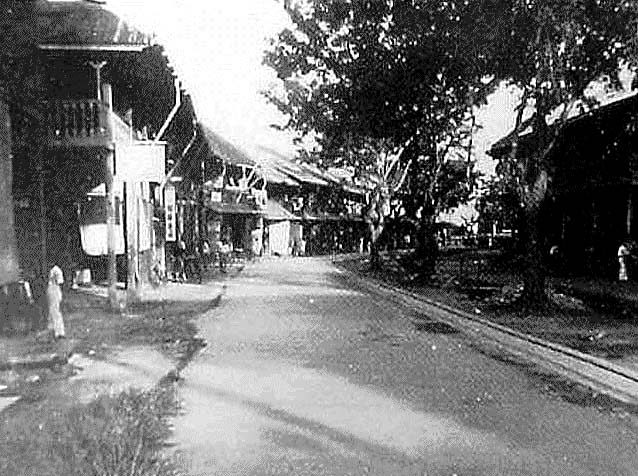
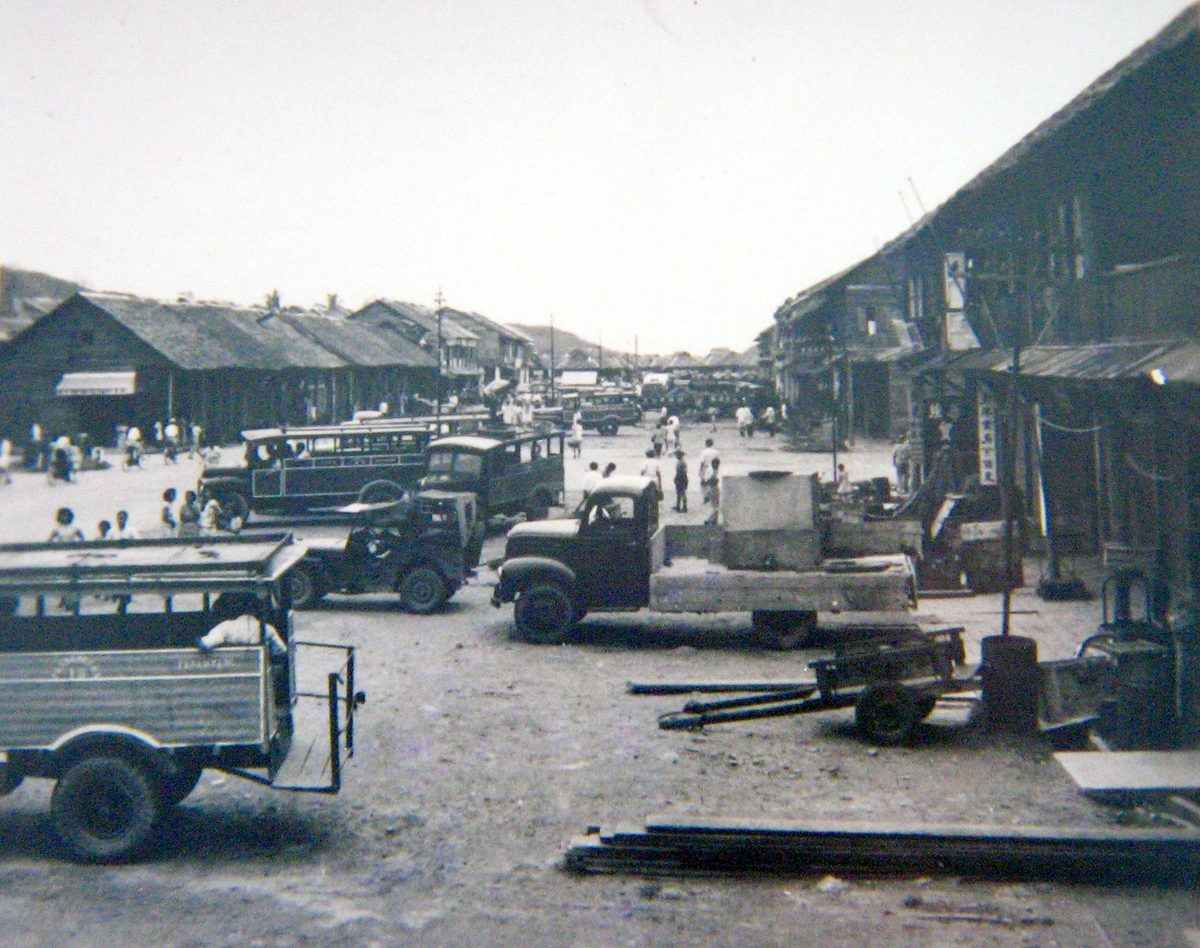
Chester Street in the 1930s. Most shops were owned by Chinese. From eTawau’s Tawau history pages.1930年代的Chester街。大部分商店由華人經營。取自eTawau的斗湖歷史頁面。Jalan Chester pada 1930-an. Kebanyakan kedai milik orang Cina. Daripada halaman sejarah Tawau eTawau.Dunlop Road in the 1940s. From eTawau’s Tawau history pages.1940年代的丹洛路。取自eTawau的斗湖歷史頁面。Jalan Dunlop pada 1940-an. Daripada halaman sejarah Tawau eTawau.
In 1914 Tawau’s first road of crushed stone and sand was finished and named after the first District Officer, Dunlop. Dunlop Street, lined for a mile with shops and houses, became the town. A push-cart railway ran from the wharf along Dunlop Street to the Kuhara estate, with a branch along Sin On Road to Kubota, carrying estate produce, rice and water. By the end of the 1930s about 60 timber shophouses stood along Dunlop Street and Man Cheong Street (now part of Dunlop Street), home of the popular Man Cheong coffee shop. Most shops were owned by Chinese and sold the food and tools that households and smallholders needed.
Pada 1914 jalan pertama Tawau daripada batu hancur dan pasir siap dan dinamakan sempena Pegawai Daerah pertama, Dunlop. Jalan Dunlop, dipenuhi kedai dan rumah sepanjang satu batu, menjadi bandar itu. Landasan kereta sorong berjalan dari jeti di sepanjang Jalan Dunlop ke ladang Kuhara, dengan cabang di sepanjang Jalan Sin On ke Kubota, membawa hasil ladang, beras dan air. Menjelang akhir 1930-an kira-kira 60 rumah kedai kayu berdiri di sepanjang Jalan Dunlop dan Jalan Man Cheong (kini sebahagian Jalan Dunlop), tempat kedai kopi Man Cheong yang popular. Kebanyakan kedai milik orang Cina dan menjual makanan serta peralatan yang diperlukan isi rumah dan pekebun kecil.
Under Company rule, schools were left to the Chinese community and the churches. The Teochew had organised themselves as the 義安郡 association in 1901. In 1922 Teochew residents founded Tawau’s first Chinese school, 新華 and in 1923 the 興華 school opened at Sin On. In 1926, when the Kapitan could no longer handle all Chinese affairs and the Teochew and Bao’an associations looked after their own members, the merchants founded the Tawau Chinese Chamber of Commerce, with the Teochew 辜丁甲 as its first president.
Di bawah pemerintahan Syarikat, sekolah diserahkan kepada masyarakat Cina dan gereja. Orang Teochew telah menubuhkan persatuan 義安郡 pada 1901. Pada 1922 penduduk Teochew mengasaskan sekolah Cina pertama Tawau, 新華 dan pada 1923 sekolah 興華 dibuka di Sin On. Pada 1926, apabila Kapitan tidak lagi dapat menguruskan semua hal ehwal Cina dan persatuan Teochew serta Bao’an hanya menjaga ahli sendiri, para peniaga menubuhkan Dewan Perniagaan Cina Tawau, dengan orang Teochew 辜丁甲 sebagai presiden pertama.
Tawau town: people and shops, 1890s–1953.斗湖市鎮的人口和店舖,1890年代–1953年。Bandar Tawau: penduduk dan kedai, 1890-an–1953.
Sources: eTawau, “斗湖簡史” (History 1898); eTawau, “History of Tawau 1930–1939” (Chester Street; 60 timber shophouses; Man Cheong); eTawau, Tawau Teochew Association (義安郡 1901; Sin Hwa school).
資料來源:eTawau, “斗湖簡史” (History 1898); eTawau, “History of Tawau 1930–1939” (Chester Street; 60 timber shophouses; Man Cheong); eTawau, Tawau Teochew Association (義安郡 1901; Sin Hwa school).
Sumber: eTawau, “斗湖簡史” (History 1898); eTawau, “History of Tawau 1930–1939” (Chester Street; 60 timber shophouses; Man Cheong); eTawau, Tawau Teochew Association (義安郡 1901; Sin Hwa school).
6
War, 1942–1945
戰爭,1942–1945年
Perang, 1942–1945
Tawau fell to the Japanese on 24 January 1942. The town’s Chinese Kapitan, Stephen Tan, was later killed by the Japanese. The 1998 history says that under the occupation many residents were killed, food ran short, and most townspeople moved out to the countryside to grow their own; the Japanese used Javanese labourers and Chinese men pressed into service to build Tawau’s airfield. Hakka farmers fled into the jungle.
Tawau jatuh ke tangan Jepun pada 24 Januari 1942. Kapitan Cina bandar itu, Stephen Tan, kemudian dibunuh oleh Jepun. Sejarah 1998 menyatakan di bawah pendudukan ramai penduduk dibunuh, makanan berkurangan, dan kebanyakan penduduk bandar berpindah ke kawasan luar untuk bercucuk tanam sendiri; Jepun menggunakan buruh Jawa dan lelaki Cina yang dikerah untuk membina lapangan terbang Tawau. Petani Hakka melarikan diri ke hutan.
Allied bombers hit Tawau in 1945. When the war ended the town was in ruins: hardly a building survived — the Bell Tower of 1921 is the best-known survivor.
Pengebom Pihak Berikat menyerang Tawau pada 1945. Apabila perang tamat bandar itu musnah: hampir tiada bangunan yang terselamat — Menara Jam 1921 ialah yang paling terkenal.
Sources: eTawau, “History of Tawau 1898” (Kapitan Stephen Tan) and “斗湖簡史”; eTawau, “History of Tawau 1940–1949”; Frederick Lo, “Brief accounts of early history of Tawau” (eTawau). See also The Japanese of Tawau.
資料來源:eTawau, “History of Tawau 1898” (Kapitan Stephen Tan) and “斗湖簡史”; eTawau, “History of Tawau 1940–1949”; Frederick Lo, “Brief accounts of early history of Tawau” (eTawau). See also The Japanese of Tawau.
Sumber: eTawau, “History of Tawau 1898” (Kapitan Stephen Tan) and “斗湖簡史”; eTawau, “History of Tawau 1940–1949”; Frederick Lo, “Brief accounts of early history of Tawau” (eTawau). See also The Japanese of Tawau.
7
Little Gold Mountain and the fire of 1953
小金山與1953年大火
Bukit Emas Kecil dan kebakaran 1953
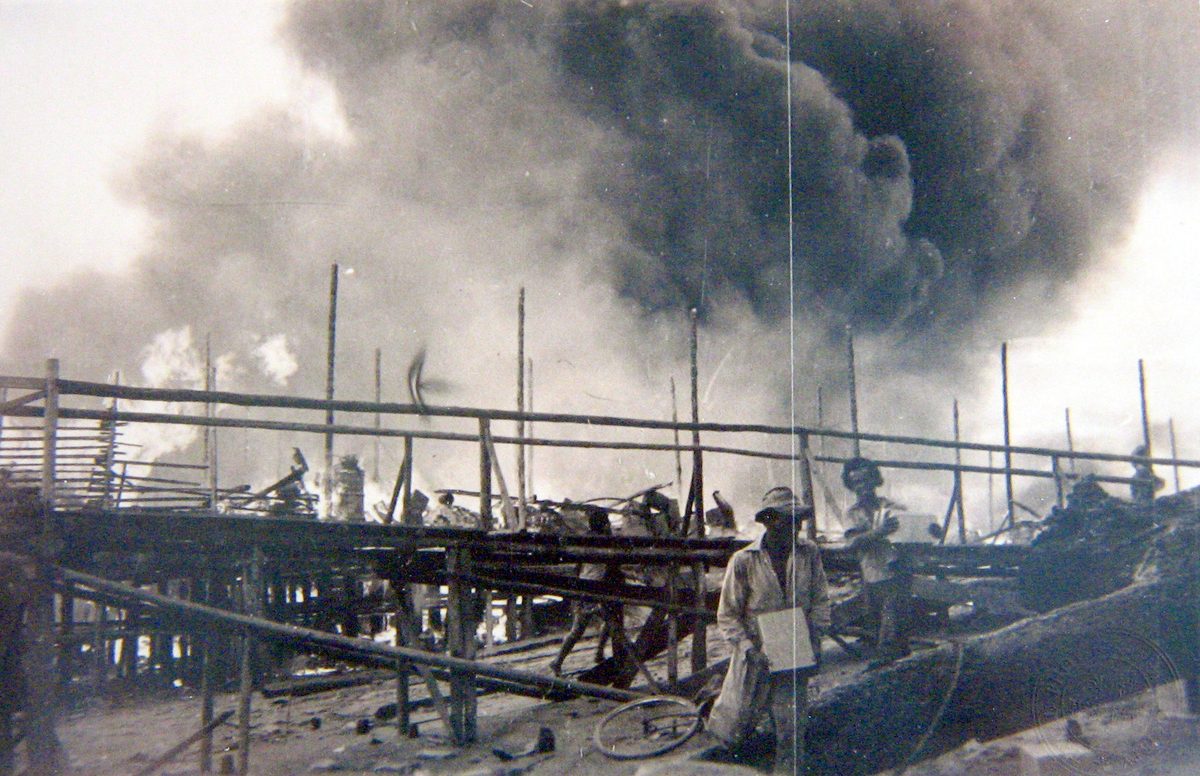
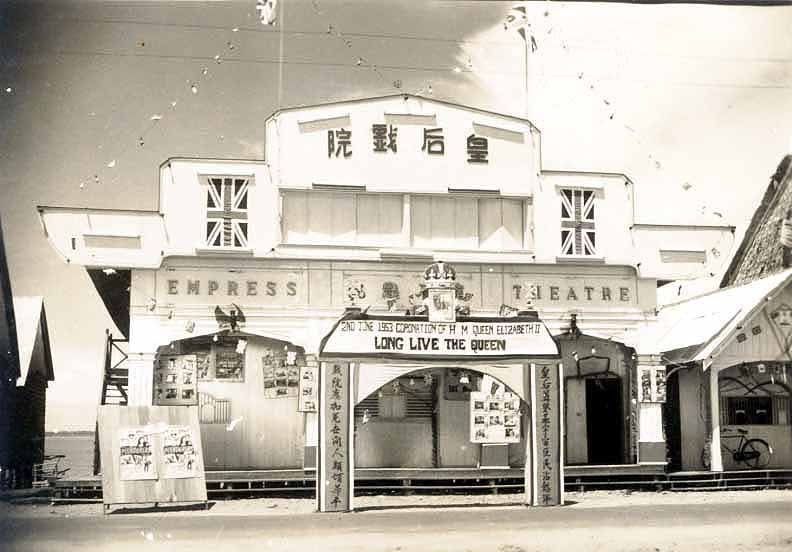
The fire of 7 March 1953. From eTawau’s Tawau history pages.1953年3月7日的大火。取自eTawau的斗湖歷史頁面。Kebakaran 7 Mac 1953. Daripada halaman sejarah Tawau eTawau.The Empress Theatre (皇后戲院) in the 1950s. From eTawau’s Tawau history pages.1950年代的皇后戲院。取自eTawau的斗湖歷史頁面。Panggung Empress (皇后戲院) pada 1950-an. Daripada halaman sejarah Tawau eTawau.
People rebuilt with timber walls and attap roofs. Japanese property was seized as enemy property and auctioned; the Kubota estate was bought by a local Chinese company, 梁氏實業. When the Korean War began in June 1950, rubber and copra prices soared, and barter trade with Indonesia and the southern Philippines boomed — kumpit boats brought copra from Sulawesi and the southern Philippines and went home loaded with everyday goods. People called Tawau “Little Gold Mountain” (小金山). By 1951 the town had more than 14,200 people.
Penduduk membina semula dengan dinding papan dan atap rumbia. Harta Jepun dirampas sebagai harta musuh dan dilelong; ladang Kubota dibeli oleh sebuah syarikat Cina tempatan, 梁氏實業. Apabila Perang Korea bermula pada Jun 1950, harga getah dan kopra melambung, dan perdagangan tukar barang dengan Indonesia dan selatan Filipina berkembang pesat — kumpit membawa kopra dari Sulawesi dan selatan Filipina dan pulang dengan barang keperluan harian. Orang menggelar Tawau “Bukit Emas Kecil” (小金山). Menjelang 1951 bandar itu mempunyai lebih 14,200 penduduk.
Then, at about three in the afternoon of 7 March 1953, fire swept through the town. In 37 minutes it destroyed almost all the shophouses built since the war — 149 shops — and the post office. That June the government put up temporary shops on Kuhara Road, one mile from town. Rebuilding began in 1954 with two-storey semi-permanent shophouses, finished in 1956. The Chamber of Commerce, silent since the war, was re-formed in 1955.
Kemudian, kira-kira pukul tiga petang 7 Mac 1953, api merebak ke seluruh bandar. Dalam 37 minit ia memusnahkan hampir semua rumah kedai yang dibina selepas perang — 149 kedai — dan pejabat pos. Pada Jun tahun itu kerajaan membina kedai sementara di Jalan Kuhara, satu batu dari bandar. Pembinaan semula bermula pada 1954 dengan rumah kedai separa kekal dua tingkat, siap pada 1956. Dewan Perniagaan, yang senyap sejak perang, ditubuhkan semula pada 1955.
Sources: eTawau, “斗湖簡史” (History 1898); eTawau, “History of Tawau 1953”; The Vibes, “Once hugely promising barter trade business ‘dying’ in waters off Sabah” (16 May 2021); Ramli Dollah & Ahmad Mosfi Mohamad, “Perdagangan tukar barang Malaysia–Indonesia: potensi dan cabaran”, Jati (UM).
資料來源:eTawau, “斗湖簡史” (History 1898); eTawau, “History of Tawau 1953”; The Vibes, “Once hugely promising barter trade business ‘dying’ in waters off Sabah” (16 May 2021); Ramli Dollah & Ahmad Mosfi Mohamad, “Perdagangan tukar barang Malaysia–Indonesia: potensi dan cabaran”, Jati (UM).
Sumber: eTawau, “斗湖簡史” (History 1898); eTawau, “History of Tawau 1953”; The Vibes, “Once hugely promising barter trade business ‘dying’ in waters off Sabah” (16 May 2021); Ramli Dollah & Ahmad Mosfi Mohamad, “Perdagangan tukar barang Malaysia–Indonesia: potensi dan cabaran”, Jati (UM).
8
Towards Malaysia, and the boom years
邁向馬來西亞,以及繁榮的年代
Menuju Malaysia, dan tahun-tahun ledakan
A Chinese-medium government secondary school opened in Tawau on 21 February 1958. In October 1961, as the idea of Malaysia was debated, the North Borneo Chinese Association (婆華公會) was founded in Tawau with 方德源 as chairman; it later merged into the Sabah Chinese Association. When the Cobbold Commission heard views in Tawau in April 1962, most people said Sabah should first govern itself and then join Malaysia. In the Confrontation that followed, Tawau was on the front line until 1966.
Sebuah sekolah menengah kerajaan beraliran Cina dibuka di Tawau pada 21 Februari 1958. Pada Oktober 1961, ketika gagasan Malaysia dibincangkan, Persatuan Cina Borneo Utara (婆華公會) ditubuhkan di Tawau dengan 方德源 sebagai pengerusi; kemudian ia bergabung menjadi Persatuan Cina Sabah. Apabila Suruhanjaya Cobbold mendengar pandangan di Tawau pada April 1962, kebanyakan penduduk berkata Sabah patut berkerajaan sendiri dahulu sebelum menyertai Malaysia. Dalam Konfrontasi berikutnya, Tawau menjadi barisan hadapan hingga 1966.
In 1964 the Tawau Chinese Association (斗湖婆華公會) founded the Sabah Chinese High School (斗湖巴華中學), first housed in the Hainan association’s hall; the next year it moved to its present site, and on 20 February 1965 it was handed to the Chinese Chamber of Commerce. It is one of Sabah’s nine independent Chinese secondary schools and in 2026 had 577 pupils. The Chamber runs three schools in all. In the first state election of 8 April 1967, 曾富生 became Tawau’s first state assemblyman.
Pada 1964 Persatuan Cina Tawau (斗湖婆華公會) mengasaskan Sekolah Tinggi Cina Sabah (斗湖巴華中學), mula-mula di dewan persatuan Hainan; tahun berikutnya ia berpindah ke tapak sekarang, dan pada 20 Februari 1965 diserahkan kepada Dewan Perniagaan Cina. Ia salah satu daripada sembilan sekolah menengah persendirian Cina di Sabah dan pada 2026 mempunyai 577 murid. Dewan Perniagaan mengendalikan tiga sekolah kesemuanya. Dalam pilihan raya negeri pertama pada 8 April 1967, 曾富生 menjadi ahli dewan undangan negeri pertama Tawau.
From the 1960s timber made Tawau rich, followed by cocoa and oil palm. Cocoa reached RM12,000 a tonne in 1976 and set off a cocoa rush; Tawau became famous for cocoa, a story told today at the Teck Guan Cocoa Museum. In the mid-1970s land was reclaimed from the sea in front of the town; the new land became Sabindo (雙富市).
Dari 1960-an balak menjadikan Tawau kaya, diikuti koko dan kelapa sawit. Harga koko mencecah RM12,000 setan pada 1976 dan mencetuskan demam koko; Tawau terkenal dengan koko, kisah yang diceritakan hari ini di Muzium Koko Teck Guan. Pada pertengahan 1970-an laut di hadapan bandar ditambak; tanah baharu itu menjadi Sabindo (雙富市).
Sources: eTawau, “斗湖簡史” (History 1898); Sabah Chinese High School, 2026 prospectus (founding 1964; handover 20 Feb 1965; 577 pupils); eTawau, “Tawau Chinese Chamber of Commerce” and “Independent Chinese schools”; Wikipedia, “Tawau” (Teck Guan Cocoa Museum).
資料來源:eTawau, “斗湖簡史” (History 1898); Sabah Chinese High School, 2026 prospectus (founding 1964; handover 20 Feb 1965; 577 pupils); eTawau, “Tawau Chinese Chamber of Commerce” and “Independent Chinese schools”; Wikipedia, “Tawau” (Teck Guan Cocoa Museum).
Sumber: eTawau, “斗湖簡史” (History 1898); Sabah Chinese High School, 2026 prospectus (founding 1964; handover 20 Feb 1965; 577 pupils); eTawau, “Tawau Chinese Chamber of Commerce” and “Independent Chinese schools”; Wikipedia, “Tawau” (Teck Guan Cocoa Museum).
9
Through the ages
歷代變遷
Sepanjang zaman
1882–83The first organised Hakka settlers land at Kudat.第一批有組織的客家移民在古達登岸。Peneroka Hakka teratur pertama mendarat di Kudat.
1893Three Chinese shops at the Tawau river mouth.斗湖河口有三間華人商店。Tiga kedai Cina di kuala Sungai Tawau.
1894Kee Kim Swee becomes Tawau’s customs examiner.Kee Kim Swee出任斗湖海關檢查員。Kee Kim Swee menjadi pemeriksa kastam Tawau.
1901The Teochew form the Ngee Ann association (義安郡).潮州人組成義安郡。Orang Teochew menubuhkan persatuan Ngee Ann (義安郡).
1903Over 1,000 people and about 60 Chinese shops and homes.人口超過1,000,約60間華人商店和民宅。Lebih 1,000 penduduk dan kira-kira 60 kedai dan rumah Cina.
1905Coal mining begins at Silimpopon.實林蓬蓬開始採煤。Perlombongan arang batu bermula di Silimpopon.
1914Dunlop Street is built.丹洛街建成。Jalan Dunlop dibina.
1921Fighting between Hakka and Cantonese miners at Silimpopon.實林蓬蓬客家與廣府礦工械鬥。Pergaduhan antara pelombong Hakka dan Kantonis di Silimpopon.
1922Sin Hwa, Tawau’s first Chinese school; coal output peaks.新華小學創辦,是斗湖第一間華校;煤產量達到高峰。Sin Hwa, sekolah Cina pertama Tawau; pengeluaran arang batu memuncak.
1926The Tawau Chinese Chamber of Commerce is founded.斗湖中華商會成立。Dewan Perniagaan Cina Tawau ditubuhkan.
1942–1945Japanese occupation; Kapitan Stephen Tan killed; the town bombed flat.日據時期;甲必丹斯蒂芬陳遇害;市鎮被炸成廢墟。Pendudukan Jepun; Kapitan Stephen Tan dibunuh; bandar musnah dibom.
1950–1951Korean War boom — “Little Gold Mountain”; over 14,200 people.韓戰繁榮──「小金山」;人口逾一萬四千二百。Ledakan Perang Korea — “Bukit Emas Kecil”; lebih 14,200 penduduk.
19537 March: 149 shops burn in 37 minutes.3月7日:149間店在37分鐘內燒毀。7 Mac: 149 kedai terbakar dalam 37 minit.
1955The Chamber of Commerce is re-formed.中華商會再度成立。Dewan Perniagaan ditubuhkan semula.
1958A Chinese-medium government secondary school opens.一間以華文為媒介的政府中學開課。Sekolah menengah kerajaan beraliran Cina dibuka.
1961The North Borneo Chinese Association is founded in Tawau.婆華公會在斗湖成立。Persatuan Cina Borneo Utara ditubuhkan di Tawau.
1964Sabah Chinese High School and the Hokkien Association are founded.巴華中學和福建會館成立。Sekolah Tinggi Cina Sabah dan Persatuan Hokkien ditubuhkan.
1967Tawau elects its first state assemblyman.斗湖選出第一任州議員。Tawau memilih ahli dewan undangan negeri pertamanya.
1976Cocoa reaches RM12,000 a tonne; the cocoa rush begins.可可價格達每噸一萬二千元,可可熱開始。Harga koko mencecah RM12,000 setan; demam koko bermula.
2012Tawau’s first Chinese New Year Carnival at the municipal council.斗湖第一屆新春嘉年華會在市議會舉行。Karnival Tahun Baru Cina pertama Tawau di Majlis Perbandaran.
Sources: As in the sections above; eTawau, “Chinese Cultural Festivals” (2012 carnival).
資料來源:As in the sections above; eTawau, “Chinese Cultural Festivals” (2012 carnival).
Sumber: As in the sections above; eTawau, “Chinese Cultural Festivals” (2012 carnival).
10
Associations, festivals and faith
社團、節慶與信仰
Persatuan, perayaan dan kepercayaan
Tawau’s Chinese live their culture through their associations. eTawau lists the Hakka, Teochew, Hokkien, Hainan, Foochow and Sze Yap associations, the 安平福利社, the United Chinese Association and the Association of Chinese Kapitans. The Hokkien Association was founded on 23 August 1964 in the Chamber’s hall. The Hakka Association gave RM350,000 in 2012 to buy land for the Sabah Chinese High School, where, the Borneo Post reported, about 80% of pupils were Hakka. The Hainan Association staged the Yellow River Cantata in December 2010 to raise money for the same school.
Orang Cina Tawau menghidupkan budaya mereka melalui persatuan. eTawau menyenaraikan persatuan Hakka, Teochew, Hokkien, Hainan, Foochow dan Sze Yap, 安平福利社, Persatuan Cina Bersatu dan Persatuan Kapitan Cina. Persatuan Hokkien ditubuhkan pada 23 Ogos 1964 di dewan Dewan Perniagaan. Persatuan Hakka menyumbang RM350,000 pada 2012 untuk membeli tanah bagi Sekolah Tinggi Cina Sabah, yang menurut Borneo Post kira-kira 80% muridnya Hakka. Persatuan Hainan mementaskan Kantata Sungai Kuning pada Disember 2010 untuk mengumpul dana bagi sekolah yang sama.
A web of associations. Drawing.社團網絡。示意圖。Rangkaian persatuan. Lukisan.
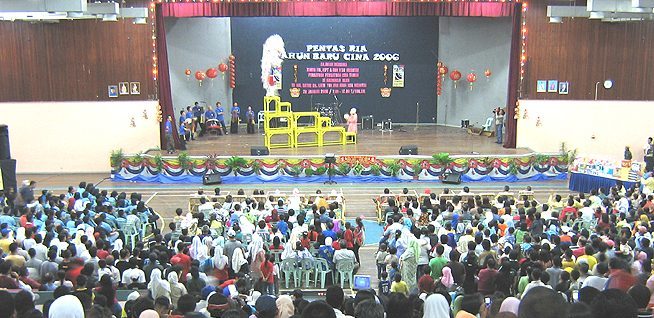
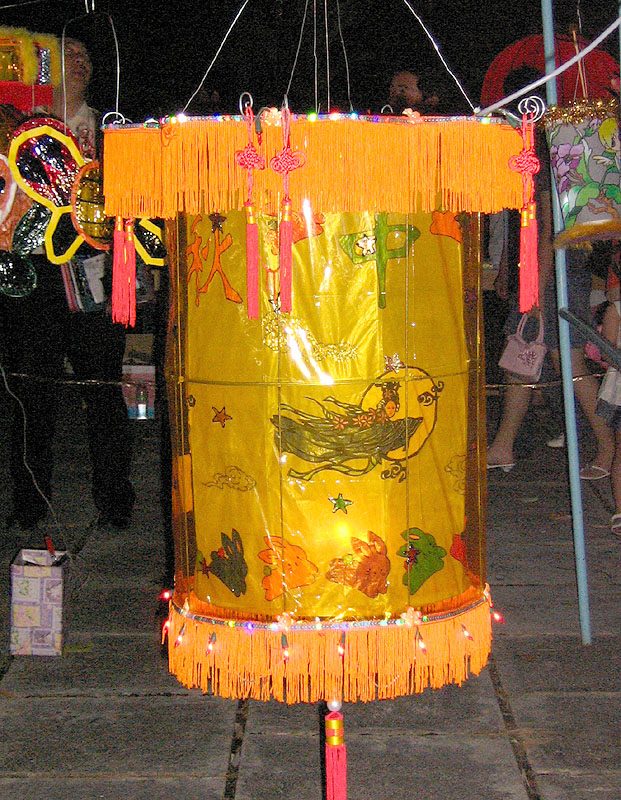
Festivals fill the year. At Chinese New Year lion, dragon and qilin troupes visit shops, temples and homes; eTawau lists eleven troupes, among them the Sabah Chinese High School alumni’s golden dragon, founded in 1988, and the Hakka association’s qilin — a dance rare in the Peninsula but common in Sabah. In 2012 Tawau held its first Chinese New Year Carnival at the municipal council, launched by Datuk Pang Yuk Ming. At the Mid-Autumn Festival, eTawau has photographed lantern nights and stage shows at Tawau temples.
Perayaan memenuhi tahun. Pada Tahun Baru Cina kumpulan tarian singa, naga dan qilin mengunjungi kedai, tokong dan rumah; eTawau menyenaraikan sebelas kumpulan, antaranya naga emas alumni Sekolah Tinggi Cina Sabah yang ditubuhkan pada 1988, dan qilin persatuan Hakka — tarian yang jarang di Semenanjung tetapi biasa di Sabah. Pada 2012 Tawau mengadakan Karnival Tahun Baru Cina pertama di majlis perbandaran, dilancarkan oleh Datuk Pang Yuk Ming. Pada Pesta Pertengahan Musim Luruh, eTawau merakam malam tanglung dan persembahan pentas di tokong-tokong Tawau.
A Chinese New Year stage show (Pentas Ria Tahun Baru Cina), 2006. Team photo.2006年新春聯歡會(Pentas Ria Tahun Baru Cina)。團隊照片。Pentas Ria Tahun Baru Cina, 2006. Foto pasukan.A Mid-Autumn lantern, 2006. Team photo.中秋燈籠,2006年。團隊照片。Tanglung Pertengahan Musim Luruh, 2006. Foto pasukan.
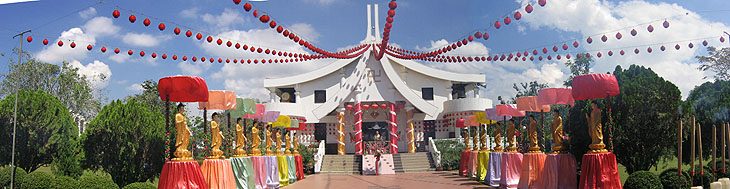
A decorated temple at Chinese New Year, 2006. Team photo.2006年農曆新年期間裝飾一新的寺廟。團隊照片。Tokong dihias pada Tahun Baru Cina, 2006. Foto pasukan.
Most Tawau Chinese are Buddhists; others follow Taoism and Chinese folk religion, and some are Christians. eTawau counts nine Buddhist and five Taoist organisations in Tawau, among them the Pu Zhao Temple of the Tawau Buddhist Lodge and the Tian Hou temple. Across Sabah many Hakka families belong to the Basel Church. Marriage across communities is common: Wikipedia notes Sino-native families and Chinese who marry Torajan and Filipino partners.
Kebanyakan orang Cina Tawau beragama Buddha; yang lain mengikut agama Tao dan kepercayaan rakyat Cina, dan sebahagian beragama Kristian. eTawau mengira sembilan pertubuhan Buddha dan lima pertubuhan Tao di Tawau, antaranya Tokong Pu Zhao milik Tawau Buddhist Lodge dan tokong Tian Hou. Di seluruh Sabah ramai keluarga Hakka ahli Gereja Basel. Perkahwinan antara komuniti biasa: Wikipedia mencatat keluarga Sino-native dan orang Cina yang berkahwin dengan pasangan Toraja dan Filipina.
What we still do not know
我們仍然不知道的
Apa yang masih belum kita ketahui
What were the Latin names of the early leaders 林雲從, 辜丁甲, 方德源 and 曾富生? Who were the three shopkeepers of 1893? When were the Hakka and Hainan associations of Tawau founded? Do any families still keep photos of Silimpopon, of the 1953 fire, or of the old Sin On farms? Please write to eTawau@yahoo.com.
Apakah ejaan rumi nama pemimpin awal 林雲從, 辜丁甲, 方德源 dan 曾富生? Siapakah tiga pekedai pada 1893? Bilakah persatuan Hakka dan Hainan Tawau ditubuhkan? Adakah keluarga yang masih menyimpan foto Silimpopon, kebakaran 1953, atau ladang lama Sin On? Sila tulis kepada eTawau@yahoo.com.
Sources: eTawau, association pages (Hakka, Teochew, Hokkien, Hainan, Foochow, Sze Yap, Kapitans, United Chinese, Onn Ping Sha); The Borneo Post (2012), as quoted on eTawau’s Hakka Association page; eTawau, “Lion dance troupes in Tawau” and the SCHS Alumni golden dragon; eTawau, “Chinese Cultural Festivals” (2012 carnival); eTawau, “斗湖佛教概況” and “斗湖道教概況”; Wikipedia, “Tawau”; team photos 2006.
資料來源:eTawau, association pages (Hakka, Teochew, Hokkien, Hainan, Foochow, Sze Yap, Kapitans, United Chinese, Onn Ping Sha); The Borneo Post (2012), as quoted on eTawau’s Hakka Association page; eTawau, “Lion dance troupes in Tawau” and the SCHS Alumni golden dragon; eTawau, “Chinese Cultural Festivals” (2012 carnival); eTawau, “斗湖佛教概況” and “斗湖道教概況”; Wikipedia, “Tawau”; team photos 2006.
Sumber: eTawau, association pages (Hakka, Teochew, Hokkien, Hainan, Foochow, Sze Yap, Kapitans, United Chinese, Onn Ping Sha); The Borneo Post (2012), as quoted on eTawau’s Hakka Association page; eTawau, “Lion dance troupes in Tawau” and the SCHS Alumni golden dragon; eTawau, “Chinese Cultural Festivals” (2012 carnival); eTawau, “斗湖佛教概況” and “斗湖道教概況”; Wikipedia, “Tawau”; team photos 2006.
11
The Chinese Story, in eight chapters
華人的故事(共八篇)
Kisah Orang Cina, dalam lapan bab
A light-reading series for visitors, students and families, in three languages. These are short first drafts that eTawau will develop into full articles as more information and photos arrive.
Siri bacaan ringan untuk pelawat, pelajar dan keluarga, dalam tiga bahasa. Ini draf pertama yang pendek yang akan dikembangkan oleh eTawau menjadi artikel lengkap apabila lebih banyak maklumat dan foto diterima.
A customs officer who became a Penghulu, a first Kapitan, the founders of the Chamber and of the Chinese Association, a cocoa pioneer, and today’s leaders. Photos are not shown; eTawau uses only its own team’s photos.
Seorang pegawai kastam yang menjadi Penghulu, Kapitan pertama, pengasas Dewan Perniagaan dan Persatuan Cina, perintis koko, dan pemimpin hari ini. Foto tidak dipaparkan; eTawau hanya menggunakan foto pasukannya sendiri.
KK
Kee Kim Swee (Kee Abdullah)
1863–1936 · first Penghulu of Tawau1863–1936 · 斗湖第一任村長1863–1936 · Penghulu pertama Tawau
A Hainanese born in Labuan, made customs examiner at Tawau in 1894 and entrusted with the town’s development. He married a Suluk–Tidung woman, became a Muslim, and founded the Kee family, which has given Sabah many leaders.
Orang Hainan yang lahir di Labuan, dilantik pemeriksa kastam di Tawau pada 1894 dan diamanahkan membangunkan bandar. Beliau berkahwin dengan wanita Suluk–Tidung, memeluk Islam, dan mengasaskan keluarga Kee, yang telah melahirkan ramai pemimpin Sabah.
Wikipedia; The Star (2008)
林
林雲從
first Chinese Kapitan of Tawau斗湖第一任華人甲必丹Kapitan Cina pertama Tawau
According to the 1998 Tawau history, he moved from Lahad Datu to Tawau and became its first Chinese Kapitan. His name in Latin letters is not recorded on eTawau.
據《斗湖簡史》,他從拿篤移居斗湖,成為斗湖第一任華人甲必丹。eTawau沒有記錄他的英文拼名。
Menurut sejarah Tawau 1998, beliau berpindah dari Lahad Datu ke Tawau dan menjadi Kapitan Cina pertamanya. Ejaan rumi namanya tidak direkodkan di eTawau.
eTawau, 斗湖簡史
辜
辜丁甲
first president of the Chamber, 1926中華商會首任理事長,1926年Presiden pertama Dewan Perniagaan, 1926
A Teochew merchant chosen as the first president when Tawau’s Chinese merchants founded the Chinese Chamber of Commerce in 1926.
潮州籍商人,1926年斗湖華商成立中華商會時,被推舉為首任理事長。
Peniaga Teochew yang dipilih sebagai presiden pertama apabila peniaga Cina Tawau menubuhkan Dewan Perniagaan Cina pada 1926.
eTawau, 斗湖簡史
ST
Kapitan Stephen Tan
Chinese Kapitan · killed in the occupation華人甲必丹 · 日據時期遇害Kapitan Cina · dibunuh semasa pendudukan
A Chinese Kapitan of Tawau before the war, remembered on eTawau’s history page as later killed by the Japanese invaders.
戰前斗湖的華人甲必丹,eTawau的歷史頁面記載他後來被日本侵略者殺害。
Kapitan Cina Tawau sebelum perang, dikenang di halaman sejarah eTawau sebagai kemudian dibunuh oleh penceroboh Jepun.
eTawau, History 1898
方
Datuk 方德源
founder of the North Borneo Chinese Association, 1961婆華公會創會主席,1961年Pengasas Persatuan Cina Borneo Utara, 1961
Chairman of the North Borneo Chinese Association founded in Tawau in October 1961, which later became part of the Sabah Chinese Association; he also chaired the Tawau Hokkien Association.
Pengerusi Persatuan Cina Borneo Utara yang ditubuhkan di Tawau pada Oktober 1961, yang kemudian menjadi sebahagian Persatuan Cina Sabah; beliau juga pernah mempengerusikan Persatuan Hokkien Tawau.
eTawau, 斗湖簡史; Hokkien Association
曾
曾富生
Tawau’s first state assemblyman, 1967斗湖第一任州議員,1967年ADUN pertama Tawau, 1967
Elected in Sabah’s first state election on 8 April 1967 as Tawau’s first state assemblyman.
在1967年4月8日沙巴第一次州選舉中當選為斗湖第一任州議員。
Dipilih dalam pilihan raya negeri pertama Sabah pada 8 April 1967 sebagai ahli dewan undangan negeri pertama Tawau.
eTawau, 斗湖簡史
HT
Datuk Seri Panglima Hong Teck Guan
cocoa pioneer可可業先驅Perintis koko
Wikipedia credits him with founding the Teck Guan Cocoa Museum in Tawau, dated to the 1970s, which tells the story of Tawau as the cocoa capital of Sabah and Malaysia.
Wikipedia menyebut beliau mengasaskan Muzium Koko Teck Guan di Tawau, bertarikh 1970-an, yang menceritakan Tawau sebagai ibu kota koko Sabah dan Malaysia.
Wikipedia, “Tawau”
LY
Tan Sri Liew Yun Fah
Brigadier General (Rtd) · politician退役准將 · 政治人物Brigedier Jeneral (B) · ahli politik
A former commander of the 516 Regiment and a former Gerakan vice-president; state assemblyman for Merotai after the 2004 election, Sabah Minister of Youth and Sports in 2007, and later president of Parti Harapan Rakyat Sabah.
Bekas komander Rejimen 516 dan bekas naib presiden Gerakan; ADUN Merotai selepas pilihan raya 2004, Menteri Belia dan Sukan Sabah pada 2007, dan kemudian presiden Parti Harapan Rakyat Sabah.
eTawau, sports page (2007); press reports
羅
Lo Su Fui 羅思輝
born 1981, Tawau · MP and Chamber president1981年生於斗湖 · 國會議員、商會會長Lahir 1981, Tawau · Ahli Parlimen dan presiden Dewan
Born in Tawau in 1981, elected Member of Parliament for Tawau in 2022, and president of the Tawau Chinese Chamber of Commerce.
1981年生於斗湖,2022年當選斗湖國會議員,並任斗湖中華商會會長。
Lahir di Tawau pada 1981, dipilih Ahli Parlimen Tawau pada 2022, dan presiden Dewan Perniagaan Cina Tawau.
eTawau, 「斗湖簡史」 (History of Tawau, written for the 1998 centenary) — 200 people in 1892; Normanhurst 1893; three Chinese shops 1893; 榮順號; Kapitan 林雲從; Tanjong 1898; 1,000 people and 60 shops 1903; Sin On; Silimpopon 1905–1931; Dunlop Street 1914; push-cart railway; passes 1921–38; schools 1922–23; the Chamber 1926 and 辜丁甲; occupation; Little Gold Mountain; 14,200 people in 1951; the fire of 7 March 1953; rebuilding 1954–56; 1958 school; 婆華公會 1961 and 方德源; Cobbold 1962; Confrontation; 曾富生 1967; timber, cocoa, oil palm; Sabindo — link
eTawau, “History of Tawau 1922” — the Silimpopon boilers photo — link
eTawau, “History of Tawau 1930–1939” — Chester Street; Dunlop Road; 60 timber shophouses on Dunlop and Man Cheong Streets; Apas and Sin On; the mine closed 1932 — link
eTawau, “History of Tawau 1940–1949” — occupation, bombing, Hakka farmers in the jungle; aerial view — link
eTawau, “History of Tawau 1953” — photos of the fire and the post office — link
Wikipedia, “Kee Kim Swee” — citing Bernama in The Star (25 Sep 2008), the North Borneo Herald and Nicholas Chung, Under the Borneo Sun: A Tawau Story (2005) — link
Wikipedia, “Silimpopon Riots” — 21 Feb–2 Mar 1921; Hakka and Cantonese miners; 12 dead, 5 wounded, 300 detained; Reginald Rutter; over 3,000 people at the peak (citing Straits newspapers, March 1921) — link
Wikipedia, “Tawau” — Hakka majority and Apas Road; languages; intermarriage; religion; Teck Guan Cocoa Museum; Sabah Chinese High School — link
Wikipedia, “Demographics of Sabah” — census table 1991–2020; Hakka, Cantonese, Hokkien; Tianjin people; Sino-natives — link
Wikipedia, “Basel Christian Church of Malaysia” — the first 100 Hakka at Kudat, December 1882 — link
Wikipedia, “Kudat” — the Company’s first capital, 1881 — link
openmuseum.tw, 「渣打公司的客家移民計劃:沙巴客家基督徒的移民史」 — the first group in January 1883
South China Morning Post — the Basel Mission’s recruiting at Shau Kei Wan and Sai Ying Pun, Hong Kong
Borneo History, “Chinese Migration to Sabah” — Crocker and Medhurst; 150 Hakka in 1905; 884 settlers in 1906; Inanam, Menggatal and Telipok in 1913; northern Chinese 1913; 30,000 Chinese in the early 1920s; 70,000 arrivals from 1881, 30,000 of them women
張德來 (Chong Tet Loi), 「沙巴早期的客家移殖史」 (History of Early Hakka Migration in Sabah), New Era University College
Danny Wong Tze Ken, “Sustaining the Hakka Chinese Identity in Sabah: The Role of the Basel Church” (Springer, 2021)
Sabah Chinese High School (斗湖巴華中學), prospectus 2026 — founded 1964 by 斗湖婆華公會; Hainan association hall; handed to the Chamber 20 Feb 1965; 577 pupils
eTawau, “Tawau Chinese Chamber of Commerce” (斗湖中華商會) — three schools; presidents — link
eTawau, “Independent Chinese schools” — nine in Sabah — link
eTawau, Tawau Teochew Association — 義安郡 1901; 新華 school — link
eTawau, Tawau Hokkien Association — founded 23 Aug 1964; building 1969; cemetery 1966 — link
eTawau, Tawau Hakka Association — RM350,000 for SCHS land and about 80% Hakka pupils (after the Borneo Post, 2012); the qilin troupe — link
eTawau, Tawau Hainan Association — the Yellow River Cantata, 10 Dec 2010 — link
eTawau, Foochow and Sze Yap associations; 安平福利社; United Chinese Association; Association of Chinese Kapitans — link
eTawau, SCHS alumni golden dragon (1988) and the lion and dragon troupes of Tawau — link
eTawau, “Chinese Cultural Festivals” — the first Chinese New Year Carnival, 17–20 Jan 2012 — link
eTawau, 「斗湖佛教概況」 — about 42,000 Chinese in Tawau in 2010; nine Buddhist organisations — link
eTawau, 「斗湖道教概況」 — five Taoist organisations; 天后宮 — link
eTawau, Tanjung Batu Chinese Cemetery — 4 km from town; tombs over 100 years old
Frederick Lo, “Brief accounts of early history of Tawau”, on eTawau (Rotary Club) — the occupation — link
The Vibes, “Once hugely promising barter trade business ‘dying’ in waters off Sabah” (16 May 2021) — barter trade since the late 1940s
Ramli Dollah and Ahmad Mosfi Mohamad, on Malaysia–Indonesia barter trade at Tawau, Nunukan and Tarakan, Jati (University of Malaya)
Wikipedia, “Lo Su Fui” — born 14 April 1981 in Tawau; MP for Tawau from 2022 — link
Old photos: eTawau History pages (1922, 1930s, 1940s, c.1947, 1953, 1950s). Team photos: Chinese New Year and Mid-Autumn 2005–2006; Yellow River Cantata, 10 December 2010
Does your family remember Silimpopon, the 1953 fire, or the first shops on Dunlop Street? Do you know the Latin names of 林雲從, 辜丁甲, 方德源 or 曾富生? Corrections, memories and old photos are welcome: please email eTawau@yahoo.com.
Adakah keluarga anda ingat Silimpopon, kebakaran 1953, atau kedai-kedai pertama di Jalan Dunlop? Adakah anda tahu ejaan rumi nama 林雲從, 辜丁甲, 方德源 atau 曾富生? Pembetulan, kenangan dan foto lama amat dialu-alukan: sila e-mel eTawau@yahoo.com.