Last Updated on
Sunday, 20 August, 2023 10:57:52 AM
INDEX >
Dragonflies of Borneo >
Family Aeshnidae >
Genus Indaeschna > Indaeschna
grubaueri (Förster, 1904)
Family Aeshnidae
Indaeschna grubaueri (Förster, 1904)
Found in Asia: China, Indonesia, Malaysia, Philippines, Peninsular Malaysia,
Thailand
"A GUIDE TO THE DRAGONFLIES OF BORNEO" page 105 by A. G. Orr
This is the only species in this genus Indaeschna found in Borneo.
Indaeschna grubaueri
Indaeschna grubaueri male and female has a body length difference of 1cm
because of the male extra length of 1cm of the appentage. Male body length
measured to around 96mm (with appentage) while the female is about 86mm
Both male and female have same wingspan of 140mm
Male has exactly similar pattern as female but the abdomen is longer and
thinner.
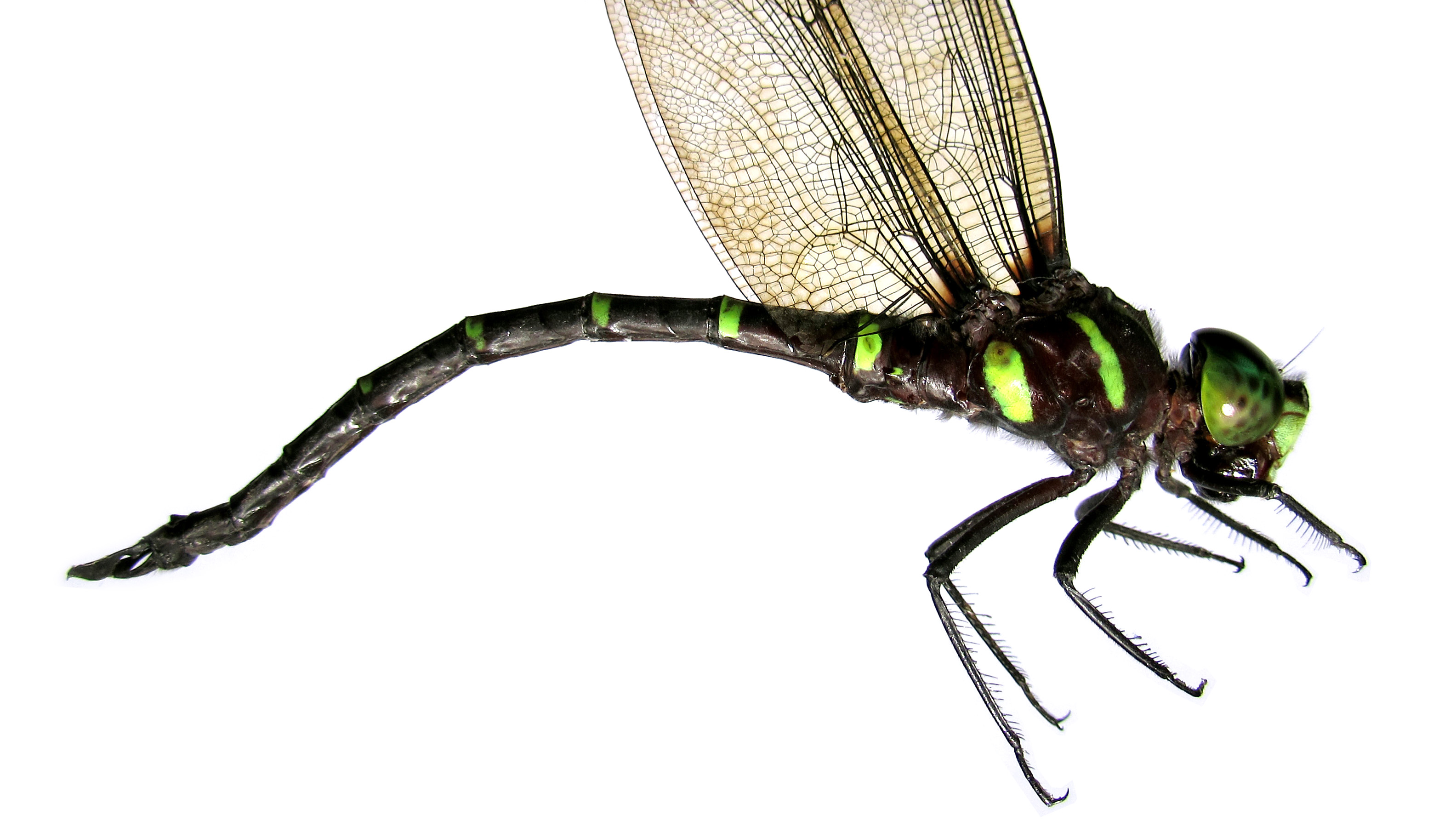
The males and aging female hang vertically with wings spread on nearby
vegetation of the breeding sites.
MALE
♂ |
FEMALE
♀ |

Male Body Length + Appentage = 96mm
Male front wing span = 140mm |

Female Body Length = 85mm
Female front wing span = 140mm |
 |
 |
 |
 |

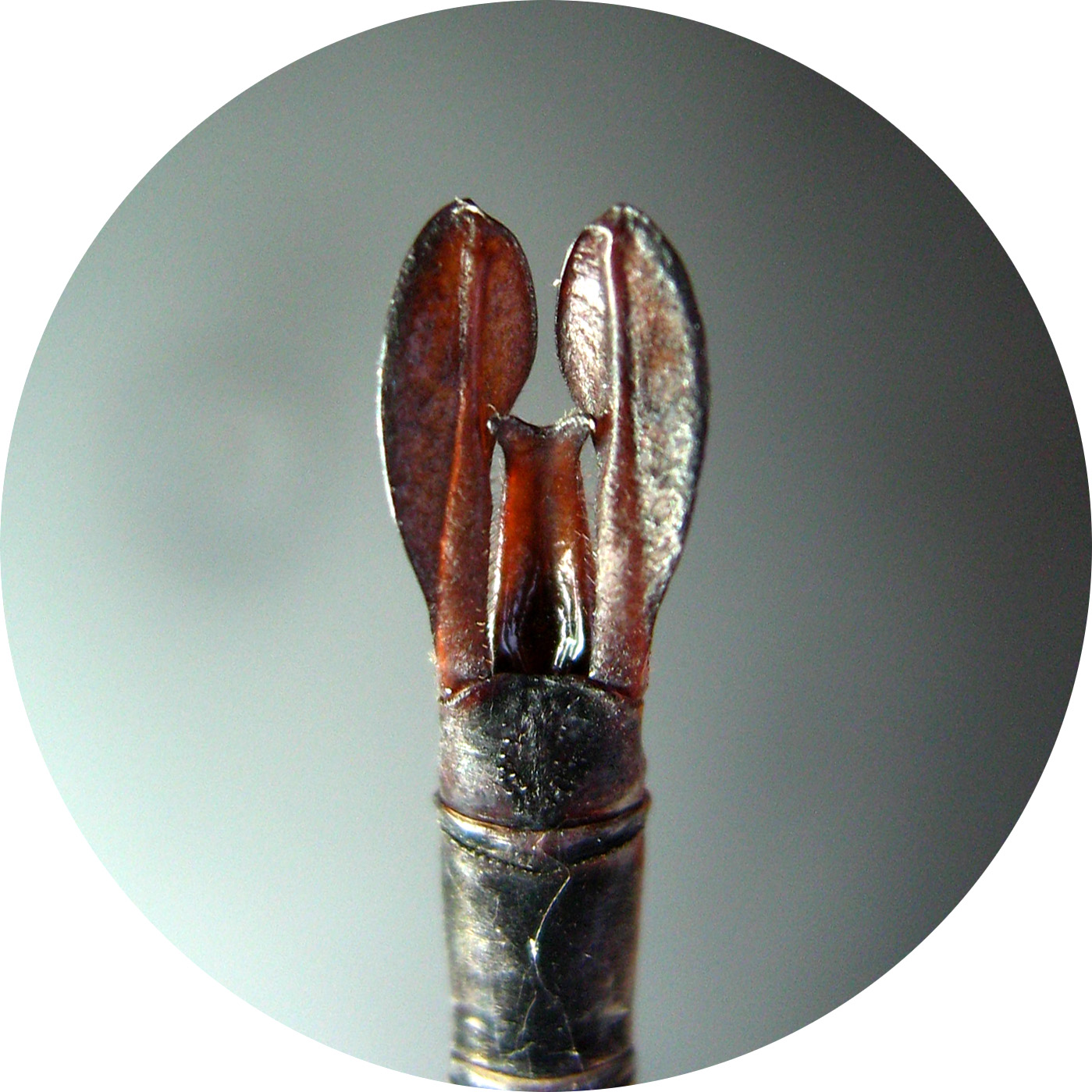
Indaeschna grubaueri Male Segment 8,9,10 |

Indaeschna grubaueri Female Segment 8,9,10 |
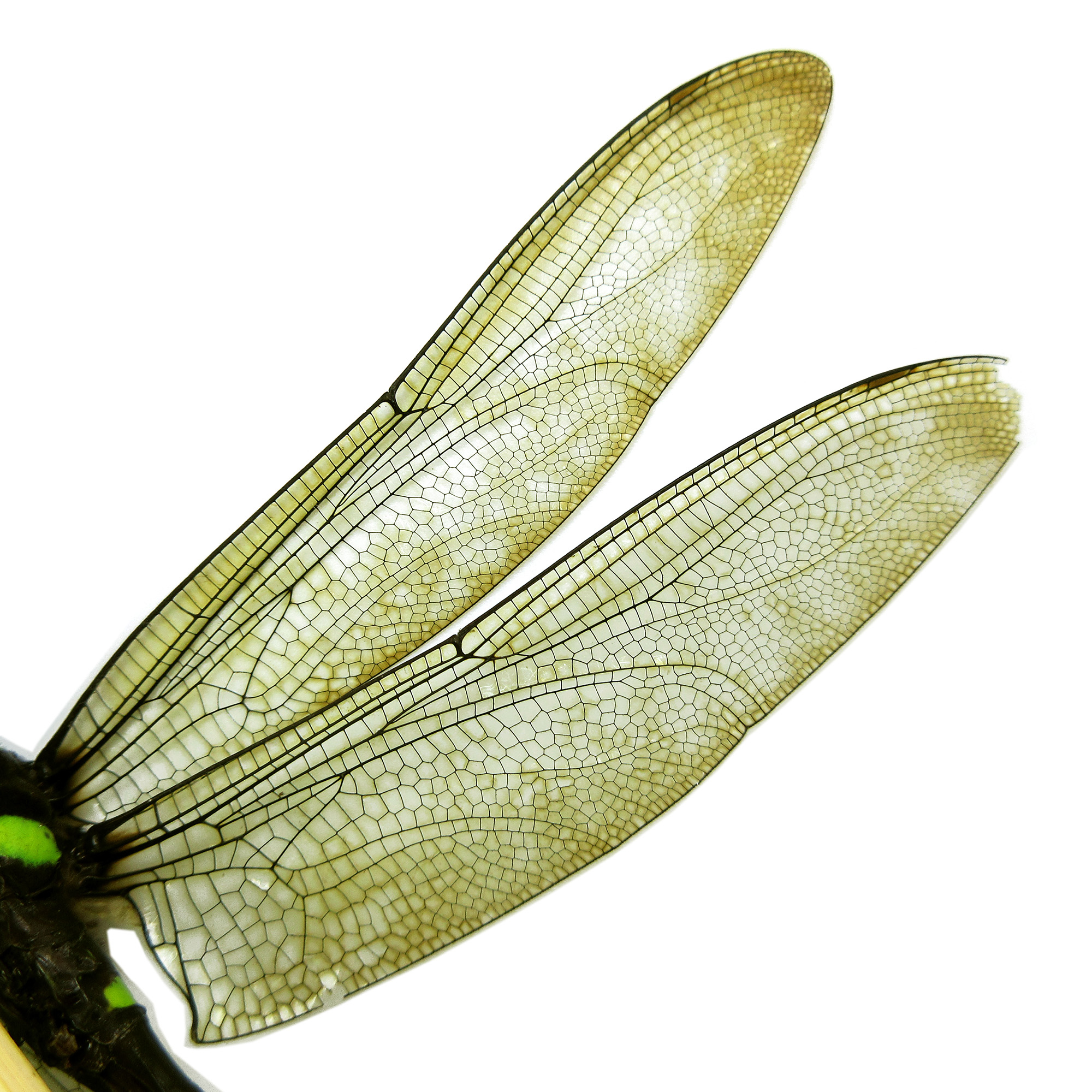
Wings of a male Indaeschna grubaueri |

Wings of a female Indaeschna grubaueri |
|
|
|
|
|
|

The Largest and Smallest species of Dragonflies in Borneo
Indaeschna grubaueri
Nannophya pygmaea
The Largest Species
♂ Indaeschna grubaueri
body length = 96mm
wingspan = 137mm
------------------------
The Smallest Species
♂ Nannophya pygmaea
body length = 17.5mm
wingspan = 29mm
www.eTawau.com 2023-07-14 FRI 18:34
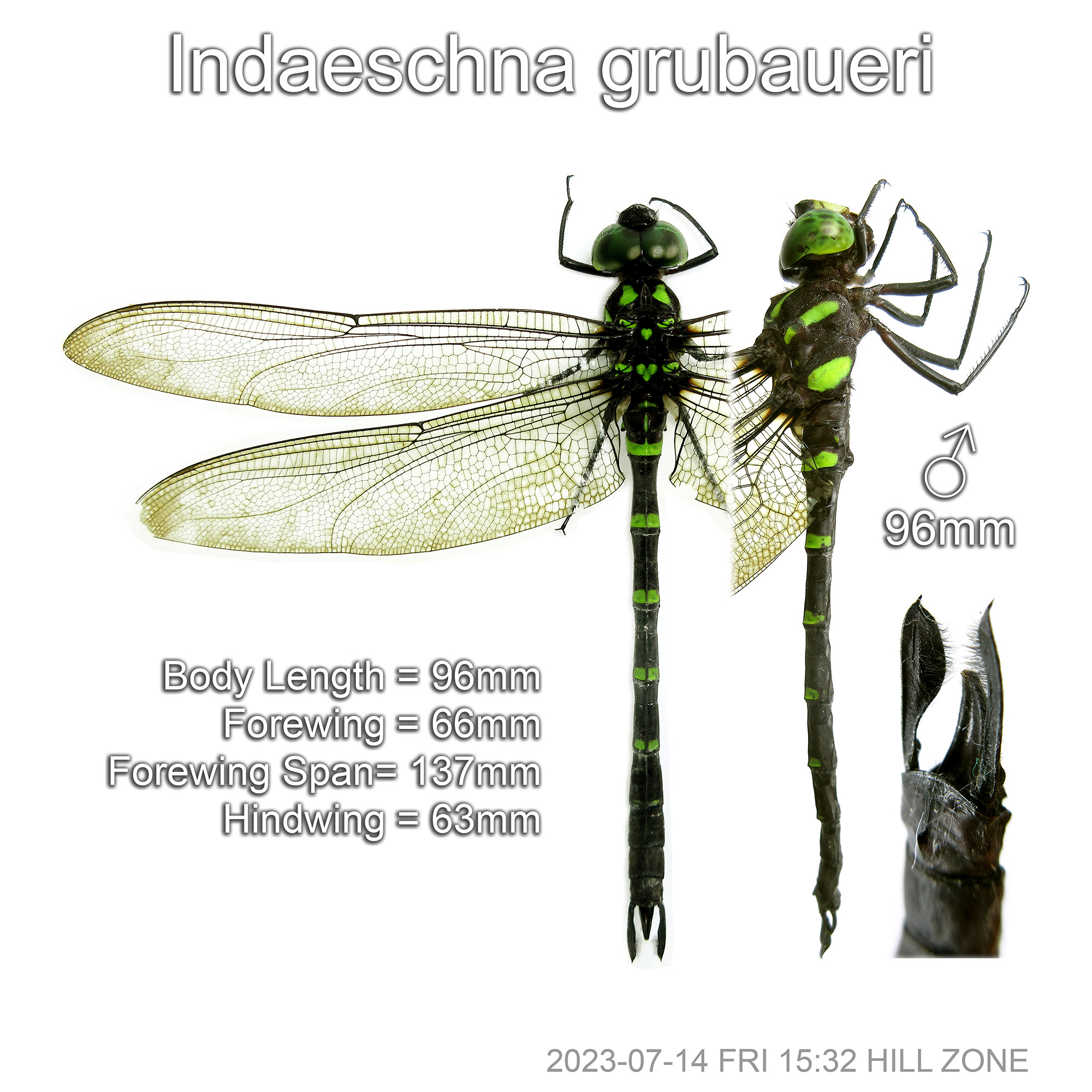
Indaeschna grubaueri ♂96mm
Body Length = 96mm
Forewing = 66mm
Forewing Span= 137mm
Hindwing = 63mm
2023-07-14 FRI 15:32 HILL ZONE
THE LARGEST DRAGONFLY IN OUR IMAGE COLLECTION
This dragonfly photographed in 2023 is the largest measured male
Indaeschna grubaueri at 96mm body length. Also the largest dragonfly in our
image collection.
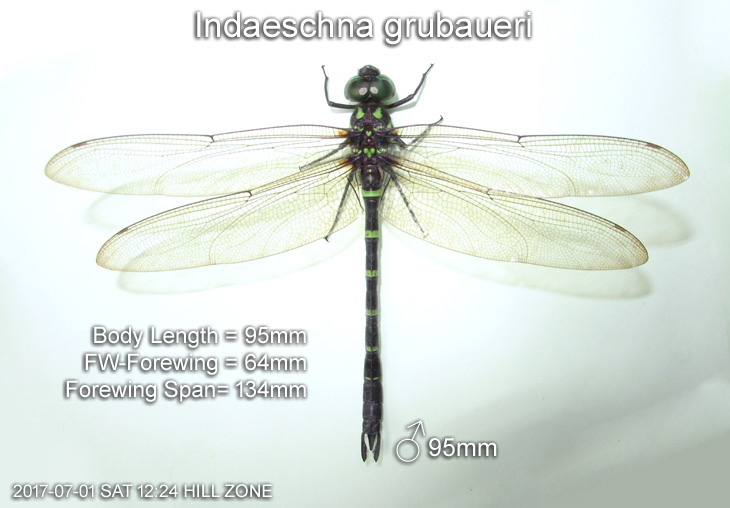
Indaeschna grubaueri ♂95mm
The only Borneo species in this genus
♂95mm 2017-07-01 SAT 12:24 HILL ZONE
Body Length = 95mm
Forewing = 64mm
Forewing Span= 134mm
HW-Hindwing =
Borneo, Indonesia, Peninsular Malaysia,Philippines, Thailand
Ref: Page 104 of DRAGONFLIES OF BORNEO by A.G. Orr

Indaeschna grubaueri
A spectacular and common dragonflies to be found inside the rainforest of
Malaysia is Indaeschna grubaueri . It is another very large species (Male hw,
63-65 mm) quite the equal of any Tetracanthagyna except plagiata. In both the
male and female the head and thorax are brightly marked with green and the
abdomen has broad lime green bands at the distal end of segments 2-6 or 7.
The wings are hyaline, sometimes smudged with brown in older specimens. By
virtue of its striking colours and size it is unmistakable and is easily
identified on the wing. It is most commonly seen in the day inside the forest
where males hang in the shade beside suitable breeding sites—shallow bottomed
leafy pools, small rocky pools formed in depressions in dry stream beds and even
large rot holes and buttress pans (pools formed when tree buttresses grow to
form a cavity which fills with water).
The females are encountered when they arrive to mate and lay their eggs.
Larvae are large and may live at very high density in close confinement. They
appear to have lost the cannibalistic instincts found in other aeshnid larvae.
Later instars feed voraciously on the tadpoles of many species of frog.
Development in smaller bodies of water may take two to three years. The adults
are semi-crepuscular, emerging into the open to feed in the late afternoon,
sometimes coming to light. They occur from sea level up to about 800 m, mostly
in hilly country in mixed dipterocarp forest.
A COMPARISION of the four Genus in Family Aeshnidae

The 3 families of dragonflies found in Borneo Island:
1 Family of Aeshnidae
2 Family of Gomphid
3 Family Libellulidae
RELATED TOPICS
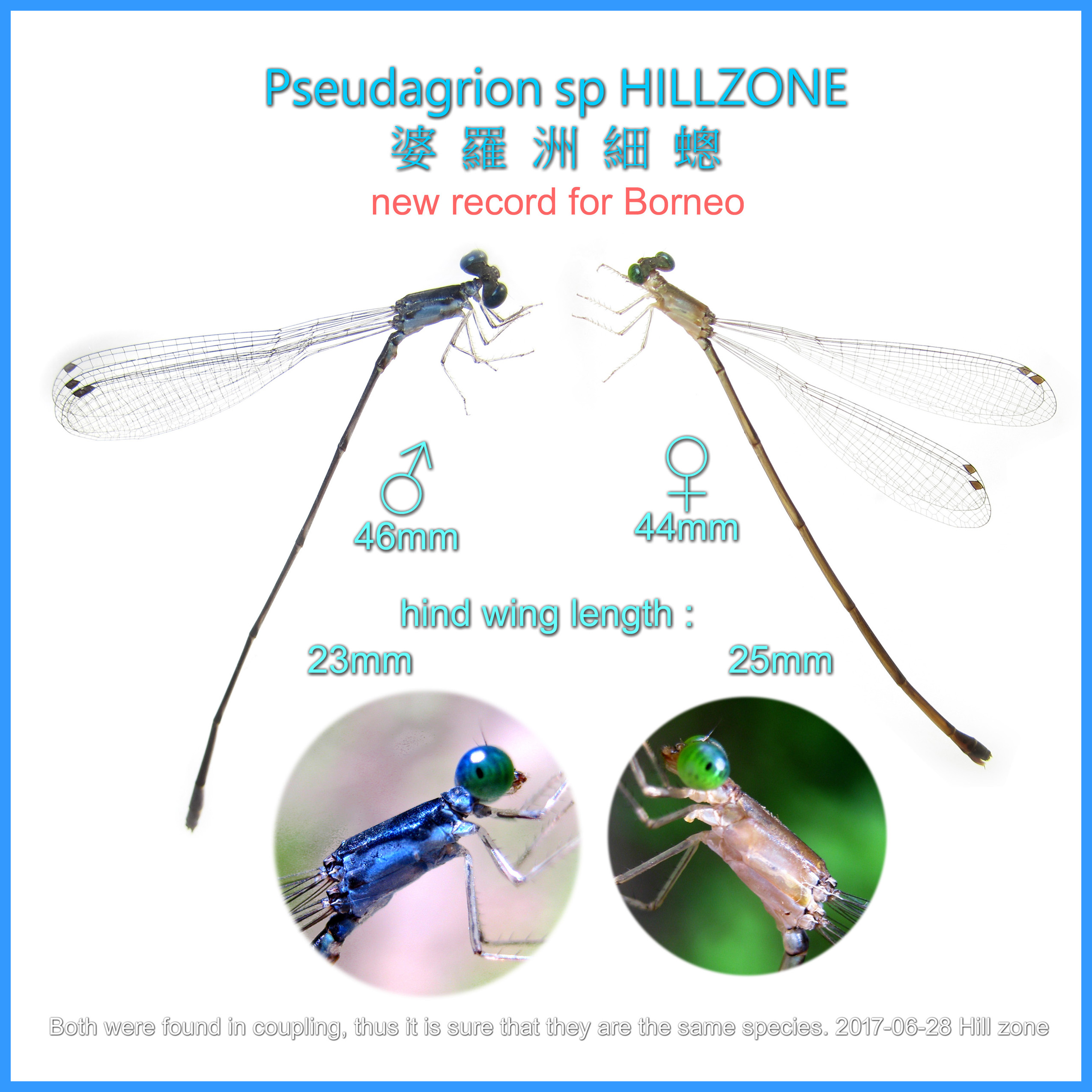
INTRODUCTION TO THE DAMSELFLIES OF SABAH, BORNEO ISLAND
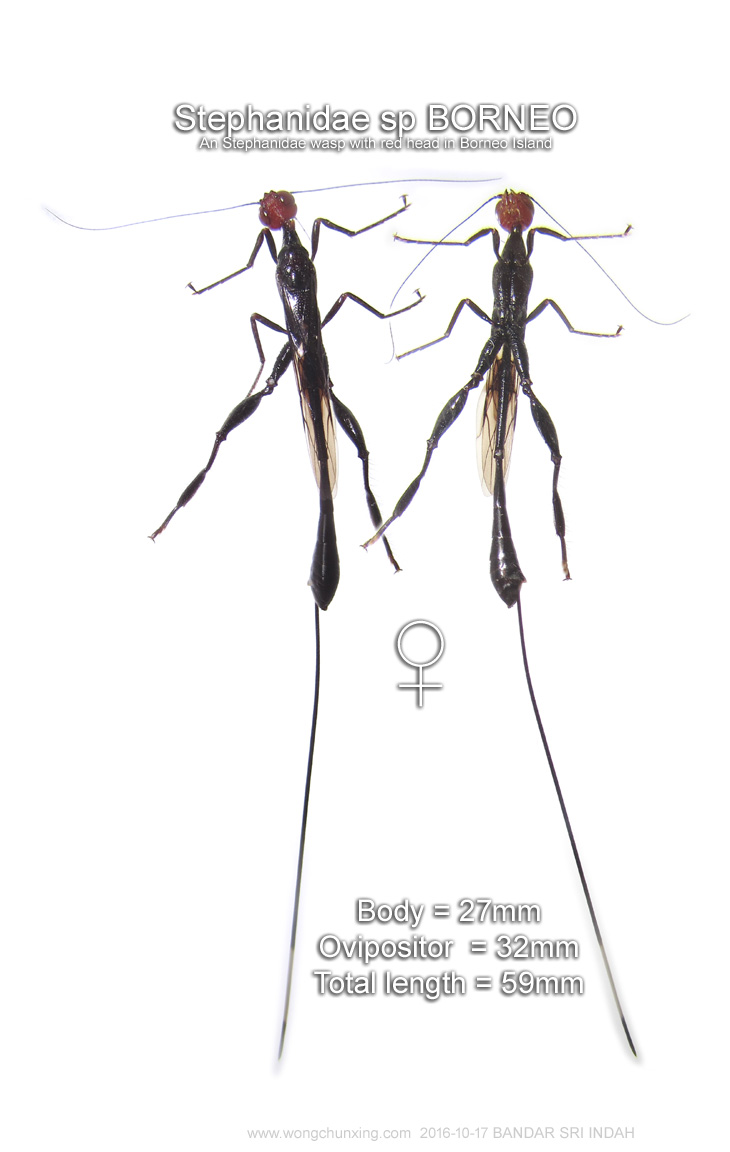
Insects of Borneo
Insects are diverse and dominant inhabitants of the tropical
rainforests in Borneo Island. New species are discovered too often.
Entomologists are still struggling to cope with the documentation of tropical
insect diversity.

Red Dragonfly of Sabah
Most of the common dragonflies in Sabah are red coloured, especially from the
family Libellulidae. Some red pecies are even confused as same species,
for example the three species of Genus Neurothemis.

The compound eyes of dragonflies
Dragonflies and damselflies have large compound eyes that can see in all
directions. When the compound eye is magnified several hundred times, each
individual facet (ommatidium) is shown to be hexagonal in shape.
Ovipositor (Vulvar Lamina)
of Female Dragonflies and Damselflies
Female dragonflies have either one of the two method of depositing eggs from
the abdomen:
1- using Ovipositor Structure
2- using Vulvar Lamina
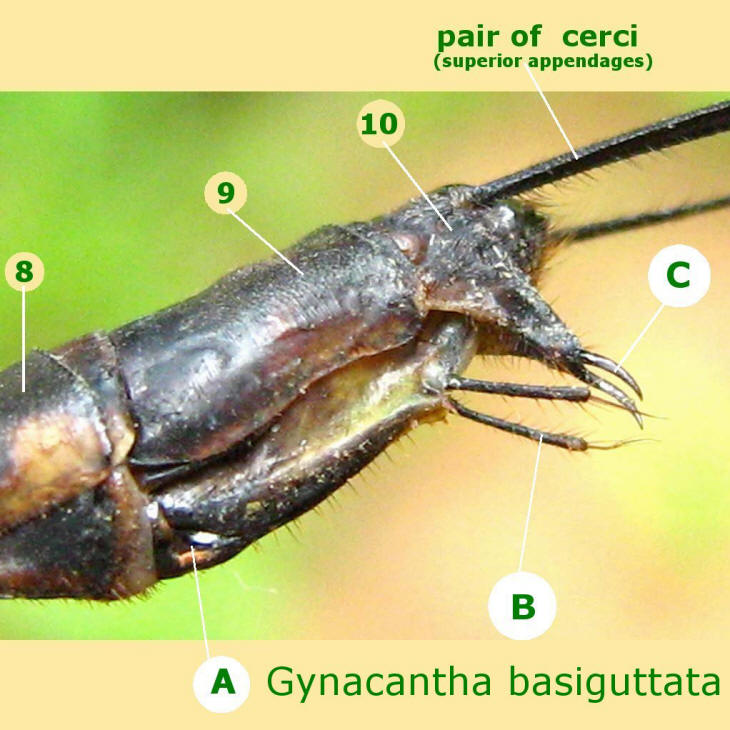
Male do not have an ovipositor. Instead male dragonfly and damselfly have
appendages.
|
GO FURTHER
FLORA

Fig trees of Sabah
Borneo has 150 species of
wild fig trees. Most of them are found in forests of Sabah.
FISHERIES

Tiger Prawn Farms in Tawau
Prawn farming is a main
commercial activities in Tawau. Spawners from Tawau are graded the
best in Malaysia. For decades, Tawau has been exporting high-grade
tiger prawns to several countries such as Korea, Japan, Taiwan,
China, Vietnam, Singapore, Egypt and Australia.
|