Wednesday, 13 April, 2022 06:07:20 PM
婆羅洲蜻蜓 >
蜻 蜓
Common dragonflies in Sabah, Borneo Island
蜻蜓索引
A Survey on dragonflies of Sabah in North Borneo)
A state rich in Odonata in malaysia
婆羅洲島氣候宜人,藍天白雲,常年溫度28至33攝氏度之間。其地理環境得天獨厚,有綿延的海岸線,極為特殊的珊瑚等海洋生物;有世界上第二大的原始熱帶雨林,諸多的紅樹林,還有世界罕見的珍禽昆蟲,奇花異草,名貴藥材……
婆羅洲島,不僅是旅遊勝地,還是自然愛好者、植物學家、鳥禽觀察家、潛水者、登山愛好者的天堂,更是喜愛親近大自然人士的好去處.
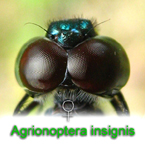
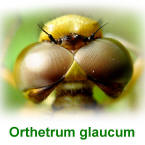
The compound eyes of dragonflies
蜻蜓的複眼
蜻蜓和豆娘有兩隻大復眼compound eyes,一雙複眼有超過二萬隻的單眼ommatidium;每個單獨的小眼為六邊形hexagonal
in shape.
蜻蜓是世界上眼睛最多的昆蟲。又大又鼓的眼睛佔據著頭的絕大部分,
蜻蜓視力極好,而且還能向上、向下、向前、向後看而不必轉頭。

蜻蜓的交配
蜻蜓的交配也是在飛行中進行的。雄蜻蜓用腹部末端的把握器抓緊雌蜻蜓的頸部;雌蜻蜓腹部由下向前彎,把生殖孔接到雄蜻蜓腹部第二節下面的貯存精子器官,然後雄蜻蜓才進行授精。產卵時,大多是邊飛邊用尾部碰水面,把卵排出。我們常見的所謂「蜻蜓點水」,就是雌蜻蜓產卵的表演動作。蜻蜓還有「領域佔據」的習性,雄性的蜻蜓為了覓食及搶得與雌蜻蜓交尾配對的機會,常會發生爭奪地盤而互相追逐的場面。


蜻蜓之美
蜻蜓有強健的胸肌來帶動薄薄窄長的翅膀.蜻蜓能在空中高速飛行,時速可達100公里.
蜻蜓休息時翅膀仍外伸,不能折疊,所以停留的地方要有相當的空間的枝頭或葉頂。
|
|
豆娘
珈蟌科 Calopterygidae |
|
|
蜻蜓
勾蜓科 Cordulegastridae |

蜻蜓的頭與胸部連結的部分較窄,使頭部能夠上下左右轉動,且有一對大複眼,視覺非常敏銳,能夠在空中追擊或攔截一些動作慢的飛翔昆蟲,所以是空中的惡棍。
捕捉的昆蟲包括蜜蜂、蛾類,甚至較小的蜻蜓。
文獻參考
Odonata related sites in Britain and Ireland
|
References Baker, R. L., and H. F. Clifford. 1982. Life cycle of an Enallagma boreale Selys population from the boreal forest of Alberta, Canada (Zygoptera: Coenagrionidae). Odonatologica 11(4):317-322. Calvert, P. P. 1902, in Calvert, P. P. 1901-1908. Odonata. In Biologia Centrali Americana: Insecta Neuroptera. R. H. Porter & Dulau & Co.: London. Dec 1902, p. 114. Calvert, P. P. 1919. Gundlach's work on the Odonata of Cuba: a critical study. Transactions of the American Entomological Society 45:335-396. Cannings, R. A. 1989. Enallagma basidens Calvert, a dragonfly new to Canada, with notes on the expansion of its range in North America (Zygoptera: Coenagrionidae). Notulae Odonatologicae 3(4):53-55. Charpentier, T. de. 1840. Libellulinae europaeae descriptae e depictae. Lipsiae, Leopold Voss. 180 pp. Donnelly, T. W. 1989. The status of Enallagma cyathigerum (Charp.) and E. vernale Gloyd in south-central New York (Zygoptera: Coenagrionidae). Odonatologica 18:373-378. Gloyd, L. K. 1943. Enallagma vernale, a new species of Odonata from Michigan. Occasional Papers of the Museum of Zoology, University of Michigan 479:1-8. Hagen, H. A. 1861. Synopsis of the neuroptera of North America, with a list of the South American species. Smithsonia Miscellaneous Collections 4:1-347. Ingham, B. R., and C. E. Jenner. 1976. Life histories of Enallagma hageni (Walsh) and E. aspersum (Hagen) (Zygoptera: Coenagrionidae). Odonatologica 5:331-345. Johannsson, O. E. 1978. Co-existence of larval Zygoptera (Odonata) common to the Norfolk Broads (U.K.). Oecologia 32:303-321. Kellicot, D. S. 1895. Catalogue of the Odonata of Ohio, Part 1. Journal of the Cincinnati Society of Natural History 17:195-216. Kormondy, E. J., and J. L. Gower. 1965. Life history variations in an association of Odonata. Ecology 46:882-886. Macan, T. T. 1964. The Odonata of a moorland fishpond. Int. Revue ges. Hydrobiol. 49:325-360. Morse, A. P. 1895. New North American Odonata. Psyche 7:207-211. O'Brien, M. F., and P. D. Pratt. 1999 (In press). Enallagma anna, a damselfly new to the Great Lakes region (Odonata: Coenagrionidae). The Great Lakes Entomologist 32(1). Pearlstone, P. S. M. 1973. The food of damselfly larvae in Marion Lake, British Columbia. Syesis 6:33-39. Say, T. 1839. Descriptions of new North American neuropterous insects and observations on some already described by (the late) Th. Say. Journal of the Academy of Natural Science of Philadelphia 8:9-46. Selys-Longchamps, E. de. 1875. Notes on Odonata from Newfoundland collected in 1874 by Mr. John Milne. Entomologists Monthly Magazine 11:241-243. Selys-Longchamps, E. de. 1876. Synopsis des agrionines, cinquième légion: Arion (suite). Le genre Agrion. Bulletin de l'Académie royale des Sciences de Belgique (2) 42:480-531. Walker, E. M. 1953. The Odonata of Canada and Alaska, Vol. 1. University of Toronto Press: Toronto, Ontario. xi + 292 pp. Walsh, B. D. 1862. List of the Pseudoneuroptera of Illinois contained in the cabinet of the writer, with descriptions of over forty new species, and notes on their structural affinities. Proceedings of the Entomological Society of Philadelphia 1862:361-402. Walsh, B. D. 1863. Observations on certain N. A. neuroptera by Hagen, M. D., of Konigsberg, Prussia; translated from the original French MS., and published by permission of the author, with notes and descriptions of about twenty new N. A. species of Pseudoneuroptera. Proceedings of the Entomological Society of Philadelphia 2:167-272. [note: see also Walsh, B. D. 1862 for original description of adults, which were named in Walsh 1863. Source: Westfall and May 1996 ). Westfall, M. J., Jr. and M. L. May. 1996. Damselflies of North America. Scientific Publishers: Gainesville, Florida. x + 650 pp. |
相關科目
文獻參考

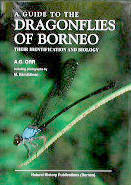
A Guide to the Dragonflies of Borneo
: Their Identification and Biology
By: Orr A G
婆羅洲蜻蜓指南
: 鑑定和生物學
這是一本權威性婆羅洲蜻蜓的指南
The first guide to the dragonflies of Borneo Island. The most comprehensive
coverage for any tropical region. 275 species (60%) occurring on the island are
described and illustrated in photographs and 25 beautiful plates of 1/2-wing
drawings. Chapters on biology, classification and ecology, as well as a complete
checklist. 19.5 x 26.5 cm.
Many more yet to be discovered, Borneo has one of the richest and most exciting
dragonfly faunas in the world. More than 40% species found nowhere else, making
Borneo the most distinctive sub-region of Sundaland. It is home to such
spectacular species as Tetracanthagyna plagiata, the heaviest of all
dragonflies, many beautiful picture-winged chlorocyphids and euphaeids, and
high-altitude endemics such as Matronoides cyaneipennis restricted to Mount
Kinabalu and nearby mountains.
The first guide to Borneo’s dragonflies, is also the most comprehensively
illustrated account of any large tropical dragonfly fauna yet published. Species
are figured by natural photographs and half-wing drawings. About 60% of known
species are shown, including almost all the distinctive and common species
likely to be encountered by a casual visitor. Particular attention is given to
the identification of the common but difficult medium-sized red dragonflies of
which there are several.
The text augments the illustrations and provides useful information on biology.
Introductory chapters discuss structure and general biology, ecology and
conservation, faunistics and biogeography and collecting techniques and
photography. There is a complete and up to date checklist. Illustrated keys to
families of adults give the reader an understanding of the structures used in
classifying dragonflies and augment the usefulness of the illustrations of
entire insects. Main larval forms are shown. This book will be useful not just
in Borneo, but also in neighboring parts of south-east Asia.

A
Pocket Guide to Dragonflies of Peninsular Malaysia
By : AG Orr
127 pages, colour illus, map.
Natural History Publications
Dragonflies are among the most beautiful of insects. Peninsular Malaysia and Singapore are home to more than 230 species (twice the number found in Europe). They include some of the most exquisite forms found anywhere in the World. They occur wherever there is suitable fresh water habitat. Many species frequent the borders of garden ponds in our largest cities, perching on lily pads with glowing red bodies in striking contrast to their green platform. Others haunt swift clear streams in virgin rainforest, while yet others are confined to blackwater swamps. A few occur deep in the forest understorey, far from streams or pools, where they breed in the water accumulated in cavities in tree trunks. This book figures 98.7% of species known from Peninsular Malaysia and Singapore. For most, coloured drawings of the whole insect (omitting one pair of wings) are provided. Where necessary, coloured or monochrome drawings showing diagnostic features are also included. For some species, especially small Zygoptera (damselflies), only detailed structures are figured, as the general resemblance between close species is strong. A wide range of larval types is also figured.

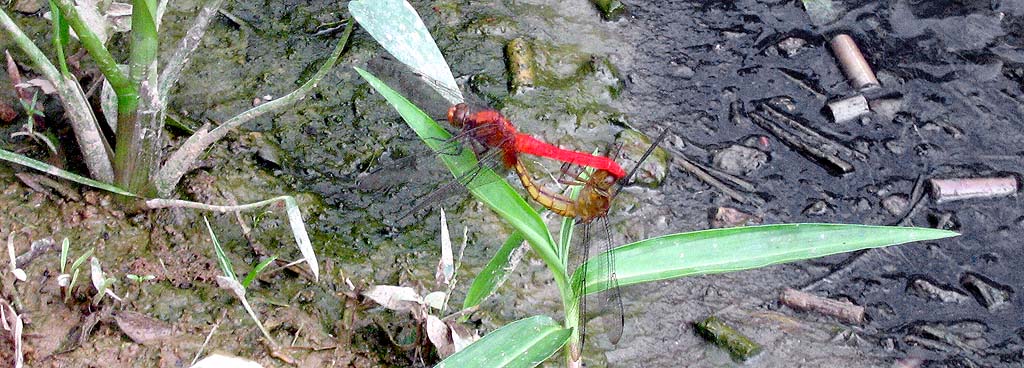
蜻蜓和豆娘交尾
蜻蜓和豆娘交尾的方式非常獨特,雌雄會形成"輛狀",雄的在上用尾部緊緊拑著雌性的頭部或胸部,在下的雌性會彎曲腹部貼著雄性的第三節腹部,這時精子和卵子便會結合.交尾的時間由數分鐘至數小時不等.一般雄蜻蜓會伴著雌蜻蜓直至產卵才分開......
| COMMON SPIDERS OF BORNEO |